
Quick Answer
Downy Mildew Hydroponic Greens (downy mildew hydroponic greens) is the practical focus of this guide for home growers.
Downy mildew on hydroponic greens (notably lettuce) causes angular yellow lesions with fuzzy sporulation often on leaf undersides. It thrives in cool, humid, leaf-wet conditions. It is frequently confused with powdery mildew—but management and pathogen groups differ.
Related: powdery mildew, lettuce, basil, humidity/VPD.
Key Takeaways
- UC IPM and UMass lettuce downy mildew pages describe angular chlorosis and underside sporulation under cool wetness.
- UMN Extension notes downy mildew among diseases seen in Minnesota hydroponic surveys—vent and spacing matter.
- True powdery mildew usually looks like white powder on upper surfaces in drier/warmer patterns—do not clone treatments blindly.
- Reduce leaf wetness; avoid overhead misting on susceptible greens.
- Remove infected leaves/plants early in recirculating rooms to limit spread.
- Resistant cultivars help in commercial lettuce—pathogen races change over time.
- Environment breaks beat late spraying on home salad crops.
- Scout undersides of older leaves first.
Related HydroponicEra guides
Downy Mildew Hydroponic Greens: Downy vs Powdery on Greens
UC IPM’s lettuce downy mildew guide: light green to yellow angular spots above, white fluffy growth beneath. UMass Extension stresses cool weather + leaf wetness, and warns growers who see white growth may wrongly assume powdery mildew. Powdery mildew is a different pathogen group with different chemistry and climate preferences—see powdery mildew.
Basil and other herbs can have their own downy issues in humid rooms; when unsure, compare photos from extension sources rather than guessing from memory.
Downy Mildew Hydroponic Greens: Conditions That Favor Outbreaks

| Condition | Why it matters | Break |
|---|---|---|
| Cool + wet leaves | Infection window | Dry leaves; gentle heat/vent |
| High overnight RH | Sporulation | Dehumidify / exhaust |
| Tight spacing | Long wetness duration | Thin canopy |
| Continuous lettuce cycles | No host break | Sanitize; rotate varieties |
Downy Mildew Hydroponic Greens: Step-by-Step Response

- Confirm underside sporulation vs upper-surface powdery films
- Remove worst leaves/plants into sealed bags
- Stop misting/foliar wetting
- Increase airflow under and through the canopy
- Lower overnight humidity
- Sanitize channels/reservoirs between cycles
- Prefer resistant lettuce types when available for your race pressure
- Scout daily for a week
- Restart only after a dry, clean environment
- Log RH and leaf-wet events
Downy Mildew Hydroponic Greens: Common Mistakes
- Treating downy exactly like powdery mildew
- Leaving infected lettuce in a shared NFT run
- Overhead watering “to cool” greens
- Ignoring older leaves where symptoms start
- Skipping sanitation between salad crops
Downy Mildew Hydroponic Greens: Troubleshooting Table

| Symptom | Suspect | Next |
|---|---|---|
| Angular yellow + underside fuzz | Downy mildew | Remove + dry climate |
| White powder on top | Powdery mildew | PM guide |
| Soft gray on dead tissue | Botrytis | Botrytis guide |
| Only tip necrosis | Tip burn / Ca movement | Tip burn guide |
Prevention Framework
Prevention: dry leaves, airflow, sane density, clean seed/starts, and cultivar choice. Hydroponics does not block foliar oomycetes/fungal-like pathogens that travel by spores in air and splash. Pair with lettuce and VPD guides.
What to Check Before You Escalate
- Undersides checked?
- Leaf wetness overnight?
- Powdery vs downy differentiated?
- Infected tissue removed?
- Misting stopped?
- Channels cleaned between crops?
Salad-Crop Scout Loop and Restart Rules
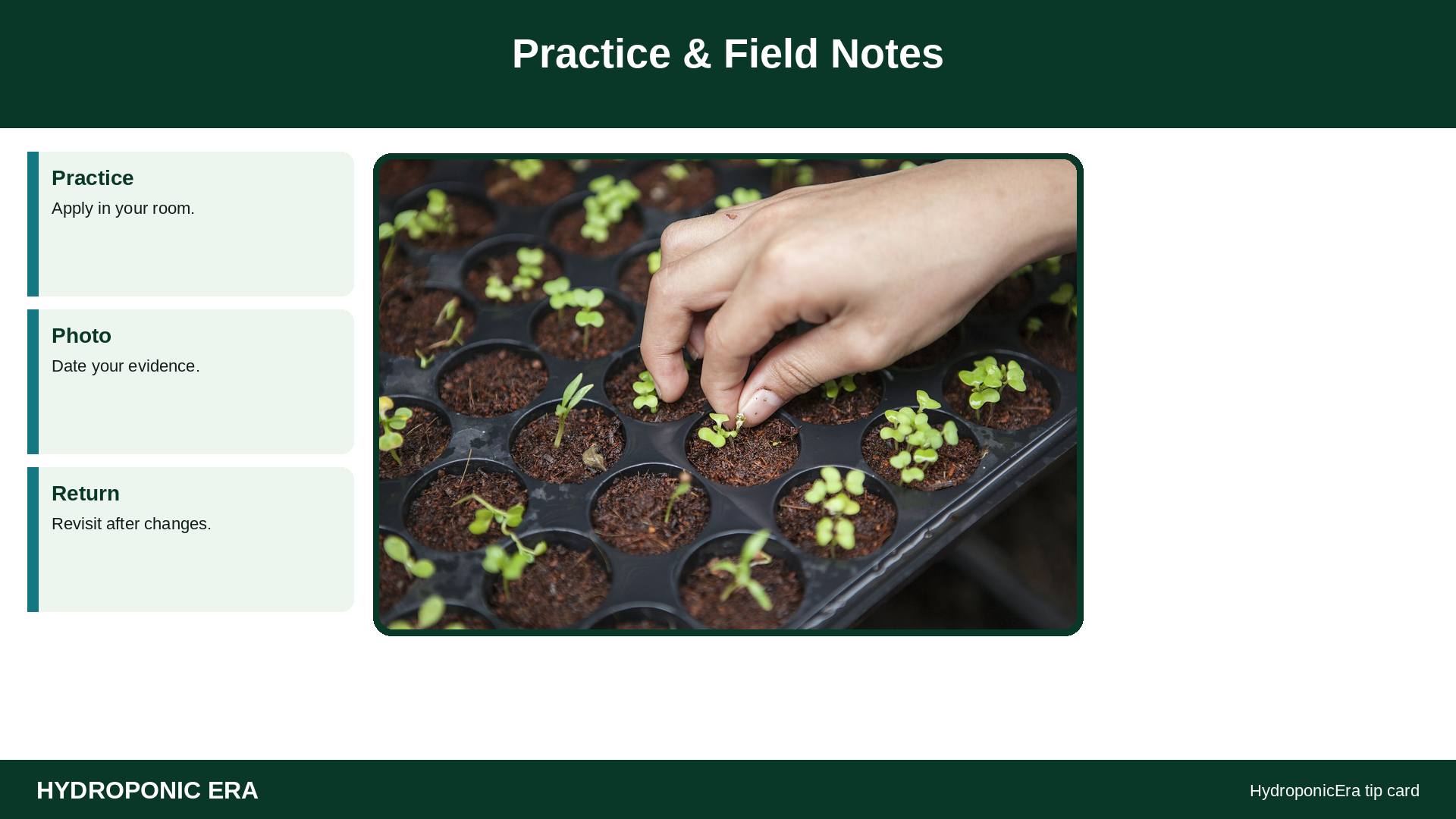
Hydroponic lettuce turns over quickly—use that speed. Scout undersides of older leaves every other day during cool, humid stretches. UC IPM and UMass downy mildew pages describe angular chlorosis with underside sporulation; UMN’s small-scale hydroponics notes list downy among diseases seen in hydro systems. Early removal beats whole-channel losses.
Original channel map: label plant positions 1–N. When symptoms appear, record position + date + photo of underside. Patterns near intakes, misters, or stagnant ends reveal microclimates. Fix airflow and wetness there (airflow, VPD).
Stop overhead misting on susceptible greens. NFT and DWC already wet roots—leaves do not need a shower. If you use foliar feeds, time them so leaves dry promptly, or skip them on high-risk weeks (lettuce, basil).
Restart rule: if more than a minority of a shared recirculating run shows active sporulation, consider a clean-out rather than heroic leaf-by-leaf nursing. Sanitize channels and reservoirs (cleaning). Continuous lettuce without sanitation is how rooms keep a spore background.
Cultivar honesty: resistant lettuce helps when races match—UC IPM notes resistance is powerful but not permanent forever. Keep a short list of what worked in your room without inventing universal “immune” claims.
Do not treat downy like powdery mildew by default (powdery mildew). Different pathogen biology means different expectations for products and climate breaks.
Practice closer: one dry-leaf night challenge per week—vent until leaves are dry to the touch before sleep. Track whether new lesions slow. Pair with bok choy and other greens guides when expanding the salad mix.
Field Notes: Continuous Lettuce Without Continuous Disease
Staggered seeding is great for harvests and risky for disease if you never sanitize. Between raft or channel cycles, scrub and dry. UMN hydro notes and UC IPM lettuce downy guidance both reward clean starts and wetness control.
Keep a “symptom jar” photo album on your phone: confirmed downy, powdery, tip burn, nutrient unevenness. Comparative photos reduce misdiagnosis when a pale leaf appears before work. Use lettuce and powdery mildew pages as internal cross-links.
If only the end of an NFT run shows lesions, check for stagnant film and weak airflow at that end (fans). Microclimates matter as much as whole-room RH.
Original restart threshold: write your personal threshold (for example, “>X symptomatic heads in a shared loop → clean-out”). Follow it once—not after begging dying plants for a week. Pair with cleaning.
FAQs
Is downy mildew a true fungus like powdery?
Pathogen groups differ—identification matters for management.
Will warmer always fix it?
Warmth helps only if leaves also dry and RH drops—heat alone in a sealed wet tent fails.
Can it live in the nutrient tank forever?
Focus is foliar/sporulation and debris; still sanitize systems between crops.
Safe to eat infected leaves?
Quality and food-safety judgment: discard diseased tissue; wash healthy harvests appropriately.
Basil too?
Humid indoor basil can show downy-type diseases—confirm with good references.
Sources?
UC IPM, UMass lettuce downy mildew, UMN hydro notes, OSU hydroponics.
Does downy mildew stay in the channel forever?
Sanitation and debris removal matter; treat restarts seriously in recirculating salad systems.
Are resistant seeds enough alone?
Helpful, but environment and scouting still matter as pathogen races shift.
Measurement and Logging Habits That Keep Advice Honest
Every troubleshooting or equipment claim on HydroponicEra should collapse to something you can measure or photograph. Write the date, the meter reading, and one photo when you change a variable. That habit prevents stacking five fixes overnight and then inventing a success story. Use calibrated pH/EC meters where nutrients are involved, and canopy-level climate sensors where humidity and heat are involved (humidity/VPD).
When you link outward to university extension pages in the Sources section, treat them as anchors—not as promises that your exact tent will match a greenhouse trial. Translate ranges into your room with logs. If a fix works, keep it; if not, revert one step and retest. That methodology is the expertise signal search and AI systems can trust without fabricated statistics.
Internal next reads stay in-cluster: problems pages cross-link to cleaning, airflow, and crop guides like tomatoes or lettuce when symptoms live on those plants. Equipment pages cross-link to reservoir setup, pumps, and grow tents so purchases match the system you already run.
Downy Mildew Hydroponic Greens: Practical Checklist
Downy Mildew Hydroponic Greens matters every week in a home system. Recheck downy mildew hydroponic greens after transplants, heat spikes, and canopy fill-in. Strong downy mildew hydroponic greens habits beat one-time guesses. When downy mildew hydroponic greens drifts, leaves crowd, roots stress, or harvest quality drops. Write downy mildew hydroponic greens targets into your log so you do not rely on memory. Teach helpers your downy mildew hydroponic greens checklist before you leave town. Improve downy mildew hydroponic greens in small steps—measure, adjust, then wait a day. Compare downy mildew hydroponic greens notes against light, airflow, and reservoir temperature.
Sources
- UC IPM — Downy Mildew of Lettuce
- UMass Extension — Lettuce Downy Mildew
- University of Minnesota Extension — Growing tomatoes
- Oklahoma State University Extension — Hydroponics
- Michigan State University Extension — Why greenhouse growers should pay attention to VPD
- University of Florida IFAS — HS1279: Leafy Greens in Hydroponics and Protected Culture for Florida
- University of Kentucky — Managing Greenhouse & High Tunnel Environmental Conditions to Reduce Plant Diseases (PPFS-GH-01)
1 thought on “Downy Mildew on Hydroponic Greens”