
Broad mites attack the newest growth, leaving young leaves twisted, cupped and bronzed. Russet mites start low on the plant and turn stems and lower leaves greasy bronze as they move up. Both are too small to see without a 14–20× lens. Control starts with confirming the mite, removing badly hit shoots, using predatory mites and choosing a true miticide.
| Feature | Broad mite | Tomato russet mite |
|---|---|---|
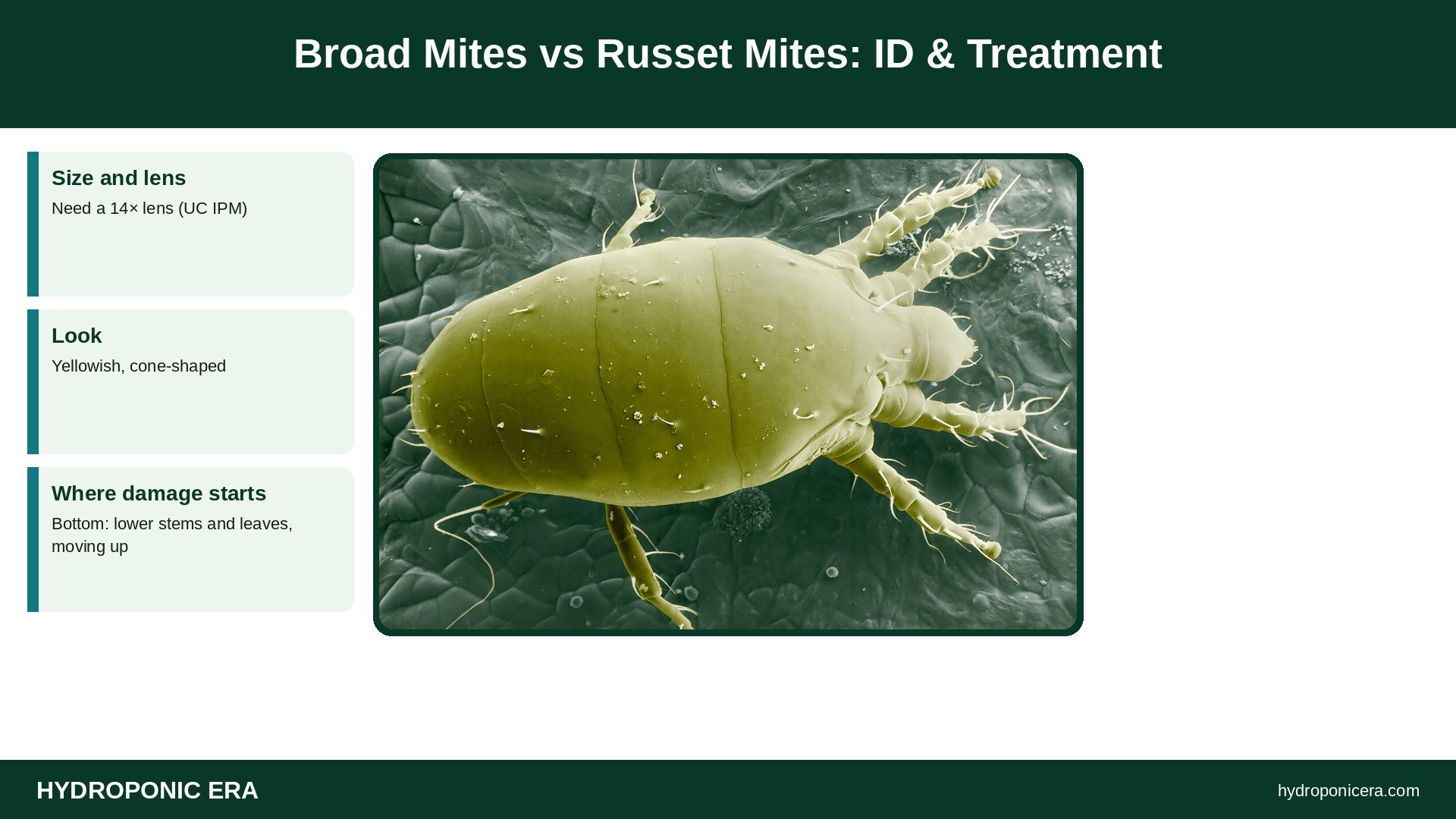
| Size and lens | About 0.2–0.25 mm; 20× lens (UC IPM) | Need a 14× lens (UC IPM) |
| Look | Oval, translucent to yellow-green; females have a pale stripe | Yellowish, cone-shaped |
| Where damage starts | Top: new leaves, buds, growing tips | Bottom: lower stems and leaves, moving up |
| Symptoms | Twisted, cupped, thickened, bronzed new leaves; scarred fruit | Greasy bronze or russet stems and leaves; lower leaves dry out |
| Key ID clue | Eggs covered with white tufts or bumps | Hundreds of mites on green leaves just above bronzed ones |
| Main hosts | Peppers, tomatoes, many ornamentals | Tomatoes and other nightshades |
What Are Broad Mites?

Broad mites (Polyphagotarsonemus latus) belong to the thread-footed mites, not spider mites. UC Statewide IPM says adult females are about 1/100 inch (0.25 mm) long, about one-quarter the size of spider mites, and can’t be seen without a microscope or at least a 20× hand lens. They’re oval, translucent to amber, greenish or yellowish, and adult females carry a white stripe down the back.
The eggs are the giveaway. University of Maryland Extension says the eggs are covered with scattered white tufts that look like round dots, and they’re often found when adults can’t be. UConn describes them as clear ovals with white raised bumps. In warm, humid conditions, UC IPM puts egg-to-adult development at about 6–10 days, so numbers climb fast in a grow room.
What Damage Do Broad Mites Cause?
These mites inject toxic saliva as they feed. UC IPM says infested leaves become cupped, curled, dwarfed and thickened, and leaves or flowers may bronze and stiffen; buds deform or drop, and short internodes make plants look stunted or tufted. UConn adds that young leaves twist or curl down with browning while veins can stay green, and that fruit may show scarred, cracked patches.
Damage shows up after feeding, as tissue expands. By the time you notice it, the mites may have moved on. UC IPM also warns that similar symptoms can come from herbicide injury, boron or zinc deficiency, or poor growing conditions, so confirm with a lens before you treat.
How Are Russet Mites Different?

Tomato russet mites (Aculops lycopersici) are eriophyid mites. UC IPM says they need a 14× hand lens and are rarely noticed until plants are damaged. Infestations usually start near the ground and move up; lower leaves dry out, and stems and leaves turn greasy bronze or russet. Check the green leaves just above the bronzed zone, where there may be hundreds of mites. If left alone, UC IPM says russet mites can kill plants.
So the direction tells you a lot: one distorts the top, the other bronzes from the bottom up. Spider mites leave webbing and stippling instead; see spider mites in hydroponics.
How Do You Control Broad Mites? 7 Steps

- Confirm the pest. Use a 14–20× lens on the undersides of young leaves, or on the green leaves above bronzing for russet mites.
- Quarantine new plants. UConn advises inspecting and isolating new plants, a common way mites arrive.
- Remove the worst growth. Cut out badly distorted shoots or bronzed lower leaves and bag them.
- Release predatory mites early. UConn lists Amblyseius swirskii, Neoseiulus californicus and N. cucumeris, released preventively or at low pest levels.
- Use a true miticide. UConn stresses using miticides, not just insecticides; products labeled only for spider mites may not work.
- Get coverage into growing points. Maryland Extension says thorough coverage of tightly wrapped tips and leaf undersides is the key.
- Clean up between crops. Maryland describes mites overwintering in a high tunnel that wasn’t cleaned before replanting.
Those seven steps work for both mites; the difference is where you aim.
How Should You Scout for Tiny Mites?
Make scouting a weekly habit rather than a reaction to damage. Pick a few plants of each crop, including the ones nearest doors and intake fans. Look at the youngest leaves and buds first, then the lower stems and the leaves just above any bronzing. A 20× lens or a cheap clip-on phone macro lens makes eggs and adults visible. Tap a shoot over white paper and watch for moving specks. Flag plants with suspicious growth and recheck them in two or three days, as UC IPM suggests for russet mite patches, to see whether the damage is spreading.
Which Products Work on Broad Mites?
For home gardeners, UC IPM lists horticultural oil, insecticidal soap, neem oil and wettable sulfur as potentially effective, and notes that abamectin and fenpyroximate are available only to licensed applicators. UConn says organic oils and soaps need repeated applications. UC IPM also cautions that the mites hide in buds and distorted tissue, which protects them from sprays.
For russet mites, UC IPM lists sulfur dust or wettable sulfur, but says not to apply sulfur above 90°F, during heavy dew, or near an oil application. Maryland warns that oils and sulfur can burn plants in hot, humid conditions. Always follow the product label, check that it allows your crop and indoor or greenhouse use, and don’t mix products the label prohibits.
Are Broad Mites a Problem in Hydroponics?
They can be. UC IPM says they are mainly greenhouse and nursery pests and thrive under warm, humid conditions, which describes many indoor grows. UConn says they’re primarily a concern on tomatoes, peppers, eggplants and potatoes, with beans and cucumbers also affected in protected structures. Hydroponics doesn’t change the mite, but it often means warm air, dense canopies and plants moved in from elsewhere. For general pest prevention, see aphids and mites in hydroponics and sticky trap placement (traps won’t catch mites, but they help track other pests).
Common Mistakes With Broad Mites

| Mistake | Why it fails | Better approach |
|---|---|---|
| Treating for nutrient deficiency | Mite distortion looks similar | Lens-check new leaves first |
| Using a spider-mite-only product | Different mite family | Choose a labeled miticide |
| Spraying only the top of leaves | Mites sit in tips and undersides | Full coverage |
| Sulfur in heat or after oil | Leaf burn | Follow temperature and label limits |
| Replanting without cleanup | Mites carry over | Clean and wait before replanting |
FAQs: Broad Mites
Can you see broad mites with the naked eye?
No. UC IPM says you need a microscope or at least a 20× hand lens.
Do broad mites make webbing?
No. Webbing points to spider mites. These mites cause distorted, bronzed new growth.
How fast do broad mites spread?
Egg to adult takes about 6–10 days in warm weather, per UC IPM, and males carry females to new leaves.
Will damaged leaves recover?
Distorted leaves stay distorted. Watch new growth: clean, flat leaves mean control is working.
Can broad mites live on peppers in hydroponics?
Yes. Peppers are a listed host, and warm, humid indoor conditions suit them.
Related HydroponicEra Guides
- Spider mites in hydroponics
- Thrips in hydroponics
- How to grow hot peppers hydroponically
- Tomato brown rugose fruit virus
Sources
- UC Statewide IPM Program — Broad Mite and Cyclamen Mite
- UC Statewide IPM Program — Tomato Russet Mite
- University of Maryland Extension — Broad Mites on High Tunnel Tomatoes
- UConn Integrated Pest Management — Tomato Broad Mites
- Photo credits (Wikimedia Commons, edited with titles): Polyphagotarsonemus latus, USDA BARC by Erbe, Pooley: USDA ARS Electron and Confocal Microscopy Unit (Public domain); 20230811 Aculops lycopersici 08 D by Gilles San Martin (CC BY-SA 4.0); PepperFlower4K by Bst9jkj (CC0)