
If you’re wondering how to grow corn hydroponically, the honest answer is: it works best in large Dutch buckets or drip-fed media, with strong light, plenty of nitrogen and hand pollination. Sweet corn is tall, hungry and wind-pollinated, so indoor ears are often small. Baby corn and corn fodder are far easier wins.
| Question | Quick answer |
|---|---|
| Difficulty | Hard for full ears; easy for baby corn or fodder |
| Best system | Dutch buckets or drip-fed media beds |
| Days to maturity | About 63–100 days by variety (UMD); 85–90 days in NC State’s calendar |
| Pollination | Wind; plant in blocks or hand pollinate indoors |
| Harvest window | About 17–24 days after silks appear (UMD) |
| Baby corn harvest | 1–2 days after silks emerge, ears 2–4 inches (Univ. of Kentucky) |
Can You Grow Corn Hydroponically Indoors?
You can, but sweet corn is one of the toughest crops for a home system. Three things work against you: plant size, light demand and pollination. University of Minnesota Extension explains that wind moves pollen from the tassel at the top of the plant to the silks on the ears, and that corn in a single row produces ears with blank spots where kernels didn’t form.
Indoors there’s no wind and only a few plants, so pollination is weak unless you help. That’s why corn appears on our list of plants that struggle in home hydroponics. Still, knowing how to grow corn hydroponically is useful for greenhouse growers, classrooms and anyone who wants baby corn.
What System Is Best for How to Grow Corn Hydroponically?
| System | Verdict | Why |
|---|---|---|
| Dutch buckets with perlite | Best | Room for roots, good support, easy drip feeding |
| Drip-fed grow bags or totes | Good | Several plants per tote for block planting |
| Deep water culture | Possible | Roots grow fast but tall plants need strong support |
| NFT channels or towers | Poor | Too little root space for a tall grass |
| Sprouting trays | Great for fodder | Not for ears; see fodder below |
See our guides to Dutch buckets and drip systems.
How to Grow Corn Hydroponically Step by Step
- Choose a short, early variety. UMD notes early cultivars tend to be smaller plants, and dwarf types are used for baby corn. Pick one genetic type (su, se or sh2) so you don’t need to isolate varieties.
- Germinate warm. UMN says seeds germinate best near 60°F soil temperature; supersweet (sh2) types want about 65°F. Start seed in rockwool or directly in moist perlite.
- Plant in a block. Group at least 4 buckets together, square rather than in a line. UMN recommends blocks of at least four rows in gardens for the same reason.
- Feed heavily. Iowa State says sweet corn needs high nitrogen with moderate phosphorus and potassium. Use a complete vegetative nutrient and raise EC as plants grow.
- Give full light. Light is where most people underestimate how to grow corn hydroponically. UMD says corn needs at least 6 hours of direct sun and prefers 8–10. Indoors, that means a powerful LED with a high daily light integral.
- Support stalks. UMD suggests running string around plantings to stop them falling over; indoors, use stakes or a trellis net.
- Hand pollinate. When tassels shed pollen, tap or shake them over the silks each morning for several days.
- Harvest at milk stage. Pick when silks are brown and dry and a punctured kernel shows milky juice (Iowa State, UMD).
How Do You Pollinate Hydroponic Corn?
Pollination is the hardest part of how to grow corn hydroponically. Each silk connects to one kernel, so any silk that misses pollen leaves a gap. Indoors, mimic wind: gently shake the tassels, or collect pollen in a paper bag and dust it over fresh silks. Repeat for several mornings while silks are green and moist.
Keep different types apart. UMN warns that cross-pollination between shrunken (sh2) and other types produces starchy, tough kernels. Iowa State adds that yellow pollen can put yellow kernels on white corn. Get pollination right and the rest of how to grow corn hydroponically is mostly light and feeding. For more on indoor pollination, see indoor pollination for hydroponics.
Is Baby Corn Easier to Grow Hydroponically?
Yes, and it’s the smartest way to start. UMD describes baby corn as immature corn from dwarf-habit cultivars, harvested when silks develop but before the ears are fertilized. That means pollination doesn’t matter at all.
The University of Kentucky’s baby corn profile says ears are hand-harvested one to two days after silk emergence, at about 2–4 inches long, with picking every two to three days. If you’re learning how to grow corn hydroponically in a small space, baby corn gives a real harvest in less time.
What About Corn Fodder and Microgreens?
Sprouted grain is another honest option. Livestock fodder is grown in trays for about a week; see hydroponic fodder. Corn is also grown as microgreens; see microgreens. Neither produces ears, but both are reliable. If your real goal is green feed or a quick tray crop, these are the simplest answers to how to grow corn hydroponically.
What Mistakes Happen When You Grow Corn Hydroponically?
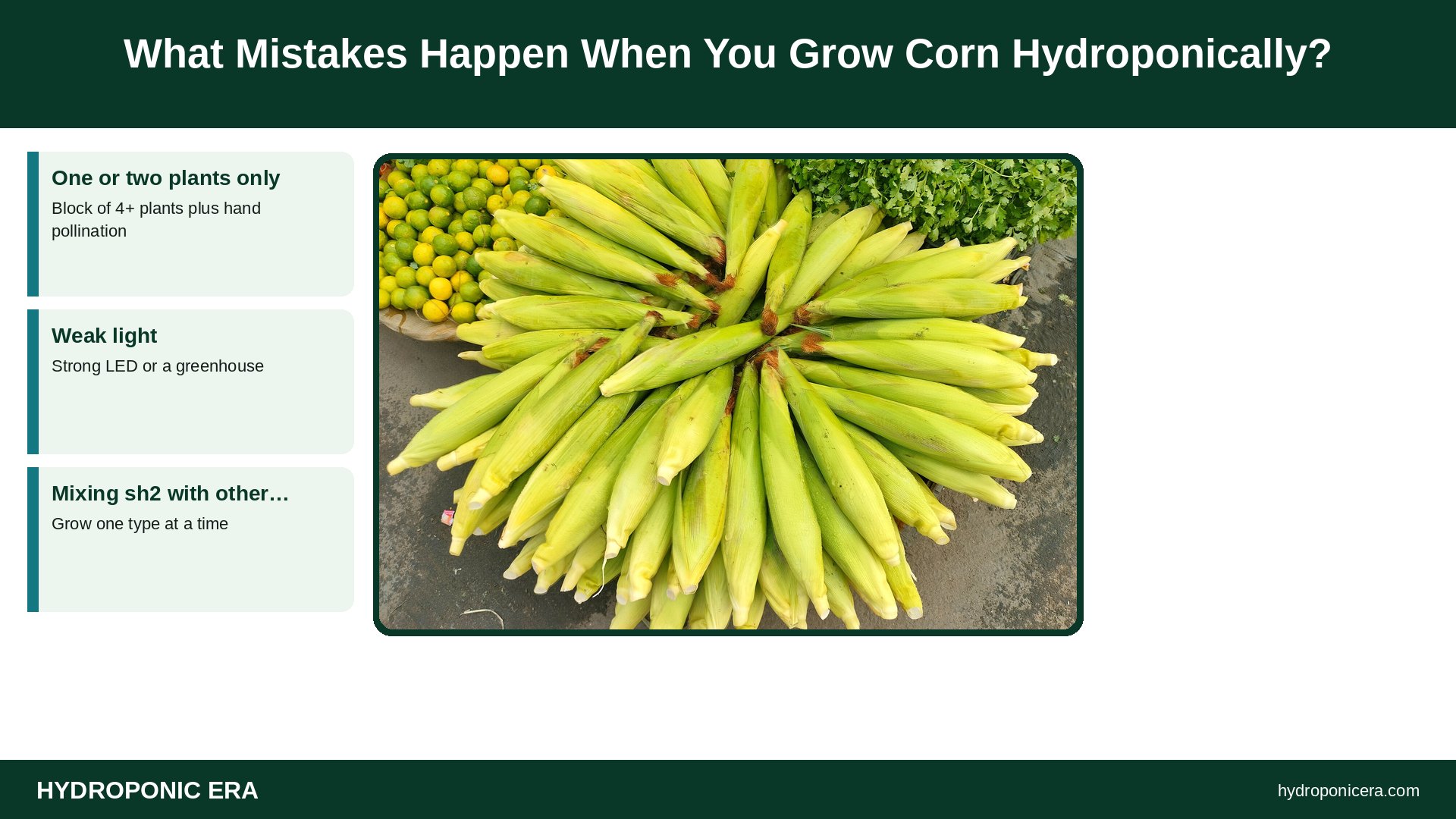
| Mistake | Result | Fix |
|---|---|---|
| One or two plants only | Poorly filled ears | Block of 4+ plants plus hand pollination |
| Weak light | Thin stalks, tiny ears | Strong LED or a greenhouse |
| Mixing sh2 with other types | Starchy, tough kernels (UMN) | Grow one type at a time |
| Low nitrogen | Pale leaves, slow growth | Higher vegetative EC; see deficiency chart |
| Picking late | Doughy, starchy ears | Check daily once silks brown |
Most failures in how to grow corn hydroponically come from the first two rows: too few plants and too little light.
When Is Hydroponic Corn Ready to Harvest?
UMD says corn matures 17 to 24 days after the first silks appear, faster in hot weather. Iowa State gives roughly 18 to 23 days and notes that prime eating quality lasts only 1–2 days in hot weather. Twist the ear downward to snap it off, and chill it quickly, since sugar turns to starch after harvest in standard (su) types. UMN notes that supersweet (sh2) types can stay sweet for about a week in the refrigerator.
Timing matters as much as technique. Write down the date silks first appear on each plant; it’s the most practical habit in how to grow corn hydroponically, because it tells you when to start checking ears.
FAQs: How to Grow Corn Hydroponically
How long does it take to grow corn hydroponically?
Plan on about 63 to 100 days from planting, depending on variety (UMD). Baby corn is ready sooner because ears are picked right after silking.
How many plants do I need when learning how to grow corn hydroponically?
Use at least four plants in a square block, and still hand pollinate indoors.
Can you grow corn hydroponically in a tower?
Not well. Towers suit leafy greens and strawberries, not a tall grass with a large root mass.
What is the easiest way to start learning how to grow corn hydroponically?
Grow a dwarf baby corn variety in Dutch buckets and harvest ears 1–2 days after silks appear.
Is hydroponic corn worth it?
For learning and baby corn, yes. For bulk sweet corn, a sunny garden is cheaper. See best plants for hydroponics.
Related HydroponicEra Guides
- Best grow lights for hydroponics
- How long does hydroponics take to grow?
- Hydroponic greenhouse for beginners
Sources
- University of Minnesota Extension — Growing Sweet Corn in Home Gardens
- University of Maryland Extension — Growing Sweet Corn in a Home Garden
- Iowa State University Extension — Growing Sweet Corn in the Home Garden
- University of Kentucky Center for Crop Diversification — Baby Corn (PDF)
- NC State Extension — Central North Carolina Planting Calendar
- Photo credits (Wikimedia Commons, edited with titles): Corn Tassels 10-14 by inkknife_2000 (7.5 million views +) (CC BY-SA 2.0); Sweet corn 2 by পাপৰি বৰা (CC BY-SA 4.0)