
Quick Answer: hydroponic fodder
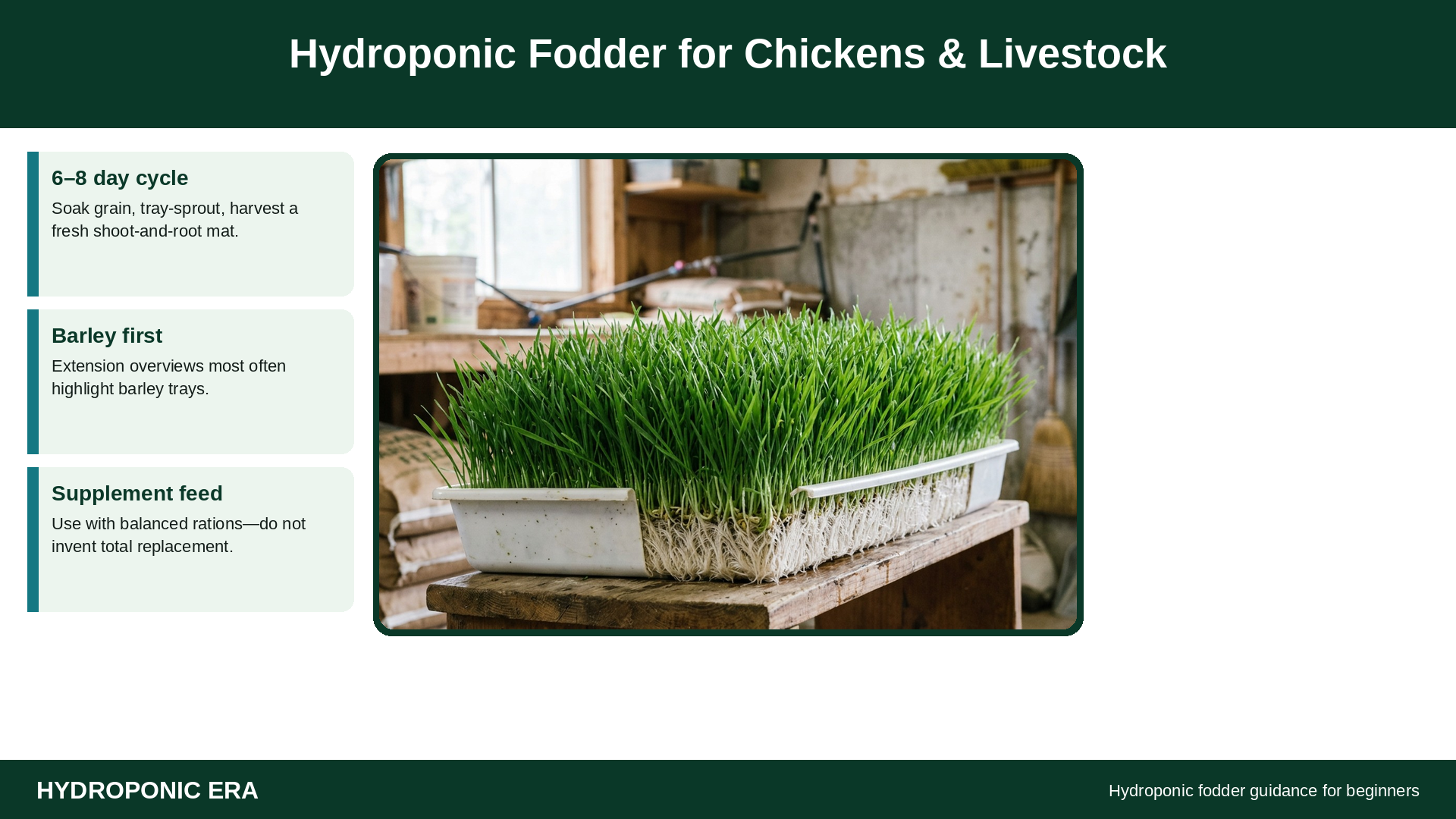
Hydroponic fodder is sprouted cereal grain—usually barley, and sometimes wheat or oats—grown in shallow trays with water for about six to eight days, then fed as a fresh shoot-and-root mat to chickens and other livestock. University of Vermont Extension describes the typical cycle as an 8–12 hour soak, tray growth near 60–70°F, with or without lights, for 6–8 days.
University of Minnesota WCROC outlines a similar seven-day tray workflow: clean seed, soak, water two or three times daily, harvest, and restock. People use hydroponic fodder as a supplemental fresh feed when land, hay, or grain access is limited—not as a magic complete ration. This HydroponicEra beginner guide covers trays, water (usually without vegetable nutrient salts), feeding variables for chickens versus ruminants, mold and heat risks, cost frameworks (not invented ROI), and when you should not replace all feed.
Pair this with how to start a small hydroponic farm, hydroponic supplies for beginners, and how often to change hydroponic water for shared water-hygiene habits—even though fodder trays are not a lettuce DWC tank.
Key Takeaways on hydroponic fodder
- Hydroponic fodder means hydroponically sprouted grain mats, not a dictionary-wide “any livestock feed.”
- Barley is the grain most often cited in extension overviews; wheat and oats also appear in UMN WCROC descriptions.
- A common cycle is soak → tray → 6–8 days → harvest a rooted green mat.
- Most beginner fodder systems irrigate with clean water; do not casually pour vegetable hydroponic nutrient concentrates into fodder trays unless a livestock nutrition plan says otherwise.
- Mold is a primary drawback named across extension reviews—warmth plus constant moisture favors fungi as well as sprouts.
- Compare feeds on a dry-matter basis; fresh mats are mostly water, so wet weight alone misleads.
- For chickens, treat fodder as a supplement alongside a balanced complete feed—not a sole diet.
- Costs, labor (often daily), and capital can be high per pound of dry matter—run local numbers; when land, hay storage, or drought stress is real, hydroponic fodder can still be worth testing as a controlled supplement.
Related HydroponicEra guides
- Hydroponics for beginners
- How to start hydroponics at home
- Hydroponic system for beginners
- How to use hydroponic nutrients (vegetable systems—contrast with fodder water habits)
- How to grow microgreens hydroponically (short sprout cycle cousin; different end use)
- How to start a small hydroponic farm
What hydroponic fodder is
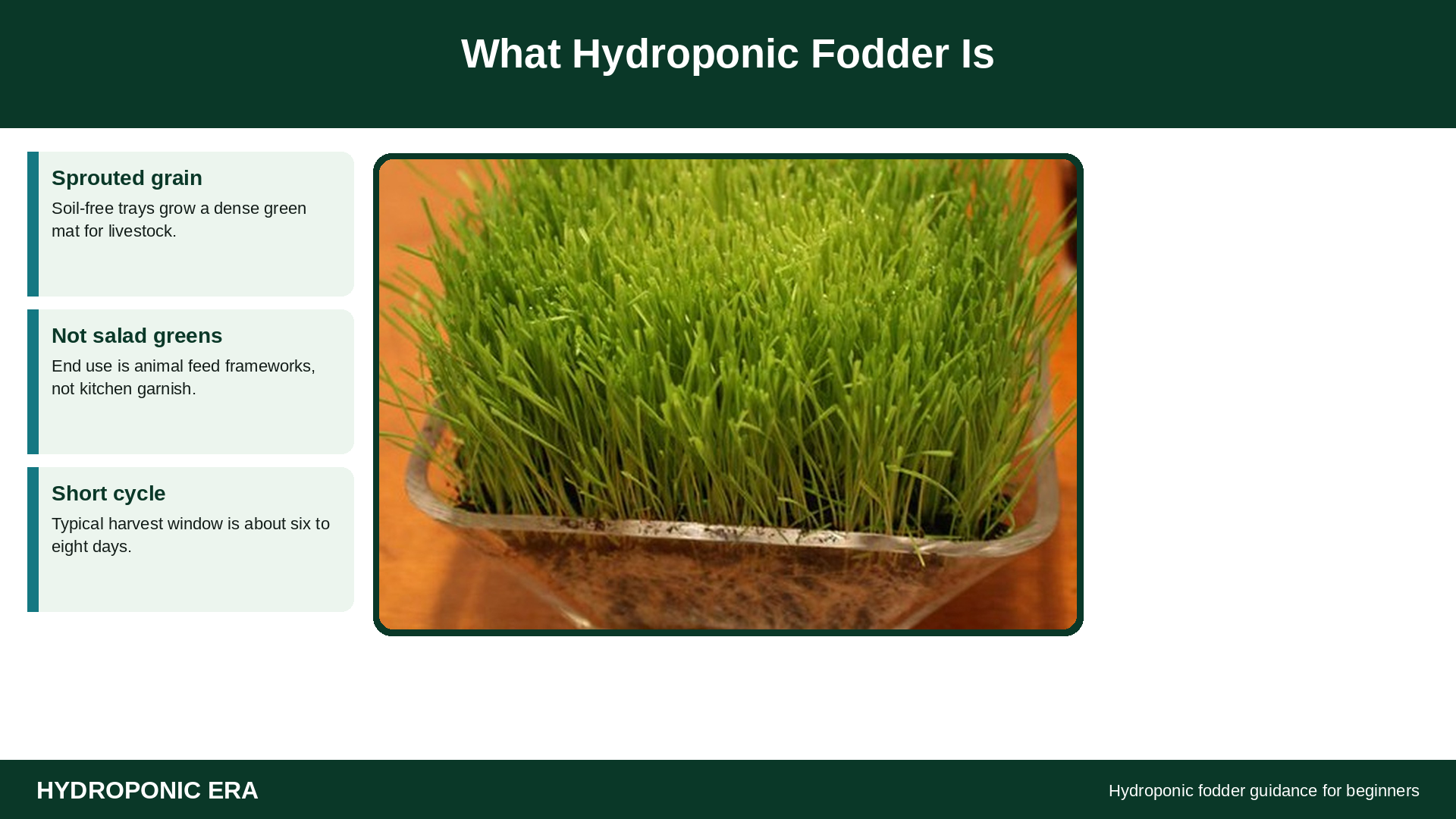
In everyday farm talk, “fodder” can mean almost any livestock feed. In the systems discussed by UVM Extension and UMN WCROC, hydroponic fodder specifically means grain sprouted in trays with water—no soil—until a dense green mat of shoots and roots forms. Growers then cut or tear that mat into animal-sized pieces and feed it fresh.
That mat looks a bit like a thick microgreen carpet, but the goal is livestock nutrition and forage substitution frameworks—not a salad garnish. Chemical changes during sprouting convert some complex seed reserves into simpler compounds; UVM notes literature interest in digestibility and certain vitamins, while also citing animal nutritionists who urge caution about over-interpreting dramatic vitamin percentage claims relative to whole-animal requirements.
If you already run DWC, NFT, or Dutch buckets, reuse sanitation discipline—not vegetable fertilizer recipes. Hydroponic fodder trays are a different crop class with different risk points (especially mold).
Why growers use hydroponic fodder
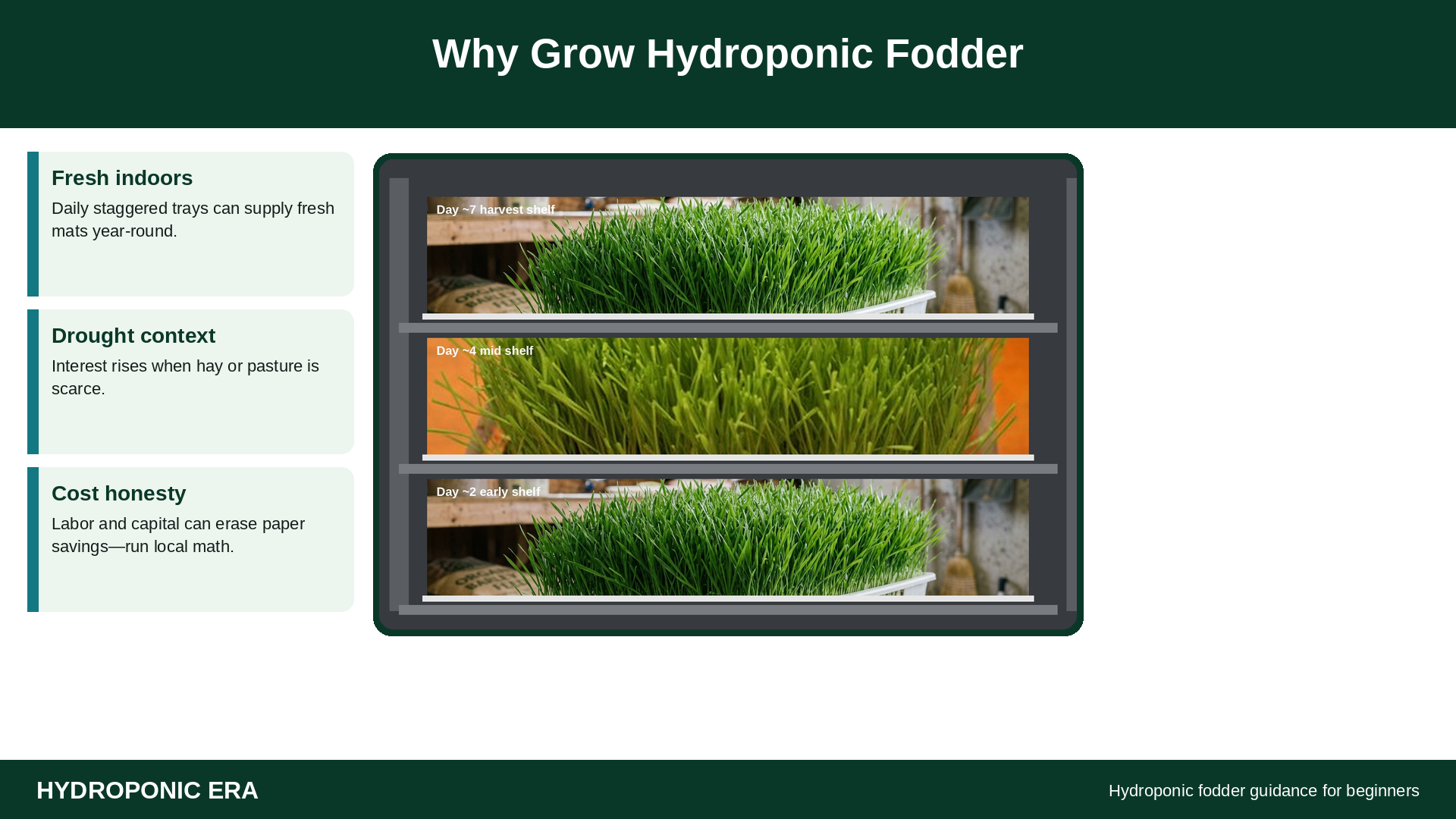
Extension writing lists practical motives, not miracle marketing:
- Fresh feed on a short cycle when pasture or hay is scarce.
- Indoor control of a daily harvest stream (UMN describes restocking trays so seven-day mats can be harvested every day).
- Water-use interest relative to field forage in dry regions (UVM summarizes literature claiming much lower water use than field crops for sprouted fodder—treat that as context, then measure your own meter).
- Organic dairy feed pressure when certified grain or alfalfa is expensive or short (UMN WCROC frames renewed interest this way).
Oregon State University’s Small Farms program (with WSU livestock extension co-authors) also stresses the other side: startup cost, labor, production challenges, and economics make fodder of “dubious application” for many operations, while selected producers with limited acreage, poor hay storage, or difficult weather may still benefit—if they understand true cost of production first.
NDSU Extension notes interest in purposeful sprouting as forage, while cost and labor often limit large commercial use. Honest baseline: hydroponic fodder is a tool, not a guaranteed profit engine.
Grains used for hydroponic fodder
Barley is the grain most often highlighted for hydroponic fodder (UVM “typically barley”; OSU Small Farms; UMN dairy trials). UMN WCROC also lists wheat and oats among sprouting grains; other cereals appear in research notes. Beginners usually master one clean, untreated feed-grade seed lot first.
Seed quality rules: start with clean seed free from visible mold (UMN WCROC); use seed intended for livestock feed sprouting—not treated seed labeled unsafe for feed; store dry seed cool and dry. Test a small tray batch before you scale seed orders—we do not invent farm-specific germination percentages here.
7 essential steps to grow hydroponic fodder
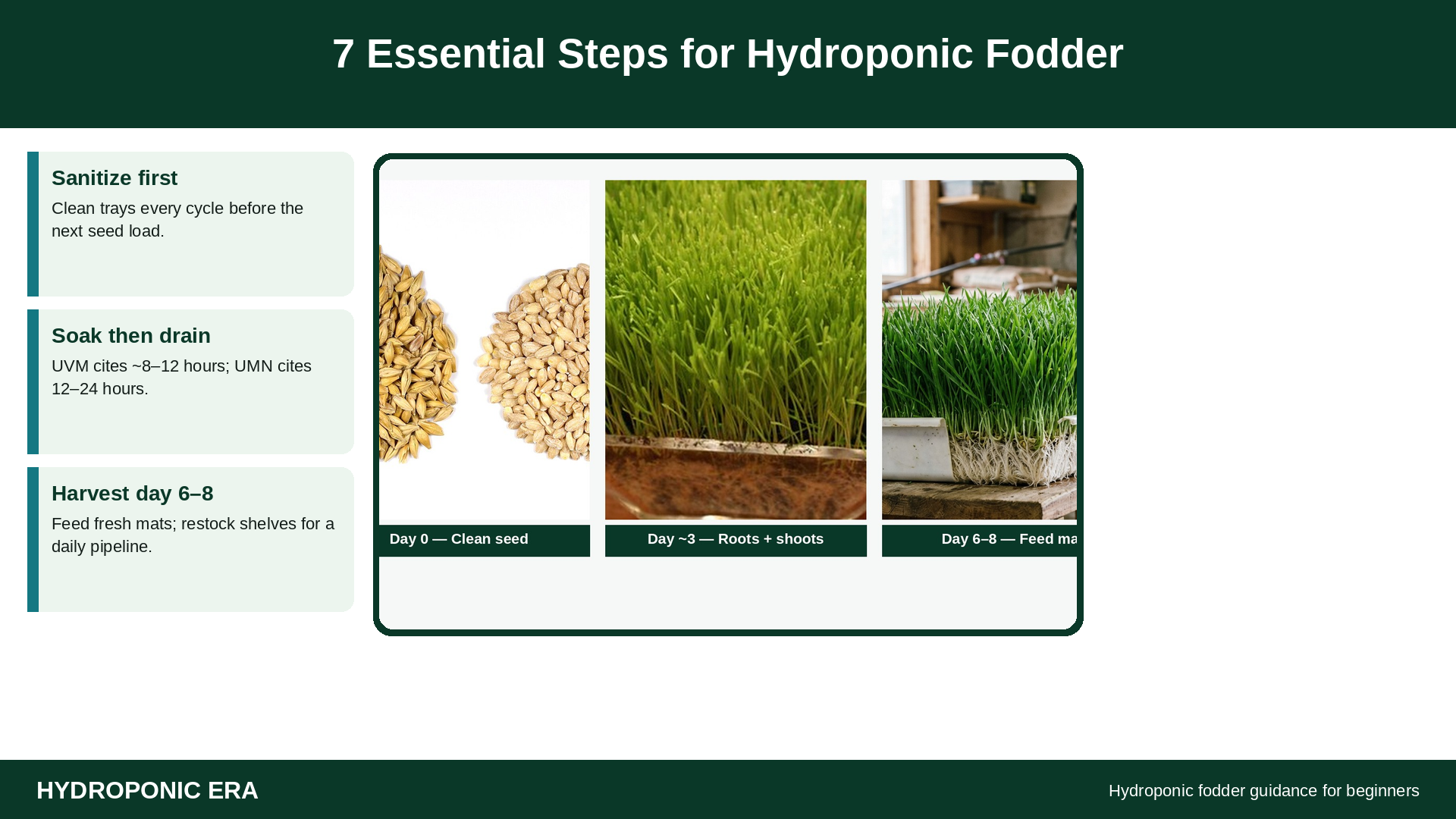
Use this as a beginner operating pattern aligned with UVM (8–12 hour soak; 60–70°F; 6–8 days) and UMN WCROC (12–24 hour soak; water 2–3× daily; seven-day harvest). Adjust to your climate and seed lot.
- Sanitize trays and the room zone. Wash trays between cycles. Leftover slime seeds the next mold bloom. Borrow hygiene mindset from edible hydroponics guides on this site, then keep fodder tools separate from vegetable nutrient stock tanks when you can.
- Measure clean, untreated seed. Weigh what you can track. Depth should allow a uniform layer after soak—overpacking traps heat and anaerobic pockets.
- Soak. UVM cites about 8–12 hours; UMN cites 12–24 hours. Use potable or otherwise clean water. Drain thoroughly—standing soak water goes anaerobic fast.
- Spread into trays. Aim for an even layer so water and air move through the seed bed. Crowding is a top mold trigger.
- Rinse or irrigate on a schedule. UMN describes watering two or three times daily during the grow-out. Keep water moving; do not leave trays flooded.
- Hold temperature in a moderate band. UVM’s typical band is about 60–70°F. Hotter rooms push mold risk; cold rooms stall germination unevenly.
- Harvest on day 6–8 (often day 7) and feed fresh. Cut mats to animal-appropriate sizes. Clean trays, then restock so staggered shelves create a daily pipeline of hydroponic fodder.
Lights are optional in many descriptions (“with or without artificial light” in UVM). If you add light, keep intensity modest; fodder is not a fruiting tomato canopy. For indoor environment ideas, see indoor hydroponic garden basics and grow lights for hydroponics—then downshift expectations for short sprout cycles.
Trays, racks, and room setup for hydroponic fodder
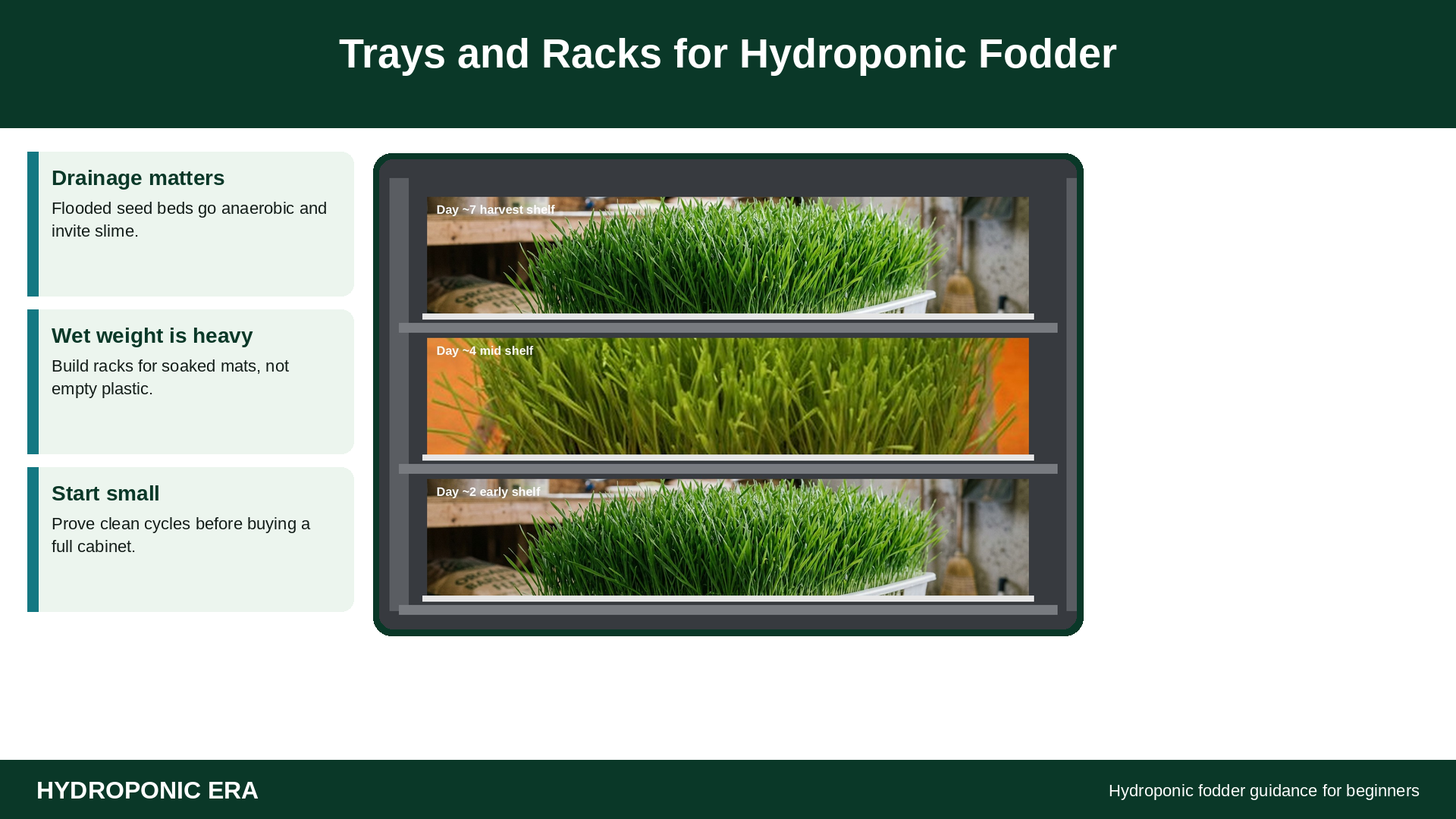
A practical beginner hydroponic fodder layout is boring on purpose: food-safe trays with drainage, sturdy racks that hold wet weight, splash control so upper trays do not contaminate lower mats, gentle airflow without dry/swamp corners, and separation from poultry litter dust and vegetable fertigation benches when possible.
Start with a few trays before buying a turnkey cabinet—capital cost is one reason NDSU and OSU Small Farms urge careful evaluation. Skim hydroponic supplies for beginners, then buy fodder-specific drainage trays, not nursery flats that puddle.
Water for hydroponic fodder (usually low or no nutrients)
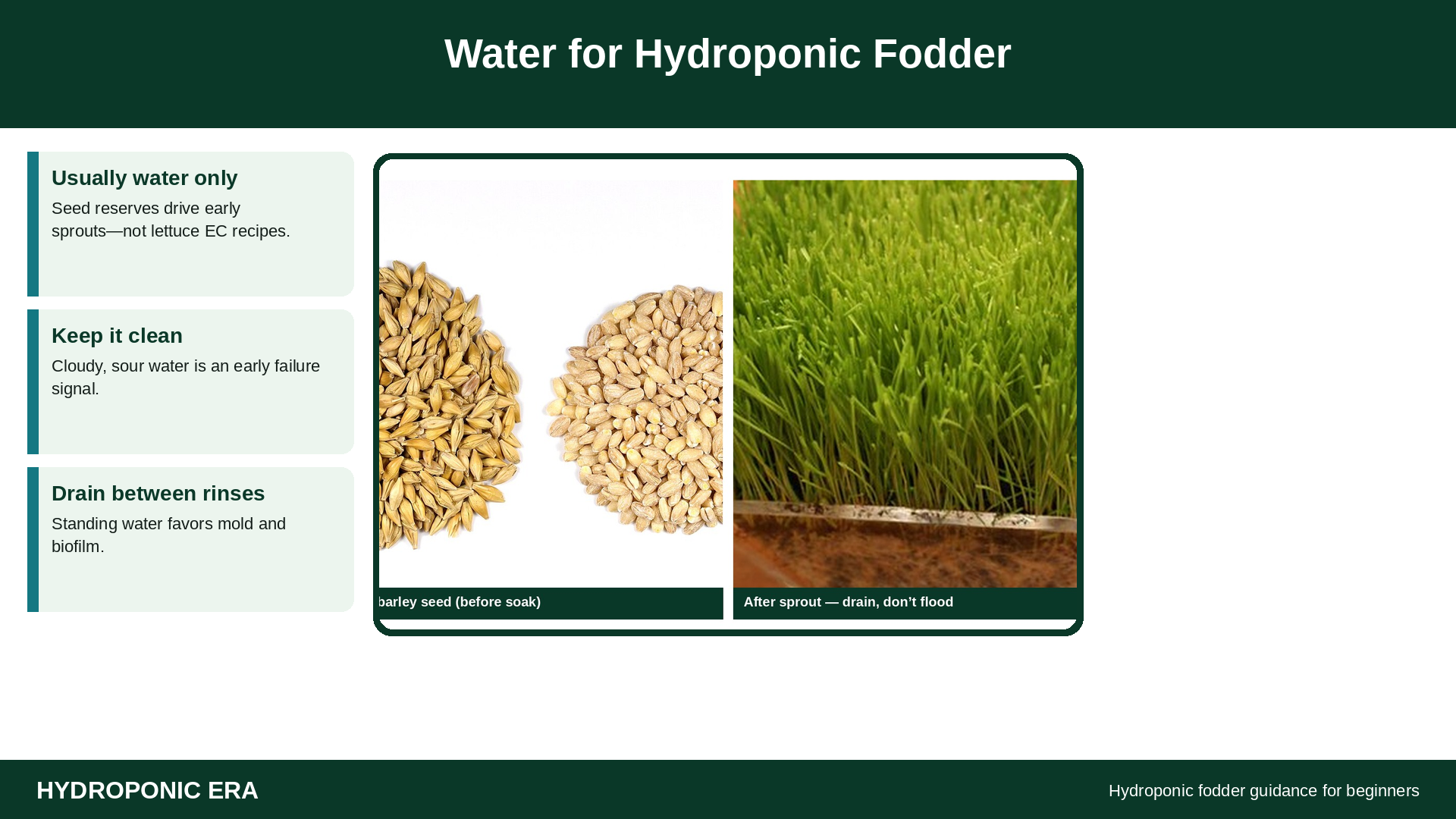
This is where vegetable hydroponics habits can hurt beginners.
In typical fodder workflows described by UVM and UMN, the “hydroponic” part means growing without soil in water culture trays—not running a high-EC lettuce recipe. The seed’s own reserves drive early sprout growth. Research literature cited in UVM’s reference list even compares barley sprouts grown with nutrient solution versus tap water, which tells you both approaches exist in papers—but that is not permission to dump tomato bloom formula into chicken feed trays.
Practical water guidance for beginners:
- Use clean water; keep chlorine/chloramine and contamination in mind the same way you would for any animal-facing rinse.
- Do not treat fodder water like a vegetable nutrient reservoir unless a qualified livestock nutrition plan specifies a product and rate.
- Watch for slime films, sour smells, and cloudy standing water—early mold/biofilm signals.
- Drain trays well between irrigations; flooded seed beds go anaerobic.
- If you ever test EC/pH out of curiosity, remember fodder goals differ from crop pH control for produce.
Oklahoma State University Extension’s hydroponics overview is useful background for soilless culture concepts, but livestock fodder still needs animal-feed judgment on top of plant-growing mechanics.
Feeding chickens vs goats, sheep, and cattle

Animals are not interchangeable. Use general guidance and variables—not invented grams-per-bird guarantees from HydroponicEra.
Chickens and other poultry
Oregon State University Small Farms coverage includes poultry among livestock that people feed sprouted grain to. Peer-reviewed broiler work (a 2023 Animals journal study, PMC full text) tested hydroponic barley fodder inclusions alongside basal diets. Results are study-specific—evidence that supplemental use is researched, not a universal prescription for your flock.
Chicken-oriented guardrails:
- Keep a balanced complete feed as the nutritional backbone unless a poultry nutritionist redesigns the ration.
- Offer hydroponic fodder as a fresh supplement; watch litter moisture if birds drag wet mats into the coop.
- Chop large mats so birds can manage pieces without smothering chicks.
- Never feed moldy trays “because chickens will sort it.”
Goats, sheep, and cattle
UVM frames fodder as supplemental feed for cattle and other livestock and notes organic pasture-rule nuances: sprouted-grain fodder does not count toward the NOP pasture dry-matter intake minimum the way pasture does. UMN WCROC dairy work evaluated hydroponic barley fodder in organic dairy rations. Read those station reports for measured outcomes in that herd—do not copy numbers as your guarantee. Ruminants need fiber and ration balance; work with local extension or a nutritionist before large hydroponic fodder inclusion rates.
Variables that change hydroponic fodder results
| Variable | Why it matters | Beginner action |
|---|---|---|
| Seed cleanliness | Mold inoculum starts on seed | Buy clean feed-grade lots; discard suspect bags |
| Soak time | Too short = uneven sprout; too long = sour water | Start near 8–12 h (UVM) or 12–24 h (UMN); drain well |
| Seed depth / density | Crowding traps heat and low oxygen | Even, moderate layer; test small trays |
| Temperature | UVM cites ~60–70°F as typical | Avoid hot sheds and cold garages |
| Irrigation frequency | UMN cites 2–3× daily watering | Keep moist, not flooded |
| Airflow | Stale wet air favors mold | Gentle air exchange; no dead corners |
| Cycle length | 6–8 days common; day 7 often used | Harvest before mats yellow or slime |
| Animal class | Poultry vs ruminant needs differ | Supplement first; do not wholesale-swap rations |
| Dry matter | Wet weight overstates feed value | Compare on dry-matter thinking |
| Labor | Daily cleaning and restocking | Budget hours before buying racks |
Cost framework for hydroponic fodder (not fake ROI)
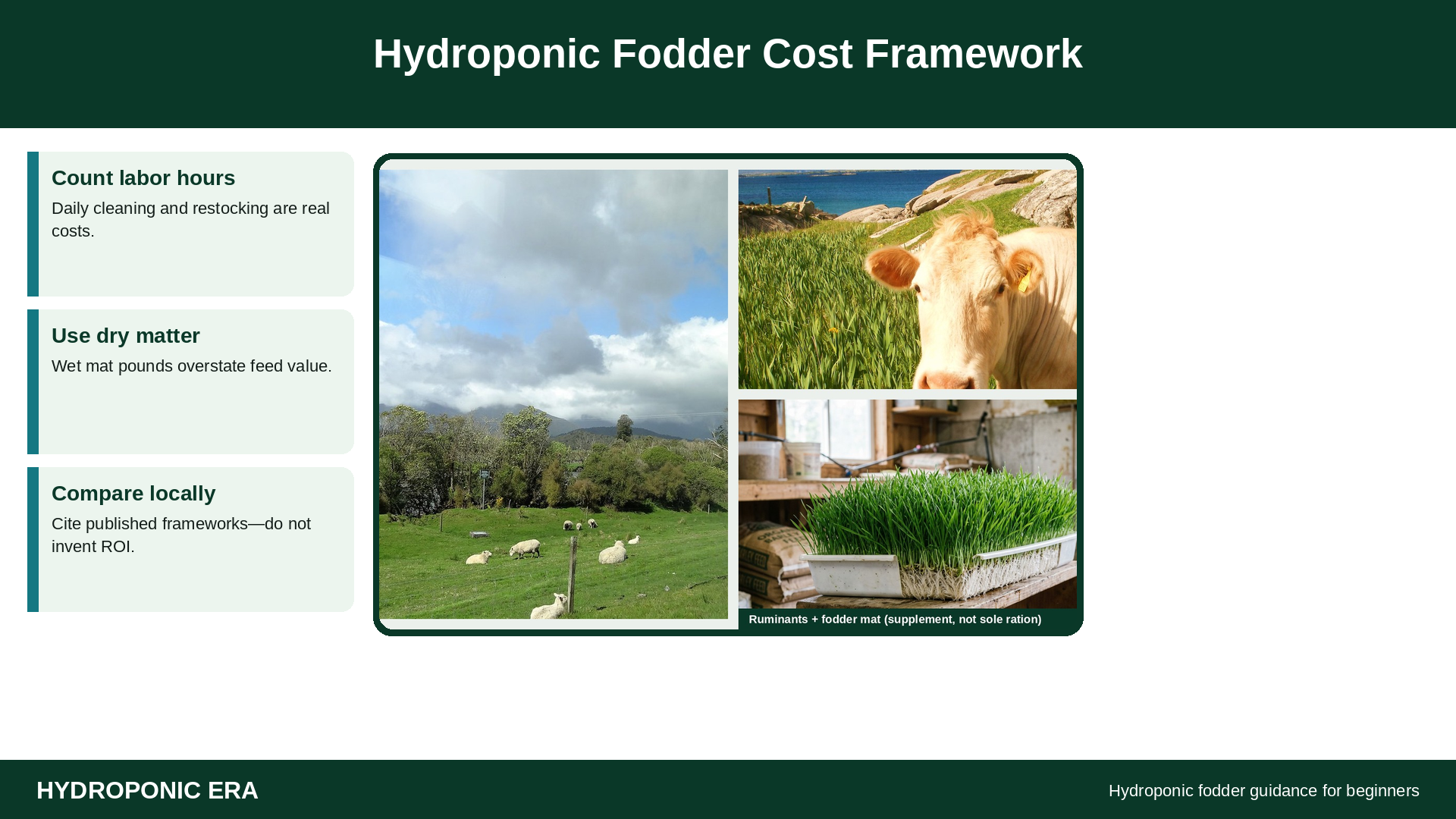
HydroponicEra will not invent your payback period for hydroponic fodder. Use a worksheet mindset:
- Capital: trays, racks, pumps or hose, room, contingency for replacements.
- Seed: price per pound × daily seed use.
- Labor: UVM summarizes studies reporting roughly 1–4 hours daily depending on scale—verify with your own stopwatch.
- Utilities: water, any heating/cooling, optional lights.
- Loss factor: mold dumps, poor germination, spilled mats.
- Comparison feed: what hay, grain, or complete feed would you otherwise buy—priced per pound of dry matter.
UVM cites an economic study reporting about $0.40 per pound of dry matter to produce fodder versus about $0.11 per pound of dry matter for a comparison hay figure in that analysis. Those are published comparison points for decision-making—not your local 2026 invoice. NDSU likewise urges producers to evaluate costs carefully before investing. If your spreadsheet only works when you ignore labor, it does not work.
When not to replace all feed with hydroponic fodder
Skip the “fodder only” fantasy if you cannot keep trays mold-free for several cycles, lack a balanced complete feed (poultry) or fiber-aware ruminant plan, compare wet mat weight to dry grain without dry-matter thinking, are already out of labor hours, need NOP pasture dry-matter credit (UVM notes fodder does not meet pasture-rule DM intake the way pasture does), or see refusals/manure problems after abrupt large swaps. A sane path for hydroponic fodder is staged inclusion: master clean cycles, offer modest amounts, watch body condition with local advice, then decide.
Mold and heat risks in hydroponic fodder rooms

UVM is blunt: mold is a primary drawback; nearly every study in their review mentioned it. Warmth and high moisture that grow sprouts also grow fungi. Moldy fodder can mean dumped feed, respiratory irritation risk for people cleaning trays, and unsafe animal feed.
Risk reducers for hydroponic fodder: clean seed and trays every cycle; stay near moderate temperatures (UVM’s ~60–70°F planning band); avoid stagnant flood layers; improve airflow without sandblasting mats dry; harvest on time before mats collapse; isolate moldy trays—do not “blend them in.”
Heat waves in tin sheds are a classic hydroponic fodder failure mode—shrink batch size or pause rather than steam-cooking a fungal incubator.
Common mistakes with hydroponic fodder
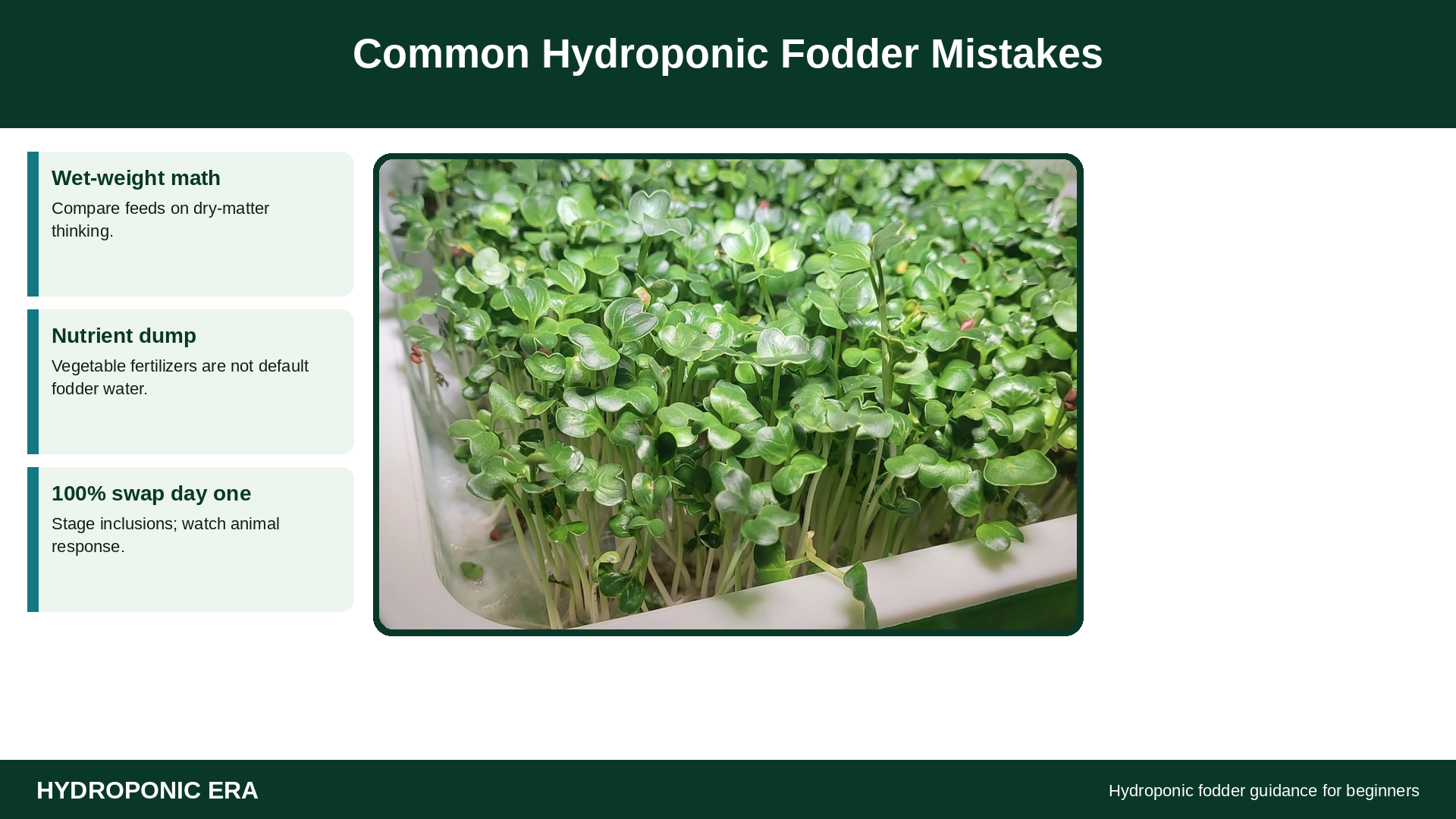
- Treating wet weight as dry-matter feed equivalence.
- Pouring vegetable hydro nutrients into fodder water by habit.
- Skipping tray sanitation between cycles.
- Overloading seed depth until the middle cooks anaerobic.
- Replacing 100% of chicken feed on day one.
- Buying a huge commercial rack before proving three clean weeks on a few trays.
- Ignoring labor in the cost model.
- Feeding moldy mats to “save seed cost.”
- Copying another farm’s inclusion rate without matching animal class and ration.
Troubleshooting hydroponic fodder
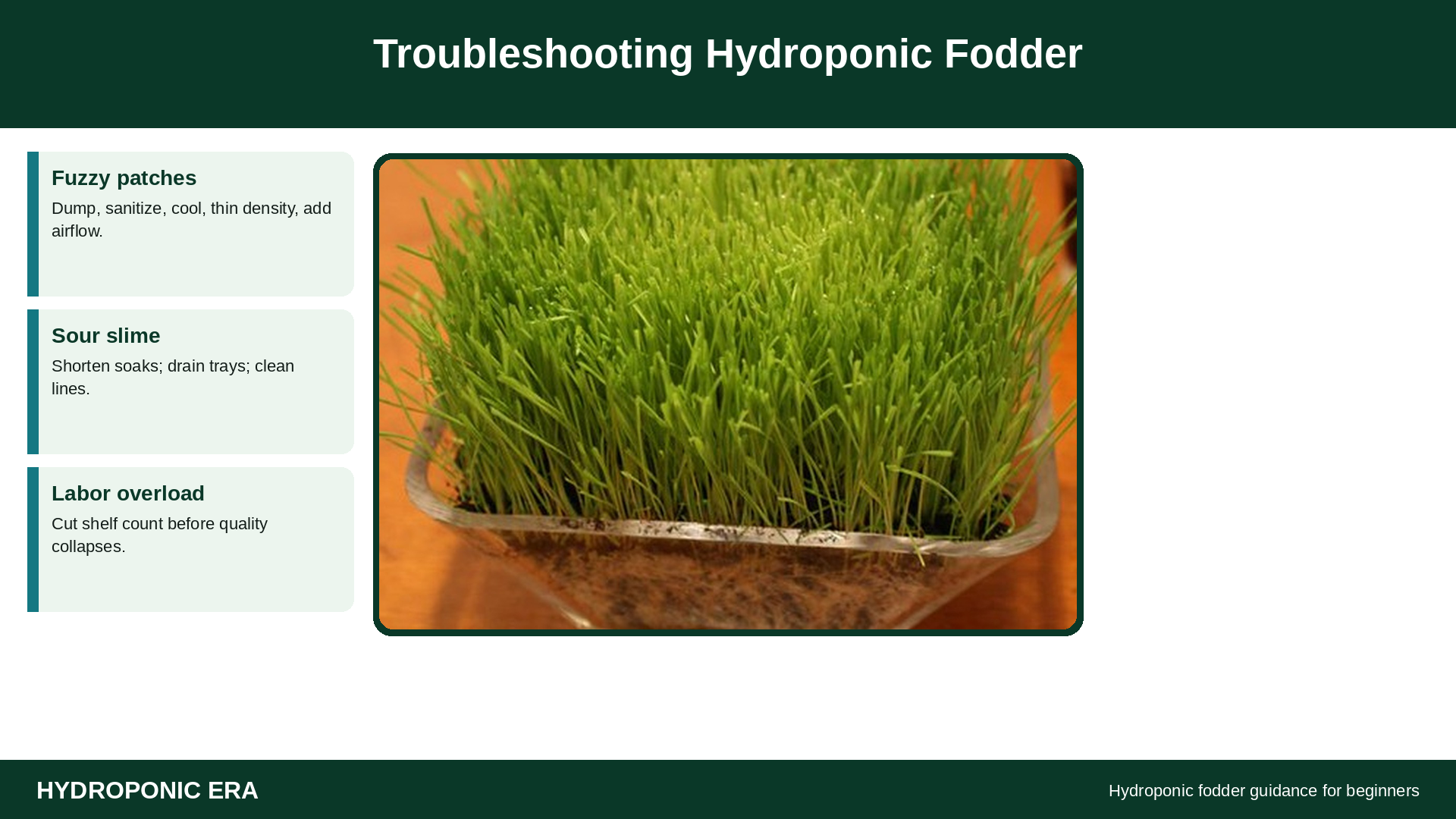
| Symptom | Likely causes | What to try |
|---|---|---|
| Fuzzy mold patches | Dirty seed/trays, heat, poor airflow, overwatering | Dump affected trays; sanitize; thin density; cool room; increase air exchange |
| Sour smell / slime | Standing water, long soaks, warm stagnation | Drain better; shorten soak; rinse schedule; clean plumbing |
| Uneven germination | Old seed, uneven layer, dry corners | Seed germination test; level trays; even irrigation |
| Yellow thin mats | Too little light in some setups, nutrient exhaustion of seed, delayed harvest | Harvest sooner; modest light trial; check seed quality |
| Animals refuse feed | Off smells, abrupt switch, particle size | Offer smaller fresh amounts; chop; never force moldy feed |
| Wet poultry litter | High-moisture mats dragged into coop | Feed in managed areas; reduce wet volume; refresh litter |
| Labor overload | Too many trays for available hours | Cut shelf count; automate rinsing carefully; or pause |
For broader soilless hygiene habits, see why hydroponic roots turn brown and how often to change hydroponic water (biofilm and stagnant-water lessons transfer even when the crop differs).
hydroponic fodder FAQs
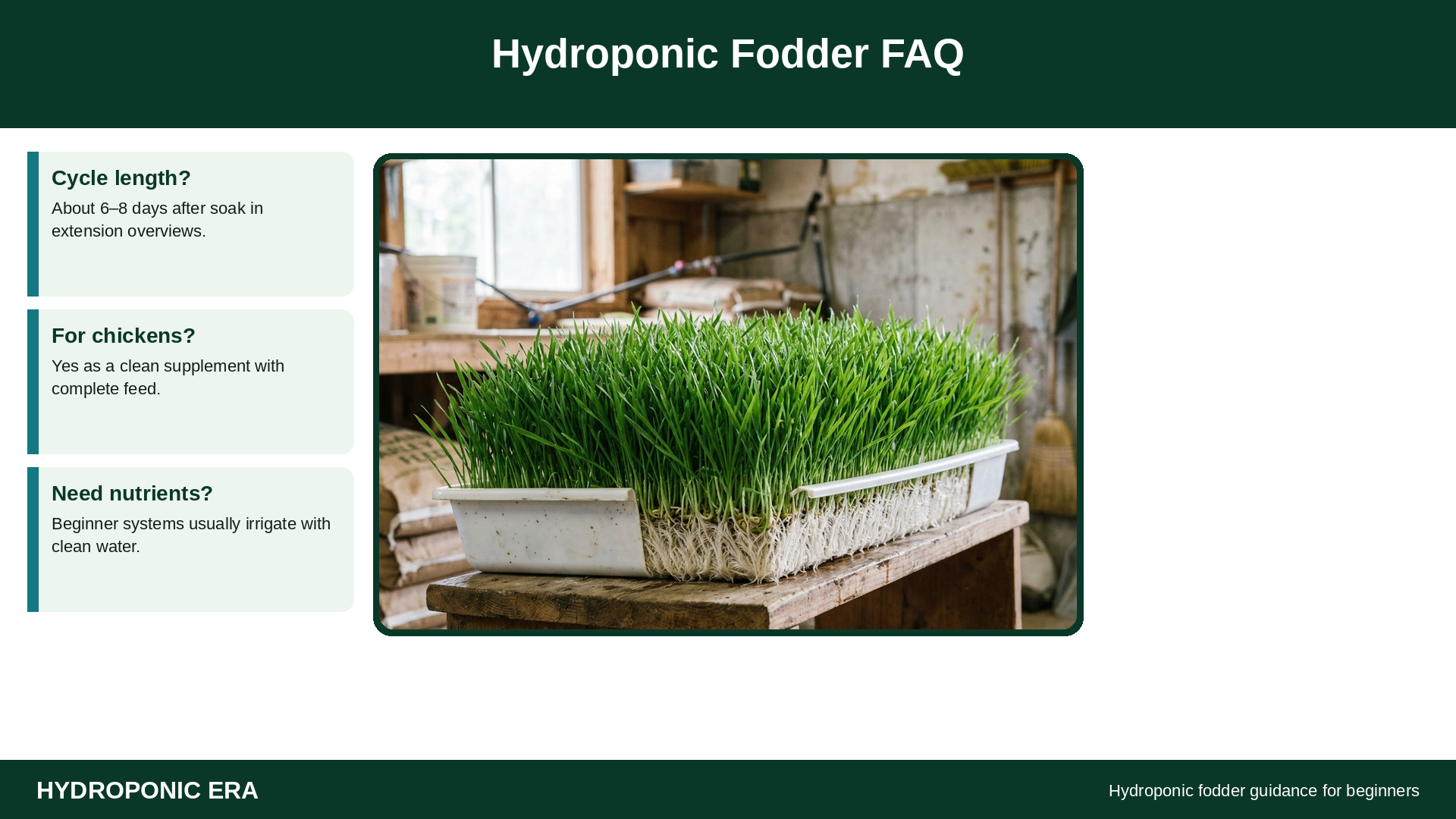
What is hydroponic fodder in one sentence?
It is cereal grain sprouted in water trays into a shoot-and-root mat and fed fresh to livestock, typically on a 6–8 day cycle.
Is hydroponic fodder good for chickens?
It can be a fresh supplement when trays are clean and a complete feed still covers nutrient requirements. Research has tested inclusions; your flock still needs a balanced program.
Which grain is best to start with?
Barley is the grain most often featured in extension overviews. Start with one clean lot and master sanitation before mixing grains.
Do I need hydroponic nutrients for hydroponic fodder?
Beginner tray systems described by UVM and UMN center on water and seed reserves. Do not assume vegetable nutrient schedules apply to animal feed sprouts.
How long does a cycle take?
About 6–8 days after soak in UVM’s overview; UMN describes seven-day sprouts with daily harvests from staggered trays.
Why does my hydroponic fodder mold?
Because the same warmth and moisture that sprout grain also favor fungi. Clean seed, clean trays, moderate temperature, drainage, and airflow are the first fixes.
Can hydroponic fodder replace hay or complete feed?
Treat it as a supplement unless a qualified nutrition plan says otherwise. UVM also notes organic pasture-rule limits on counting fodder as pasture DM.
Sources
- University of Vermont Extension — Fodder Systems on the Certified Organic Dairy Farm (PDF)
- University of Minnesota WCROC — Fodder Production Systems
- University of Minnesota WCROC — Evaluation of Feeding Hydroponic Barley Fodder to Organic Dairy Cattle
- Oregon State University Small Farms — Fodder for Forage: Fact, Folly, Fable or Fabulous?
- North Dakota State University Extension — Feeding Value of Sprouted Grains (AS647)
- PMC / Animals journal — Effects of Adding Different Levels of Hydroponic Barley Fodder on Broiler Chickens
- Oklahoma State University Extension — Hydroponics fact sheet (soilless culture context)
Source URLs re-verified HTTP 200 on 2026-09-19 (Asia/Karachi); PMC used for the broiler fodder paper. No fabricated farms, yields, or ROI claims. Draft only—not published.