
Quick Answer
daily water use reservoir sizing means matching tank volume and top-off habits to how many plants you run, what they are (leafy vs fruiting), and how hard the room drives transpiration. Undersized reservoirs swing EC and temperature; oversized ones hide problems until roots have baked in stale solution.
Build the framework with reservoir setup, top-off vs change, auto top-off, EC/TDS, and spacing.
Key takeaways for daily water use reservoir sizing
- Hydroponic reservoir sizing plant count is ops math, not a single magic liters-per-plant myth.
- Crop class and room climate change daily water use more than Instagram tank photos.
- Small tanks need more frequent checks; large tanks need sanitation discipline.
- Oklahoma State EC/pH guidance still assumes you can measure a stable volume.
- Original card: plants × class factor × climate factor → working volume + freeboard.
- Hydroponic reservoir sizing plant count fails when you only buy the tote that fits the shelf.
- Plan top-off water quality equal to fill water quality.
- Leave freeboard so pumps do not suck air after a hot afternoon.
Related HydroponicEra guides
Why Plant Count Alone Is Not Enough
daily water use reservoir sizing starts with headcount but must multiply by crop thirst and environment. A dozen butterhead lettuces in a cool basement drink differently than eight fruiting peppers under high PPFD. Extension hydroponic production notes emphasize monitoring solution volume and concentration together—because water loss concentrates salts.
This page gives a sizing framework and check rhythm. It does not invent precise milliliters per cultivar; you will calibrate with your own top-off log.
Sizing Comparison

| Scenario | Volume lean | Watch-out |
|---|---|---|
| 6–12 leafy in mild room | Modest tote OK if checked daily | Hot snaps empty fast |
| Fruiting peppers/tomatoes | Larger volume or dedicated buckets | Midday EC spikes |
| Mixed canopy one tank | Size for thirstiest class | compatibility |
| Vacation / work travel | More volume + ATO discipline | Do not “set and forget” stale tanks |
Step-by-Step Sizing Workflow
- Count plant sites and note crop class (leafy, herb, fruiting).
- Estimate daily top-off for one week with a marked jug—real data beats forums.
- Choose working volume so a hot day does not expose pump intakes.
- Add freeboard for displacement and media drips.
- Place the reservoir for cool, dark conditions (temp, lid proofing).
- Decide top-off vs partial change rhythm before plants are heavy.
- If using ATO, feed it source water with known EC baseline.
- Mark min/max lines on the reservoir wall with permanent paint pen.
- Recalculate when you add a second light bar or denser spacing.
- Log liters topped off vs EC drift (logs).
Variables
| Variable | Effect | Link |
|---|---|---|
| PPFD / DLI | Higher light → more water use | PPFD |
| VPD / RH | Dry air increases transpiration | humidity |
| Plant size stage | Fruiting surge after canopy fills | NPK stages |
| System type | NFT film failure vs DWC thermal mass | systems |
Common mistakes with daily water use reservoir sizing

- Buying the smallest tote that fits under a table
- No min-line mark so pumps run dry
- Topping off with mystery water of unknown EC
- Sizing for seedlings then never upsizing at fruiting
- Ignoring freeboard until overflow floods the floor
- Using one tiny tank for mixed fruiting + delicate greens
Troubleshooting
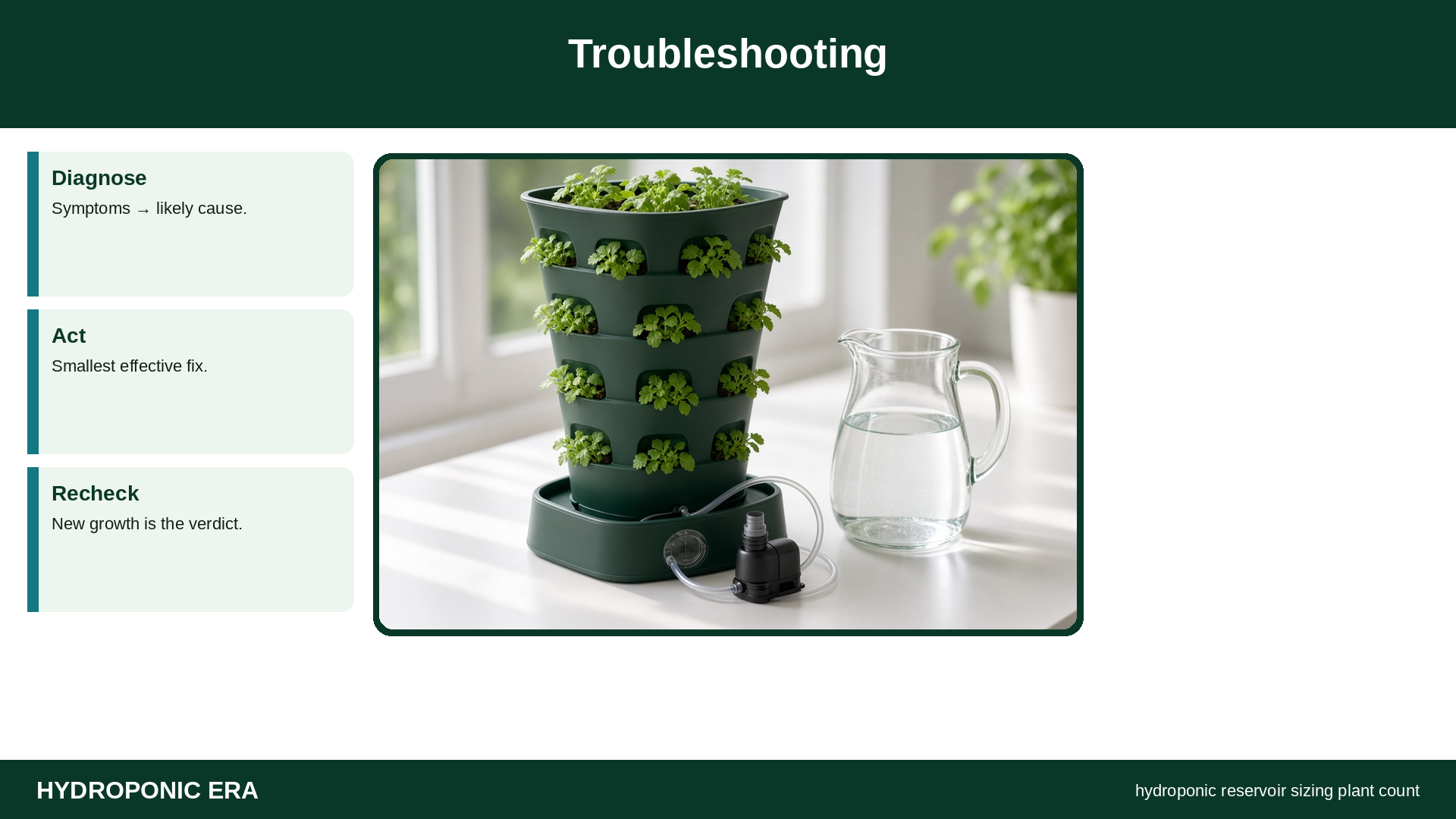
| Signal | Action |
|---|---|
| EC climbs every afternoon | Volume too small or light/heat high; top-off sooner; check climate |
| Pump whining / cavitation | Raise min line or lower intake; add volume |
| Wild pH with tiny swings in volume | More solution mass or more frequent management |
| Cool stable EC but slow growth | Not a volume issue—check light/nutrients |
Original Framework: Volume Card

Write: Sites × Class × Climate = Working liters + Freeboard + Top-off plan. Recalculate at transplant and at first flower.
Closing practice for hydroponic reservoir sizing plant count: if you cannot state yesterday’s top-off liters, you are flying blind.
What to Check Before You Buy or Fill a Reservoir
- Plant count current?
- Crop class noted?
- Min/max lines marked?
- Week of top-off data?
- Source water EC known?
- Pump intake below min line?
Measuring Real Uptake Instead of Guessing Gallons
Hydroponic reservoir sizing plant count math fails when you invent liters-per-plant from a forum. Mark the reservoir wall, run 48 hours without top-off if safe, and calculate disappearance. Fruiting canopies under strong LEDs drink differently than sparse lettuce. Hot rooms and windy fans raise transpiration; cool dim rooms shrink it.
Size for the thirsty week, not the average week. Include a reserve so pumps do not suck air if you miss a day. Auto top-off helps—but only if the source water quality matches your plan (ATO, EC).
Plant Count Versus Canopy Reality
Twelve tiny seedlings are not twelve mature tomatoes. Count effective canopy demand: leaf area and stage beat hole count. When upsizing, re-check pump duty and dissolved oxygen—larger volumes change thermal mass and oxygen management (DO, res temp). Write the sizing assumptions on the lid so future expansions do not inherit myths.
Hydroponic Reservoir Sizing Plant Count: Worked Mini-Example
Suppose twelve fruiting peppers under strong LEDs drink roughly a measured 6 liters in 48 hours in your room. That is 3 L/day system demand—not “0.5 L per plant forever.” Size the reservoir so two days of forgetfulness still leave pump intake covered, then add margin for heat waves. Recheck after canopy fills in; demand rises with leaf area.
Small tanks swing EC and temperature faster (res temp, top-off vs changes). Larger tanks forgive schedule slips but need sanitation discipline. Pick based on your real attendance pattern, not catalog aesthetics.
FAQs about daily water use reservoir sizing

Is there a universal liters-per-plant number?
No trustworthy universal number—measure your room’s top-offs.
Bigger always better?
Not if you never sanitize and solution ages poorly.
Kratky jars vs shared tote?
Jars size per plant; shared totes need freeboard and access.
Does ATO replace volume planning?
No—ATO stabilizes level; you still choose sensible working volume.
Fruiting vs leafy?
Fruiting usually needs more buffer volume per site.
When to upsize?
When daily top-offs are large fractions of total volume or EC swings hard.
Extended Home-Grower Walkthrough
Use this extended walkthrough as a second pass after the Quick Answer. Walk the system with a notebook: write the date, crop, EC, pH, reservoir temperature, and one observation about roots or leaves. Change only one control at a time when a problem appears. If last week’s fix did not show in new growth, revert and try the next smallest lever. Keep university and extension principles in mind—oxygen, sanitation, and measured nutrition beat product stacking.
Photograph the canopy and the reservoir surface weekly. Dated photos settle arguments about algae, tip burn, or stretch faster than memory. When a helper waters for you, leave a one-page card with do-not-touch items and the exact top-off rule. Store calibration sachets next to the meters so “I will calibrate later” stops being the default. Review timers after any power event. Confirm air stones still roar. Confirm drains still drain.
At the end of the week, score the cycle 1–5 for ease and plant quality. Low scores should trigger a sanitation or climate review before you buy new hardware. Link neighboring HydroponicEra guides when the symptom matches a cluster page. Prefer labeled procedures over improvisation under stress. Healthy boring routines are the real upgrade path for home hydroponics.
Keep daily water use reservoir sizing on your ops card so helpers follow one standard.
Keep daily water use reservoir sizing on your ops card so helpers follow one standard.
Keep daily water use reservoir sizing on your ops card so helpers follow one standard.
Keep daily water use reservoir sizing on your ops card so helpers follow one standard.
Keep daily water use reservoir sizing on your ops card so helpers follow one standard.
Keep daily water use reservoir sizing on your ops card so helpers follow one standard.
Review daily water use reservoir sizing whenever you change crop, climate, or water source.
Review daily water use reservoir sizing whenever you change crop, climate, or water source.
Review daily water use reservoir sizing whenever you change crop, climate, or water source.
Review daily water use reservoir sizing whenever you change crop, climate, or water source.
Review daily water use reservoir sizing whenever you change crop, climate, or water source.
Review daily water use reservoir sizing whenever you change crop, climate, or water source.
Sources
- Oklahoma State University Extension — Electrical Conductivity and pH Guide for Hydroponics
- Oklahoma State University Extension — Hydroponics
- University of Florida IFAS — HS184: Building a Floating Hydroponic Garden
- University of Florida IFAS — HS1421: Growing Herbs in Small Hydroponic Systems
- Penn State Extension — Hydroponics Systems and Principles of Plant Nutrition
- Michigan State University Extension — Hydroponics as an agricultural production system
2 thoughts on “Daily Water Use and Reservoir Sizing by Plant Count”