
Here’s how to grow duckweed indoors: float a starter culture on dechlorinated water in a shallow, still container, add a very dilute nutrient solution, give it bright light, and harvest a portion every few days so it never covers more than the surface can support. Duckweed can double in as little as 3 days under ideal conditions. Grow it only in closed containers, never release it into ponds or streams, and use only clean, controlled cultures for feed or food.
| Factor | Starting point | Notes |
|---|---|---|
| Container | Shallow tub, tote or tray with a wide surface | Surface area matters more than depth |
| Water | Dechlorinated tap, rain or RO water | Still or very gently moving |
| Nutrients | Very dilute; one research system used EC 0.6 mS/cm | Far weaker than lettuce solution |
| Temperature | One research system held 24°C (about 75°F) | Room temperature works for many home cultures |
| Light | Bright window or LED; research used 50–150 µmol/m²/s | Growth rose with more light in that range |
| Harvest | Every few days, leaving a healthy mat | Overcrowded mats slow down |

What Is Duckweed (and Why Learn How to Grow Duckweed)?
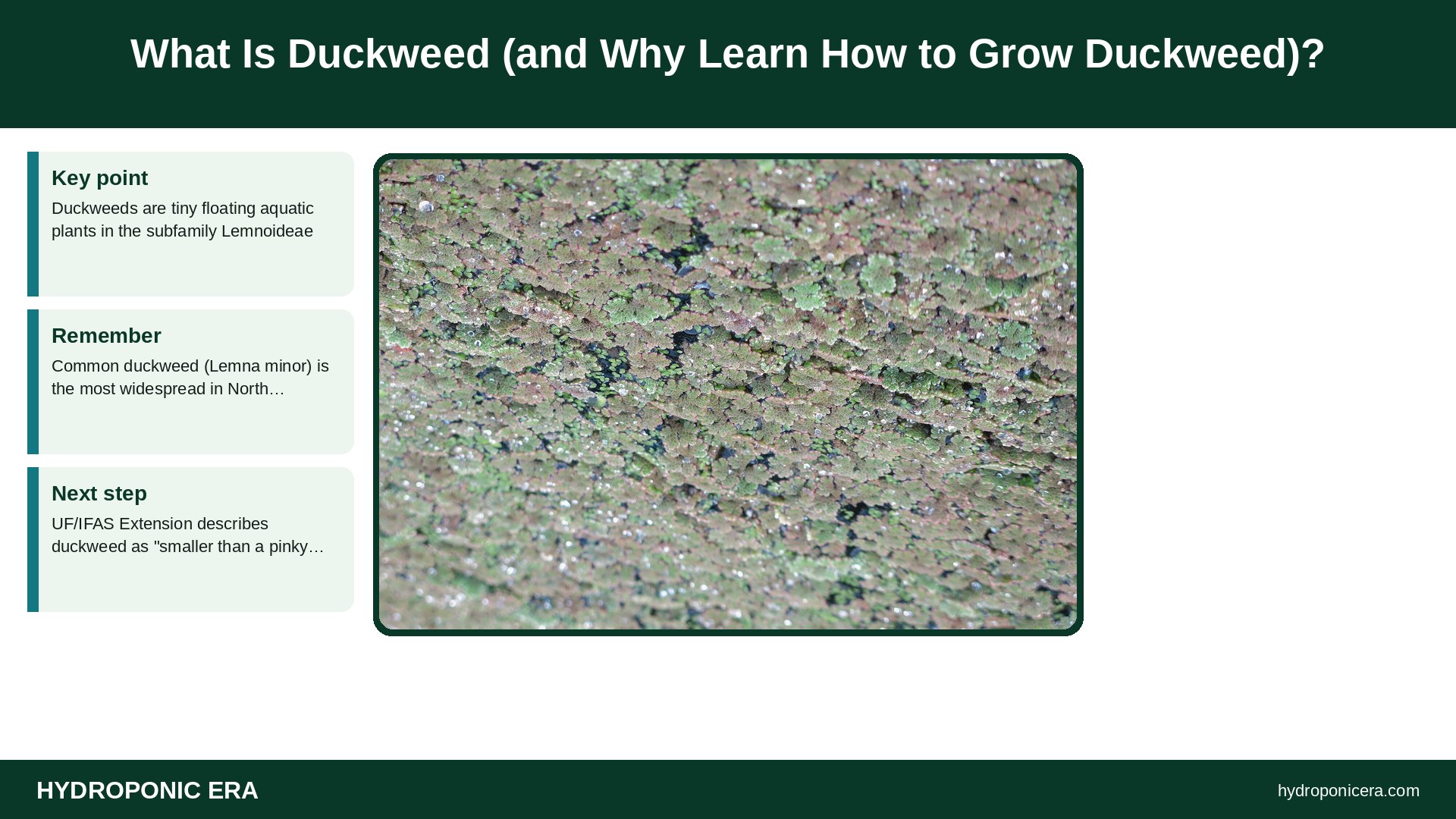
Duckweeds are tiny floating aquatic plants in the subfamily Lemnoideae. Common duckweed (Lemna minor) is the most widespread in North America, according to Texas A&M AgriLife Extension. UF/IFAS Extension describes duckweed as “smaller than a pinky fingernail” and notes it reproduces rapidly by budding. Watermeal (Wolffia), a close relative, holds the title of the world’s smallest flowering plant.
That speed is why people want to know how to grow duckweed: it’s a fast, protein-rich biomass used in research on animal feed, human food and wastewater treatment. It’s also why it can become a problem in the wrong place.
Safety First: 4 Rules Before You Learn How to Grow Duckweed
Read these before you buy a starter culture. Getting how to grow duckweed right starts with containment and clean water.
- Never release it. Texas A&M’s AquaPlant site warns that duckweed “can be very invasive in quiet, nutrient rich waters.” Mats can cover ponds, cut light and lower dissolved oxygen, which can lead to fish die-offs.
- Know your species. Texas A&M says dotted duckweed (Landoltia punctata) is non-native, invasive and “illegal to possess or transport in Texas.” Check your state’s rules before buying.
- Use clean cultures only. A 2023 review in Plants notes duckweeds absorb nitrogen, phosphorus, heavy metals and other pollutants, which is why they’re studied for cleaning wastewater. Never feed or eat duckweed collected from ponds, ditches or runoff.
- Dispose of extras safely. Compost surplus or bag it for the trash. Don’t dump water down storm drains or into waterways.
How to Grow Duckweed Indoors: 7 Steps
- Get a clean starter. Buy from a reputable aquarium or plant supplier, not from a wild pond. Rinse it and remove snails or debris.
- Pick a wide, shallow container. A storage tote, plant tray or aquarium works. Surface area determines how much you can grow.
- Prepare the water. Use dechlorinated tap water, rainwater or RO water. See our chlorine and chloramine guide.
- Add a very dilute nutrient. Duckweed is adapted to nutrient-rich ponds, but it doesn’t need lettuce-strength solution. A research vertical farm in Germany dosed nutrients to an EC of just 0.6 mS/cm. Check with an EC meter.
- Provide light. A bright window or LED fixture works. In the same study, growth increased as light rose from 50 to 150 µmol/m²/s. See our PPFD and DLI guide.
- Keep it still and comfortable. Duckweed prefers calm water. Avoid strong pump currents and big temperature swings.
- Harvest regularly. Skim off part of the mat with a fine net every few days, leaving enough to keep growing.
How to Grow Duckweed Outdoors (With Caution)
If you’re figuring out how to grow duckweed outdoors, a stock tank or kids’ pool works, but the risks rise. Mosquitoes can breed in still water, and a single storm overflow can release fronds into a ditch. Keep outdoor cultures covered with fine mesh, set them on a solid patio far from drains, and never place them next to natural water. In many climates, an indoor tote is safer and easier to control.
How to Grow Duckweed for Chickens and Other Animals
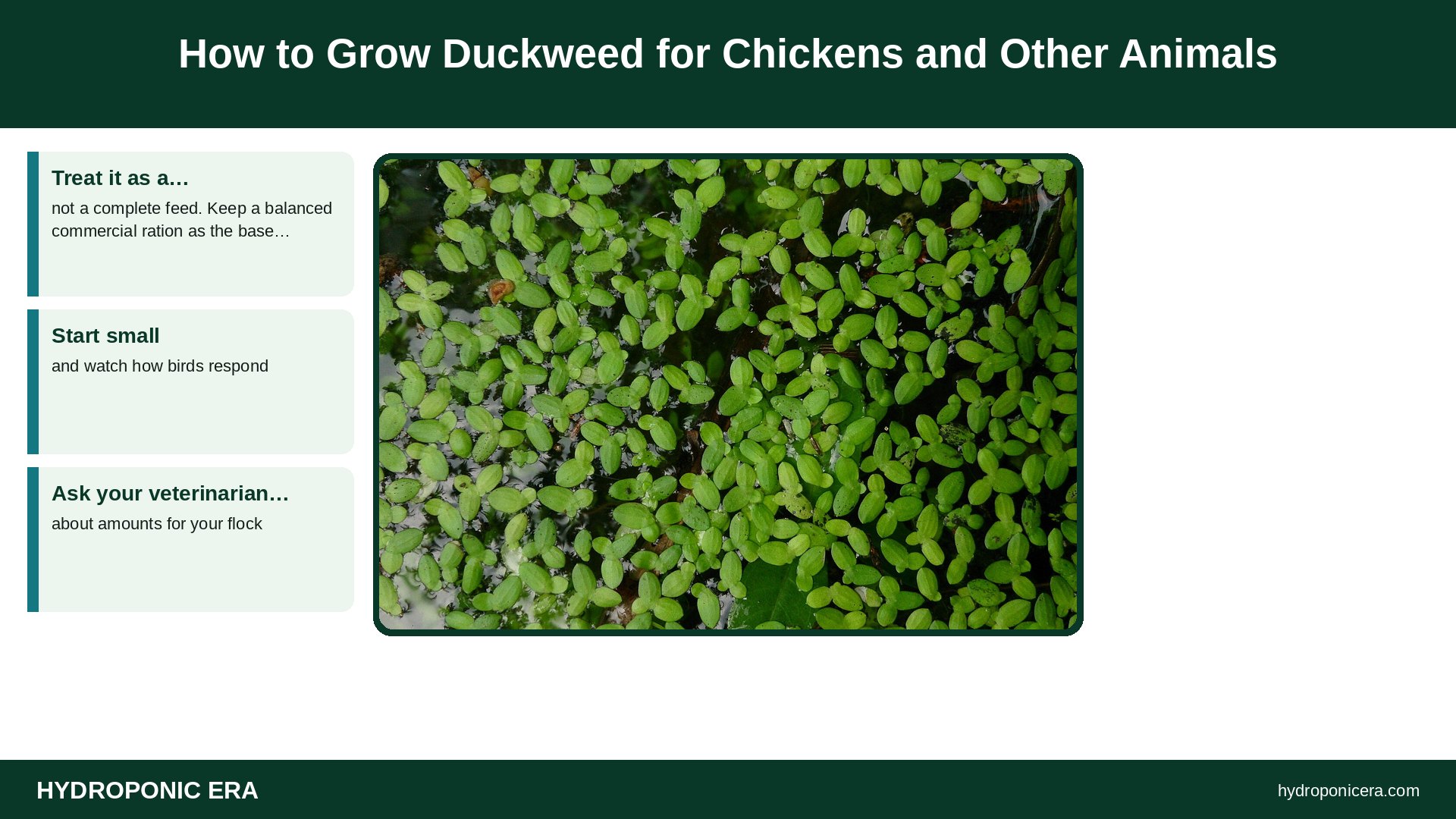
UF/IFAS Extension notes that in some areas duckweed “is harvested as a crop, and used as a nutrient-rich feed for livestock,” and the 2023 Plants review lists animal feed among its uses. Many backyard keepers offer fresh duckweed to chickens and ducks as a treat or supplement.
- Treat it as a supplement, not a complete feed. Keep a balanced commercial ration as the base diet.
- Start small and watch how birds respond.
- Feed only clean, home-grown duckweed.
- Ask your veterinarian or county extension office about amounts for your flock.
For another fresh-feed project, see our guide to hydroponic fodder for chickens and livestock.
Can People Eat Homegrown Duckweed?
Interest in how to grow duckweed for food is rising, so the regulatory details matter.
Duckweed has been studied as human food, and FDA has reviewed at least one commercial product. In 2018, FDA issued a “no questions” letter (GRN 742) on Parabel’s conclusion that its duckweed protein powder and degreened duckweed powder are GRAS (generally recognized as safe) for use as a protein source in foods at 3–20%. FDA noted the letter is “not an affirmation” of GRAS status.
That applies to a specific processed product under its intended conditions of use. It’s not approval for homegrown duckweed. A separate notice for a Wolffia globosa product (GRN 984) was closed in 2021 after FDA “ceased to evaluate” it at the company’s request. If you’re considering eating duckweed, talk with a qualified health professional and only use clean, controlled cultures.
Common Problems When Learning How to Grow Duckweed
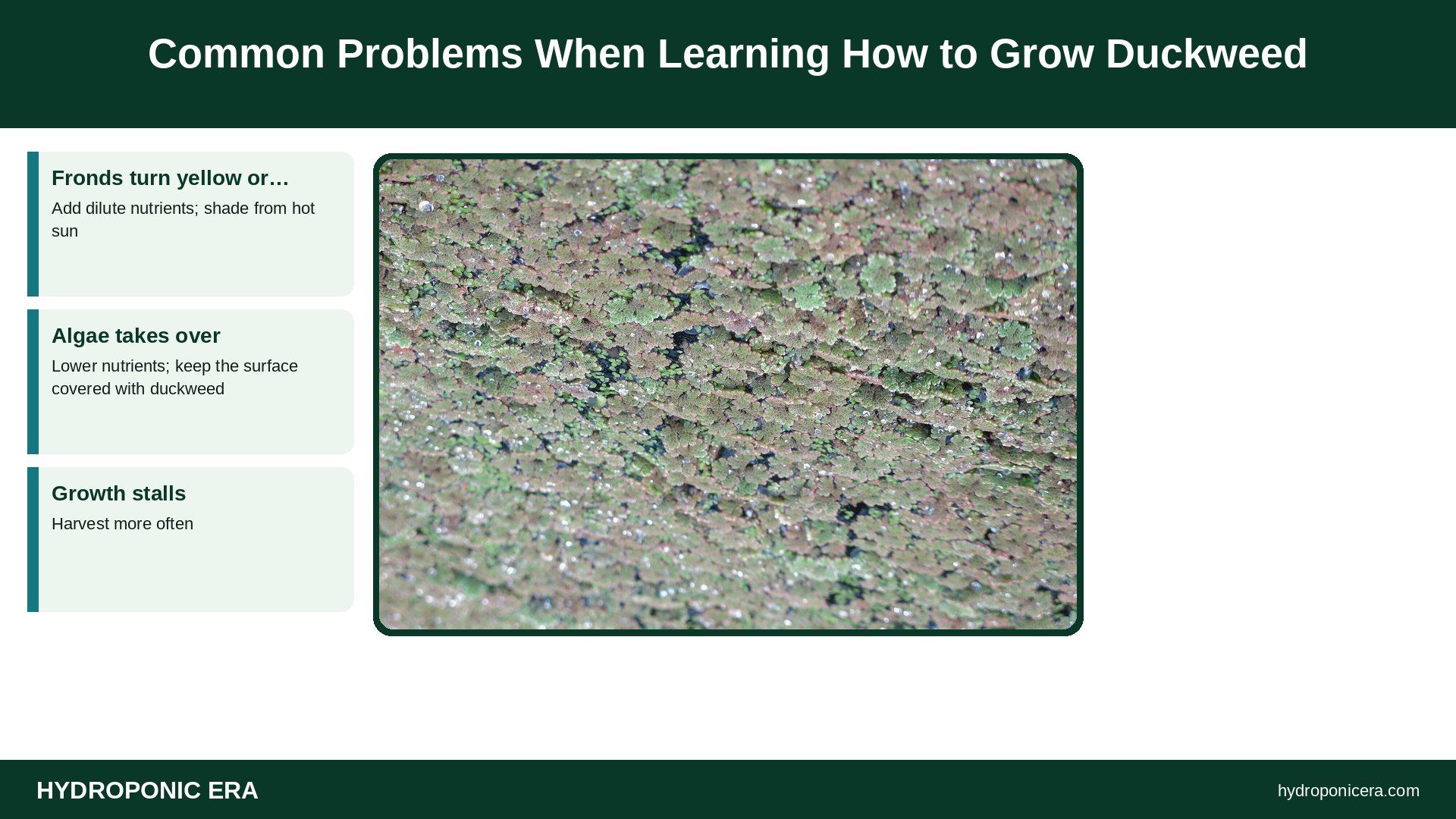
Most issues with how to grow duckweed come from overcrowding, too-strong nutrients or dirty water.
| Problem | Likely cause | Fix |
|---|---|---|
| Fronds turn yellow or white | Too few nutrients, or too much direct heat | Add dilute nutrients; shade from hot sun |
| Algae takes over | Too many nutrients and strong light with open water | Lower nutrients; keep the surface covered with duckweed |
| Growth stalls | Overcrowding | Harvest more often |
| Mosquito larvae | Still water outdoors | Keep cultures indoors or covered; change water |
| Culture dies off | Chlorinated water or a sudden temperature swing | Dechlorinate; keep away from heaters and cold drafts |
FAQs: How to Grow Duckweed
How fast does duckweed grow?
Texas A&M says populations can double in as little as 3 days in ideal conditions.
Do you need fertilizer when you grow duckweed?
It needs some nutrients, but very little. Start dilute and increase slowly if fronds pale.
Can I grow duckweed in my aquarium?
Yes, many aquarists do, but it can cover the surface quickly. Remove extra regularly.
Is it legal to grow duckweed everywhere?
Common native species are widely sold, but some species are restricted. Dotted duckweed is illegal to possess in Texas. Check your state’s invasive species list.
Related HydroponicEra Guides
- Plants that grow in water
- How to grow water spinach
- How to grow watercress hydroponically
- Controlled environment agriculture
Sources
- Texas A&M AgriLife Extension — Duckweed and Watermeal (EWF-037, PDF)
- Texas A&M AquaPlant — Duckweed management options
- UF/IFAS Extension Escambia County — Weekly “What is it?”: Duckweed
- Zhou et al. (2023), Plants — Duckweeds for Phytoremediation of Polluted Water
- Petersen et al. (2022), Plants — Influence of Light Intensity and Spectrum on Duckweed Growth and Proteins in an Indoor Vertical Farm
- US FDA — GRN 742 response letter (duckweed powder)
- US FDA — GRAS Notice Inventory: GRN 984 (Wolffia globosa)
- Photo credits (Wikimedia Commons, edited with titles): Common Duckweed (Lemna minor) by Mokkie (CC BY-SA 3.0); Floating duckweed by BeanieAll (CC BY-SA 4.0); Backyard chickens by Isalinky (CC BY-SA 4.0)