
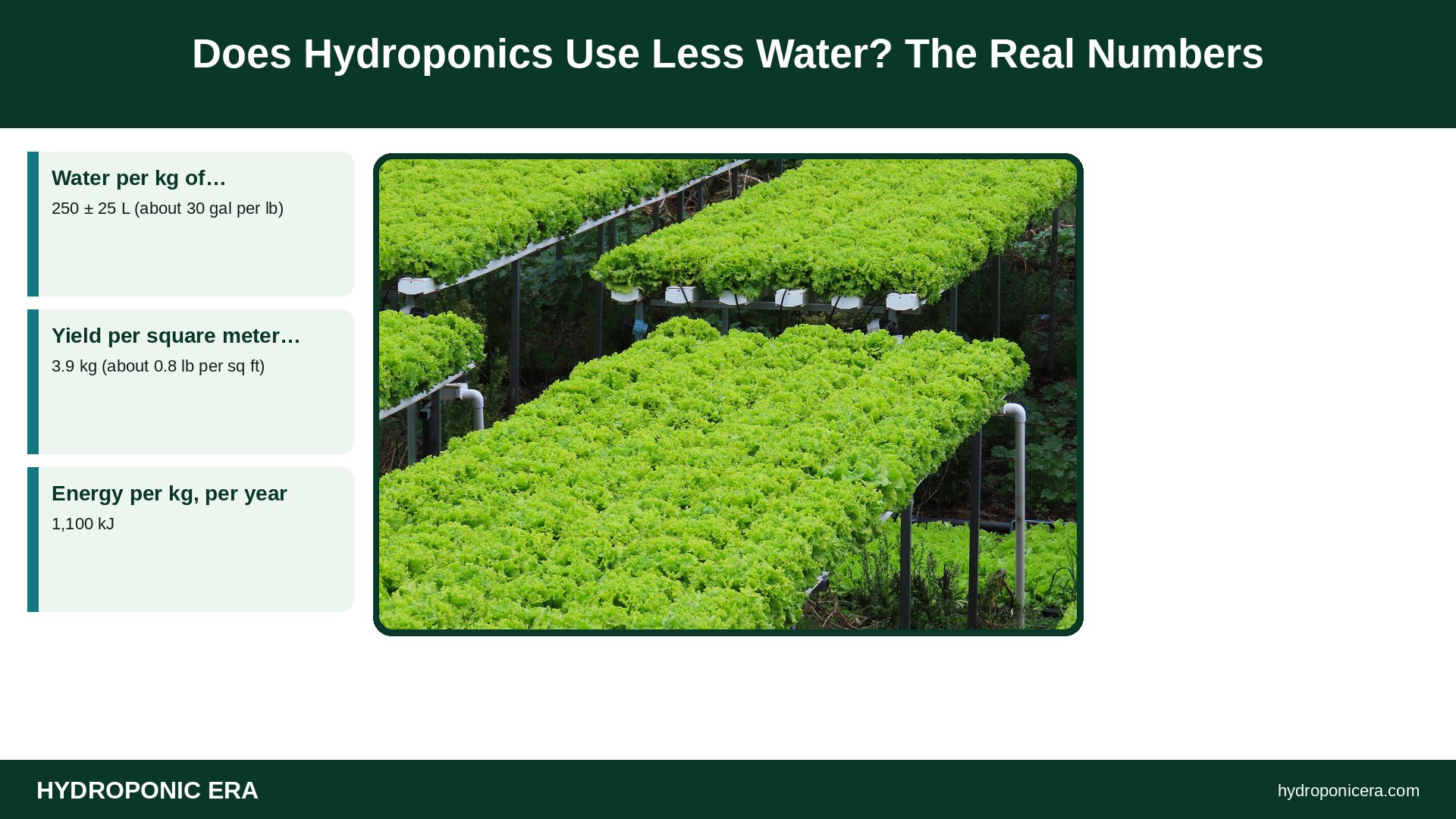
Does hydroponics use less water? Yes, per pound of food, a well-run recirculating system usually does. The best-known US comparison, a 2015 study of lettuce in Yuma, Arizona, modeled about 20 liters of water per kilogram for greenhouse hydroponics versus about 250 liters per kilogram for field lettuce. That’s roughly 13 times less water per unit of harvest. The catch is energy: the same study estimated hydroponic lettuce needed about 82 times more energy per kilogram.
| Measure (Yuma, AZ lettuce, modeled) | Hydroponic greenhouse | Conventional field |
|---|---|---|
| Water per kg of lettuce, per year | 20 ± 3.8 L (about 2.4 gal per lb) | 250 ± 25 L (about 30 gal per lb) |
| Yield per square meter, per year | 41 kg (about 8.4 lb per sq ft) | 3.9 kg (about 0.8 lb per sq ft) |
| Energy per kg, per year | 90,000 kJ | 1,100 kJ |
| Main reason for the difference | Water recirculates; little runoff or evaporation from soil | Evaporation, runoff and deep drainage |
Does Hydroponics Use Less Water Than Soil Farming?
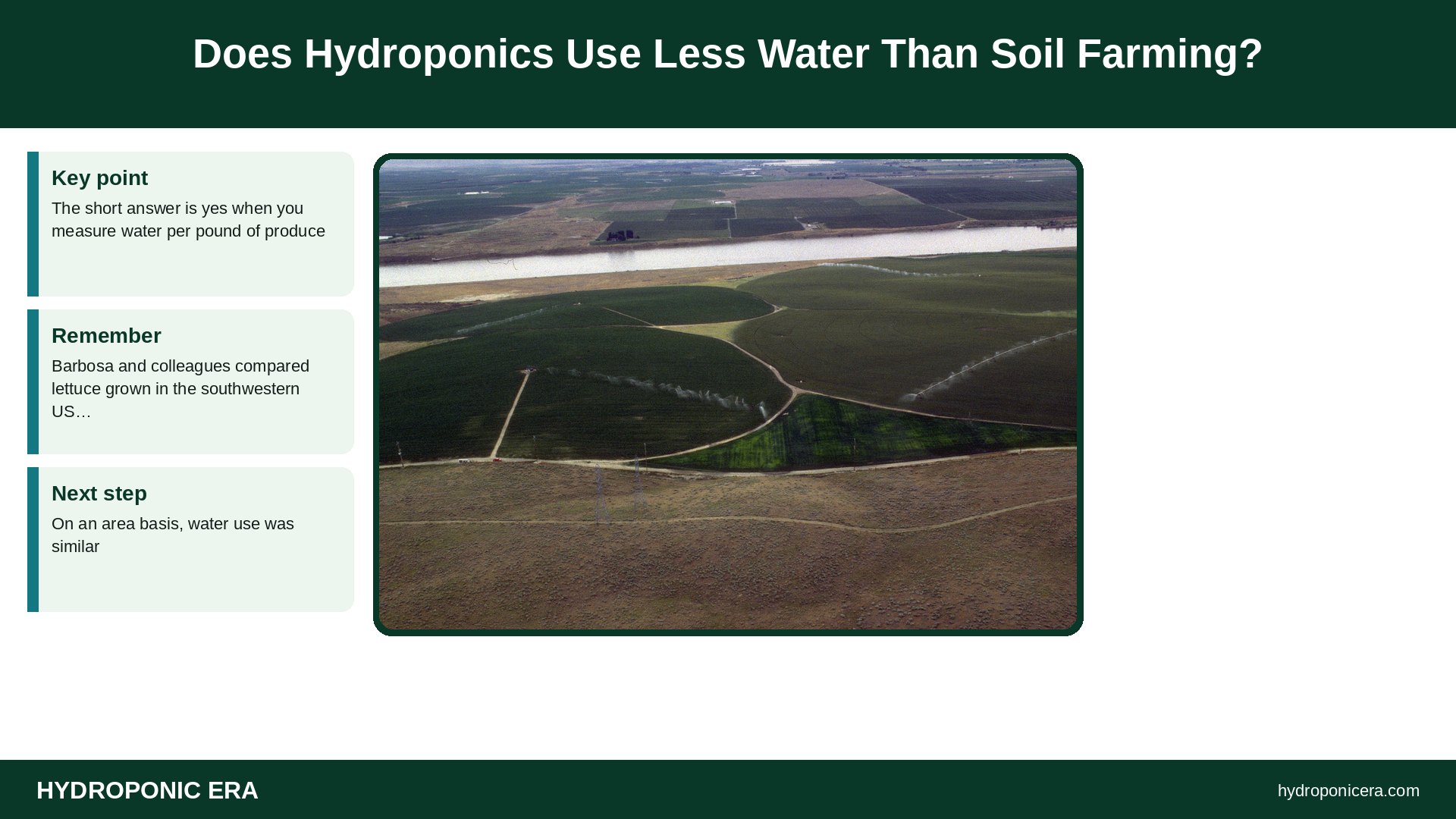
The short answer is yes when you measure water per pound of produce. Barbosa and colleagues compared lettuce grown in the southwestern US using crop budgets and USDA statistics for field production, and engineering equations for a hydroponic greenhouse. On an area basis, water use was similar. Once they divided by yield, hydroponics came out about 13 times more water-efficient, because the greenhouse grew roughly 11 times more lettuce per square meter.
Keep in mind what kind of number this is. The hydroponic figure is modeled, not measured on a working farm, and it assumes a 10% allowance for flushing nutrient solution. Real farms can do better or worse depending on design, climate and management.
Why Recirculating Systems Save Water
Recirculation is the core reason the answer to “does hydroponics use less water” is usually yes. In a field, a lot of irrigation water never reaches a plant. It evaporates from bare soil, runs off, or drains below the roots. In a closed hydroponic loop, the nutrient solution returns to the reservoir, so nearly all the water that leaves the system goes out through the leaves as transpiration.
- No bare soil. Covered reservoirs and channels lose very little to evaporation.
- Little runoff. Solution is caught and reused instead of soaking past the root zone.
- Dense planting. More plants per square foot means more food per gallon transpired.
- Precise feeding. Growers top off and adjust instead of over-watering to be safe.
That’s why the honest answer to “does hydroponics use less water” depends on the system. A recirculating NFT or deep water culture setup saves the most. A drain-to-waste drip system can still be efficient, but it sends some water out with every irrigation.
When Does Hydroponics Use Less Water, and When Not?
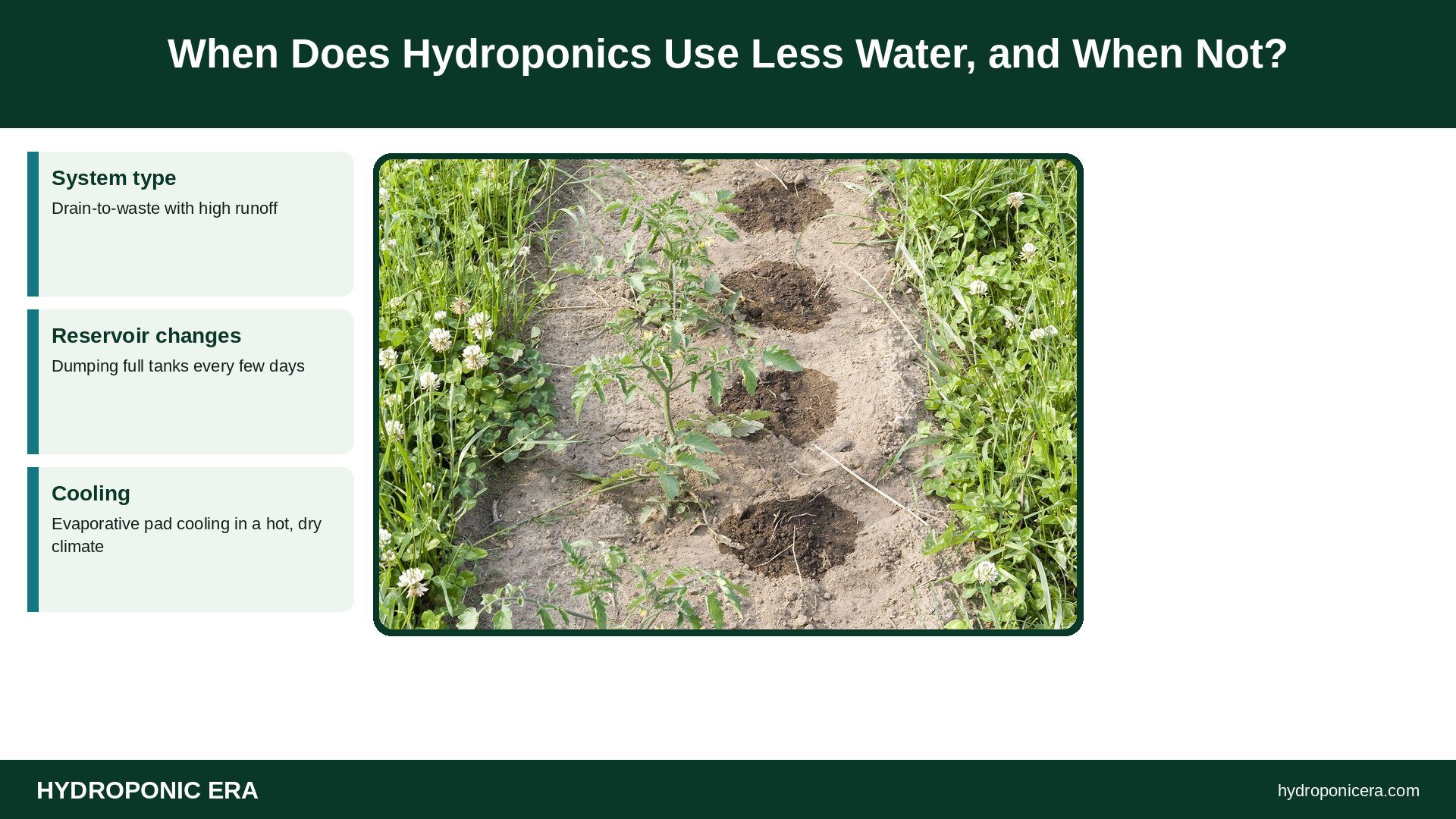
The savings shrink or disappear in a few situations. Use this checklist before you assume your setup is water-thrifty:
| Factor | Saves water | Wastes water |
|---|---|---|
| System type | Recirculating (NFT, DWC, ebb and flow) | Drain-to-waste with high runoff |
| Reservoir changes | Top off and change on a schedule | Dumping full tanks every few days |
| Cooling | Shade, ventilation, efficient cooling | Evaporative pad cooling in a hot, dry climate |
| Leaks and overflows | Checked daily | Unnoticed drips and spills |
| Crop choice | Fast leafy greens and herbs | Long crops with heavy flushing |
Greenhouse cooling is the big hidden user. The Barbosa estimate covered plant water needs and flushing; it didn’t count water used by evaporative coolers, which can be large in desert summers.
The Energy Trade-Off
Water is only half the story. The Arizona study found hydroponic lettuce used about 82 times more energy per kilogram, mostly for heating, cooling and lighting. The authors said energy availability is a major factor in whether hydroponics is sustainable, and pointed to water-scarce places with plenty of renewable power as the best fit.
So does hydroponics use less water and still come out greener overall? Not automatically. The fair answer is: it uses far less water and land per pound, but it can cost far more electricity. For home growers, that mostly means grow lights. Our electricity cost framework helps you estimate your own bill.
Does Hydroponics Use Less Water at Home?
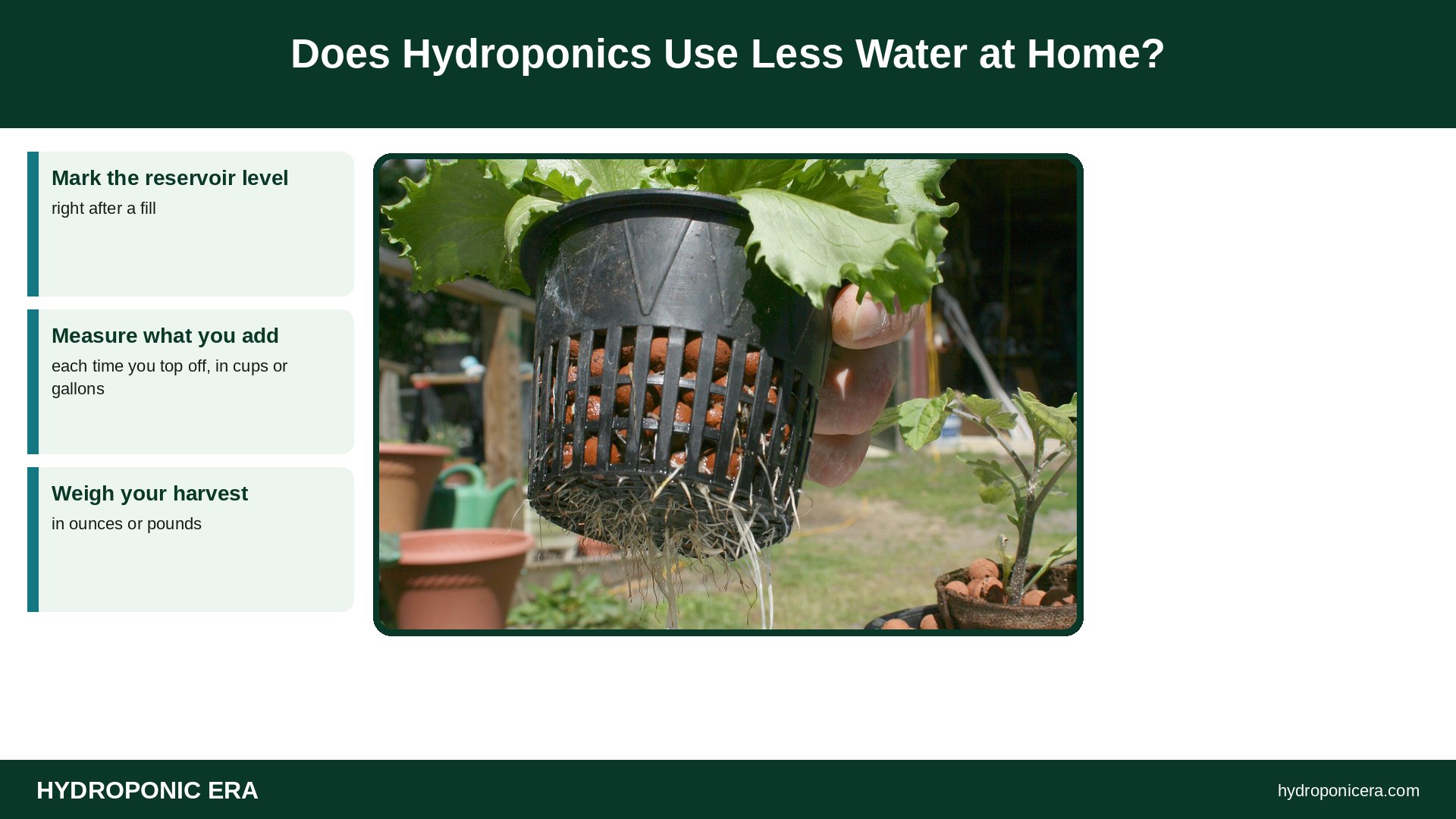
At home, the scale is tiny, but the same logic applies, so does hydroponics use less water on a windowsill too? Usually, yes. A small lettuce tower or deep water culture tote loses water mainly through the leaves. You can track it yourself:
- Mark the reservoir level right after a fill.
- Measure what you add each time you top off, in cups or gallons.
- Weigh your harvest in ounces or pounds.
- Divide gallons used by pounds harvested for your own water-per-pound number.
- Count reservoir changes too, since dumped solution is water used.
After one crop cycle, you’ll have your own answer to does hydroponics use less water in your home. That’s real data instead of a borrowed statistic. Our guide to daily water use and reservoir sizing shows typical top-off patterns, and the Kratky method is one of the lowest-water setups because it has no pump and no runoff at all.
Why It Matters in the US
Irrigation is a huge share of US water use. The USGS estimates that about 110,904 million gallons per day were withdrawn for crop irrigation across the lower 48 states in 2020, and roughly 72% of irrigation withdrawals are consumptive, meaning the water doesn’t return to local rivers or aquifers. In dry regions like the Southwest, that’s why growers and researchers keep asking: does hydroponics use less water for leafy greens? For lettuce and herbs, the evidence says it can.
Does hydroponics use less water than field farming for everything? No. It won’t replace field farming for grains or most staple crops. Hydroponics fits best for high-value, fast crops such as lettuce, herbs, tomatoes and strawberries. See our hydroponics vs soil comparison for the full picture.
Common Mistakes That Waste Water

Habits matter as much as hardware. Does hydroponics use less water if you dump a full tank every few days? Not by much.
- Changing reservoirs too often. Follow a schedule based on EC and plant stage, not habit.
- Running uncovered tanks. Lids cut evaporation and algae.
- Ignoring small leaks. A slow drip can waste more than your plants drink.
- Overflowing trays. Check timer settings on ebb and flow systems.
- Pouring old solution down the drain. Reuse it on lawns or landscape beds where local rules allow.
FAQs: Does Hydroponics Use Less Water?
How much less water does hydroponics use?
In the best-known US study, modeled hydroponic lettuce used about 13 times less water per kilogram than field lettuce in Arizona. Other crops and climates will differ.
Does hydroponics use less water than drip irrigation in soil?
Often, but the gap is smaller. Drip already cuts evaporation and runoff, so a recirculating system mainly wins by reusing solution and growing more per square foot.
Does hydroponics use less water for every crop?
No. The strongest data is for leafy greens. Long-season or bulky crops gain less, and some aren’t practical in hydroponics at all.
Does hydroponics use more energy?
Usually yes, especially indoors or in heated greenhouses. The Arizona study estimated about 82 times more energy per kilogram of lettuce.
Is hydroponics good for drought areas?
It can be for leafy greens and herbs, especially with renewable power. It isn’t a fix for staple field crops.
Related HydroponicEra Guides
- Hydroponics vs soil
- Daily water use and reservoir sizing
- Recirculating vs drain-to-waste hydroponics
- Controlled environment agriculture, explained
Sources
- Barbosa et al., 2015 (Int. J. Environ. Res. Public Health) — Comparison of Land, Water, and Energy Requirements of Lettuce Grown Using Hydroponic vs. Conventional Agricultural Methods
- USGS — Irrigation Water Use
- USDA ERS — Irrigation and Water Use
- Congressional Research Service — Controlled Environment Agriculture (CEA) Production (PDF)
- Photo credits (Wikimedia Commons, edited with titles): Hydroponic lettuce @ Plaine des Cafres 03 by Rémih (CC BY-SA 4.0); Center pivot irrigation Idaho by Bob Heims, U.S. Army Corps of Engineers (Public domain); Drip irrigation (2552390830) by Dwight Sipler from Stow, MA, USA (CC BY 2.0); 2009-03-30 Lettuce roots by Ildar Sagdejev (Specious) (CC BY-SA 4.0)