
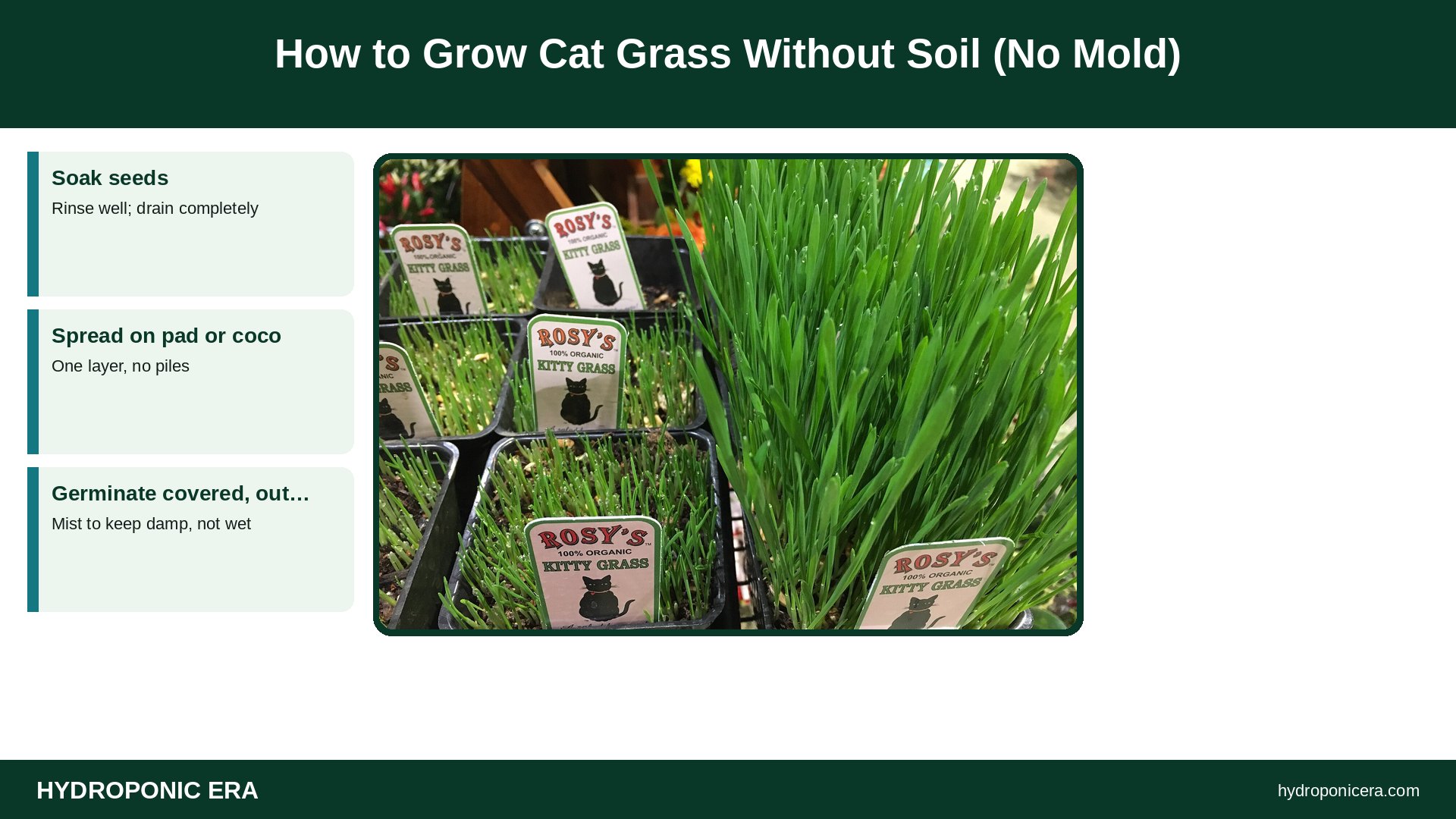
Here’s how to grow cat grass without soil: soak oat, wheat, barley or rye seeds, spread them in a single layer on a damp soilless pad or coco coir in a draining tray, keep them moist but never waterlogged, and give them bright light once they sprout. Sprouts appear in about 3–7 days, and grass is ready in 10–14 days at about 4 inches tall. Most mold comes from too much water and poor airflow. Offer it in moderation, and ask your vet if your cat has health issues.
| Step | Timing | Key tip |
|---|---|---|
| Soak seeds | Several hours (optional) | Rinse well; drain completely |
| Spread on pad or coco | Day 0 | One layer, no piles |
| Germinate covered, out of direct sun | Days 1–7 | Mist to keep damp, not wet |
| Move to bright light | Once sprouted | Uncover for airflow |
| Ready to offer | Days 10–14 (about 4 inches) | Lasts up to about 3 weeks |
| Replant | Every 7 days | Rotate pots for a steady supply |
Timing from VCA Animal Hospitals’ cat grass guide.
What Is Cat Grass?

“Cat grass isn’t any one type of grass but can be a combination of grasses, such as rye, barley, oat, and wheat,” says Dr. Lori Teller of the Texas A&M College of Veterinary Medicine & Biomedical Sciences. It’s simply young cereal grass grown indoors for cats to nibble. Learning how to grow cat grass takes about two weeks from seed to a nibble-ready pot.
Teller also notes cat grass “is not a required part of a cat’s diet” if the cat eats a complete, balanced food. Many cats just enjoy chewing it. VCA adds that cats like chewing on grass and that it provides entertainment.
Safety First: What to Know Before You Grow Cat Grass
Learning how to grow cat grass is easy. Using it sensibly matters more.
- Moderation: VCA says cats can’t digest large amounts of grass. Overeating can cause vomiting, and the insoluble fiber can potentially build up and cause a blockage.
- Treat limit: VCA’s rule of thumb is that treats of any kind, including grass, should be no more than 10% of a cat’s daily calories.
- Ask your vet: Teller says that if a cat eats grass “voraciously,” it may be worth consulting your veterinarian about its diet.
- Keep toxic plants away: Cornell’s Feline Health Center warns that lilies are especially toxic to cats and can cause life-threatening kidney failure even in tiny amounts. Check plants with the ASPCA’s toxic and non-toxic plant list.
- Emergencies: if you think your cat ate something toxic, call your vet or the ASPCA Animal Poison Control Center at (888) 426-4435.
We don’t make health claims about cat grass. It’s an optional treat, not a remedy. This guide covers how to grow cat grass cleanly; your vet is the right person for questions about your cat’s diet.
How to Grow Cat Grass Without Soil: 7 Steps
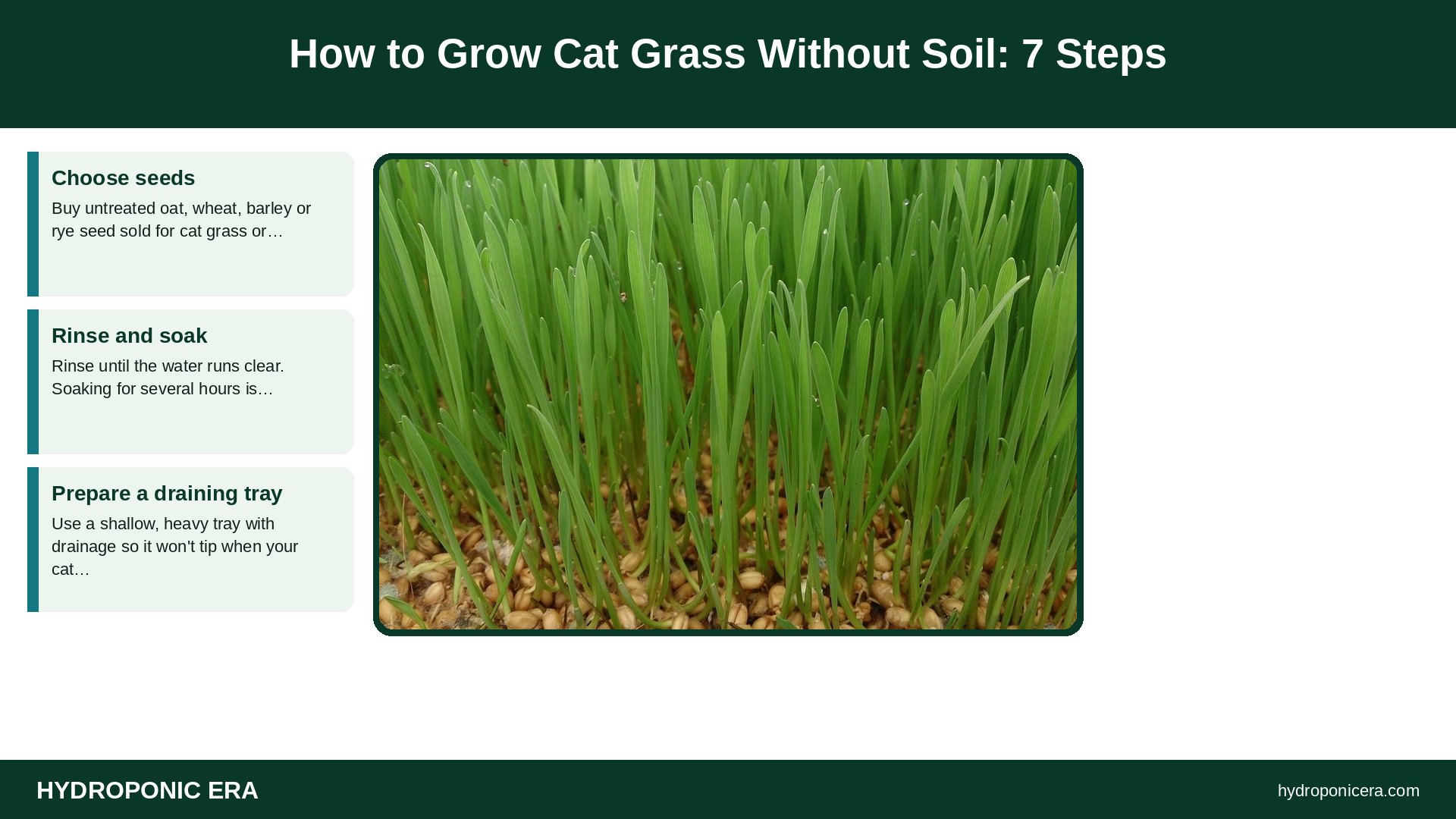
- Choose seeds. Buy untreated oat, wheat, barley or rye seed sold for cat grass or sprouting. Avoid seed treated with fungicides.
- Rinse and soak. Rinse until the water runs clear. Soaking for several hours is optional; VCA notes many gardeners plant straight from the packet.
- Prepare a draining tray. Use a shallow, heavy tray with drainage so it won’t tip when your cat paws at it. Line it with a hemp or jute grow mat, or a thin layer of coco coir.
- Spread seeds in one layer. Crowded, piled seeds hold water and mold first.
- Cover loosely and keep out of direct sun until sprouts appear in 3–7 days. Mist to keep seeds damp, and lift the cover daily for air.
- Move to bright light once sprouted. Remove the cover. A sunny window or small LED keeps blades green and upright.
- Water sparingly. VCA warns too much water may cause mold. Water when the mat or coco feels dry on top, and pour off any standing water.
How to Grow Cat Grass With No Mold
Mold is the top reason a batch fails. If you want to know how to grow cat grass that stays fresh, these habits matter most:
- Drain, don’t drown. Seeds sitting in a puddle rot fast.
- Thin the seeding. Space lets air reach every seed.
- Add airflow. A small fan on low, across the room, helps. See our humidity guide.
- Start clean. Wash trays with hot soapy water between batches.
- Know root hairs from mold. Fine white fuzz on young roots is usually normal root hairs; it disappears when misted. Fuzz on seeds and blades that smells musty is mold. Our white fuzz guide shows the difference.
- Toss moldy batches. Don’t offer moldy grass to your cat.
How to Grow Cat Grass: Soilless Options Compared
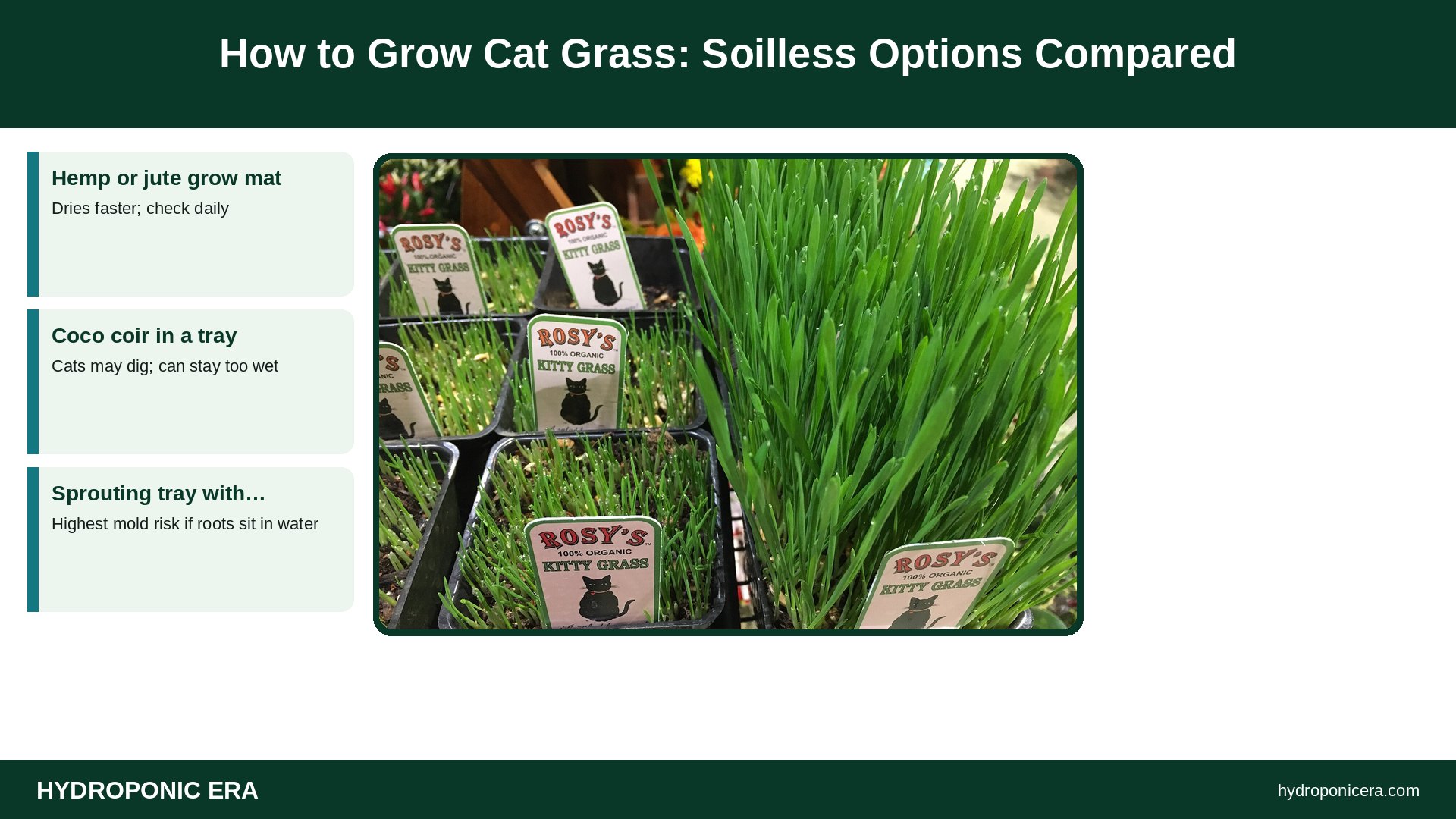
| Method | Pros | Cons |
|---|---|---|
| Hemp or jute grow mat | Clean, no loose media for cats to dig | Dries faster; check daily |
| Coco coir in a tray | Holds moisture evenly; roots anchor well | Cats may dig; can stay too wet |
| Sprouting tray with water reservoir | Easy watering | Highest mold risk if roots sit in water |
| Potting soil (for comparison) | Forgiving; VCA’s standard method | Messier indoors |
Coco is a natural fit if you already grow hydroponically; see our coco coir guide.
How to Grow Cat Grass Year-Round
Knowing how to grow cat grass year-round is mostly about timing. VCA says a crop lasts up to about three weeks. When blades wilt or yellow, pull out the old shoots. If your cat loves it, plant several pots about a week apart and rotate them. That way, there’s always a fresh tray and none sit long enough to get tired.
That rotation is the simplest answer to how to grow cat grass continuously: one tray sprouting, one maturing and one in use.
How to Grow Cat Grass vs Wheatgrass and Catnip

| Plant | What it is | Guide |
|---|---|---|
| Cat grass | Mix of young oat, wheat, barley or rye | This guide |
| Wheatgrass | Young wheat, usually grown for juicing | How to grow wheatgrass |
| Catnip | A mint-family herb (Nepeta cataria) | How to grow catnip indoors |
Common Mistakes When Learning How to Grow Cat Grass
- Sowing seeds three or four layers deep “for a thicker lawn.”
- Keeping the cover on after sprouting, which traps humidity.
- Using a light, tippy container that a curious cat knocks over.
- Leaving a tray in place after it yellows instead of replanting.
- Placing the tray next to houseplants that aren’t safe for cats.
FAQs: How to Grow Cat Grass
How long does it take to grow cat grass?
Sprouts emerge in about 3–7 days, and the grass is ready in 10–14 days or at about 4 inches tall, according to VCA.
Why is my cat grass moldy?
Usually too much water, too many seeds or too little airflow. Drain trays, seed thinner and uncover once sprouted.
Do I need fertilizer to grow cat grass?
No. The seed holds enough energy for a short crop. Skip fertilizers and additives on anything your cat will eat.
Is cat grass safe for all cats?
In moderation it’s generally fine for healthy cats, but ask your vet if your cat has digestive issues or eats it constantly.
Related HydroponicEra Guides
- How to grow sprouts in a jar
- How to grow microgreens hydroponically
- Hydroponic fodder for chickens and livestock
- How to grow duckweed
Sources
- Texas A&M VMBS Pet Talk (Dr. Lori Teller) — Eating Your Greens: The Basics of Cat Grass
- VCA Animal Hospitals — Where the Green Grass Grows: Grass Treats for Cats
- ASPCA — Toxic and Non-Toxic Plant List: Cats
- ASPCA — Animal Poison Control
- Cornell Feline Health Center — Common Cat Hazards
- Photo credits (Wikimedia Commons, edited with titles): Dactylis glomerata 1 2017-12-18 by FASTILY (CC BY-SA 4.0); Oats dewdrop by Ross Berteig from Monrovia, California, USA (CC BY 2.0); Wheatgrass (Triticum aestivum) by Mokkie (CC BY-SA 3.0); Nepeta cataria, 2021-07-04, Bethel Park, 03 by Cbaile19 (CC0)