
Here’s how to grow sprouts in a jar safely: buy certified pathogen-free sprouting seed, sanitize the seed and jar, soak the seed overnight, then drain, cap with mesh and rinse at least three times a day. Sprouts are ready in 3–4 days at 1–2 inches. Raw sprouts carry real food-poisoning risk, so high-risk people should eat them cooked.
| Question | Quick answer |
|---|---|
| Seed | Certified pathogen-free seed sold for sprouting |
| Seed treatment | 3% hydrogen peroxide at 140°F for 5 minutes, or vinegar for 15 minutes |
| Soak | Overnight in 4 times the seed’s volume of lukewarm water |
| Rinse | At least 3 times a day or every 4 hours |
| Ready in | 3–4 days at room temperature, 1–2 inches long |
| Who shouldn’t eat them raw | Young children, older adults, pregnant women and anyone with a weakened immune system |
Are Homegrown Jar Sprouts Safe?

They can be safer if you follow a food-safety routine, but they’re never risk-free. UC Agriculture and Natural Resources (UC ANR) Publication 8151 says raw sprouts have been a significant source of Salmonella and E. coli O157:H7 illness in the U.S. since 1995, and that contaminated seed is the usual source.
The FDA explains that sprouts grow in warm, humid conditions that are also ideal for bacteria, so a few bacteria on a seed can multiply to high levels “even if you are growing your own sprouts under sanitary conditions at home.”
That’s why learning how to grow sprouts in a jar starts with safety, not just soaking. The FDA says children, older adults, pregnant women and people with weakened immune systems are especially vulnerable to foodborne illness, and that people who are more vulnerable to foodborne illness should avoid raw or lightly cooked sprouts of any kind. UC ANR says cooked sprouts can be eaten if heated to steaming hot or above 165°F.
What Do You Need?
The gear for how to grow sprouts in a jar is cheap and simple:
- Certified pathogen-free sprouting seed from a supplier that understands seed safety (Kansas State and University of Missouri Extension)
- A wide-mouth quart jar
- Cheesecloth or ¼-inch mesh screening and a band, or a mesh sprouting lid
- 3% hydrogen peroxide and a cooking thermometer, or plain store-bought vinegar
- Unscented bleach for sanitizing
- A pan or bowl to hold the jar tilted upside down
How to Grow Sprouts in a Jar Step by Step

Here’s how to grow sprouts in a jar the way extension food-safety specialists recommend. These 10 steps follow the Kansas State/University of Missouri Extension fact sheet, which draws on UC ANR 8151.
- Buy safe seed. Choose seed specified as certified pathogen-free.
- Treat the seed. Heat 3% hydrogen peroxide to 140°F, immerse the seed in a mesh strainer for 5 minutes and swirl every minute. Discard the peroxide after each batch. Or soak the seed in undiluted vinegar for 15 minutes.
- Rinse and skim. Rinse in running tap water for 1 minute. Cover with water plus 1 inch and skim off floating seeds, hulls and debris.
- Sanitize the jar. Soak the clean jar in ¾ cup bleach per gallon of water (3 tablespoons per quart) for at least 5 minutes, then rinse. Or boil it for 10 minutes. Boil the cheesecloth or mesh too.
- Soak overnight. Cover the seed with four times its volume of lukewarm drinking water.
- Drain and rinse. Pour off the water, rinse thoroughly and drain.
- Cap with mesh. Cover the jar with cheesecloth or ¼-inch mesh and tie it securely.
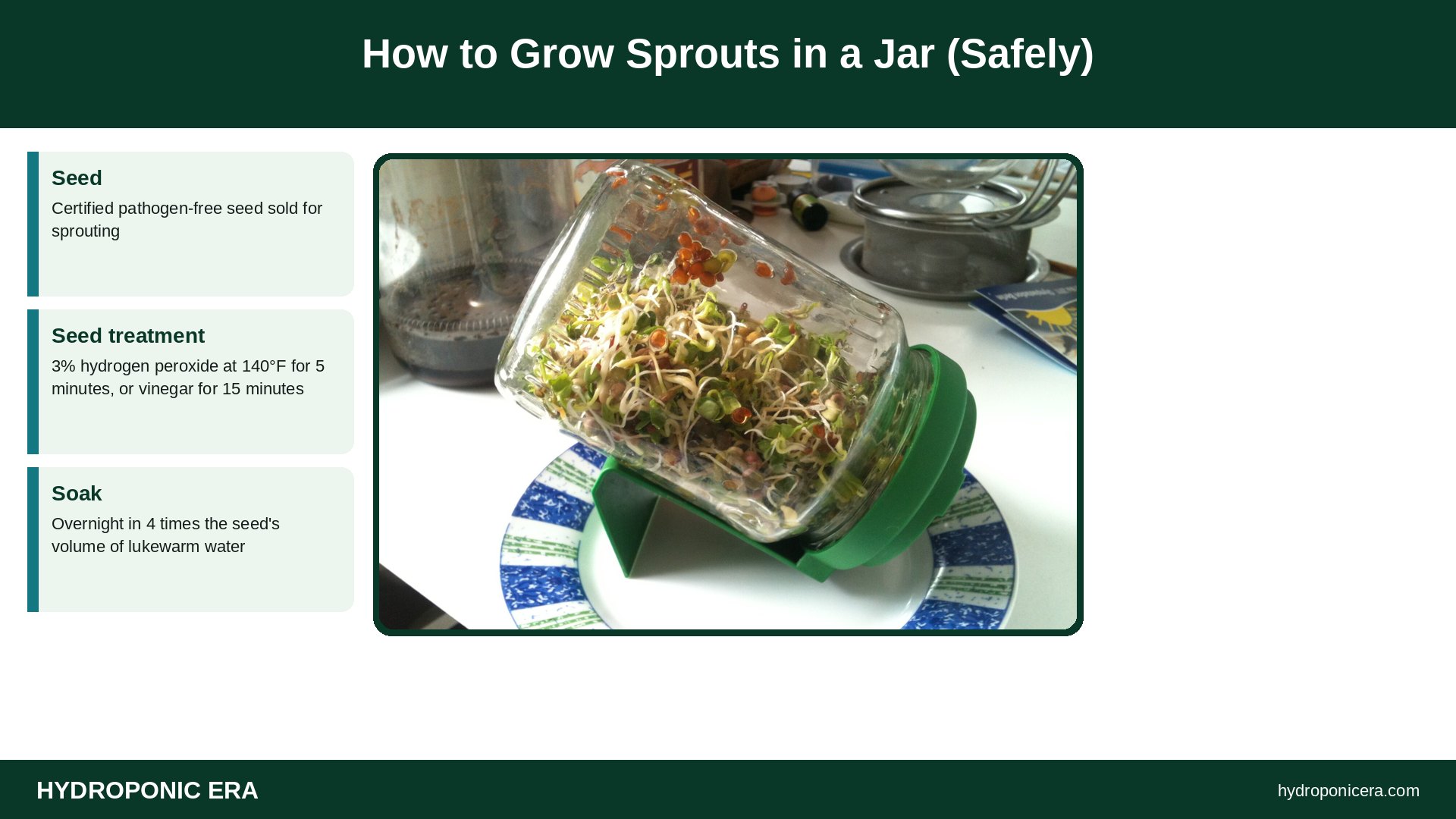
- Invert and tilt. Set the jar upside down at a slight angle in a pan in a cupboard or dark place so water drains away.
- Rinse often. At least three times a day or every four hours, flush with plenty of cool water, then return the jar to its tilted position.
- Harvest. In 3–4 days at room temperature, sprouts are 1–2 inches long. Pour them into clean, cold water and shuck off the skins.
That’s the full method for how to grow sprouts in a jar. Clean hands, surfaces and utensils at every rinse matter as much as the steps themselves.
Where Should You Keep the Jar?

Kansas State/MU advises sprouting well away from food preparation areas, pets and high household traffic. Keep the jar in a cupboard or dark place at room temperature. The fact sheet also warns it’s not wise to sprout in summer unless the room can be kept at about 70°F, since warmth speeds bacterial growth. Room location is an easy part of how to grow sprouts in a jar to get right.
Which Seeds Can You Sprout in a Jar?
| Seed | Notes |
|---|---|
| Mung bean | Classic stir-fry sprout; UC ANR notes cooking is most practical for mung bean sprouts |
| Alfalfa, clover | Fine, mild sprouts; among those most often linked to outbreaks (UC ANR) |
| Radish, onion | Spicy sprouts; FDA lists these among sprouts vulnerable people should avoid raw |
UC ANR notes the seed-treatment method that works for one seed type may not work as well for another, because seed surfaces differ. Kansas State/MU suggests testing germination on a small amount of seed before treating a big batch. Whatever seed you choose, how to grow sprouts in a jar follows the same safe routine.
What Mistakes Happen When You Grow Sprouts in a Jar?

| Mistake | Risk | Fix |
|---|---|---|
| Garden or grocery seed not meant for sprouting | Contaminated seed | Certified pathogen-free sprouting seed |
| Skipping seed treatment | Bacteria multiply during sprouting | Peroxide at 140°F or vinegar soak |
| Not skimming floaters | Debris tied to most contamination (UC ANR) | Skim after the rinse |
| Rinsing once a day | Mold and bacterial growth | At least 3 times a day |
| Jar not draining | Standing water, spoilage | Invert and tilt in a pan |
| Warm summer room | Faster bacterial growth | Sprout only if the room stays near 70°F |
If you want greens with lower risk, try microgreens instead. Penn State Extension says microgreens carry slightly lower risks than sprouts, partly because they’re exposed to light, while sprouts are harvested with seeds attached and are often grown in water. See hydroponic microgreens.
Can You Sell Jar Sprouts?
Not casually. Kansas State/MU notes that in Kansas and Missouri, a license is required to sell sprouts, even direct to consumers or in small quantities, and growers must attend Sprout Safety Alliance training. The same fact sheet notes seed treatment is a requirement for commercial sprout growers. Knowing how to grow sprouts in a jar for your own table doesn’t qualify you to sell them, so check your state’s rules first.
FAQs: How to Grow Sprouts in a Jar
How long does it take to grow sprouts in a jar?
About 3–4 days at room temperature, when sprouts reach 1–2 inches, according to Kansas State/MU Extension.
How often should I rinse when I learn how to grow sprouts in a jar?
At least three times a day or every four hours, with plenty of cool water.
Is seed treatment part of how to grow sprouts in a jar?
It’s highly recommended for home sprouters. UC ANR describes heating 3% hydrogen peroxide to 140°F for 5 minutes; Kansas State/MU also lists a 15-minute vinegar soak.
Who should skip raw sprouts even after learning how to grow sprouts in a jar?
Young children, older adults, pregnant women and anyone with a weakened immune system, per FDA and UC ANR guidance. Cook sprouts until steaming hot instead.
Is how to grow sprouts in a jar different from growing microgreens?
Yes. Sprouts grow in water in the dark and are eaten whole with the seed. Microgreens grow in a medium with light and are cut above the roots.
Related HydroponicEra Guides
- How to grow wheatgrass
- Hydroponic fodder for chickens and livestock
- Plants that grow in water
Sources
- UC Agriculture and Natural Resources — Growing Seed Sprouts at Home (Publication 8151, PDF)
- Kansas State University and University of Missouri Extension — Sprouting Seeds at Home—Safely (PDF)
- U.S. Food and Drug Administration — Selecting and Serving Produce Safely
- Penn State Extension — Ensuring Food Safety in Microgreens Production
- Photo credits (Wikimedia Commons, edited with titles): Growing bean sprouts by User:tlcoles (CC BY-SA 3.0); Mung bean sprouts, close-up by pics_pd (CC0)