
Quick Answer
Humidity dome tent cuttings clones workflows keep leaf surfaces from desiccating until adventitious roots form—then you must vent or you invite damping-off and botrytis. This is the climate layer on top of cuttings/cloning and heat mats & domes gear guides.
Target high RH early, moderate light, stable warmth, then wean into the main tent’s humidity/VPD band before transplant (transplanting).
Key takeaways for humidity dome tent cuttings clones
- Days 1–3: dome mostly closed; mist only if leaves soften—avoid soggy media.
- Vent gradually as roots show; leave dome cracked then remove for longer periods.
- Clone lights should be gentle—legginess and algae both come from wrong intensity ({a(‘leggy’,’leggy seedlings’)}, {a(‘ppfd_b’,’PPFD’)}).
- Heat mats under trays help rooting temps; do not cook the cube surface.
- Sterile scissors and clean domes matter as much as RH numbers.
- If condensate rains constantly, increase vents—do not only wipe droplets forever.
- Move clones to net pots only after roots anchor through the plug.
- Separate sick cuttings immediately; humidity amplifies pathogen spread ({a(‘botrytis’,’botrytis’)} when published / powdery mildew hub).
Related HydroponicEra guides
- Cuttings and cloning
- Heat mats and humidity domes
- Germination methods
- Humidity and VPD
- Grow tent setup
- Transplanting
- Oasis cubes
- Rockwool
- Leggy seedlings

What the Dome Is Actually Doing

Cuttings have little or no root water uptake. A dome raises boundary-layer humidity so leaves lose water slower while callus and roots form. Extension greenhouse propagation practice stresses sanitation and gradual acclimation—home tents fail when growers treat “100% RH forever” as a goal.
Pair climate with media choice (oasis, rockwool) and mother-plant health.
Day-by-Day Venting Framework
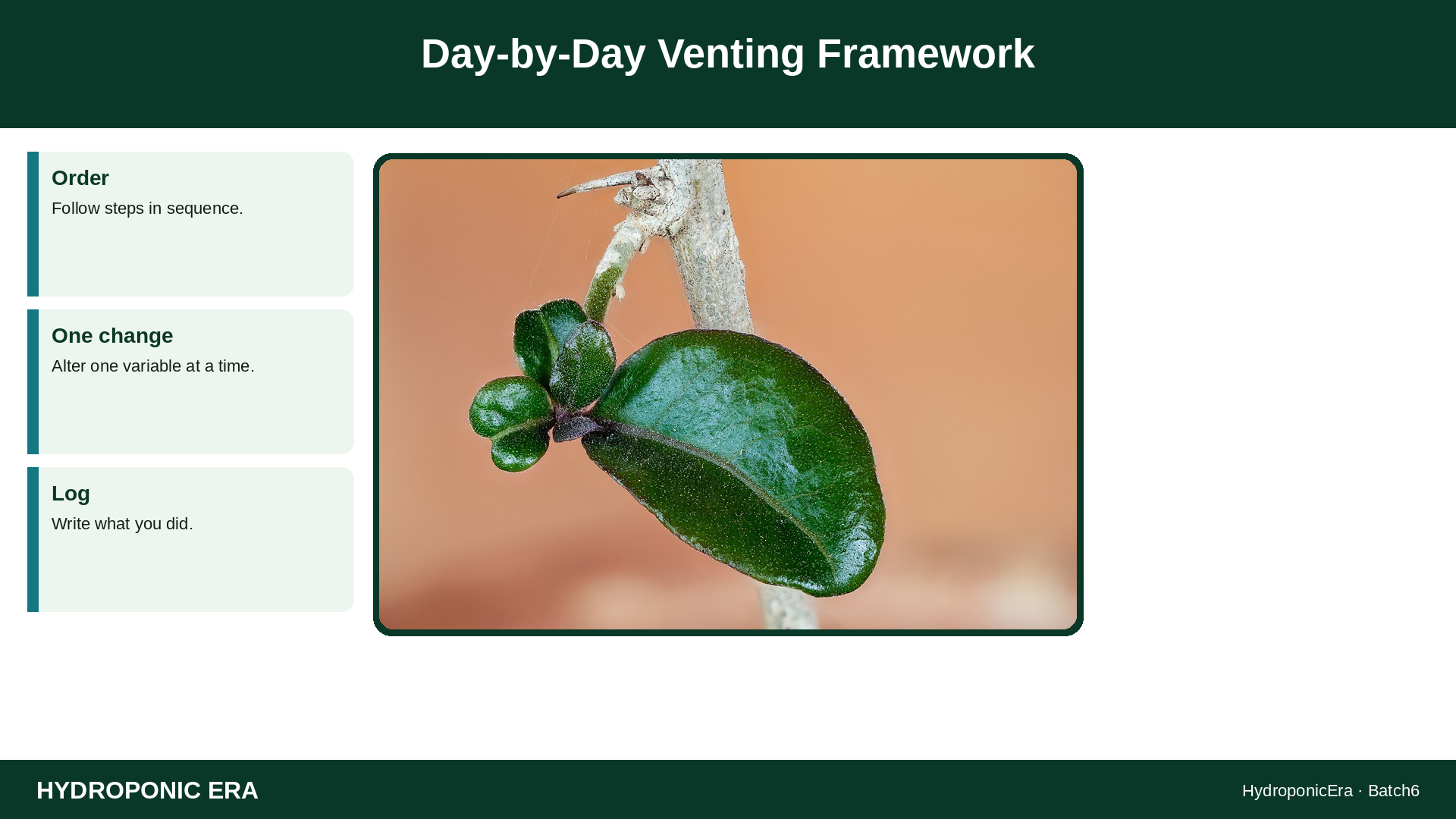
- Prep: clean dome, tray, and tools; label cultivars.
- Stick cuttings into moist (not flooded) plugs.
- Close dome; place under mild light in the tent.
- Check daily for wilt, mold, and pooled water.
- When root tips appear, crack vents 1–2 hours, then longer.
- Remove dome for half days once turgor holds.
- Transplant into system pots with gentle EC (transplanting, EC).
- Log RH/temp so the next round is repeatable ({a(‘logs_b’,’logs’)}).
Tent Settings vs Dome Microclimate

| Stage | Dome | Tent note |
|---|---|---|
| Fresh sticks | Closed / high RH | Mild PPFD; avoid hot LED distance |
| First roots | Vented periods | Watch leaf edges for dryness |
| Weaning | Dome off daytime | Match main VPD slowly (VPD) |
| In system | No dome | Normal crop climate |
Common mistakes with humidity dome tent cuttings clones

- Leaving domes sealed until gray mold appears
- Blasting clones with fruiting-level PPFD
- Heat mat on high with shallow trays—cooks plugs
- Dirty domes reused between runs
- Misting so hard the media goes anaerobic
- Skipping labels when many cultivars share a tray
Troubleshooting Clones
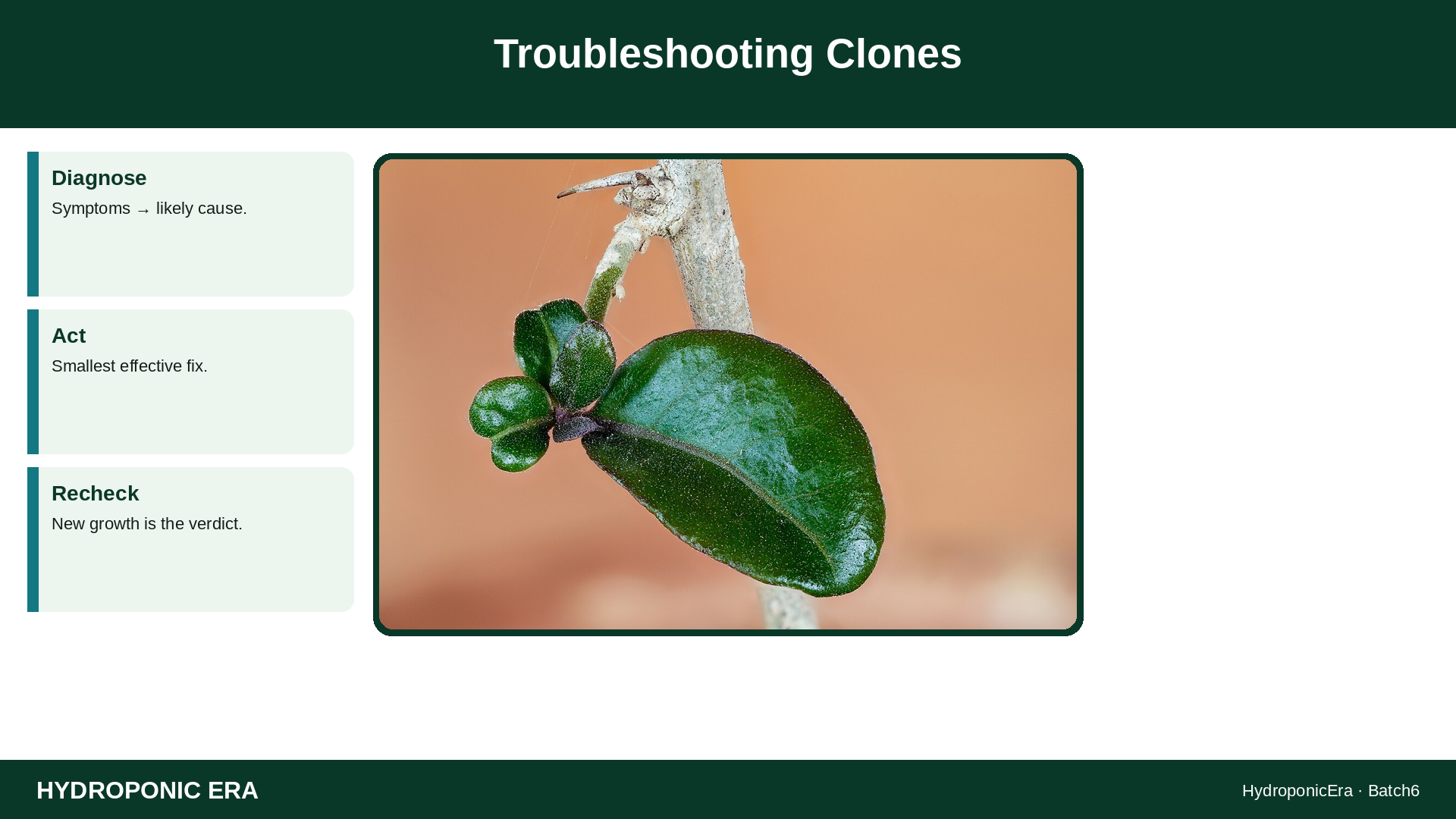
| Symptom | Likely | Fix |
|---|---|---|
| Black stems | Rot / too wet | Discard; reduce mist; sanitize |
| Crispy tips | Weaned too fast / high VPD | Re-dome briefly; ease light |
| Algae on plugs | Light + wet | Lower intensity; opaque trays |
| No roots at day 14 | Woodiness / cold / hormone skip | Fresher tips; check mat temp |
Also see powdery mildew and airflow habits (fans).
What to Check Before You Stick a Dome Tray
- Dome and tray washed and dry?
- Mother plants pest-free?
- Plug moisture even (not dripping)?
- Mild light distance set?
- Heat mat thermostat verified?
- Vent schedule written?
- Quarantine cup ready for sick cuts?
Clone Room Micro-Habits That Compound
Successful humidity dome tent cuttings clones runs are mostly boring habits. Wipe dome interiors when condensate becomes rain. Space cuttings so leaves do not plaster each other. Discard any cutting that turns translucent at the stem—humidity will amplify rot. Keep a mini oscillating fan outside the dome, not blasting inside it, to refresh tent air without shredding RH.
Mother plants should be IPM-clean before you take tips; otherwise the humidity dome tent cuttings clones tray becomes a pest incubator. Use fresh plugs, not mystery leftovers. When weaning, move the tray to a slightly lower RH shelf for a day before the main canopy. If you share a tent with flowering plants, consider a tote-with-dome on a separate shelf to reduce powdery mildew pressure.
Record cultivar rooting days. Some soft herbs root quickly; woody herbs stall—your notes beat generic calendars. Humidity dome tent cuttings clones success is measured by uniform turgor after the dome comes off, not by Instagram foggy trays. Keep scissors in a cup of sanitizer during sessions and change gloves when moving from dirty mothers to clean trays.
If clones stretch, lower intensity before raising the dome forever. If they crisp, you weaned too fast—re-dome briefly. These micro-adjustments are the real skill inside humidity dome tent cuttings clones work.
Sanitation Theater That Actually Helps
Wipe dome gaskets, replace cracked trays, and never stack wet domes. A “clean enough” tray is how bacterial soft rot tours your cultivars. Take fewer cuttings of higher quality rather than stuffing the dome. Leave walkways so you can inspect without dripping condensation from the lid onto every leaf.
If using gel or powder rooting products, follow labels; more is not kinder. Keep mothers under decent PPFD so cuttings are not starving when severed. After weaning, do not immediately blast clones with fruiting light—step intensity over a few days using your PPFD notes.
Quarantine new genetics in a separate dome before they join the main tent. Pests love humid starts.
Practice Notes for This Guide
Re-read the Quick Answer before each cycle and apply only the checks that match your system type. Keep meters calibrated, write what you changed, and give new growth time to judge results. Link outward to related HydroponicEra cluster guides rather than stacking five new additives in one night. University and extension sources listed below frame principles—your room’s sensors decide the final setpoints.
If something conflicts with a product label, the label wins. If a plant shows severe disease, isolate and sanitize before optimizing fine points. Share honest notes with anyone who co-owns the system so habits survive busy weeks. Return to this page when symptoms rhyme with the troubleshooting table, not only when buying new gear.
Small consistent improvements beat rare heroic overhauls. Schedule a 20-minute weekly review: environment, roots, pests, and notes. That rhythm turns articles into operations.
FAQs about humidity dome tent cuttings clones

Do I need a heat mat?
Helpful in cool rooms; optional in warm tents—avoid overheating plugs.
How long until roots?
Often 5–14 days depending on species and climate—inspect, do not invent a universal day count.
Can I clone in the main flowering tent?
Possible but pest/humidity risk rises; a separate shelf is cleaner.
Is a plastic bag as good as a dome?
It can work for a few cups; trays are easier to vent evenly.
Should I fertilize heavily while rooting?
Keep EC gentle; roots are not ready for fruiting strength.
What about DWC cloning collars?
Follow the same humidity wean; do not drown fresh cuts.
Keep humidity dome tent cuttings clones on your weekly ops card so the next cycle inherits the habit, not just the gear list.
When training a helper, explain humidity dome tent cuttings clones in plain language before handing them scissors, timers, or meters.
Keep humidity dome tent cuttings clones on your weekly ops card so the next cycle inherits the habit, not just the gear list.
When training a helper, explain humidity dome tent cuttings clones in plain language before handing them scissors, timers, or meters.
Keep humidity dome tent cuttings clones on your weekly ops card so the next cycle inherits the habit, not just the gear list.
When training a helper, explain humidity dome tent cuttings clones in plain language before handing them scissors, timers, or meters.
Keep humidity dome tent cuttings clones on your weekly ops card so the next cycle inherits the habit, not just the gear list.
When training a helper, explain humidity dome tent cuttings clones in plain language before handing them scissors, timers, or meters.
Extended Home-Grower Walkthrough
Use this extended walkthrough as a second pass after the Quick Answer. Walk the system with a notebook: write the date, crop, EC, pH, reservoir temperature, and one observation about roots or leaves. Change only one control at a time when a problem appears. If last week’s fix did not show in new growth, revert and try the next smallest lever. Keep university and extension principles in mind—oxygen, sanitation, and measured nutrition beat product stacking.
Photograph the canopy and the reservoir surface weekly. Dated photos settle arguments about algae, tip burn, or stretch faster than memory. When a helper waters for you, leave a one-page card with do-not-touch items and the exact top-off rule. Store calibration sachets next to the meters so “I will calibrate later” stops being the default. Review timers after any power event. Confirm air stones still roar. Confirm drains still drain.
At the end of the week, score the cycle 1–5 for ease and plant quality. Low scores should trigger a sanitation or climate review before you buy new hardware. Link neighboring HydroponicEra guides when the symptom matches a cluster page. Prefer labeled procedures over improvisation under stress. Healthy boring routines are the real upgrade path for home hydroponics.
If you sell or share produce, keep food-safe handling in the same notebook as EC readings. Clean harvest tools, avoid stagnant splash, and quarantine sick plants away from harvest bins. A tidy teardown between cycles protects the next seeding more than any single additive. Return to the checklists above whenever the room’s weather or crop mix changes.
Sources
- University of Florida IFAS — HS1421: Growing Herbs in Small Hydroponic Systems
- University of Minnesota Extension — Growing herbs in home gardens
- Oklahoma State University Extension — Hydroponics
- Michigan State University Extension — Hydroponics as an agricultural production system
- University of Georgia Extension — B1314: Soilless Growing Media
- Virginia Cooperative Extension — SPES-720: Calculating and Using Daily Light Integral (DLI)