
Bitter cucumbers are caused by cucurbitacins, natural bitter compounds that cucumber plants produce more of under stress. In hydroponics, the usual triggers are irregular water or nutrient supply, high temperatures, root problems, and plant stress from pests or disease. Variety matters too: many modern “burpless” and greenhouse types are bred to be low in cucurbitacin. The bitterness concentrates near the stem end and just under the skin, so peeling and trimming the stem end often removes most of it.
Key takeaway: Keep growing conditions steady, choose low-bitterness varieties, and harvest on time. Bitter fruit is safe to taste-test, but very bitter cucumbers should be discarded.
| Trigger | Why it matters | Fix |
|---|---|---|
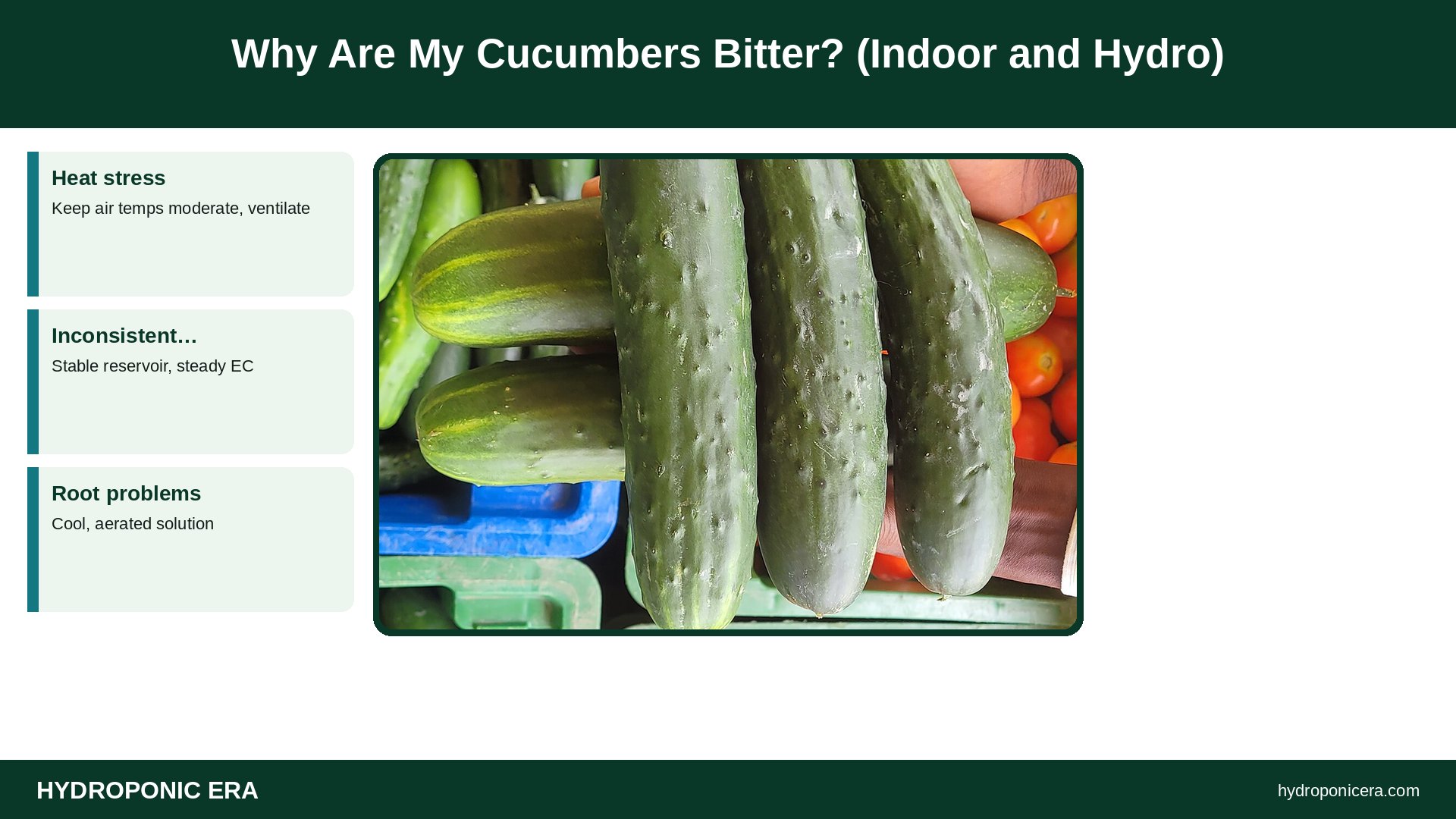
| Heat stress | Raises cucurbitacin production | Keep air temps moderate, ventilate |
| Inconsistent water/nutrients | Stress from wet/dry or EC swings | Stable reservoir, steady EC |
| Root problems | Uptake limited, plant stressed | Cool, aerated solution |
| Variety | Some types carry more bitterness | Grow bitter-free/greenhouse types |
| Over-mature fruit | Quality declines | Harvest at proper size |
| Pests/disease | Plant stress | Inspect and treat early |
What Causes Bitter Cucumbers?
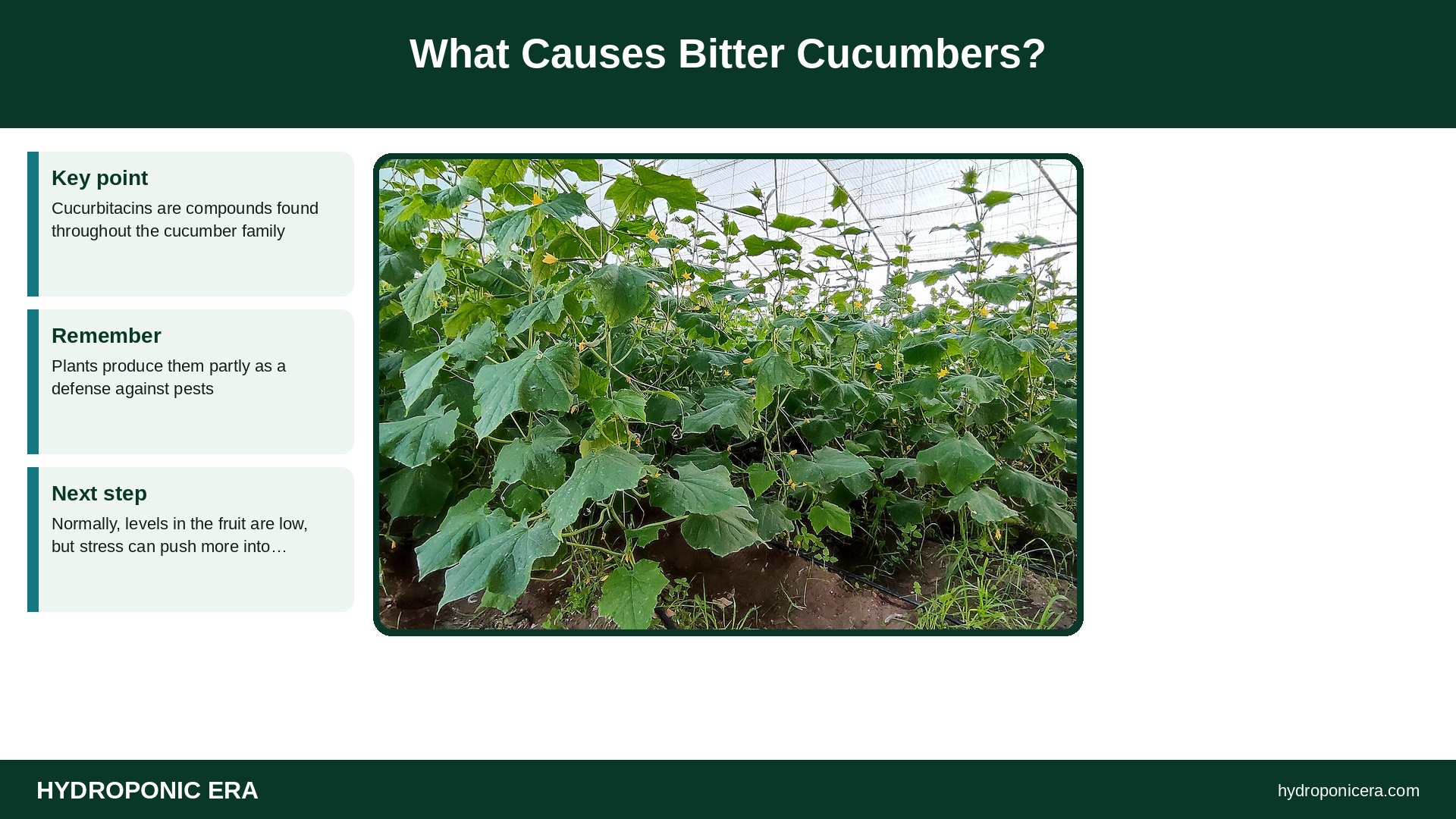
Cucurbitacins are compounds found throughout the cucumber family. Plants produce them partly as a defense against pests. Normally, levels in the fruit are low, but stress can push more into the fruit. University extension services, including Clemson’s Home & Garden Information Center, describe stress from temperature extremes and uneven watering as common causes. The compounds collect most in the stem end and skin.
Heat Stress
Heat is one of the most common reasons for bitter cucumbers. Cucumbers like warmth, but extreme heat stresses them. Indoors, hot grow rooms with poor ventilation are a common trigger. Keep daytime air temperatures in a moderate range and ensure good airflow. Watch for hot spots near lights. See heat stress in hydroponics and canopy hot spots.
Inconsistent Water and Nutrients
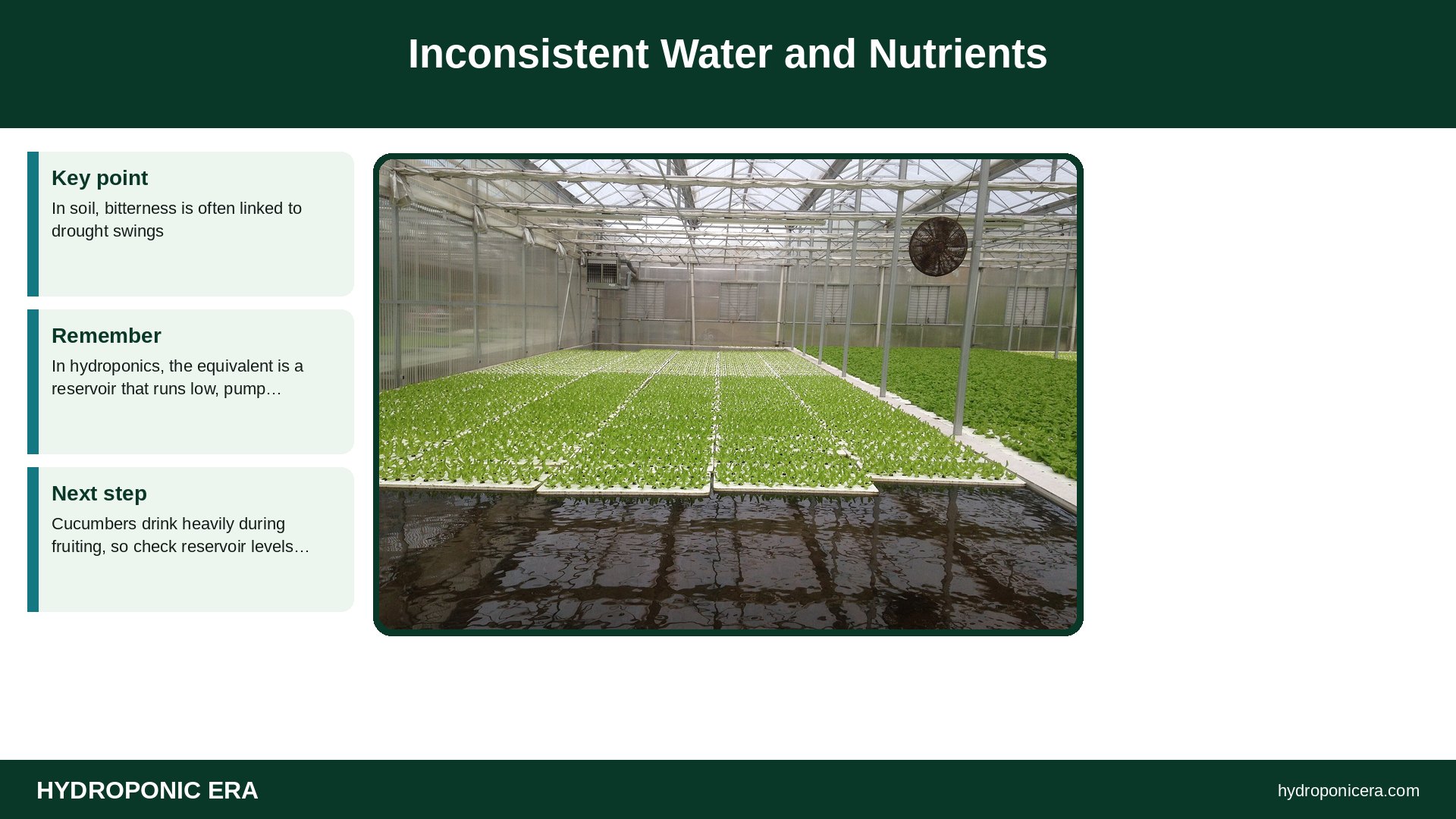
In soil, bitterness is often linked to drought swings. In hydroponics, the equivalent is a reservoir that runs low, pump failures in NFT or drip systems, or EC swinging up and down. Cucumbers drink heavily during fruiting, so check reservoir levels daily and top off. Keep EC steady instead of letting it spike between changes. See auto top-off float valves and growing cucumbers hydroponically.
Root Health
Damaged roots can’t supply steady water and nutrients, which stresses the plant. Keep the solution cool and aerated, and inspect roots regularly. See Pythium root rot.
Variety Choice
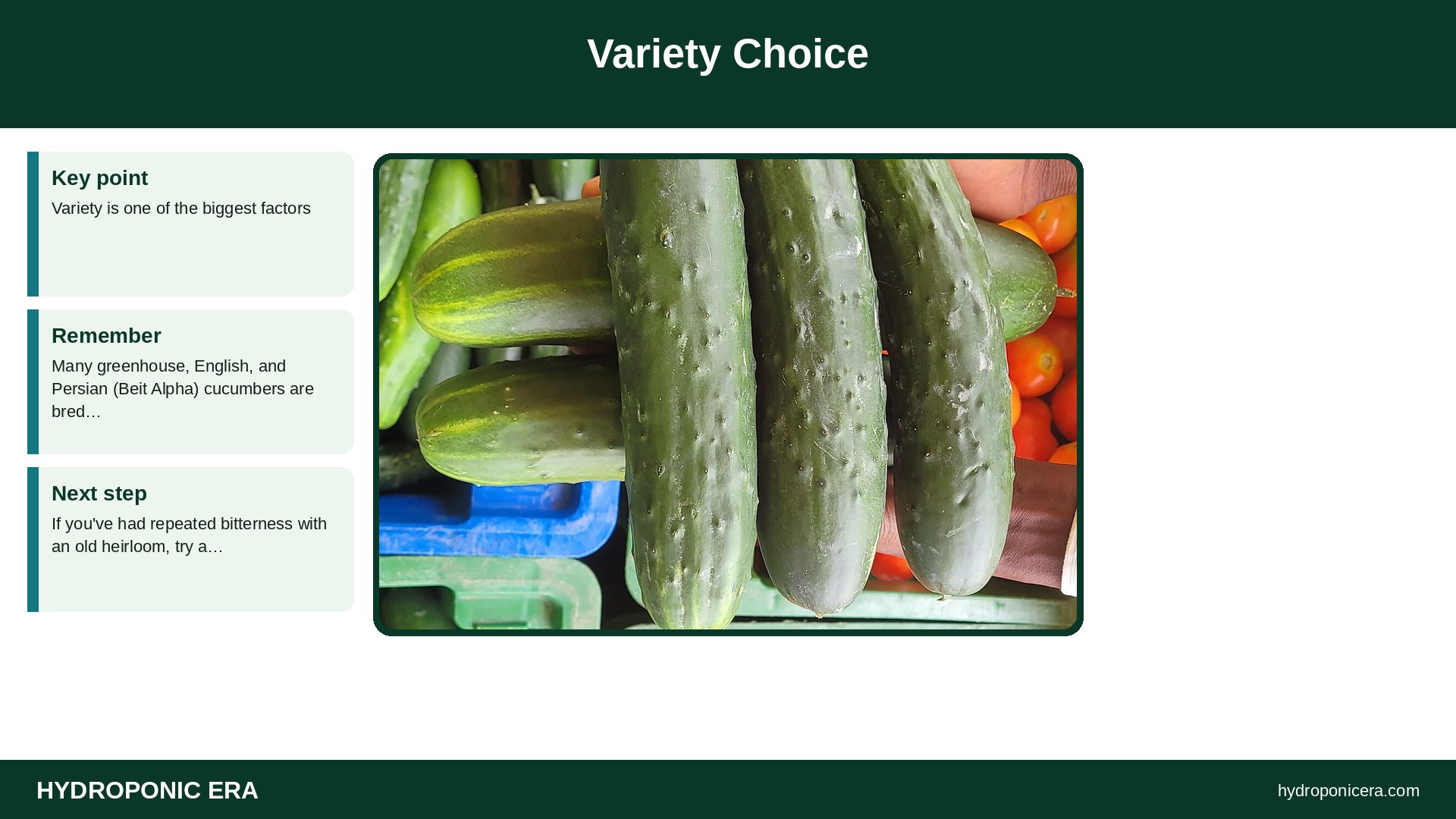
Variety is one of the biggest factors. Many greenhouse, English, and Persian (Beit Alpha) cucumbers are bred for low bitterness and thin skins, and seed catalogs often label them “burpless” or “bitter-free.” These types also tend to be parthenocarpic, meaning they set fruit without pollination, which is ideal indoors. If you’ve had repeated bitterness with an old heirloom, try a bitter-free greenhouse type next round.
Harvest Timing
Overgrown cucumbers can become tough, seedy, and less pleasant. Harvest at the size recommended for the variety. Regular picking also keeps the plant productive. See the cucumber growing guide for timing.
Pests and Disease
Spider mites, aphids, powdery mildew, and other problems stress the plant. Inspect leaf undersides weekly. See spider mites and powdery mildew.
Can You Eat Bitter Cucumbers?
Mild bitterness near the stem end can usually be removed by cutting off the stem end and peeling. However, cucurbitacins in high amounts can upset the stomach. If a cucumber tastes intensely bitter, don’t eat it. Taste a small piece from each plant before preparing a big batch, especially if bitterness has been a problem.
How to Reduce Bitterness in Prepared Fruit
- Cut off an inch or so at the stem end.
- Peel the skin, where bitterness concentrates.
- Taste before serving.
Bitter Cucumbers Prevention Checklist
- Grow bitter-free or greenhouse varieties.
- Keep air temperatures moderate and ventilation strong.
- Check reservoir level and EC daily during fruiting.
- Maintain cool, oxygenated root zones.
- Harvest on time.
- Scout for pests weekly.
Related reading: bitter melon is a different crop that is bitter by nature.
Bitter Cucumbers vs Other Off Flavors
Not every bad-tasting cucumber is bitter from cucurbitacin. Overripe fruit can taste flat and seedy, and fruit from heat-stressed plants can be soft. A sour or fermented taste usually means the cucumber was stored too long or too warm. Bitter cucumbers have a sharp, lingering bitterness that’s strongest at the stem end and in the skin. Tasting a slice from each end helps you tell the difference.
Testing Your Harvest
When you’ve had bitter cucumbers before, taste a thin slice from the stem end of the first fruit from each plant. If it’s clean, the rest of that harvest is usually fine. If one plant keeps producing bitter cucumbers while others are fine, it may be a genetic outlier, especially with saved seed, and it’s worth replacing. Keeping notes on variety, temperature, and reservoir levels for each bitter batch helps you find the pattern.
Good Indoor Conditions for Sweet Fruit
Steady conditions give the best flavor. Aim for warm but not hot days, slightly cooler nights, strong light, and a reservoir that never runs dry. Keep EC in a steady range for fruiting cucumbers and avoid big swings when topping off. Prune lower leaves and side shoots according to your training system so light reaches the fruit and air moves through the canopy. Pick fruit at the size listed on the seed packet. These are the same practices that prevent most cucumber problems, so they protect yield and flavor at once. For more on growing and training, see the hydroponic cucumber guide.
Saving Seed From Bitter Cucumbers
Most greenhouse cucumbers are hybrids or seedless types, so saving seed isn’t practical. If you save seed from open-pollinated varieties, skip plants that produced bitter cucumbers, since bitterness has a genetic component and can show up again in the next generation.
FAQs: Bitter Hydroponic Cucumbers
Why are my hydroponic cucumbers bitter?
Stress raises cucurbitacin levels. Heat, uneven water or nutrients, root problems, and variety are common causes.
Are bitter cucumbers safe to eat?
Mild bitterness is usually removed by peeling and trimming. Discard intensely bitter fruit.
Which cucumbers are not bitter?
Many English, Persian, and greenhouse varieties labeled burpless or bitter-free.
Does bitterness spread to all fruit on the plant?
It can affect multiple fruits while stress continues. Fix conditions and newer fruit often improves.
Does pollination cause bitterness?
Cross-pollination with other cucurbits doesn’t make the current fruit bitter. Stress and genetics are the main factors.
Sources
- Clemson Cooperative Extension HGIC — Cucumber
- University of Minnesota Extension — Growing cucumbers in home gardens
- Photo credits (Wikimedia Commons, edited with titles): Harvested vegetables(Cucumbers) by Pascal Kings (CC BY 4.0); Cucumber greenhouse plants of Dr. Mahmoud Salem’s farm by Amnsalem (CC BY-SA 4.0); Deep water culture by ArcadiYay (CC BY-SA 4.0); Greenhouse filled with tomato plants and a bucket on the path by Shixart1985 (CC BY 2.0)