
Selling microgreens online in the US usually requires a business registration, any state or local food license that applies to fresh produce sales, sales tax registration where required, product liability insurance, and a shipping method that keeps the greens cold and moving fast. Rules depend on your state, and on whether you sell raw microgreens or processed items. Many small growers fall below the size threshold for full coverage under the FDA Produce Safety Rule (farms with average annual produce sales of $35,247 or less, adjusted for inflation, are not covered), but they still must sell safe food and follow state rules. Call your state department of agriculture before your first online sale.
Key takeaway: Licensing is state-specific. Confirm requirements with your state agriculture department and local health department, get insurance, and ship overnight with cold packs.
| Requirement | Who regulates | Notes |
|---|---|---|
| Business registration | State and city/county | LLC or sole proprietor, local license |
| Food/produce license | State ag dept or health dept | Varies widely by state |
| Sales tax | State revenue department | Many states exempt unprepared food; check |
| Produce Safety Rule | FDA (often via state) | Small farms may be exempt or not covered |
| Liability insurance | Private insurer | Often required by buyers and markets |
| Shipping | Carrier rules | Cold chain, fast transit |

Do You Need a License to Sell Microgreens?
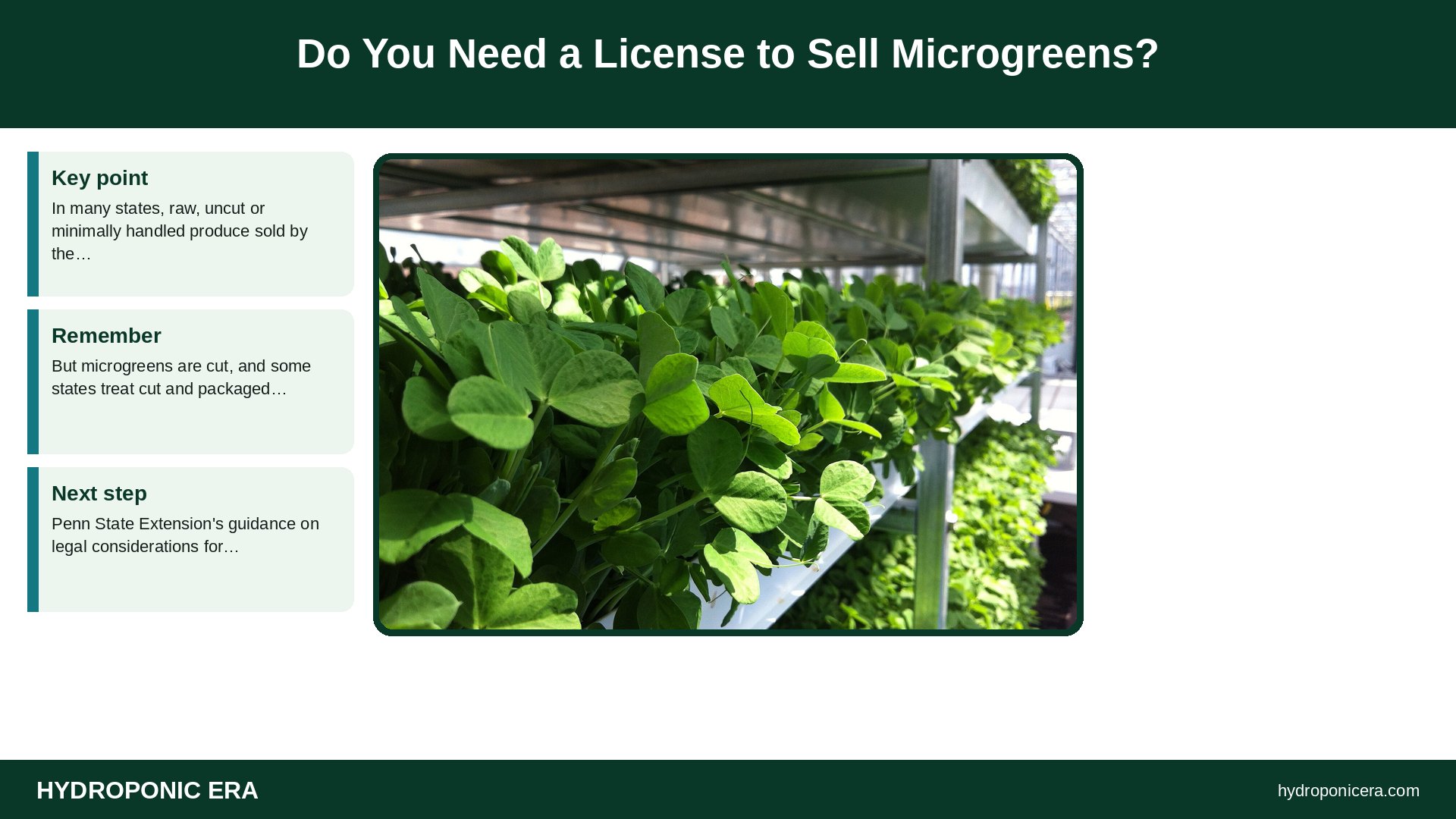
In many states, raw, uncut or minimally handled produce sold by the grower needs little or no special food license. But microgreens are cut, and some states treat cut and packaged greens differently. Penn State Extension’s guidance on legal considerations for microgreens notes that producers may need a food establishment or retail food facility license depending on how they sell. Rules differ in every state, so ask your state department of agriculture and local health department. Selling across state lines online can add complexity.
FDA Produce Safety Rule
The FSMA Produce Safety Rule sets standards for growing, harvesting, packing, and holding produce. Farms averaging $35,247 or less per year in produce sales (the inflation-adjusted figure) aren’t covered. Qualified exemptions apply to some other small farms selling mostly direct to consumers and local buyers. Even if exempt, follow good practices. Penn State’s microgreens food safety guidance recommends testing water, sanitizing tools and surfaces, training workers in hygiene, and using clean growing media.
Food Safety Practices When Selling Microgreens
- Use seed sold for sprouting or microgreens from reputable suppliers.
- Use potable water.
- Sanitize trays, tools, and surfaces between batches.
- Wash hands and wear clean gloves when harvesting.
- Cool microgreens quickly after harvest.
- Label packages with your farm name and harvest date.
See selling liability and food safety questions.
Insurance
Product liability insurance protects you if a customer claims illness. Many restaurants, stores, and farmers markets require proof of coverage. Shop around with insurers that cover small farms.
Shipping When Selling Microgreens Online
Microgreens are highly perishable. If shipping:
- Harvest close to ship day and chill thoroughly.
- Pack in breathable clamshells inside insulated boxes with cold packs.
- Ship overnight or two-day early in the week to avoid weekend delays.
- Avoid shipping into extreme heat.
- Communicate tracking to customers.
Some growers sell living microgreens in trays, which hold up better than cut greens. Many find local delivery or pickup simpler than shipping.
Where to Sell Online
- Your own website with local delivery or pickup.
- Online farmers market platforms in your region.
- Subscriptions for weekly deliveries. See CSA subscriptions.
Pricing for Selling Microgreens
Include shipping, packaging, cold packs, and losses in your price. Use a cost worksheet; see COGS worksheet. For in-person sales, see selling microgreens to restaurants. For growing, see how to grow microgreens hydroponically.
Steps Before Selling Microgreens Online
- Call your state department of agriculture and ask what applies to selling microgreens you grow yourself.
- Ask your local health department whether cutting and packaging requires a license.
- Register your business and get any local business license.
- Check sales tax rules with your state revenue department.
- Buy product liability insurance.
- Write simple food safety procedures and follow them every batch.
- Test your packaging and shipping with a few trial boxes to friends.
Labeling
When selling microgreens in packages, label each one with your farm name, location or contact information, the product name, net weight if required in your state, and a harvest or pack date. Some states have specific labeling rules for packaged produce, so confirm with your agriculture department. Clear labels also help customers reorder and help trace any issue back to a batch.
Local Delivery vs Shipping
Many growers find selling microgreens for local delivery or pickup more practical than shipping across the country. Local orders can be harvested the same day, packed simply, and delivered in a cooler, with no cold packs or overnight fees. Shipping widens your market but adds cost and risk. A common path is to start local, build steady customers, and add shipping only when you can price it in.
Record Keeping
Keep records of seed lots, sowing and harvest dates, sanitation, and who bought each batch. If a customer reports a problem, these records let you trace it. They also show inspectors or buyers that you take food safety seriously when selling microgreens.
Selling Microgreens to Stores
Grocery stores often ask for insurance certificates, consistent supply, and sometimes a food safety audit or written plan. Start with smaller independent stores and co-ops, which may be more flexible.
Repeat Customers Matter Most
Online sales cost more to win than to keep. A short thank-you note in each box, a simple reorder link, and a weekly or biweekly subscription option turn one-time buyers into steady orders, which also makes your growing schedule easier to plan.
FAQs: Selling Microgreens
Do I need a license to sell microgreens?
It depends on your state and how you sell. Check with your state agriculture department and local health department.
Can I sell microgreens from home?
Often yes, but local zoning, business licensing, and state food rules may apply.
Can you ship microgreens?
Yes, with cold packs and fast shipping, though local delivery is usually easier.
Does the FDA regulate microgreens?
Microgreens fall under produce rules. Very small farms may not be covered by the Produce Safety Rule, but food safety still applies.
Do I need insurance to sell microgreens?
It’s strongly recommended and often required by buyers.
Sources
- U.S. FDA — FSMA Final Rule on Produce Safety
- Penn State Extension — Ensuring Food Safety in Microgreens Production
- Penn State Extension — Legal Considerations for Microgreens Production
- Photo credits (Wikimedia Commons, edited with titles): Lufa Farms Microgreens in Trays by Lufa Farms (CC BY-SA 2.0); Lufa Farms Microgreens in Trays by Lufa Farms (CC BY-SA 2.0); Sealing a package with plastic tape for shipping by Meanwell Packaging (CC BY 2.0); 20220525-FPAC-PJK-1302 TONED by USDAgov (Public domain)