
To size greenhouse heating for hydroponics, multiply the total exposed surface area of the greenhouse (walls, ends and roof, not the floor) by the temperature difference you need to hold on the coldest night and by the heat loss factor (U-value) of the covering: BTU/hr = area × ΔT × U. A double-poly greenhouse has a U-value of about 0.7, so a 12 by 20 foot hobby house with about 900 square feet of surface, held at 55°F when it’s 15°F outside, needs roughly 900 × 40 × 0.7 ≈ 25,000 BTU/hr of heater output. Add 10–25% for wind, leaks and distribution losses, and size by output, not input.
Key takeaway: Most greenhouse heating cost comes from heat lost through the glazing at night. Double glazing, sealing leaks, a night curtain and a lower night set point cut fuel use more than any heater upgrade.
| Covering | Approx. U-value (BTU/hr·ft²·°F) | Notes |
|---|---|---|
| Single polyethylene | 1.1–1.2 | Cheap, high heat loss |
| Double polyethylene (inflated) | 0.7–0.9 | Common for hobby and commercial |
| Single glass | 1.1–1.2 | Older glasshouses |
| Twin-wall polycarbonate | 0.55–0.7 | Rigid, durable |
| With thermal screen | 0.3–0.5 | Large savings at night |

Why Greenhouse Heating Matters for Hydroponics
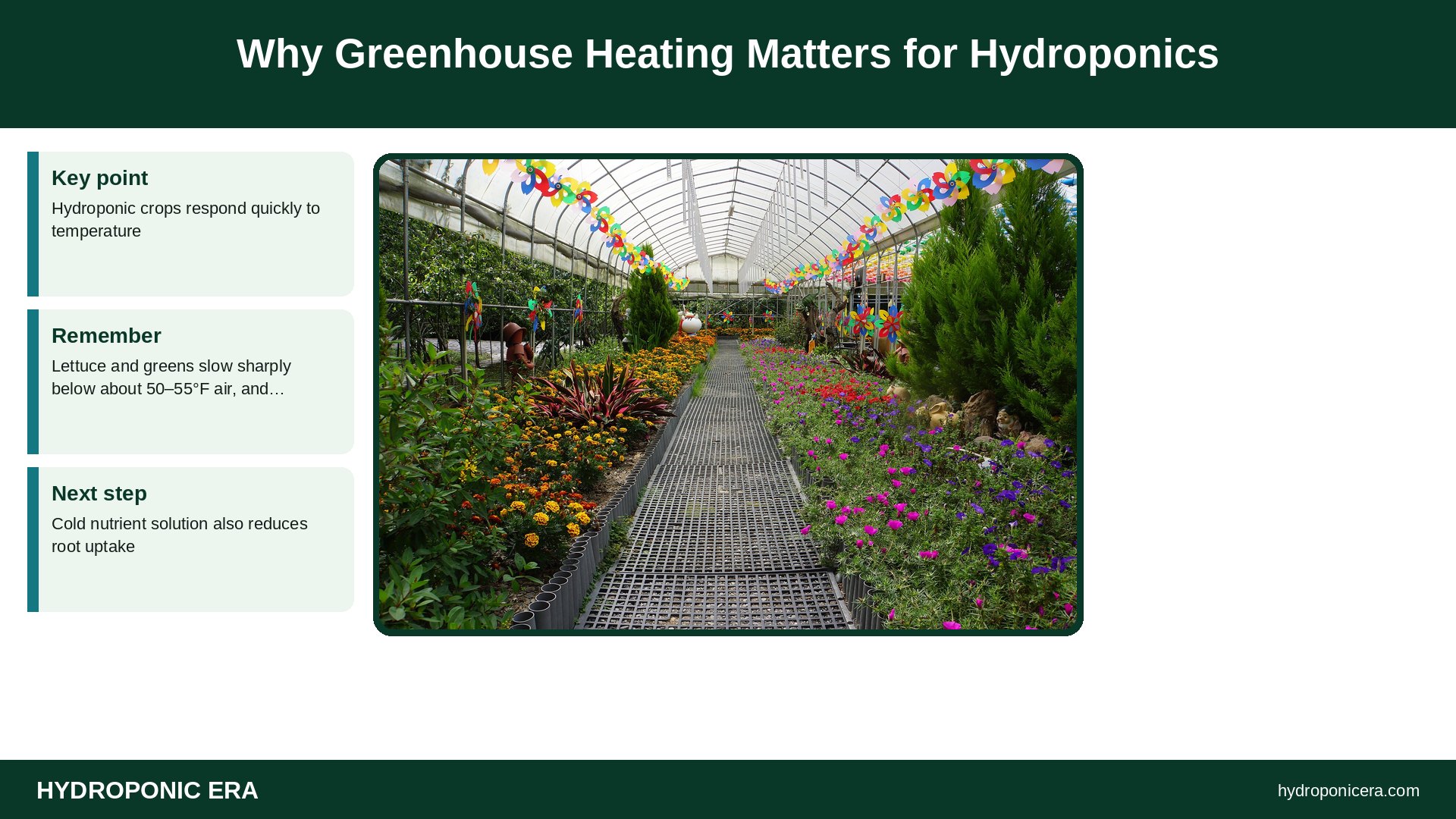
Hydroponic crops respond quickly to temperature. Lettuce and greens slow sharply below about 50–55°F air, and tomatoes, peppers and cucumbers need nights of about 60–65°F to keep setting fruit. Cold nutrient solution also reduces root uptake. A well-sized greenhouse heating system protects the crop on the coldest nights and keeps growth predictable. See hydroponic greenhouse for beginners and heat stress and cold stress.
How to Calculate Greenhouse Heating Needs
- Find the surface area. Add the area of both sidewalls, both end walls and the roof. UF/IFAS gives the example of a 30 by 120 foot gable house with 6-foot sidewalls having about 5,750 square feet of surface.
- Pick the temperature difference. Subtract the local design low (a typical coldest night) from your night set point. Holding 55°F when it’s 10°F outside is a 45°F difference.
- Choose the U-value from the table for your covering.
- Multiply: area × ΔT × U = BTU per hour.
- Add a margin: about 10% for windy or leaky houses, and about 25% more for central boilers with distribution losses.
In the UF/IFAS example, rigid plastic at a U of 1.2 and a 40°F difference needs about 276,000 BTU/hr. Purdue’s CEA program shows a similar method and how glazing choice changes the daily fuel bill.
Greenhouse Heating Options
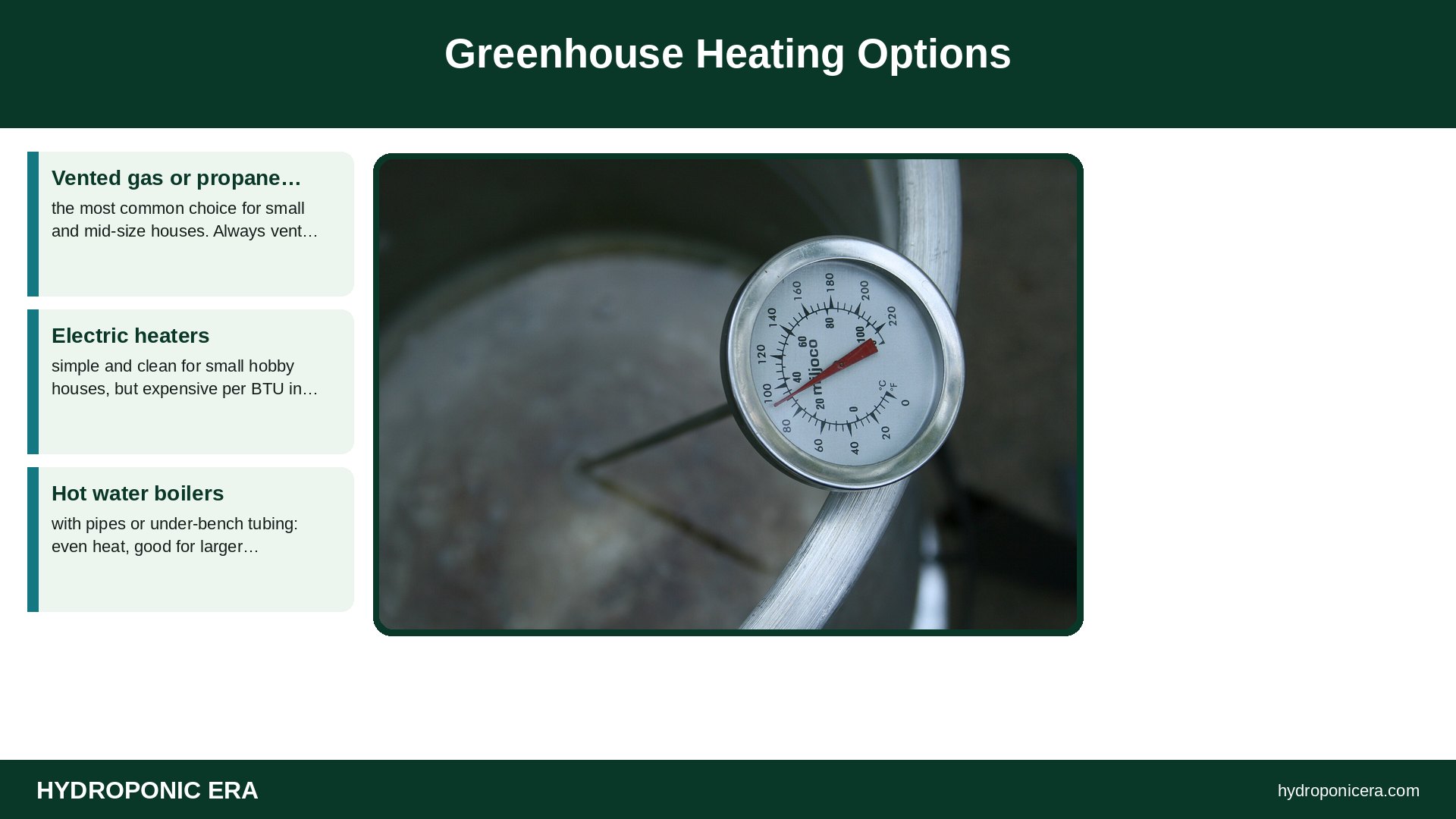
- Vented gas or propane unit heaters: the most common choice for small and mid-size houses. Always vent combustion gases outside; unvented heaters can damage plants with ethylene and pose a carbon monoxide risk.
- Electric heaters: simple and clean for small hobby houses, but expensive per BTU in most states.
- Hot water boilers with pipes or under-bench tubing: even heat, good for larger operations.
- Root-zone heating: heat mats or warm nutrient solution let you run cooler air. See reservoir heaters.
- Wood, biomass or heat pumps: lower fuel cost in some areas, more upfront cost.
Estimating Greenhouse Heating Costs
Propane holds about 91,500 BTU per gallon, natural gas about 100,000 BTU per therm, and electricity 3,412 BTU per kWh. Divide your heat need by the heater efficiency and fuel energy to estimate use. For example, 25,000 BTU/hr for 10 hours on a cold night is 250,000 BTU. A propane heater at 80% efficiency uses about 3.4 gallons. At $2.50 per gallon, that’s about $8.50 for the night. Electric heat for the same load would use about 73 kWh. See electricity cost framework.
Cutting Greenhouse Heating Bills
- Use double poly or twin-wall polycarbonate.
- Seal gaps around doors, vents and fans.
- Add a thermal or energy curtain for nights.
- Insulate the north wall and the base of the sidewalls.
- Lower the night set point for cold-hardy crops like lettuce, spinach and kale.
- Heat the root zone instead of the whole air volume.
- Insulate reservoirs and pipes. See reservoir insulation.
- Group crops with similar temperature needs.
Air Circulation and Thermostats
Warm air rises and pools at the ridge. Horizontal airflow fans mix it back down to plant level and reduce condensation and disease. Put thermostats at plant height in a shaded, aspirated box, not in direct sun or next to the heater. Use a separate low-temperature alarm that texts you. See airflow and fans.
Humidity and Condensation
Closed, heated houses get humid at night, which leads to dripping and diseases such as gray mold. A short period of venting and heating at dusk, along with good airflow, removes moist air. See Botrytis gray mold.
Backup Heat
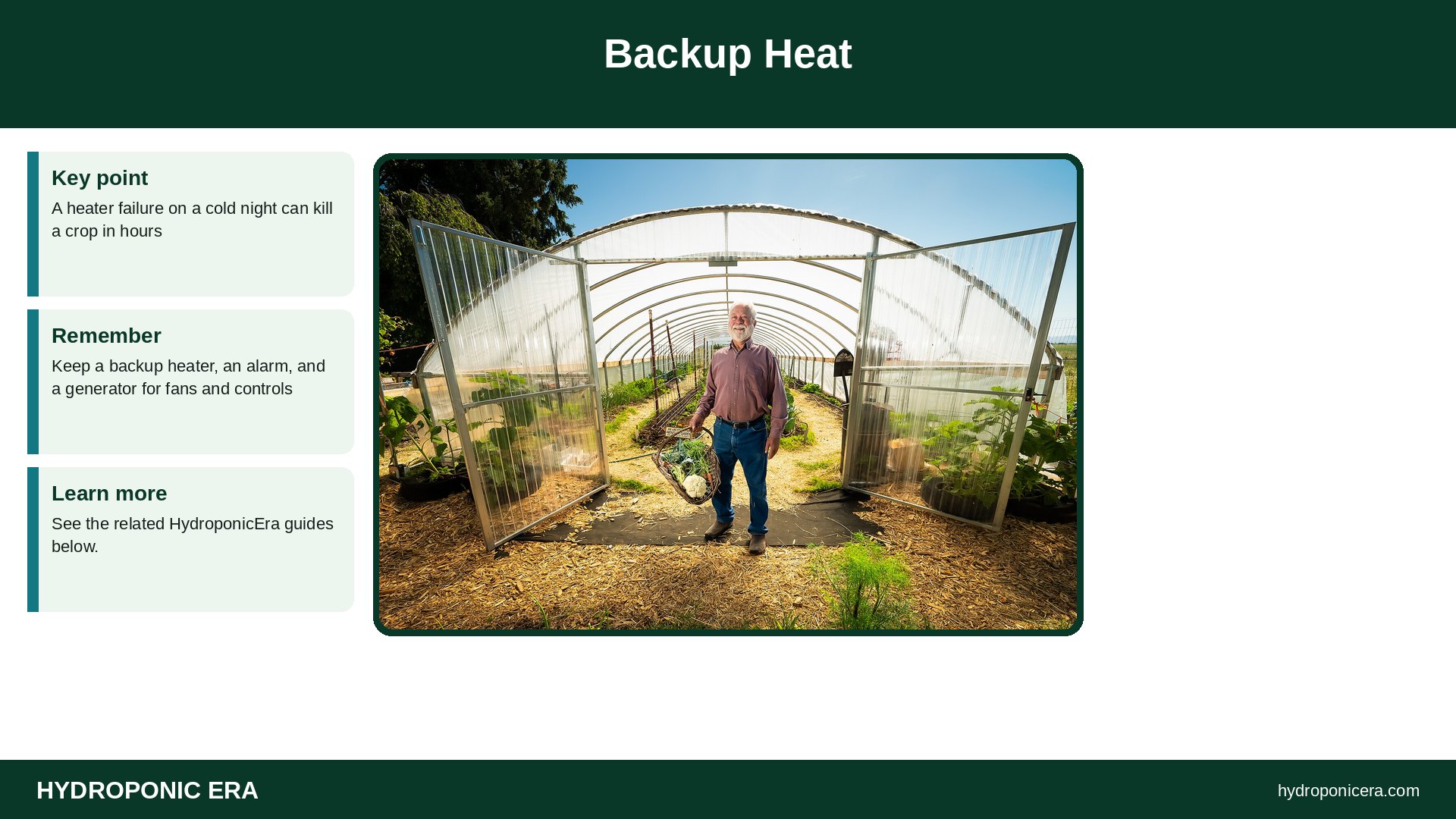
A heater failure on a cold night can kill a crop in hours. Keep a backup heater, an alarm, and a generator for fans and controls. See backup power.
Greenhouse Heating Set Points by Crop
- Lettuce, spinach, kale and Asian greens: nights about 45–55°F, days 60–70°F. These crops let you keep greenhouse heating costs low.
- Herbs such as parsley, cilantro and chives: nights about 50–55°F.
- Basil: nights at least 60°F; it is damaged by cold and grows slowly below that.
- Tomatoes, peppers and cucumbers: nights about 60–65°F, days 70–80°F.
- Strawberries: nights about 50–60°F; some chill helps flowering in June-bearers.
Choosing cool-season crops for winter is often the single biggest way to cut greenhouse heating bills in northern states. See vegetables to grow in winter.
Thermal Mass and Solar Gain
Water barrels, a concrete floor or a large nutrient reservoir absorb heat on sunny days and release it at night. Painted dark and placed where sun hits them, they can smooth temperature swings in a small hobby house, though they rarely replace a heater in cold climates. A reservoir of several hundred gallons also buffers root-zone temperature. Pair thermal mass with a tight, double-glazed shell for the best result.
Greenhouse Heating in Mild vs Cold Climates
In the Gulf Coast and Southwest, greenhouse heating may only run a few dozen nights a year, so a small propane heater plus a frost alarm is often enough. In the Upper Midwest and Northeast, heating runs most nights from November through March, and the fuel bill can exceed the cost of the heater in a single season. In cold regions, invest in insulation, a night curtain and an efficient vented heater before adding more growing space.
FAQs
How do I size a greenhouse heater?
Multiply surface area by temperature difference by U-value, then add a margin.
What is the cheapest way to heat a greenhouse?
Reduce heat loss first, then use natural gas or propane in most areas.
Can I use an electric heater?
Yes for small houses; it’s simple but costly per BTU.
What night temperature do hydroponic crops need?
About 50–55°F for greens and 60–65°F for fruiting crops.
Do I need to vent a propane heater?
Yes; unvented heaters can harm plants and people.
Does root-zone heat help?
Yes; warm roots let you run cooler air.
Sources
- UF/IFAS Extension — Heating Greenhouses
- Purdue University CEA — Calculating Greenhouse Heating Requirements
- Rutgers University — Environmental Control of Greenhouses
- UF/IFAS Extension — Florida Greenhouse Design
- Photo credits (Wikimedia Commons, edited with titles): Greenhouse of Saint Petersburg Botanical Garden winter outside by Afanasovich (CC BY-SA 4.0); Greenhouse in Qingjing Small Swiss Garden 清境小瑞士花園溫室 – panoramio by lienyuan lee (CC BY 3.0); 2008-09-20 Thermometer reading by Ildar Sagdejev (Specious) (CC BY-SA 4.0); Lettuce Closeup Greenhouse Phuktal Zanskar Jun24 A7CR 00442 by This Photo was taken by Timothy A. Gonsalves. Feel free to use my photos, but pl (CC BY-SA 4.0); Oregon High Tunnel, NRCS EQIP (20260611-NRCS-KLS-0001) by USDAgov (Public domain)