
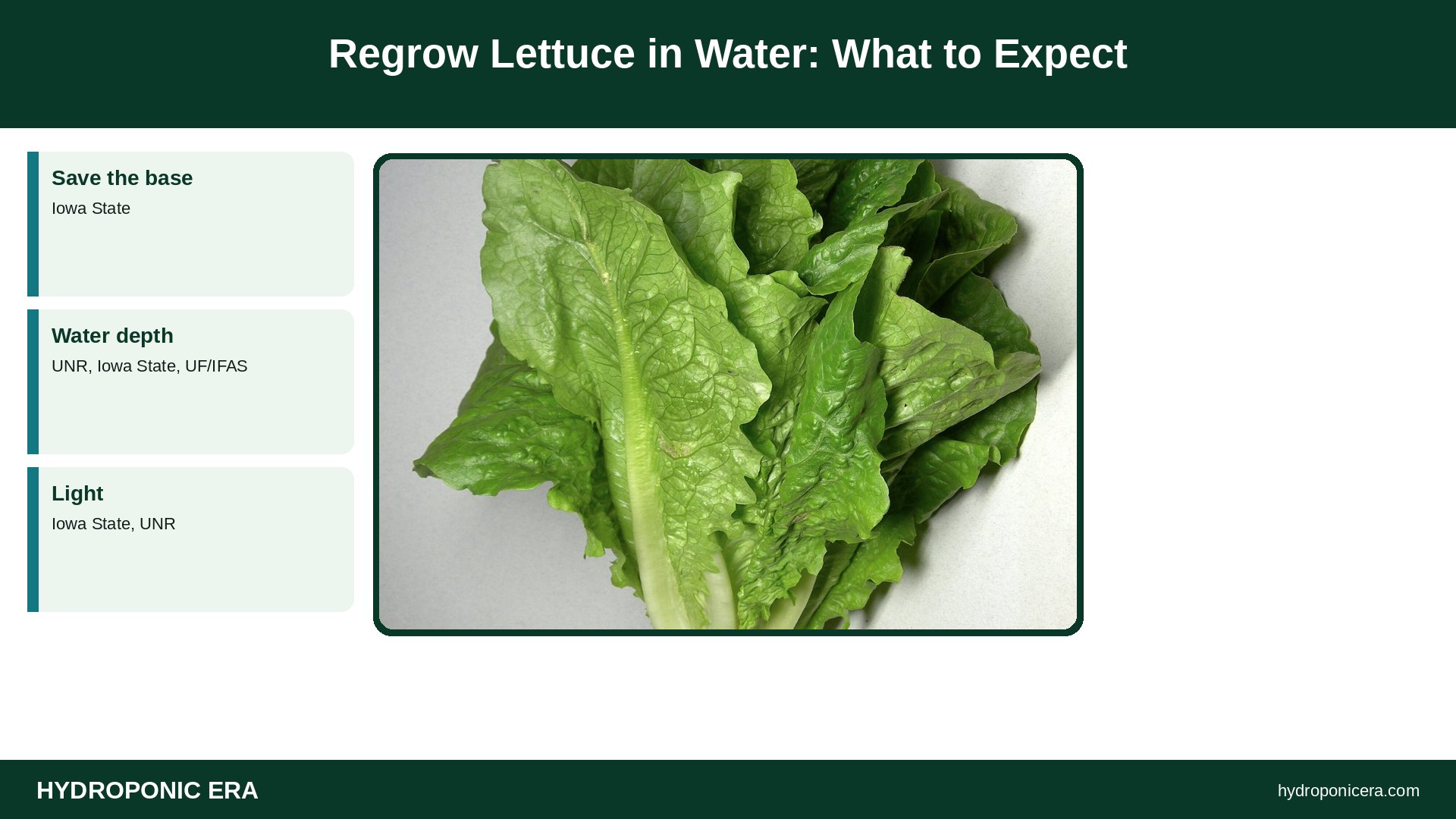
You can regrow lettuce in water from the base of a romaine head, but you’ll get a small crop of tender leaves, not a new full head. Save the bottom 2 inches (5 cm) of the root end, set it in a shallow dish with about ½–1 inch (1.3–2.5 cm) of water, place it in a sunny window, and change the water every 2–3 days. New leaves appear from the center within days to weeks. Harvest them young, and move the base to potting mix or a hydroponic system if you want more growth.
Key takeaway: University of Nevada, Reno Extension is clear: you will not get a whole new head of lettuce from this kitchen scrap, just smaller leaves for salads or sandwiches. When the plant turns spindly and bluish, toss it.
| Step | What to do | Source |
|---|---|---|
| Save the base | Keep the bottom 2 inches (5 cm) of the root end | Iowa State |
| Water depth | About ½ inch (1.3 cm) up to roughly 1 inch (2.5 cm) | UNR, Iowa State, UF/IFAS |
| Light | Warm, sunny window | Iowa State, UNR |
| Water changes | Every 2–3 days | Iowa State, UF/IFAS |
| Harvest | Trim young center leaves | Iowa State, UNR |
Which Lettuce Can You Regrow in Water?
You can only regrow lettuce in water if it was sold with its base, or basal plate, still attached. Iowa State University Extension lists romaine lettuce along with celery, bok choy and Chinese (Napa) cabbage as leafy vegetables typically sold with the crown or roots still attached. UF/IFAS Extension and University of Nevada, Reno Extension use romaine as their lettuce example too.
Loose bagged leaves can’t regrow, because each leaf has been cut away from the growing point. Iceberg and butterhead heads can also be tried if the core is intact, but our sources tested romaine, so expect varied results with other types.
How to Regrow Lettuce in Water: Step by Step
- Cut the head. Iowa State says to cut off the edible portions and keep the bottom 2 inches (5 cm) of the root end. UF/IFAS describes leaving the root end “a couple inches tall.”
- Choose a container. A shallow bowl works best for romaine, according to UF/IFAS.
- Add water. UNR recommends just enough to cover the base, about ½ inch (1.3 cm). Iowa State says to cover the bottom inch (2.5 cm) or so. Don’t submerge the cut top.
- Find light. Put it in a warm, sunny spot such as a kitchen windowsill. UNR suggests full sun indoors.
- Change the water. Every 2–3 days, Iowa State says, to prevent fungal or mold growth.
- Harvest. After several days to weeks, new leaves emerge from the center and can be trimmed and eaten.
What to Expect When You Regrow Lettuce in Water
Set realistic expectations. Iowa State notes that new leaves appear after several days to weeks, while UF/IFAS says growth may show in a few days or take weeks depending on the crop. UNR reports bok choy can show new growth in 1–2 days and celery and cabbage in 3–4 days, but lettuce varies.
The new leaves are small. UNR advises harvesting the smaller leaves for the best flavor and discarding the plant once it becomes spindly and bluish, because it won’t taste good. Iowa State’s overall verdict on scrap gardening: it won’t replace your weekly grocery trip, but it’s a fun project, especially with kids.
Regrow Lettuce in Water or Soil: Which Is Better?
Water is ideal for starting roots, but soil or a nutrient solution gives more growth. Iowa State says once roots appear you can keep harvesting with clean water about an inch (2.5 cm) deep, or transfer the base to potting soil, where “the plant will be more productive.” It can also be planted in the garden in spring. UNR suggests a soilless potting mix with the roots and base covered and the top exposed.
Plain tap water has almost no nutrients, so a lettuce base sitting in water lives mostly on its own stored reserves. That’s why growth slows after the first flush of leaves.
Regrow Lettuce in Water, Then Move It to Hydroponics
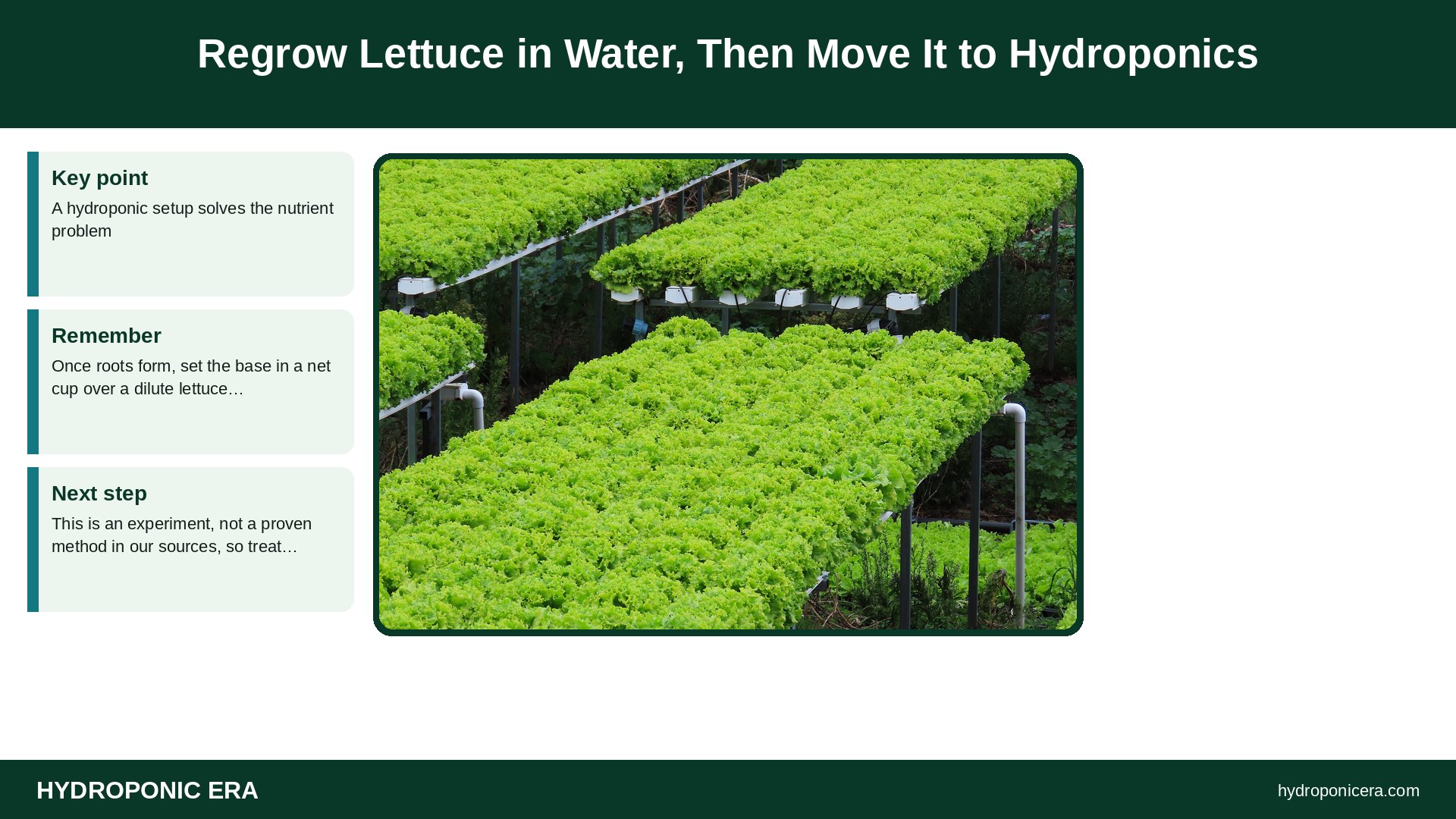
A hydroponic setup solves the nutrient problem. Once roots form, set the base in a net cup over a dilute lettuce nutrient solution in a simple Kratky jar or deep water culture system, keeping the cut crown above the solution. This is an experiment, not a proven method in our sources, so treat any harvest as a bonus. For full-size heads, start from seed instead; see how to grow lettuce hydroponically.
Common Problems When You Regrow Lettuce in Water
- Slimy, smelly base: Rot. Change water more often, use less water and trim soft tissue.
- Mold on the cut top: The top is too wet. Lower the water so only the base sits in it.
- Nothing grows: The core may be damaged or too old. Try a fresher head with a firm base.
- Tall, pale leaves: Not enough light. Move closer to a window or use a small grow light.
- Bitter leaves: The plant is aging or bolting; UNR says to discard it.
Other Scraps That Regrow the Same Way
Celery, bok choy and Napa cabbage regrow with exactly the same method, according to Iowa State and UF/IFAS. Green onions are even easier: Illinois Extension simply places the white bulb ends in a shallow dish of water in a sunny window. Our guide on growing green onions hydroponically covers that crop.
Tips to Get More Leaves When You Regrow Lettuce in Water
- Start fresh. Pick a crisp head with a firm, pale base; a dried-out or brown core rarely regrows.
- Rinse the base. Gently rinse off soil and debris before you regrow lettuce in water, since residue fouls the water faster.
- Keep it shallow. More water isn’t better. Only the base should be wet, which keeps the cut top dry and mold-free.
- Use a clean dish. Wash the container at each water change to limit slime and algae.
- Harvest lightly. Take a few outer leaves at a time and leave the center to keep growing.
- Make it a family project. Iowa State highlights scrap gardening as a fun way to connect kids with their food, and lettuce shows visible progress within days.
FAQs
Can you regrow lettuce in water forever?
No. You’ll get a few small harvests before it declines.
How long does it take to regrow lettuce in water?
New center leaves appear in several days to weeks.
Can you regrow iceberg lettuce in water?
You can try with an intact core, but our sources tested romaine.
How much water do I need to regrow lettuce in water?
About ½–1 inch (1.3–2.5 cm), just covering the base.
Is regrown lettuce safe to eat?
Yes, if the water stays clean and the base isn’t rotting.
Should I add fertilizer when I regrow lettuce in water?
For longer growth, move it to soil or dilute hydroponic nutrients.
Sources
- Iowa State University Extension and Outreach — How to Grow Vegetables from Kitchen Scraps
- University of Nevada, Reno Extension — Bring Vegetable Growing Indoors This Winter
- UF/IFAS Extension Gardening Solutions — Grocery Store Starts
- University of Illinois Extension — Regrowing Scrap Veggies
- Photo credits (Wikimedia Commons, edited with titles): Romaine lettuce by Rainer Zenz (CC BY-SA 3.0); Red leaf lettuce J1 by Jamain (CC BY-SA 3.0); Hydroponic lettuce @ Plaine des Cafres 03 by Rémih (CC BY-SA 4.0); Deepwater Aquaponics Floating Rafts Growing Lettuce, Basil and Arugula by Alabama Extension (CC0); Onion seedlings by Krish Dulal (CC BY-SA 3.0)