
Yes, an arrowhead plant in water roots readily and can live in a jar for a long time. Cut a 3–6 inch (8–15 cm) stem with at least one or two nodes, remove the leaves from the lowest node, and set it in room-temperature water with the node submerged and the leaves dry. Give it bright, indirect light at 65–80°F (18–27°C) and change the water once or twice a week. Roots usually form in about 3–6 weeks. Arrowhead plant (Syngonium podophyllum) forms aerial roots at almost every node, which is why it takes to water so well.
Key takeaway: Wear gloves when cutting, since the milky sap can irritate skin, and keep jars away from pets. In Florida, never toss cuttings outdoors: UF/IFAS lists arrowhead vine as an invasive plant.
| Factor | Recommendation | Source |
|---|---|---|
| Cutting | 3–6 inches (8–15 cm), at least 1–2 nodes | UF/IFAS; Iowa State |
| Temperature | 65–80°F (18–27°C) keeps leaf color | UF/IFAS |
| Humidity | 40–60% relative humidity indoors | UF/IFAS |
| Light | Bright indirect light; no harsh sun | UF/IFAS; N.C. State |
| Water change | Once or twice a week | Iowa State |
| Pets | Toxic to cats, dogs and horses (calcium oxalate) | N.C. State |
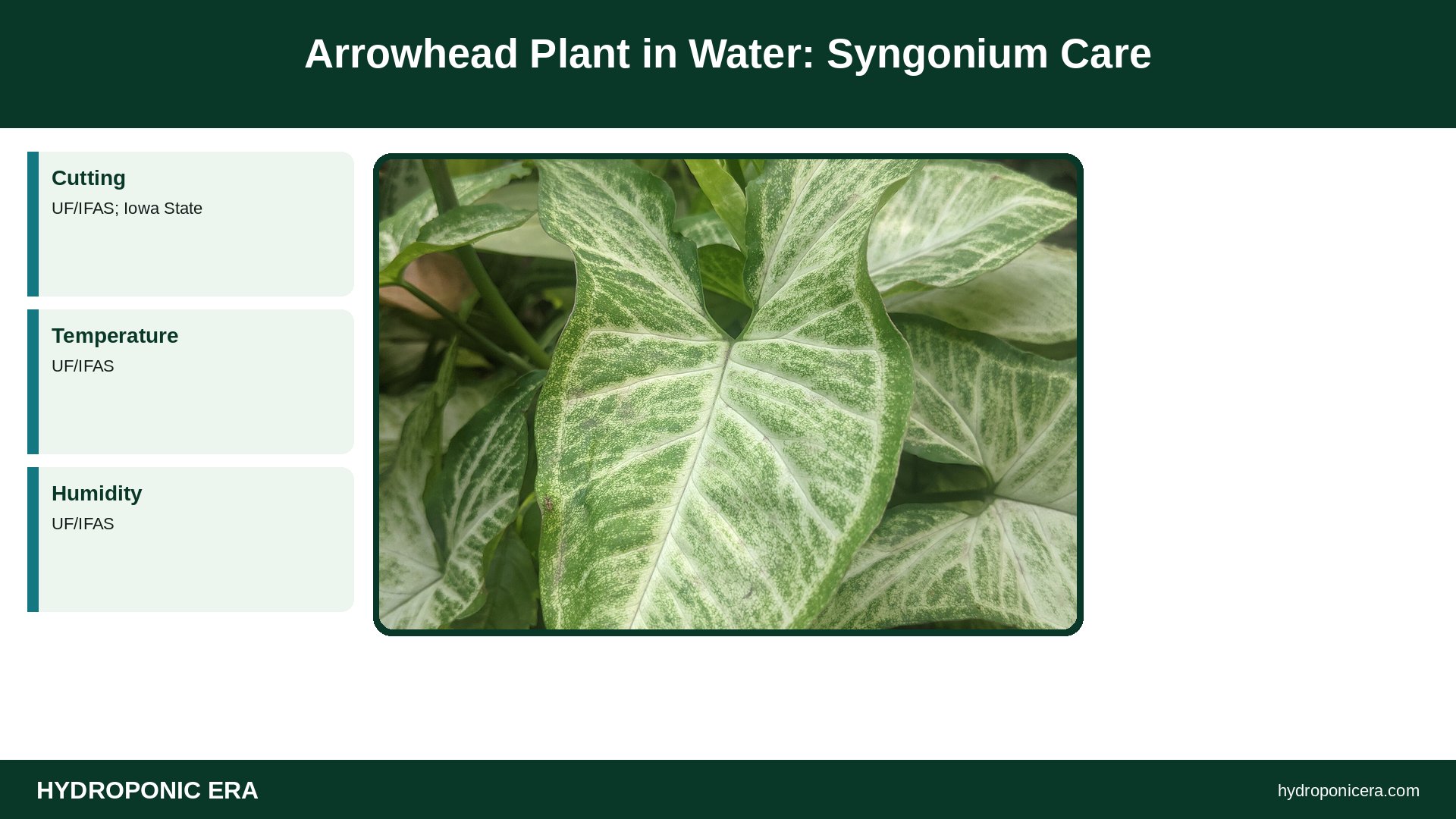
Why an Arrowhead Plant in Water Roots So Easily
UF/IFAS Extension calls Syngonium podophyllum the most commonly produced species in the foliage plant industry, and notes that in most environments each node carries adventitious roots. Those little brown root bumps are ready to grow as soon as they touch water, which is why an arrowhead plant in water roots so readily. UF/IFAS also says commercial growers propagate it easily from single-node cuttings, tip cuttings or air layers.
The plant is also called nephthytis, African evergreen and goosefoot plant. Young plants have simple, arrow-shaped leaves about 3–7 inches (7.5–17.5 cm) long. As the vine matures and climbs, the leaves split into 3–11 leaflets. N.C. State Extension describes it as a tropical vine that can climb to 6 feet (1.8 m).
How to Root Arrowhead Plant in Water, Step by Step

- Put on gloves. N.C. State notes the sap can cause contact dermatitis.
- Choose a healthy vine with firm stems and visible root nubs at the nodes.
- Cut 3–6 inches (8–15 cm) with at least two nodes, as Iowa State recommends for houseplant stem cuttings. Single-node pieces with a leaf also work.
- Remove the lowest leaf so no foliage sits underwater.
- Use a clean glass jar of room-temperature water. A narrow neck helps hold the cutting upright.
- Submerge the bare node and keep the leaves above the rim.
- Place in bright, indirect light. Iowa State suggests 4–6 hours of bright indirect light and 65–75°F (18–24°C) air for rooting.
- Change the water once or twice a week and never let the roots dry out.
How Long Does an Arrowhead Plant in Water Take to Root?
Iowa State says most houseplant stem cuttings root in 3–6 weeks, and arrowhead plant is usually on the faster side because the root nubs are already there. You may see new white roots in the first week or two in a warm room. Cool rooms slow everything down, so keep jars away from cold windows in winter.
Can an Arrowhead Plant in Water Live Long Term?
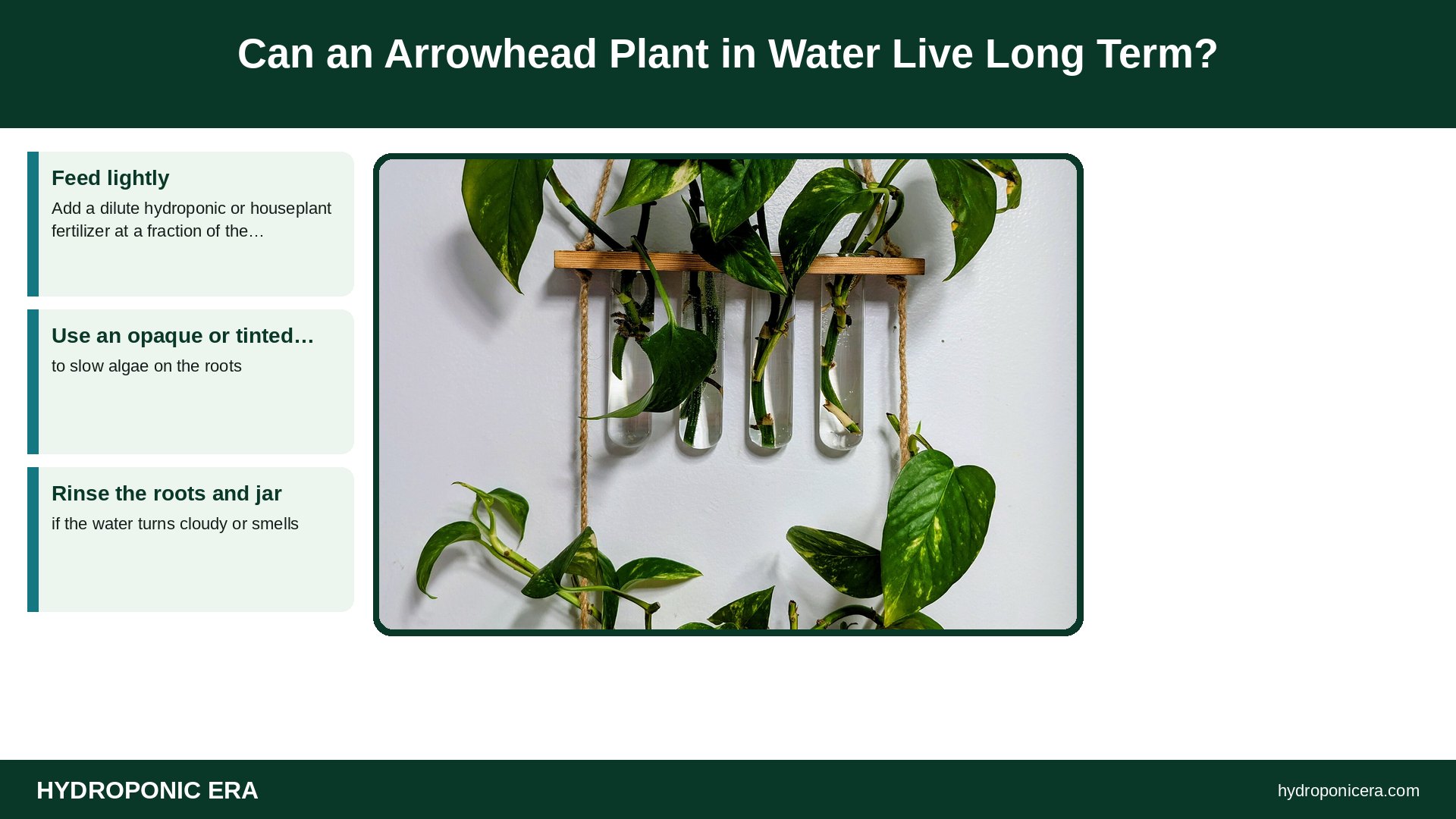
An arrowhead plant in water can live for months or longer, much like pothos. The catch is food: tap water has very few nutrients, so long-term jar plants gradually grow smaller, paler leaves. To keep one in water for good:
- Feed lightly. Add a dilute hydroponic or houseplant fertilizer at a fraction of the label rate, then refresh the water every couple of weeks.
- Use an opaque or tinted container to slow algae on the roots.
- Rinse the roots and jar if the water turns cloudy or smells.
- Keep it warm. UF/IFAS recommends 65–80°F (18–27°C) to keep leaf colors.
See pothos in water and plants that grow in water for more long-term jar plants.
Moving an Arrowhead Plant in Water to Soil
Iowa State suggests transplanting when roots are about 1 inch (2.5 cm) long. It warns that water roots are coarser and may wilt or drop leaves after potting, so keep the soil evenly moist and the light bright but indirect for the first few weeks. UF/IFAS lists commercial mixes of peat, pine bark, vermiculite and perlite with a pH of 5.5–6.5. Indoors, it says to let the surface of the mix dry slightly before watering and to reduce watering in winter without letting the plant dry out.
Keeping the Arrowhead Shape
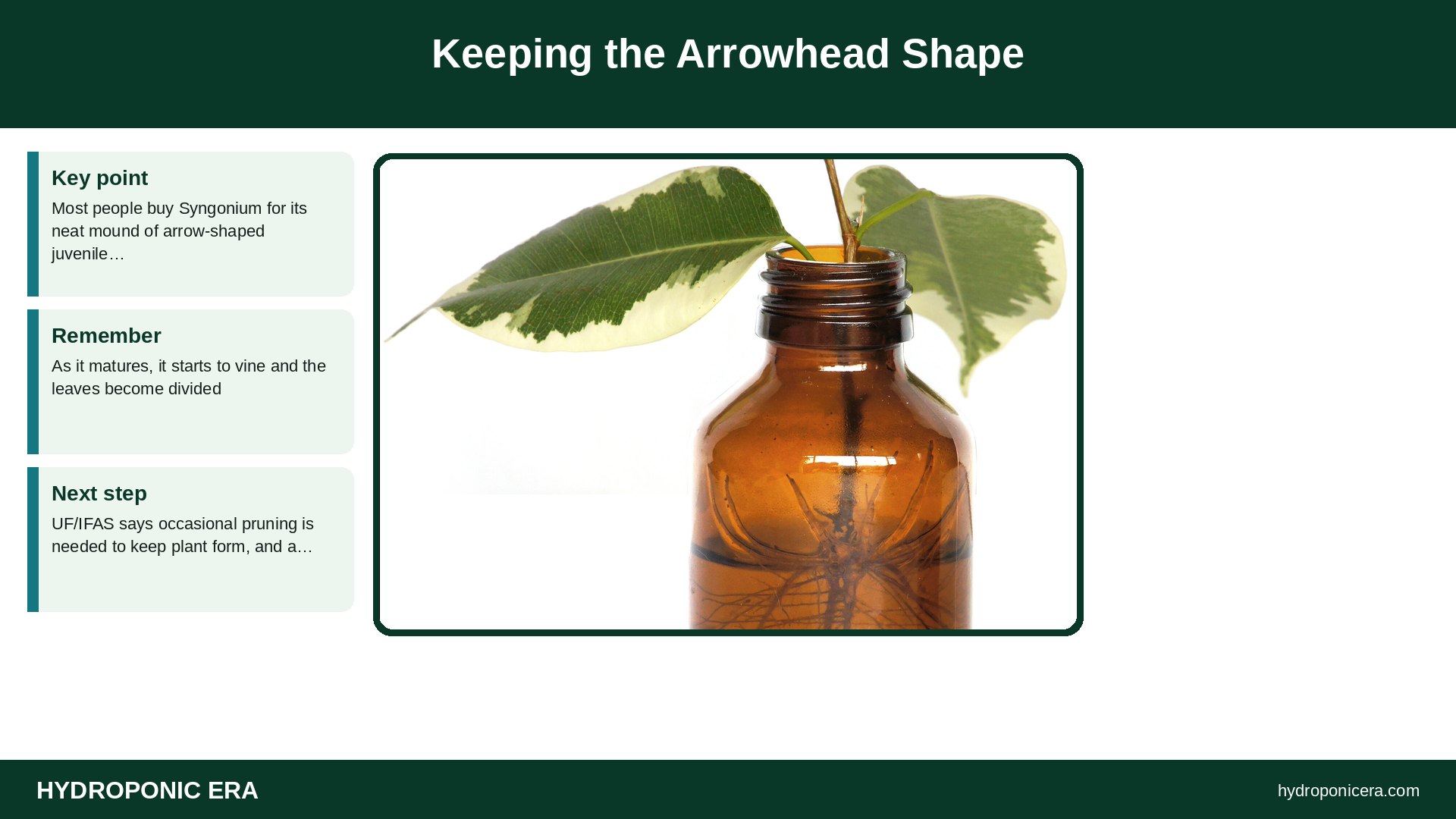
Most people buy Syngonium for its neat mound of arrow-shaped juvenile leaves. As it matures, it starts to vine and the leaves become divided. UF/IFAS says occasional pruning is needed to keep plant form, and a totem or trellis is needed if you want upright growth. Every pruned stem is a new cutting, so you can root the trimmings in water and add them back to the pot for a fuller plant.
UF/IFAS also recommends misting and wiping leaves with a lint-free cloth to keep them dust-free, which reduces pest problems. N.C. State lists aphids, two-spotted spider mites, mealybugs and thrips as common pests.
Safety: Pets, Skin and Florida
- Toxic to pets. N.C. State lists arrowhead plant as poisonous to cats, dogs and horses. All parts contain calcium oxalate crystals, which can cause mouth pain, swelling, drooling and vomiting. Keep any arrowhead plant in water out of reach of pets and children.
- Skin irritation. The milky sap can irritate sensitive skin, so wear gloves and wash hands after handling.
- Invasive in Florida. The UF/IFAS Center for Aquatic and Invasive Plants says arrowhead vine sprouts easily from cuttings, has escaped into natural areas, and is a Category I invasive species. UF/IFAS advises sealing discarded plants and cuttings in plastic bags before putting them in the trash.
Troubleshooting Arrowhead Plant in Water

- Stem turns mushy: leaves underwater or stale water. Recut above the soft area and use fresh water.
- Leaves fade to green: pink and variegated types lose color in low light. Move closer to a bright window, out of direct sun.
- Leggy growth: too little light. Prune and root the tips.
- Green slime in the jar: algae from light hitting the water. Switch to an opaque container.
- Brown leaf tips: dry air or salt buildup. Raise humidity and change the water more often. See fluoride in water for plants.
Related reading: philodendron in water, Chinese evergreen in water and begonia in water.
FAQs
Can an arrowhead plant grow in water permanently?
It can live in water for a long time if you feed it lightly and change the water regularly.
How long does an arrowhead plant in water take to root?
Usually 1–6 weeks, depending on warmth and light.
Can I root a single arrowhead leaf?
Only if it has a node attached; leaves alone don’t make new plants.
Is arrowhead plant toxic to cats?
Yes. N.C. State lists it as poisonous to cats, dogs and horses.
Why did my pink arrowhead plant turn green?
Low light usually fades the pink color.
Do I need rooting hormone?
No; the nodes already carry root initials.
Sources
- UF/IFAS Extension — Cultural Guidelines for Commercial Production of Interiorscape Syngonium
- UF/IFAS Center for Aquatic and Invasive Plants — Syngonium podophyllum
- N.C. State Extension Plant Toolbox — Syngonium podophyllum
- Iowa State University Extension and Outreach — How to Propagate Houseplants by Stem Tip Cuttings
- UF/IFAS Extension — Wildland Weeds: Arrowhead Vine, Syngonium podophyllum
- Photo credits (Wikimedia Commons, edited with titles): Syngonium podophyllum ( Arrowhead plant) by Stephanie cheks (CC BY-SA 4.0); Syngonium podophyllum Golden 0zz by Photo by David J. Stang (CC BY-SA 4.0); Pothos plant on water by Joli Rumi (CC BY-SA 4.0); Ficus cuttings with roots in a bottle, White background by Biusch (CC BY-SA 3.0); Philodendron giganteum à goyave by Filo gèn’ (CC BY-SA 4.0)