
Yes, begonia in water roots easily from stem cuttings. Take a 3–4 inch (8–10 cm) tip cutting with two to four nodes, cut just below a node, strip the lower leaves, and stand it in a small jar of room-temperature water so at least one bare node is underwater. Keep it in bright, indirect light at 60–80°F (16–27°C) and top up or change the water as needed. Roots usually appear in about 3–4 weeks. Pot the cutting into a well-drained mix once roots are about ½–2 inches (1–5 cm) long, because begonia roots rot quickly if soil stays soggy.
Key takeaway: Cane, angel wing, wax and most fibrous begonias root well in water. Rex begonias also root from leaves, but leaf-vein cuttings work best on moist media, not in a jar.
| Factor | Recommendation | Source |
|---|---|---|
| Cutting | Tip cutting with 2–4 nodes; 4–6 inches (10–15 cm) maximum | American Begonia Society; Missouri Botanical Garden |
| Container | Small jar; several begonia cuttings per container is fine | American Begonia Society |
| Temperature | 60–80°F (16–27°C); never below 55°F (13°C) | Iowa State; N.C. State |
| Light | Bright light, no intense direct sun | Iowa State |
| Time to roots | About 3–4 weeks | Missouri Botanical Garden |
| Pot up | Roots ½ inch (1 cm) to 1–2 inches (2.5–5 cm) | American Begonia Society; Missouri Botanical Garden |

Which Begonias Root in Water?
Begonia is a huge genus, but the American Begonia Society says nearly all begonias can be started from stem or tip cuttings, and nearly all types of cuttings will root in water. The exception is small leaf-section cuttings, which need sterile conditions on a rooting medium. Iowa State University Extension agrees that rooting begonia in water, or in perlite under mist, is relatively easy for stem cuttings.
- Cane begonias (including angel wing and dragon wing): thick, bamboo-like stems with swollen nodes. Iowa State calls them the easiest type to grow indoors. Stem cuttings are the most reliable method, per the American Begonia Society.
- Wax and fibrous begonias: soft stems that root fast in water.
- Rhizomatous and rex begonias: grown for their leaves. They can be rooted from stem pieces, but they’re usually propagated from leaf or leaf-vein cuttings.
- Tuberous begonias: can root from stem cuttings, but are usually grown from tubers.
How to Root Begonia in Water, Step by Step
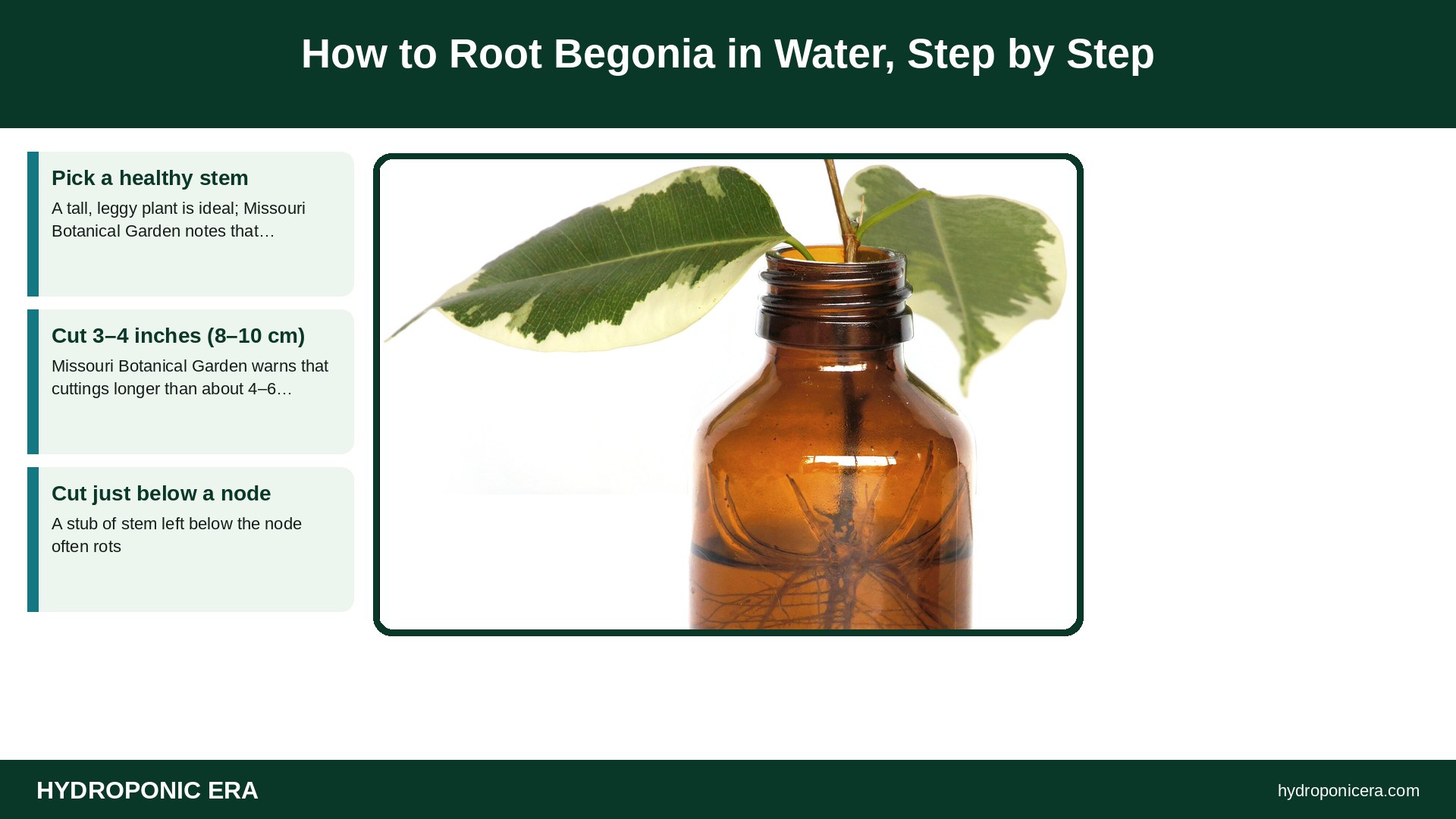
- Pick a healthy stem. A tall, leggy plant is ideal; Missouri Botanical Garden notes that cutting it back also makes the parent bushier.
- Cut 3–4 inches (8–10 cm). Missouri Botanical Garden warns that begonia cuttings longer than about 4–6 inches (10–15 cm) root poorly and grow lanky.
- Cut just below a node. A stub of stem left below the node often rots.
- Strip the lower leaves and any flowers. Keep two or three leaves at the top.
- Use a small jar. The American Begonia Society explains that cuttings release rooting compounds into the water, so less water keeps them more concentrated.
- Submerge at least one node, keeping all leaves above the water.
- Place in bright, indirect light and keep the room at 60–80°F (16–27°C).
- Add fresh water as needed and replace it if it turns cloudy; a begonia in water rots quickly in stale water.
How Long Does Begonia in Water Take to Root?
Missouri Botanical Garden says rooting generally occurs in 3–4 weeks, though some plants take longer. Soft wax begonias are often quicker, while thick cane stems can be slower in a cool room. Warmth matters: N.C. State Extension notes that most begonias don’t tolerate temperatures below 55°F (13°C), so keep jars away from cold winter windows and drafts.
When to Move Begonia in Water to Soil
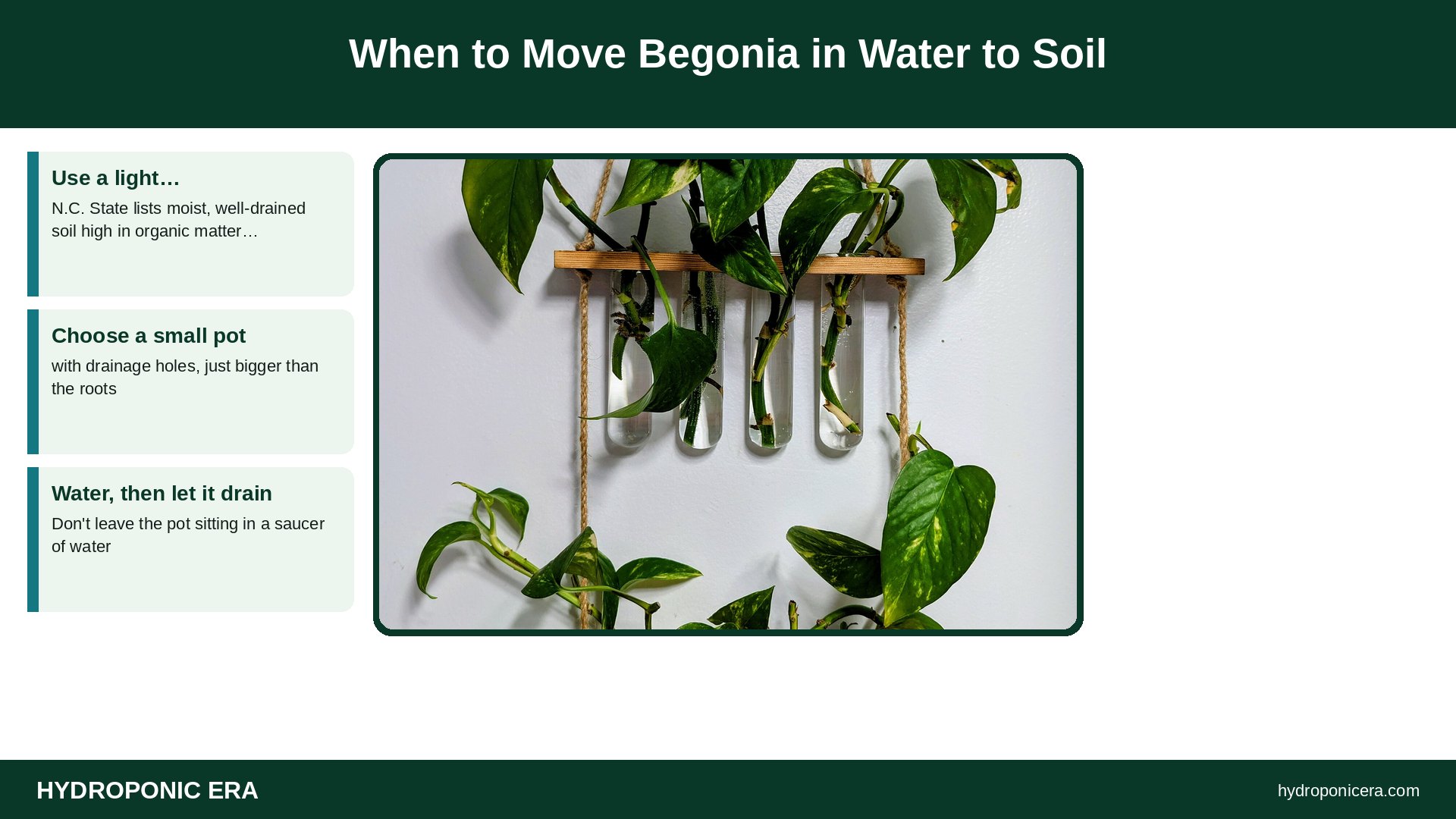
You don’t need a big root mass. The American Begonia Society says cuttings can be potted once roots are about ½ inch (1 cm) long, and adds that water-grown begonia roots transplant just fine. Missouri Botanical Garden suggests 1–2 inches (2.5–5 cm). Potting early, before roots tangle, makes the move easier.
- Use a light, well-drained mix. N.C. State lists moist, well-drained soil high in organic matter, with a pH of 5.5–6.5.
- Choose a small pot with drainage holes, just bigger than the roots.
- Water, then let it drain. Don’t leave the pot sitting in a saucer of water.
- Keep moisture even. Iowa State says begonias like consistent moisture, but roots rot quickly when soil stays wet for long periods.
Can Begonia in Water Live Long Term?
A begonia in water can live for a while, especially fibrous and cane types, but our sources all describe begonias as soil plants that need good drainage. Water has almost no nutrients, so long-term jar plants slowly get pale and weak. If you want a permanent water display, use a dilute hydroponic nutrient solution, change it regularly, and accept slower growth. For plants that are happier in jars, see plants that grow in water.
Rooting Rex Begonia From a Leaf
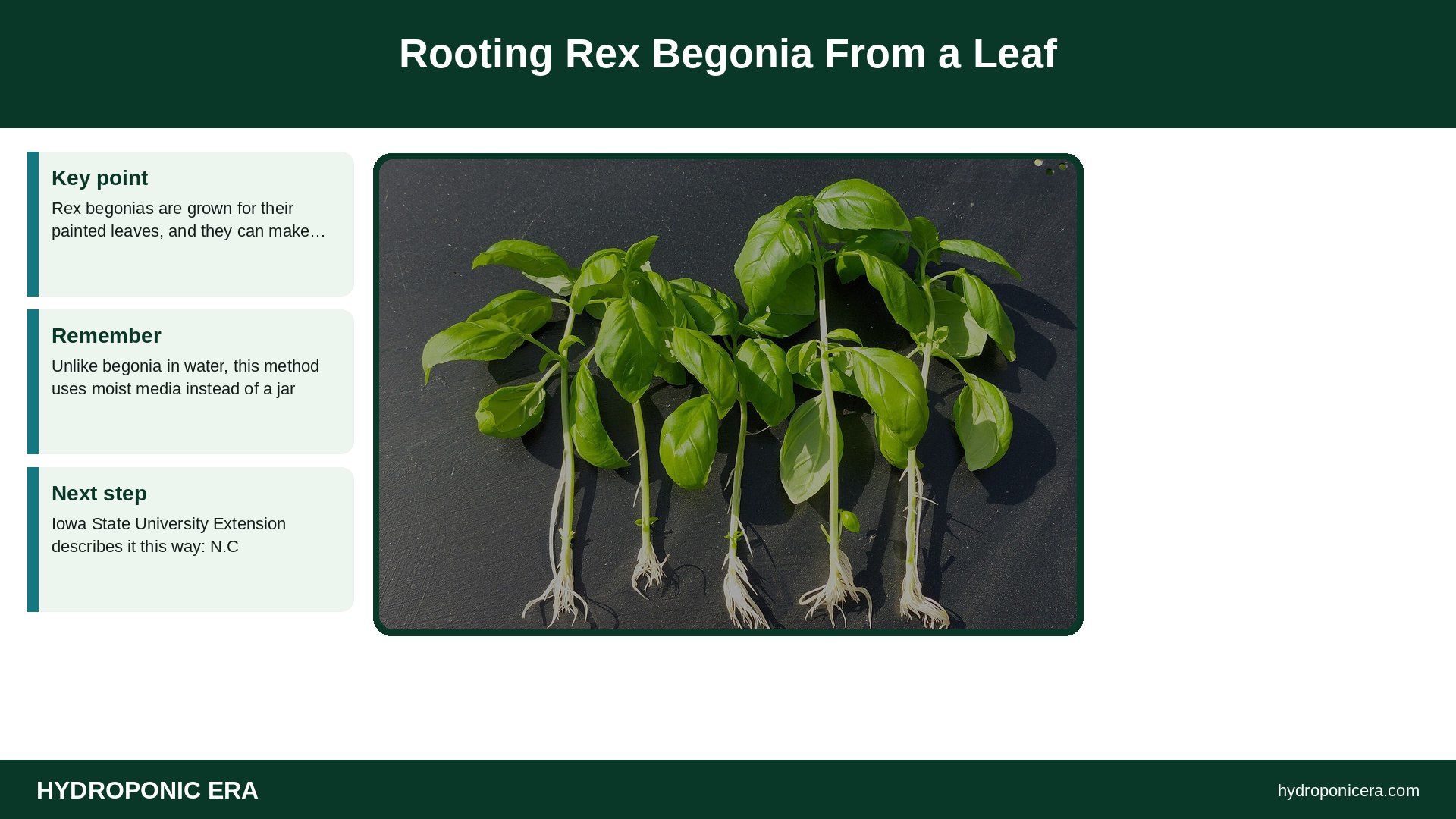
Rex begonias are grown for their painted leaves, and they can make many new plants from one leaf. Unlike begonia in water, this method uses moist media instead of a jar. Iowa State University Extension describes it this way:
- Remove a firm, healthy leaf.
- Cut across the major veins on the underside.
- Lay the leaf vein-side down on moist rooting medium and pin or weight it so the cuts touch the medium.
- Keep it warm, in bright indirect light and high humidity.
- Look for small plantlets at the cut veins, usually in 6–8 weeks.
N.C. State adds that rex begonias need high humidity and decline when the air is dry, which is why a clear cover or humidity dome helps. See humidity domes for cuttings.
Troubleshooting Begonia in Water

- Stem turns soft and black: rot from a stub below the node, leaves underwater, or dirty water. Recut above the soft area into fresh water.
- No roots after 4–6 weeks: usually too cool or too dark. Move to a warmer, brighter spot.
- Leaves wilt: too many leaves for a rootless stem. Remove all but two or three.
- Crisp, brown edges: the American Begonia Society links this to low humidity on cane types.
- White fuzz on roots: often normal root hairs. See white fuzz on roots in water.
Related reading: coleus in water, another soft-stemmed plant Missouri Botanical Garden lists as rooting easily, and hydroponic cuttings and cloning.
Begonia in Water vs. Perlite
Both work for begonia cuttings. Growing begonia in water lets you see roots form and catch rot early. Perlite under mist, which Iowa State also recommends, avoids the transplant step and suits cane cuttings, since the American Begonia Society suggests perlite or sand for them. If you have several cuttings, try some in each method and see which works best in your home.
FAQs
How long does begonia in water take to root?
Usually about 3–4 weeks in a warm, bright room.
Can I root a begonia leaf in water?
A leaf with a piece of stem may root, but rex leaf-vein cuttings work best on moist media.
Do I need rooting hormone?
No; begonia cuttings root readily without it.
Can a begonia stay in water forever?
It can survive for a time, but grows best in well-drained soil.
Which begonia is easiest to root in water?
Cane types such as angel wing, plus wax begonias.
Why is my begonia cutting rotting?
Usually a stem stub below the node, submerged leaves or stale water.
Sources
- American Begonia Society — Vegetative Propagation
- American Begonia Society — Cane-Like Begonias: Like Bamboo with Flowers
- Missouri Botanical Garden — Rooting Cuttings in Water
- Iowa State University Extension and Outreach — Growing Begonias in Iowa
- Iowa State University Extension and Outreach — How to Propagate Houseplants by Leaf Vein Cuttings
- N.C. State Extension Plant Toolbox — Begonia
- Photo credits (Wikimedia Commons, edited with titles): Begonia rex 5zz by Photo by David J. Stang (CC BY-SA 4.0); Ficus cuttings with roots in a bottle, White background by Biusch (CC BY-SA 3.0); Pothos plant on water by Joli Rumi (CC BY-SA 4.0); Basilikum (Ocimum basilicum) Stecklinge — Josef Schlaghecken by Schlaghecken Josef (CC BY-SA 4.0); Philodendron hederaceum, Singapore Botanic Gardens (141542) by Moheen Reeyad (CC BY-SA 4.0)