
Can dracaena grow in water? Yes. Dracaena in water roots well from a stem tip or a 2–3 inch (5–8 cm) cane section with at least two nodes. Keep one or two nodes underwater, use fluoride-free water if you can, and change it at least twice a week. Roots take several weeks; then pot it or keep it in water with a weak feed.
Key takeaway: Dracaena in water is one of the easiest canes to root in water. Its main weakness is fluoride and salt sensitivity, which shows up as brown leaf tips.
| Cutting type | Size | How to place it |
|---|---|---|
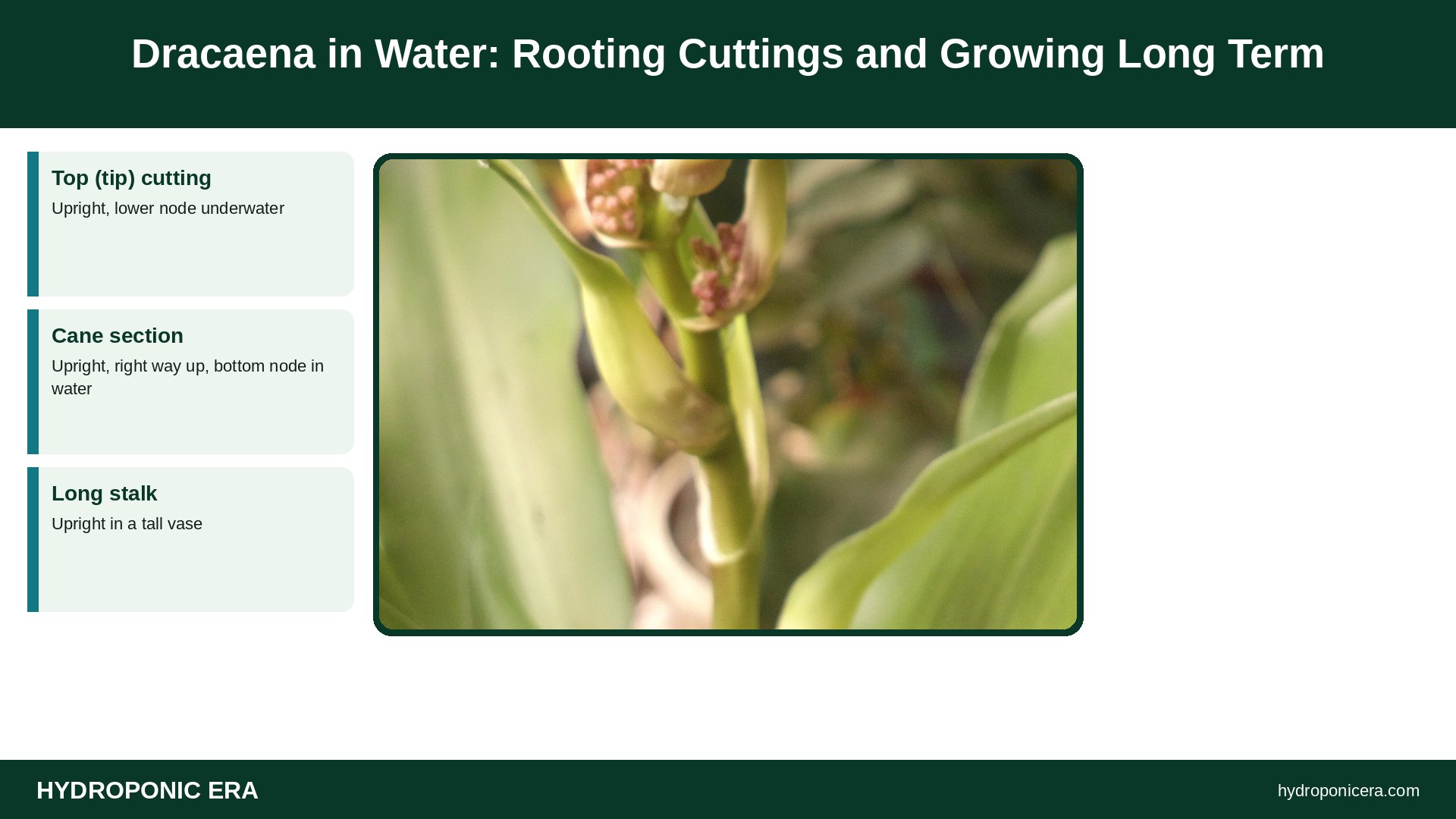
| Top (tip) cutting | 3–6 inches (8–15 cm), leafy crown | Upright, lower node underwater |
| Cane section | 2–3 inches (5–8 cm), at least 2 nodes | Upright, right way up, bottom node in water |
| Long stalk | Any length with nodes | Upright in a tall vase |
Which Types of Dracaena in Water Grow Best?
Most cane-type dracaenas root readily. Corn plant (Dracaena fragrans, including ‘Janet Craig’ and ‘Massangeana’), Madagascar dragon tree (D. marginata) and D. reflexa all propagate from stem cuttings. Lucky bamboo is a dracaena too (D. sanderiana) and is sold growing in water. North Carolina State Extension notes that corn plant is propagated by stem cuttings, and the University of Illinois Extension lists stem cuttings and air layering for dracaena. Snake plant was moved into the genus Dracaena, but it is a very different plant with its own method.
How Do You Propagate Dracaena in Water Step by Step?
To start dracaena in water, cut a tip or a cane piece, keep track of which end is up, and stand it in clean water.
- Cut the top. With clean pruners, remove a leafy crown with 3–6 inches (8–15 cm) of stem. Cutting a leggy plant back also makes the mother plant sprout new heads.
- Cut cane sections (optional). Illinois Extension and Penn State Extension both describe 2–3 inch (5–8 cm) cane sections with at least two nodes. Mark the top end so you don’t plant them upside down.
- Strip low leaves. Remove leaves that would sit underwater.
- Place in water. Submerge the bottom node or two. For cane sections, keep the top node above water so it can sprout.
- Choose bright, filtered light. NC State warns that direct sun can burn dracaena leaves, while low light makes leaves narrow.
- Keep it warm. NC State says corn plants thrive at 70–80°F (21–27°C).
- Refresh the water. At least twice a week, as Maryland Extension recommends for water rooting.

How Long Does Dracaena in Water Take to Root?
Dracaena in water usually needs several weeks. Thick, woody canes are slower than soft houseplant stems. Illinois Extension notes tougher stems take longer than tender ones, and Vermont Extension reminds growers that rooting can take weeks or months. You’ll see small white root tips at the submerged nodes first. Cane sections may push a new leaf bud from the upper node before or after roots appear.
What Water Is Best for Dracaena in Water?
Low-fluoride, low-salt water is best for dracaena in water. NC State Extension states that corn plant is sensitive to fluorides and built-up salts, and recommends non-fluoridated water and monthly salt flushing if leaf tips brown. In a jar, salts concentrate as water evaporates, so replace the water rather than topping up for weeks.
| Water source | Fit for dracaena |
|---|---|
| Rainwater | Good; low in fluoride and salts |
| Distilled or RO water | Good; add a weak fertilizer if long term |
| Fluoridated tap water | Works for rooting; may cause brown tips over time |
| Softened water | Avoid; adds sodium |
Read more in our guides to fluoride in water for plants and rainwater for hydroponics.
Can Dracaena in Water Live There Permanently?
Many can for a long time, especially lucky bamboo and small cane cuttings. Growth will be slower than in soil, and plain water runs out of nutrients. For long-term water growing:
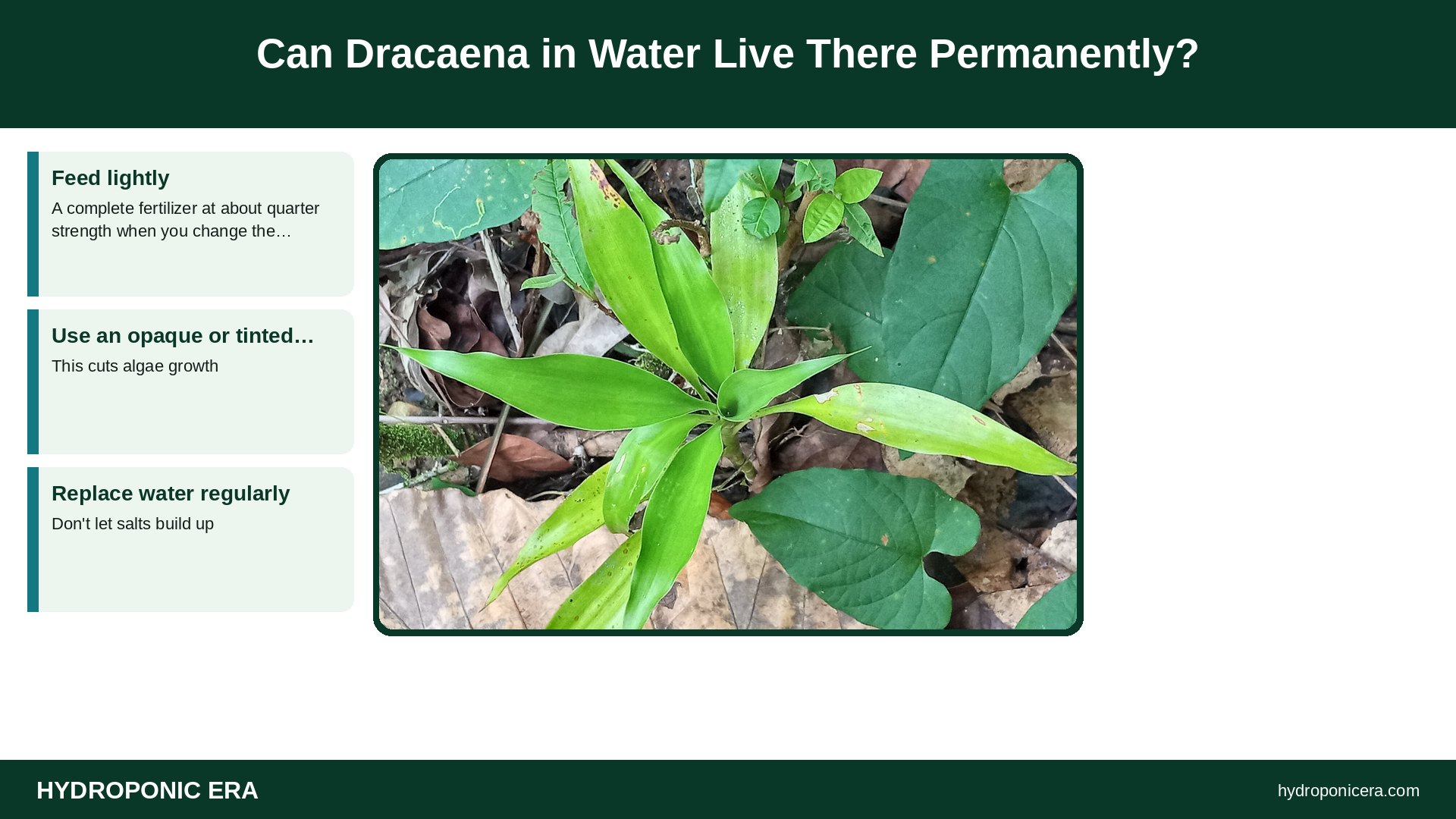
- Feed lightly: A complete fertilizer at about quarter strength when you change the water. Our guide to hydroponic nutrients explains complete formulas.
- Use an opaque or tinted vase: This cuts algae growth.
- Replace water regularly: Don’t let salts build up.
- Support tall stems: Pebbles or a weighted vase stop tipping.
Why Are My Dracaena Cutting’s Leaves Turning Brown?
Brown tips usually mean fluoride, salts or dry air. NC State notes brown tips can come from low indoor humidity and suggests a humidifier, especially in heated winter rooms. Other causes:
- Fluoride or salt buildup: Switch to rain or distilled water.
- Overfeeding: Too much fertilizer in a jar burns tips.
- Cold: NC State recommends keeping corn plants above 50°F (10°C).
- Rot: A soft, dark stem base means bacteria. Cut above it and refresh the water.
Our overview of plants that grow in water lists other low-fuss options.
Is Water or Soil Better for Rooting Dracaena?
Both work; they suit different goals. Penn State Extension roots dracaena cane by sticking sections vertically with a node buried, or laying them horizontally half-buried in moist media, so roots form below and shoots grow from exposed nodes. Illinois Extension describes the same vertical and horizontal methods. Media rooting skips the transplant step and gives sturdier roots.
Water rooting wins on visibility and simplicity. You can see exactly when roots form and catch rot early. It’s also handy when you only have one or two cuttings and no propagation mix on hand. If you want several new plants from one leggy cane, media trays are more efficient; for a single top cutting on a windowsill, a glass of water is hard to beat. Our humidity dome guide covers the media route.
How Do You Move Dracaena in Water to Soil?

Pot it once roots are 1–2 inches (2.5–5 cm) long. Illinois Extension uses about 1 inch (2.5 cm) as the potting cue; Vermont waits for 2–3 inches (5–8 cm). NC State recommends commercial potting soil in a pot with drainage holes. Keep the mix moist during the growing season and cut back in winter. Water roots can sulk for a couple of weeks while they adjust, so avoid fertilizing until new leaves appear.
Is Dracaena Toxic to Pets?
Yes, mildly. NC State lists corn plant as having low-severity poison characteristics and flags it as a problem for cats and dogs. Keep jars where pets can’t drink the water or chew leaves.
FAQs
Can I root dracaena cane upside down?
No. Roots form at the lower end; keep the original orientation.
Do dracaena cuttings need rooting hormone?
No, but a light dusting can speed rooting, as Penn State notes.
Will the cut mother plant regrow?
Usually yes; new shoots sprout below the cut.
How deep should the water be for dracaena in water?
Enough to cover one or two nodes, about 1–2 inches (2.5–5 cm).
Can I grow lucky bamboo the same way?
Yes. It’s a dracaena and roots the same way.
Sources
- North Carolina State Extension — Dracaena fragrans (Corn Plant)
- University of Illinois Extension — Cuttings
- University of Illinois Extension — Houseplant Propagation
- Penn State Extension — Propagating Houseplants
- University of Maryland Extension — 5 Plants That Root Easily in Water
- University of Vermont Extension — More, Please: Propagating Houseplants
- Photo credits (Wikimedia Commons, edited with titles): Stage 1 of the night blooming Dracaena Flower by Legendster (CC BY-SA 4.0); Dracaena fragrans (Leaves) by Filo gèn’ (CC BY-SA 4.0); Dracaena sanderiana 132158060 by Beah Vega (CC BY 4.0); US Navy 050107-N-0057P-246 Aviation Electronics Technician 2nd Class Jason D. Schapp of Oakridge, Ore., and members of the Indonesian Army unload jugs of water that were purified in distilling plant aboard USS Abraham Lincoln ( by U.S. Navy photo by Photographer’s Mate 2nd Class Seth C. Peterson (Public domain); Dracaena sanderiana 132158060 by Beah Vega (CC BY 4.0)