
Can alocasia grow in water? Partly. Alocasia leaves and stems won’t root as cuttings, but alocasia in water works for sprouting the small corms (bulbs) that form around the roots, and for rooting divided offsets. Set a corm so only its base touches water, keep it warm at 68–77°F (20–25°C) in bright, indirect light, and move sprouted corms to airy, well-drained mix.
Key takeaway: Alocasia in water is a propagation trick for corms and offsets, not a way to root a leaf. The plant is prone to root rot, so keep most of the corm dry and move it to soil once roots and a leaf form.
| Part | Will it root in water? | Notes |
|---|---|---|
| Leaf with petiole | No | No growing point; it will rot |
| Corm (bulblet) | Yes | Only the base in water |
| Offset (pup) with roots | Yes | Already has roots; water helps it settle |
| Rhizome section with a bud | Sometimes | Needs a visible bud |
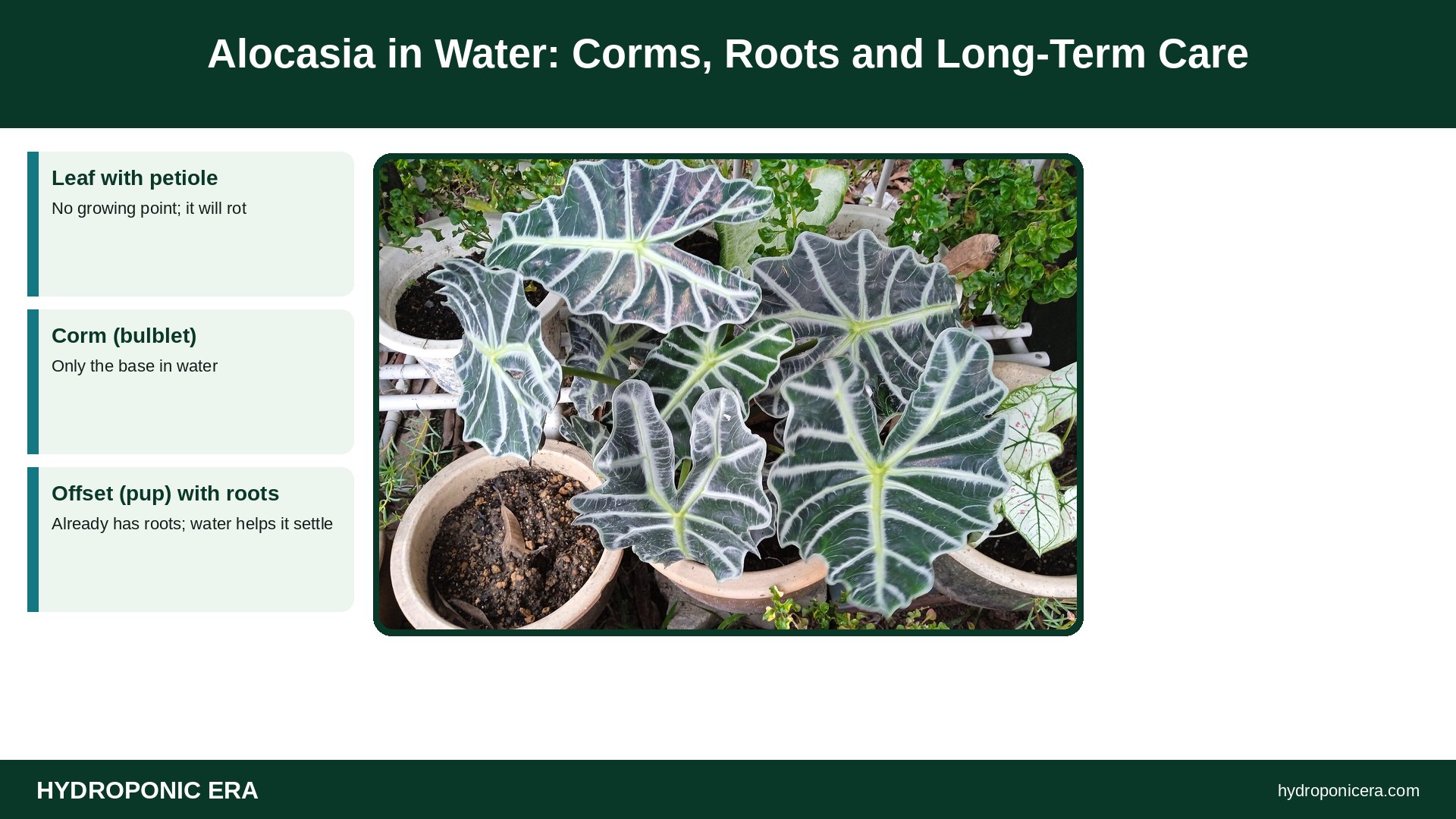
Why Won’t an Alocasia Leaf Root in Water?
A leaf has no bud to make a new plant. Alocasia grows from a tuberous base. North Carolina State Extension describes the genus as tuberous, herbaceous perennials in the arum family and says plants are propagated by division of offsets. A cut leaf stalk may stay green in water for a while, but it can’t form a new growing point. Use corms or offsets instead.
How Do You Start Alocasia in Water From Corms?
To start alocasia in water, peel or soak the corm, then let only its base touch water in a warm, bright spot.
- Find corms. When you repot, look for small, round, brown bulblets among the roots.
- Clean them. Rinse off soil. Some growers gently peel the tough outer skin to speed sprouting; leave the inner tissue intact.
- Set up a shallow dish. Place the corm on a bottle cap, pebbles or a clear container so the bottom sits just in water and the top stays dry.
- Cover for humidity. A lidded clear box or plastic bag keeps humidity high.
- Keep it warm. NC State says alocasia grows best at 68–77°F (20–25°C).
- Give bright, indirect light. Avoid direct sun on a closed container, which overheats it.
- Refresh water every few days and remove any corm that turns soft or smells.
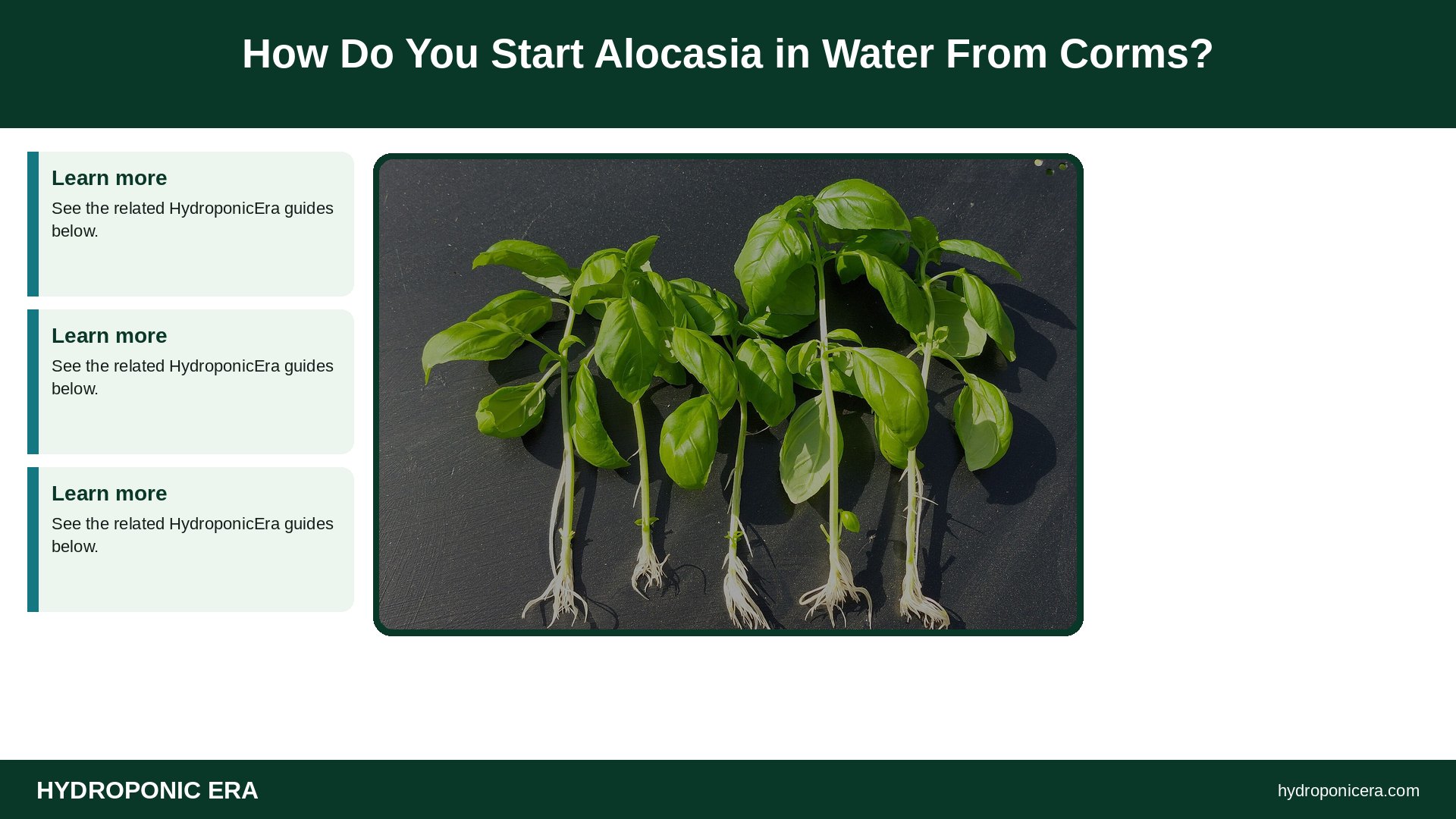
How Long Does Alocasia in Water Take to Sprout?
Often several weeks to a few months. Corms can sit dormant before a root or shoot appears, and warmth makes the biggest difference. A root usually comes first, then a pale shoot that unfurls into a small leaf. NC State notes that alocasia can take up to 600 days to mature, so a corm-grown plant takes time to reach full size.
How Do You Divide Offsets for Alocasia in Water?
Separate a pup that has its own roots and leaf, rinse it and set the roots in water.
- Unpot the plant and shake off soil.
- Find offsets with at least one leaf and some roots.
- Separate gently by hand or with a clean knife.
- Rinse the roots and place them in water with the crown above the waterline.
- Change water at least twice a week.
For alocasia in water, offsets adjust faster than loose corms because they already have roots and leaves.
Can Alocasia in Water Live There Permanently?

Some growers keep alocasia in water or semi-hydro setups for years, but it’s demanding. NC State notes root rot and leaf spots can occur from overwatering, and yellow leaves can come from overwatering, too little water or poor light. In water culture, rot shows up quickly if oxygen is low or water goes stale. If you try it long term:
- Keep the crown dry. Only roots should be submerged.
- Feed lightly with a complete nutrient; NC State says to water and fertilize regularly.
- Refresh water often to keep it oxygenated.
- Consider clay pebbles. A passive LECA setup gives roots more air; see our guide to clay pebbles.
When Should You Move Alocasia in Water to Soil?
Once a sprouted corm has a few roots and its first leaf, plant it. NC State says alocasia prefers moist, well-drained, humus-rich, slightly acidic soil. Use a small pot with drainage holes and an airy mix with bark or perlite. Keep it warm and humid, and water when the top of the mix starts to dry.
How Do You Care for Young Alocasia After Water Rooting?
Give it warmth, humidity, bright indirect light and careful watering. Young plants from alocasia in water are tender for their first few months, and NC State notes several problems to watch:
- Spider mites: NC State says alocasia is prone to them, especially in dry indoor air. Check leaf undersides weekly; our guide to spider mites shows early signs.
- Aphids and mealybugs: Also listed by NC State. Wipe off small infestations.
- Winter slowdown: NC State advises reducing watering in winter.
- Moving outdoors: Containers can go outside after the last frost and should come back in before the first fall frost.
Expect slow growth at first. A small corm plant may only produce a few leaves in its first season.
Is Elephant Ear the Same as Alocasia?
“Elephant ear” is a common name for several large-leaved aroids, including Alocasia and Colocasia. NC State notes alocasia leaves resemble elephant ears and can measure 12–36 inches (30–91 cm) long. Colocasia (taro) naturally tolerates wet soil better than most alocasias. The corm method in this guide works for both, but check which plant you have before deciding on long-term water growing.
Why Is My Alocasia in Water Rotting?
- Too deep: Only the base should touch water.
- Cold: Below the 68°F (20°C) range, corms sit still and rot.
- Damaged tissue: Remove soft corms right away so they don’t foul the water.
- Stale water: Refresh it every few days.
Healthy roots are white and firm. Brown, mushy roots point to rot; our guide to why hydroponic roots turn brown covers causes, and Pythium root rot explains the most common culprit.
Is Alocasia Toxic?
Yes. NC State lists calcium oxalate crystals as the toxic principle, says it can cause contact dermatitis, and advises caution around small children and pets. Wear gloves when dividing and keep corms and jars out of reach.
FAQs
Can I root an alocasia stem cutting?
No. Use corms or offsets; stems and leaves lack a growing bud.
Should I peel alocasia corms?
Peeling the outer husk can speed sprouting; leave the inner flesh intact.
Do alocasia corms need light to sprout?
Bright, indirect light helps once a shoot appears; warmth matters most at first.
Why is my alocasia dropping leaves after moving to water?
Transition stress. Keep it warm and humid; new roots and leaves usually follow.
Is alocasia in water good for beginners?
Corm sprouting is fun, but long-term water growing suits experienced growers.
Sources
- North Carolina State Extension — Alocasia (Elephant’s Ear)
- University of Illinois Extension — Houseplant Propagation
- University of Vermont Extension — More, Please: Propagating Houseplants
- Penn State Extension — Propagating Houseplants
- Photo credits (Wikimedia Commons, edited with titles): Alocasia mortfontanensis at Taman Rekreasi Taman Sutera, Kajang 20230708 170622 by Wiki Farazi (CC0); Basilikum (Ocimum basilicum) Stecklinge — Josef Schlaghecken by Schlaghecken Josef (CC BY-SA 4.0); Hydroton by Lucis (CC BY-SA 3.0); Hydroton by Lucis (CC BY-SA 3.0); Spathiphyllum wallisii hydroponically grown by Kephalian (CC BY-SA 4.0)