
Can you root a croton in water? Yes. A croton in water roots from a 3–6 inch (8–15 cm) stem tip with two or more nodes. Wear gloves, rinse off the sap, remove lower leaves and set a node underwater in bright light at 75–80°F (24–27°C). Croton is woody and slow, so expect several weeks before roots appear, then pot it in well-drained mix.
Key takeaway: A croton in water roots slowly but reliably if it stays warm and bright. The sap irritates skin, and the plant drops leaves when stressed, so handle it gently and keep conditions steady.
| Need | Target | Source |
|---|---|---|
| Cutting | 3–6 inches (8–15 cm), 2–6 nodes | Illinois Extension |
| Rooting warmth | 75–80°F (24–27°C) | Penn State Extension |
| Light | Bright, with some direct sun once potted | NC State Extension |
| Cold limit | Bring indoors at 50°F (10°C) | NC State Extension |
| Safety | Gloves; sap causes itching and swelling | NC State Extension |
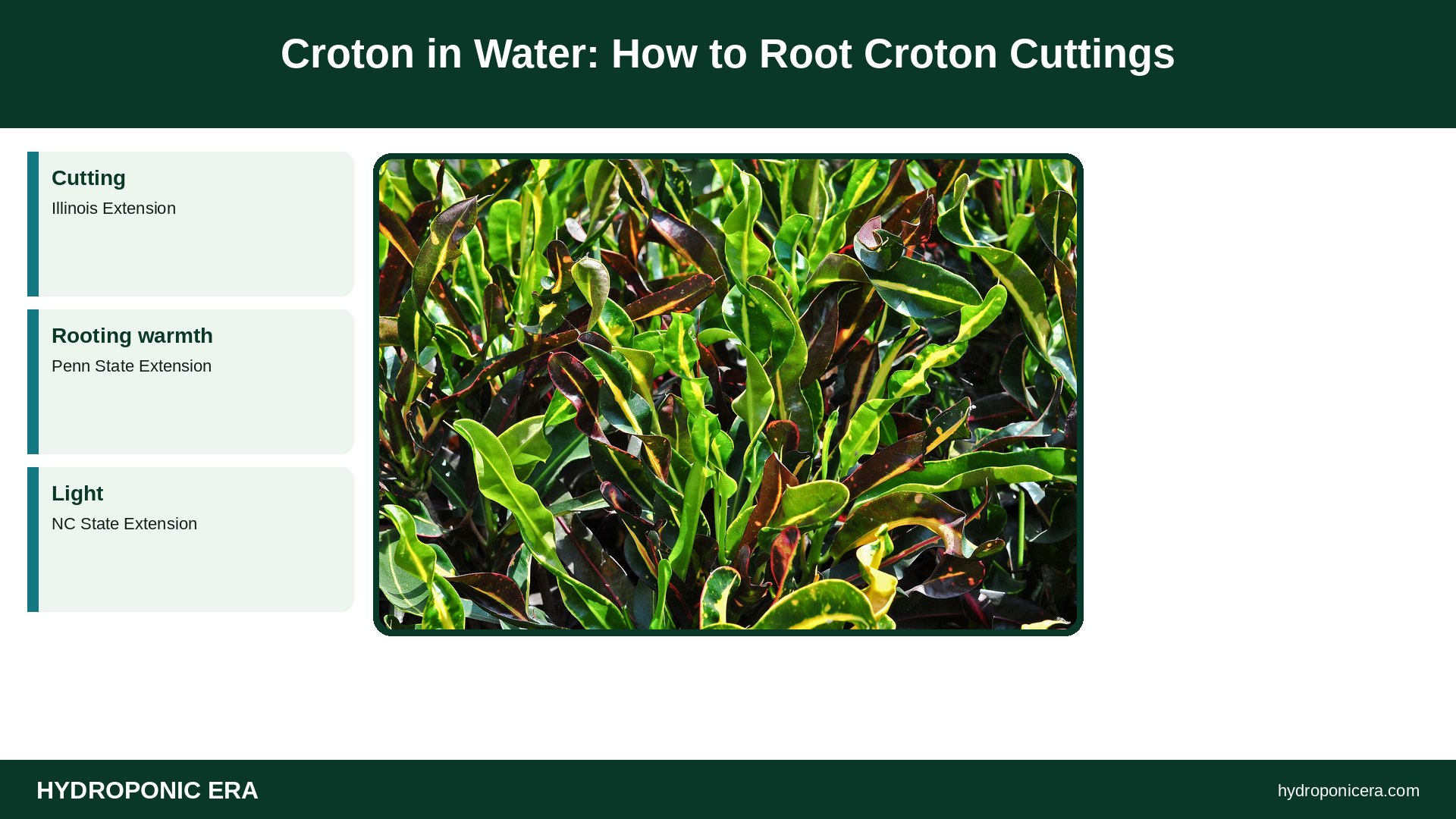
Does a Croton in Water Really Root?
Yes. University of Illinois Extension lists stem cuttings as the propagation method for croton (Codiaeum variegatum). Most guides root crotons in moist media under humidity, but water rooting works when the cutting is warm. Croton is a woody shrub in the spurge family, as North Carolina State Extension describes, and woody stems are slower to root than soft ones. Patience is the main requirement.
How Do You Propagate a Croton in Water Step by Step?
Take a healthy tip, handle the sap safely, and keep the cutting warm.
- Put on gloves. NC State warns that sap from cut leaves or stems can irritate soft tissue, causing itching and swelling, and permanently stains fabric.
- Cut a stem tip 3–6 inches (8–15 cm) long with two to six nodes, as Illinois Extension recommends for stem cuttings.
- Rinse the cut end under cool water until the sap stops.
- Strip lower leaves so none sit underwater. Leave 2–3 leaves at the top; cut large leaves in half to reduce water loss.
- Place in water with one or two nodes submerged.
- Keep it warm. Penn State gives 75–80°F (24–27°C) as the ideal rooting temperature. A seedling heat mat under the jar helps in cool rooms.
- Give bright light without hot midday sun on the glass.
- Change the water at least twice a week.

What Supplies Do You Need for a Croton in Water?
| Item | Why it helps |
|---|---|
| Disposable or rubber gloves | Protect skin from irritating sap |
| Sharp, sterilized pruners | Clean cuts heal faster; Illinois advises sterilizing tools |
| Narrow glass jar | Holds the stem upright with nodes submerged |
| Seedling heat mat | Keeps water in the 75–80°F (24–27°C) range |
| Clear plastic bag | Raises humidity around the leaves |
| Old towel | Sap permanently stains fabric, so protect surfaces |
A heat mat is the single most useful extra. Our guide to seedling heat mats and humidity domes explains how to use one safely.
How Long Does a Croton in Water Take to Root?
Expect several weeks, sometimes longer than a month. Illinois Extension notes that tough-stemmed cuttings root more slowly than tender ones, and croton stems are tough. Cool rooms slow things further. Keep the cutting as long as the stem is firm and the top leaves stay perky; a black, soft base means it’s time to recut.
Why Is My Croton Cutting Dropping Leaves?
Leaf drop is a stress response, common in cuttings and newly moved plants. The cutting has no roots yet, so it sheds leaves to save water. Common triggers:
- Too many leaves: Trim to 2–3 leaves or halve large ones.
- Cold or drafts: NC State recommends bringing crotons inside when temperatures reach 50°F (10°C); cuttings need far more warmth than that.
- Low light: NC State notes crotons may lose lower leaves in too much shade.
- Dry air: Croton prefers more humidity than most homes have in winter. A clear bag tented over the top leaves helps.
A cutting can drop most of its leaves and still root if the stem stays firm. For a humid setup, see our guide to humidity domes for cuttings.
When Should You Pot a Croton in Water?
Pot it once roots are about 1–2 inches (2.5–5 cm) long. NC State says crotons prefer well-drained, humus-rich soil that is occasionally dry. Use a small pot with drainage holes and good potting mix. After potting:
- Water liberally from spring to autumn and sparingly in winter, as NC State advises.
- Light should be bright with some direct sun for the best leaf color.
- Humidity can be raised with a tray of wet pebbles under the pot, an NC State suggestion.
Can a Croton Live in Water Permanently?
It can survive for a time but is better in soil. Crotons are shrubs that can reach about 3 feet (0.9 m) indoors, according to NC State, and need nutrients and anchorage. If you keep one in water, feed it lightly with a complete fertilizer and change the water regularly. Our guide to hydroponic nutrients explains what a complete feed includes.
Will a Croton in Water Keep Its Colors?

Color depends mostly on light. NC State says crotons need bright light, with some direct sun, for the best leaf color. A cutting rooting in a dim spot may push greener new leaves. Once potted and moved to bright light, new growth usually colors up again. If you use a grow light, see our grow light guide.
Is Croton Toxic?
Yes. NC State lists diterpene esters as the toxic principle and notes croton causes contact dermatitis; all parts, including sap, are listed. Wash hands after handling, keep it away from eyes, and keep jars out of reach of children and pets.
Should You Air Layer a Croton Instead?
For a large, leggy plant, air layering is a good alternative to a croton in water. The stem stays attached while roots form in moist sphagnum moss wrapped around a wound, so the new plant keeps getting water from the parent. It’s slower to set up but often more reliable for thick, woody branches. Illinois Extension describes air layering for several woody houseplants.
For more cutting tips, see hydroponic cuttings and cloning and plants that grow in water.
FAQs
Can a single croton leaf root in water?
A leaf may root but won’t form a new stem without a node.
Does croton need rooting hormone?
It’s optional. Hormone can help woody cuttings root faster.
Why is my croton cutting’s water cloudy?
Bacteria from sap or decaying tissue. Rinse the stem and replace the water.
What temperature is too cold for croton cuttings?
Cool rooms slow rooting a lot. Aim for 75–80°F (24–27°C), the range Penn State recommends.
Can I propagate croton in winter?
Yes, with warmth and a grow light, but spring and summer are easier.
Sources
- North Carolina State Extension — Codiaeum variegatum (Croton)
- University of Illinois Extension — Houseplant Propagation
- University of Illinois Extension — Cuttings
- Penn State Extension — Propagating Houseplants
- Photo credits (Wikimedia Commons, edited with titles): Codiaeum variegatum 31032014 by Joydeep (CC BY-SA 3.0); Ficus cuttings with roots in a bottle, White background by Biusch (CC BY-SA 3.0); 2008-09-20 Thermometer reading by Ildar Sagdejev (Specious) (CC BY-SA 4.0); Basilikum (Ocimum basilicum) Stecklinge — Josef Schlaghecken by Schlaghecken Josef (CC BY-SA 4.0); Terramera scientists working in a climate-controlled growth chamber located in Vancouver, BC. The space uses LED lighting, which supports plant growth. (50188965171) by Simon Fraser University – Communications & Marketing (CC BY 2.0)