
Can you propagate peperomia in water? Yes. Peperomia in water roots from a stem tip cutting with two or three leaves and a bare node underwater. Leaf cuttings can root too, but they grow faster in moist mix. Keep the jar warm in bright, indirect light, change the water weekly and pot when roots reach about 1 inch (2.5 cm), because peperomia hates staying wet.
Key takeaway: Peperomia in water works best as a short rooting stage, not a permanent home. Its thick stems rot if left in water too long.
| Cutting type | In water? | Notes |
|---|---|---|
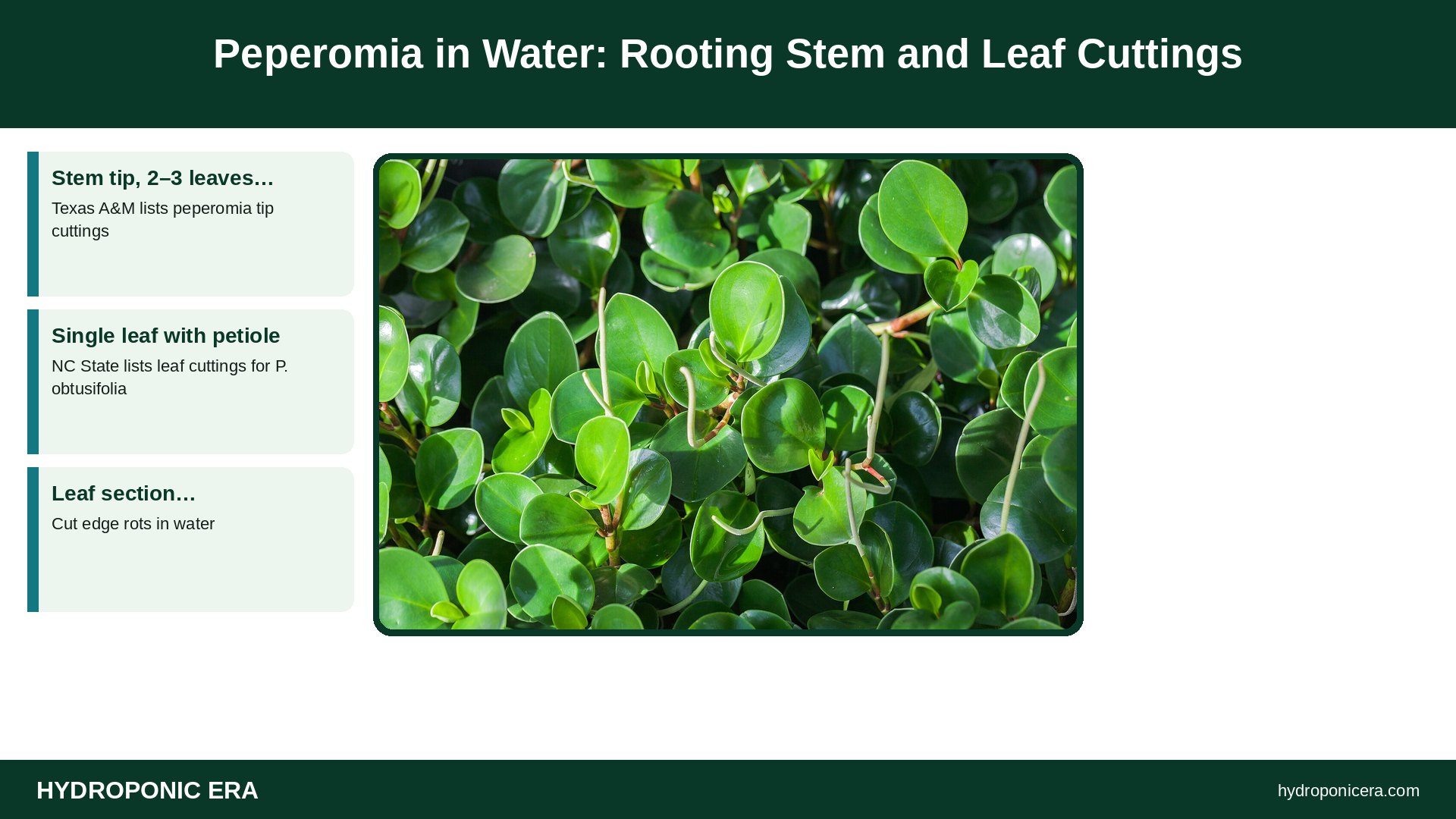
| Stem tip, 2–3 leaves, 1–2 nodes | Yes, most reliable | Texas A&M lists peperomia tip cuttings |
| Single leaf with petiole | Possible; better in mix | NC State lists leaf cuttings for P. obtusifolia |
| Leaf section (watermelon types) | No; use moist mix | Cut edge rots in water |
Does Peperomia in Water Root Well?
Yes, most upright and trailing types root readily. Texas A&M AgriLife lists peperomia among plants propagated from tip cuttings and from leaf cuttings. NC State Extension lists leaf and stem cuttings for the baby rubber plant (Peperomia obtusifolia) and leaf cuttings for string of turtles (Peperomia prostrata). The catch is moisture: NC State says P. obtusifolia is intolerant of wet soil and that overwatering yellows leaves and leads to root rot. Peperomia in water is fine for rooting but needs a timely move to a fast-draining mix.
Which Peperomia Types Root in Water?
- Baby rubber plant (P. obtusifolia): Thick stems; tip cuttings root well.
- Trailing types (P. prostrata, P. scandens): Short vine pieces root at nodes.
- Ripple and watermelon peperomia (P. caperata, P. argyreia): Usually propagated by leaf with petiole; mix is safer than water.
- Raindrop peperomia (P. polybotrya): Stem or leaf with petiole.
What Supplies Do You Need for Peperomia in Water?
Very little, which is part of the appeal. Gather these before you cut:
- Sharp scissors or a knife, wiped with rubbing alcohol; Illinois Extension recommends sterilizing tools before and between cuts.
- A small clear glass or jar, narrow enough to hold the cutting upright.
- Clean water at room temperature.
- A bright spot out of direct afternoon sun.
- Optional: a clear plastic bag or dome for humidity, and a small pot with fast-draining mix for later.
Narrow-necked bottles support stems well, but they’re harder to clean, so rinse them with each water change.
How Do You Propagate Peperomia in Water Step by Step?
- Pick a healthy stem in spring or summer.
- Cut a 3–4 inch (8–10 cm) tip just below a node with clean, sharp scissors. Penn State Extension suggests 3–6 inch (8–15 cm) tip cuttings for houseplants.
- Remove the lowest leaves so one or two nodes are bare.
- Let the cut dry for an hour or two; thick, juicy stems seal and resist rot.
- Place the bare node in water, keeping leaves dry.
- Set in bright, indirect light. NC State says strong direct sun burns peperomia leaves.
- Keep warm. Illinois and Penn State extensions recommend about 75–80°F (24–27°C) for rooting.
- Change the water weekly; Texas A&M says rooting water must be clean and well aerated.
How Long Does Peperomia in Water Take to Root?
Roots usually show within a few weeks in a warm room. Vermont Extension reminds growers that rooting can take weeks or months depending on conditions, so a cool windowsill in winter is much slower. Look for white roots at the node. Pot when they reach about 1 inch (2.5 cm), the cue Illinois Extension uses for cuttings, rather than waiting for a large root mass.
Can You Root a Single Peperomia Leaf in Water?
Sometimes, but it’s slower and riskier. A leaf with its stalk (petiole) can grow roots in water, but new plantlets form more reliably in a moist medium. Texas A&M describes the usual method: a healthy leaf with a short stem, dipped in rooting hormone and inserted into moist propagation media, with bottom heat near 75°F (24°C) and high humidity. It says plantlets form at the base after a few weeks.
Why Is My Peperomia Cutting Rotting in Water?
- Too much stem underwater: Only the bottom node needs to be submerged.
- Stale water: Change it weekly or when cloudy.
- Cold: Low temperatures slow rooting and favor rot.
- Too long in water: Thick, succulent tissue softens over time.
- Damaged tissue: Crushed or torn cuts rot first; use a clean, sharp cut.
Cut above any soft, dark area, let it dry, and restart in fresh water. Our guide to pythium root rot explains how warm, stagnant water feeds rot organisms.
When Should You Move Peperomia in Water to Soil?

Move it early, once roots are about 1 inch (2.5 cm). NC State says peperomia prefers dry soil and bright indirect light, and is intolerant of both wet and very dry soil.
- Mix: Potting mix lightened with perlite or bark; see perlite and vermiculite.
- Pot: Small, with drainage holes.
- Water: Lightly moist the first week, then let the top inch (2.5 cm) dry between waterings.
Can Peperomia Live in Water Permanently?
It’s not ideal. Some growers keep peperomia in water or semi-hydro setups with clay pebbles, but its rot-prone stems make permanent water growing tricky. If you try, keep only the roots submerged, add quarter-strength fertilizer and change the water often. Semi-hydro in clay pebbles gives the crown more air than a jar.
Is Peperomia in Water Safe for Pets?
NC State tags Peperomia obtusifolia as non-toxic for cats, dogs and horses and pet friendly. Even so, keep jars out of reach so pets don’t spill water or chew cuttings.
What Pests Should You Watch on Peperomia Cuttings?

NC State advises monitoring P. obtusifolia for mealybugs, spider mites and whiteflies. Inspect leaf undersides and stem joints before taking cuttings so you don’t propagate a problem. Rinse cuttings under lukewarm water if you see a few pests.
How Do You Care for New Peperomia Plants?
NC State notes P. obtusifolia tolerates low light for several months, especially non-variegated cultivars, but grows best in bright indirect light with medium to low humidity. Avoid drafty spots, which NC State lists among the plant’s dislikes. Feed lightly during spring and summer once new leaves appear.
FAQs
Do peperomia cuttings need rooting hormone?
No, but Texas A&M notes hormone promotes root formation, especially for leaf cuttings.
Can I use tap water for peperomia in water?
Usually, yes. Let chlorinated water stand overnight, or use filtered water.
How many cuttings per jar?
A few, as long as leaves don’t touch and the water stays clean.
Why are my peperomia cuttings wilting?
Mild wilting is normal at first; a bag over the jar raises humidity.
Does variegated peperomia root as easily?
Usually, but more slowly, since pale tissue makes less energy.
Sources
- North Carolina State Extension — Peperomia obtusifolia (Baby Rubber Plant)
- North Carolina State Extension — Peperomia prostrata (String of Turtles)
- Texas A&M AgriLife Extension — Propagating Foliage & Flowering Plants
- University of Illinois Extension — Cuttings
- Penn State Extension — Propagating Houseplants
- University of Vermont Extension — More, Please: Propagating Houseplants
- Photo credits (Wikimedia Commons, edited with titles): Peperomia obtusifolia, Conservatorio botánico, Fort Wayne, Indiana, Estados Unidos, 2012-11-12, DD 01 by Diego Delso (CC BY-SA 3.0); Peperomia prostrata, Phipps Conservatory, 2024-08-24 by Cbaile19 (CC0); Basilikum (Ocimum basilicum) Stecklinge — Josef Schlaghecken by Schlaghecken Josef (CC BY-SA 4.0); Perlite1 by KENPEI (CC BY-SA 3.0); Ficus cuttings with roots in a bottle, White background by Biusch (CC BY-SA 3.0)