
Can anthurium grow in water? Yes. Anthurium in water roots from a stem section with at least one node and some aerial roots, and established plants can live in water if the crown stays dry and you add dilute fertilizer. Keep it at 65–80°F (18–27°C) in bright, indirect light, change the water weekly and never submerge the leaves or crown.
Key takeaway: Anthurium in water succeeds when only roots touch the water. Use a cutting with aerial roots for the fastest start.
| Method | Speed | Notes |
|---|---|---|
| Stem cutting with aerial roots | Fastest | Existing roots adapt to water |
| Stem cutting with a node only | Slower | Needs warmth and humidity |
| Division of a clump | Instant plant | NC State and Illinois list division |
| Whole plant moved to water | Moderate | Wash soil off roots first |

Does Anthurium in Water Really Work?
It does. NC State Extension says the flamingo flower (Anthurium andraeanum) can be propagated by division or stem cuttings, and Illinois Extension lists stem cuttings and division for anthurium. In nature it grows as an epiphyte in warm, humid rainforests of Colombia and Ecuador, with roots that cling to bark in moist air. That root habit tolerates water well when the crown stays dry. Illinois Extension cautions that roots formed in water can be weaker in soil, so decide early whether the plant will stay in water.
How Do You Propagate Anthurium in Water Step by Step?
- Wear gloves. NC State says anthurium is toxic if ingested; the sap can irritate.
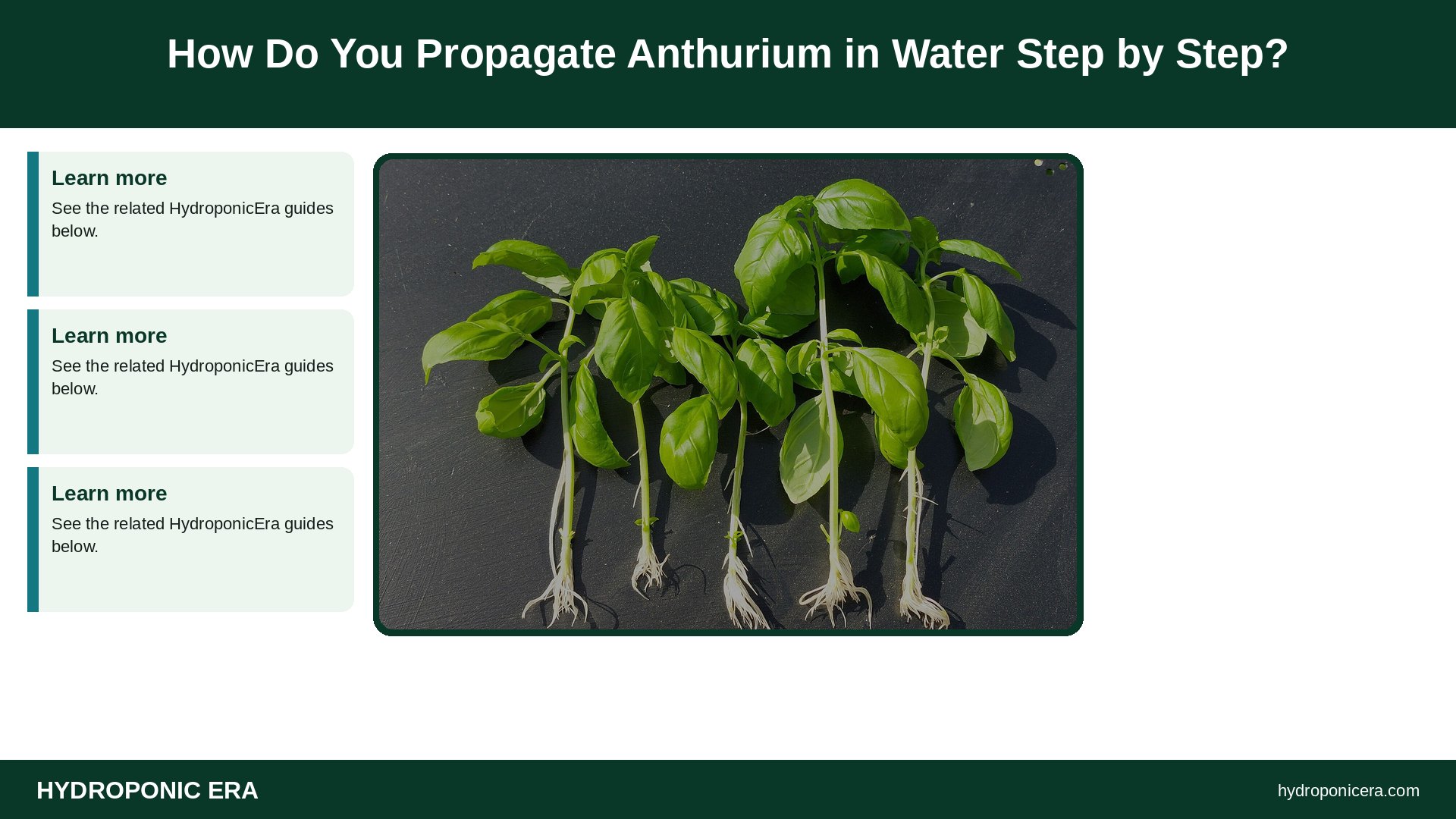
- Find a stem with a node, ideally with one or two brown aerial roots below a leaf.
- Cut below the node or aerial roots with clean, sharp shears, keeping one or two leaves.
- Remove leaves that would sit in water.
- Place in a jar so the node and roots are submerged and the leaf bases stay dry.
- Keep warm. NC State lists 65–80°F (18–27°C) as the preferred range; rooting is faster near the top.
- Give bright, indirect light. NC State says direct sun can scorch leaves.
- Change the water weekly and rinse the jar.
How Long Does Anthurium in Water Take to Root?
Expect several weeks. Cuttings with aerial roots often show new white root tips within a few weeks, while bare nodes take longer. Vermont Extension notes rooting can take weeks or months depending on the plant and conditions. Warmth and humidity speed things up. A clear bag loosely over the jar helps hold the 60–80% humidity NC State lists for this plant.
Can You Move a Whole Anthurium Into Water?
Yes, carefully. This is popular for display vases.
- Unpot the plant and soak the root ball in lukewarm water.
- Gently wash away all soil; leftover soil rots in water.
- Trim dead or mushy roots with clean scissors.
- Set the plant in a vase so roots hang in water and the crown sits above the waterline.
- Change the water weekly for the first month as roots adapt.
Expect a few older roots to die back while new water roots form. Remove any that turn brown and soft.
What Water and Fertilizer Does Anthurium in Water Need?
Plain water has no nutrients, so long-term plants need feeding. NC State recommends liquid fertilizer weekly during the growing season for potted anthurium. In water, use a much weaker dose:
- Strength: About quarter strength of a complete, water-soluble houseplant fertilizer.
- Timing: Spring through early fall; little or none in winter.
- Water changes: Replace the solution every one to two weeks to avoid salt buildup.
- Water type: Dechlorinated tap, filtered or rainwater.
Our guides to hydroponic nutrients for beginners and nutrient burn explain how to avoid overfeeding.
What Container Works Best for Anthurium in Water?
Choose a vase that supports the plant at the crown so leaves and stems stay out of the water. Good options:
- Narrow-necked glass vases: The neck holds the plant upright; tint or wrap them to limit algae.
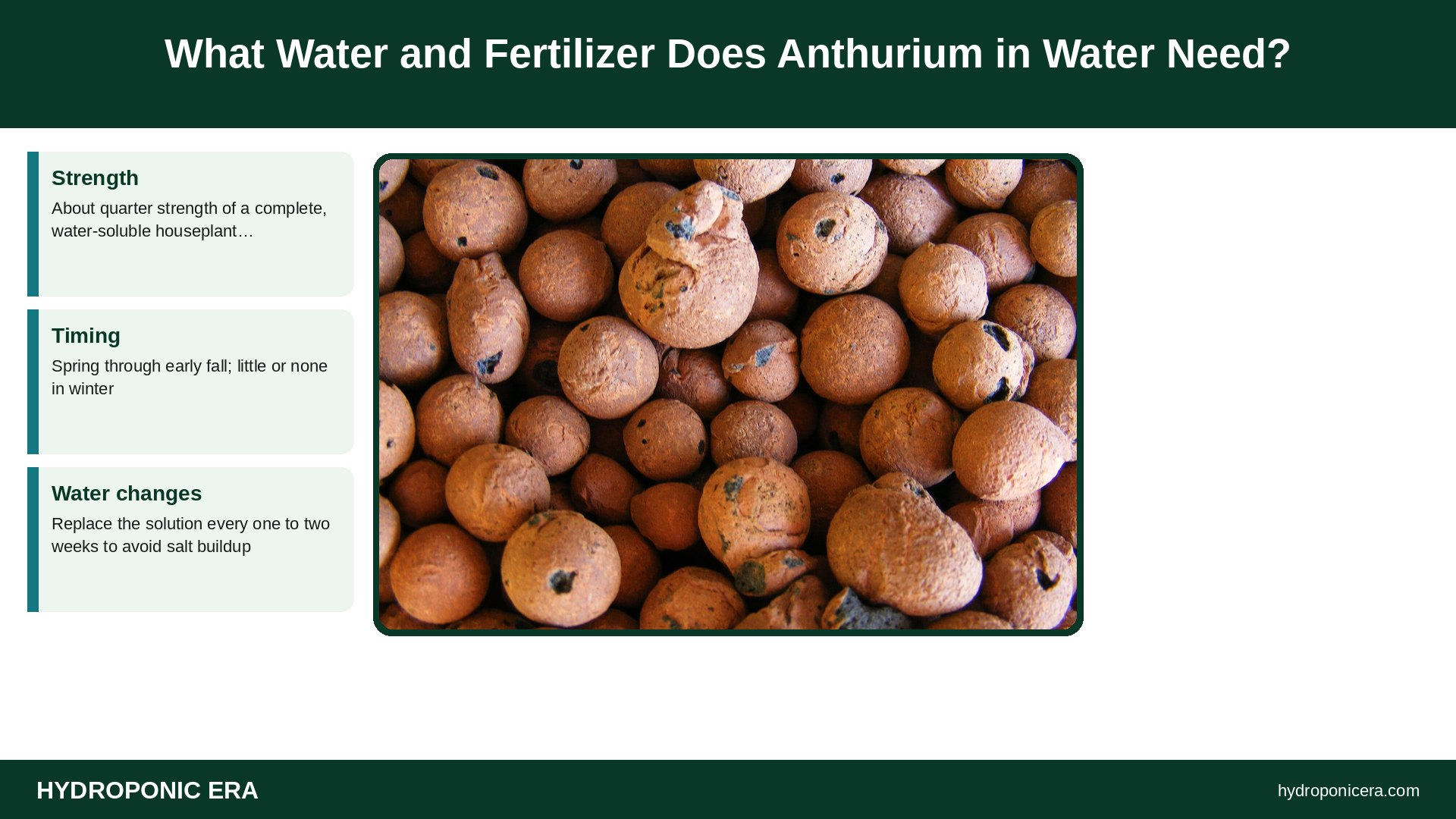
- Double-pot setups: A net pot or slotted insert filled with clay pebbles inside a watertight outer pot.
- Self-watering pots designed for semi-hydro growing, with a visible water gauge.
Whatever you pick, it should be easy to empty and scrub, because you’ll change the water often. Avoid metal containers that can corrode with fertilizer. A container slightly wider than the root mass leaves room for new roots without holding excess stagnant water.
Will Anthurium in Water Still Flower?
It can, given enough light and nutrients. NC State notes that insufficient light or nutrient deficiencies decrease flower production. Bright, indirect light and regular weak feeding are the keys. The colorful part is a spathe around a spadix of tiny flowers, and NC State says the blooms are long-lasting.
Why Are My Anthurium Leaves Yellowing in Water?
- Nutrient shortage: NC State lists lack of nutrients as a cause of yellowing.
- Root rot: Brown, mushy roots and a sour smell. Trim and refresh water.
- Crown underwater: Lower the water level.
- Cold drafts: NC State says anthurium doesn’t tolerate cold drafts or sudden temperature changes.
- Old leaves: One lower leaf yellowing occasionally is normal.
See why roots turn brown for a detailed root checklist.
How Do You Keep Anthurium Water Clean?
Light plus nutrients equals algae. Use an opaque or tinted vase, or wrap a clear one, and keep it out of direct sun. Rinse the vase at each change. Our article on algae in reservoirs covers prevention, and white fuzz on roots helps you tell healthy root hairs from mold.
Can You Divide Anthurium Instead?
Yes. NC State recommends repotting every two to three years or when rootbound, ideally in spring, which is the right time to divide. Separate offshoots that have their own roots and leaves, then pot them or wash them for water culture.
Is Anthurium Toxic?
Yes. NC State says the flamingo flower is toxic if ingested by pets or humans, and advises keeping it out of reach of small children and pets. Use gloves when cutting and wash your hands afterward.
What Pests Affect Anthurium in Water?
NC State lists aphids, spider mites, mealybugs and scale. It also notes leaf spots can develop with poor air circulation or wet foliage, so keep leaves dry and give the plant room.
FAQs
Can anthurium live in water forever?
It can live in water long term with weak fertilizer, clean water and a dry crown.
Should I use rooting hormone?
It’s optional; cuttings with aerial roots rarely need it.
How deep should the water be?
Just enough to cover the roots, keeping the crown dry.
Can I use clay pebbles?
Yes. Clay pebbles hold the plant upright and keep the crown above water.
What temperature is too cold?
Stay above 65°F (18°C), the bottom of NC State’s range.
Sources
- North Carolina State Extension — Anthurium andraeanum (Flamingo Flower)
- University of Illinois Extension — Houseplant Propagation
- University of Vermont Extension — More, Please: Propagating Houseplants
- Photo credits (Wikimedia Commons, edited with titles): Anthurium (Flamingoplant) 12-08-2019 (actm) 01 by Agnes Monkelbaan (CC BY-SA 4.0); Basilikum (Ocimum basilicum) Stecklinge — Josef Schlaghecken by Schlaghecken Josef (CC BY-SA 4.0); Hydroton by Lucis (CC BY-SA 3.0); Water droplets on a late cotoneaster (Cotoneaster coriaceus) leaf, Jardim da Fundação Calouste Gulbenkian, Lisbon, Portugal julesvernex2 by Jules Verne Times Two (CC BY-SA 4.0); Spathiphyllum wallisii hydroponically grown by Kephalian (CC BY-SA 4.0)