
Do LED grow lights get hot? Yes, they get warm, and the heat sink can be hot to touch, but they send far less heat toward plants than HPS lamps. Greenhouse modeling puts LED output at about 47% light and 27% radiant heat, versus 34% light and 55% radiant heat for HPS. Nearly all the electricity still ends up as heat in your room.
Key takeaway: Do LED grow lights get hot? At the fixture, not at the leaf. They let you hang lights closer than HPS, but a high-watt LED still warms a small tent, so plan ventilation by watts, not by bulb type.
| Energy output | LED | HPS |
|---|---|---|
| Photosynthetic light (PAR) | 47% | 34% |
| Convective heat (to the air) | 26% | 11% |
| Radiant heat (infrared) | 27% | 55% |
Source: values from the GreenLight greenhouse model (Katzin et al., 2020) as used by Nauta et al., Energies 2023.
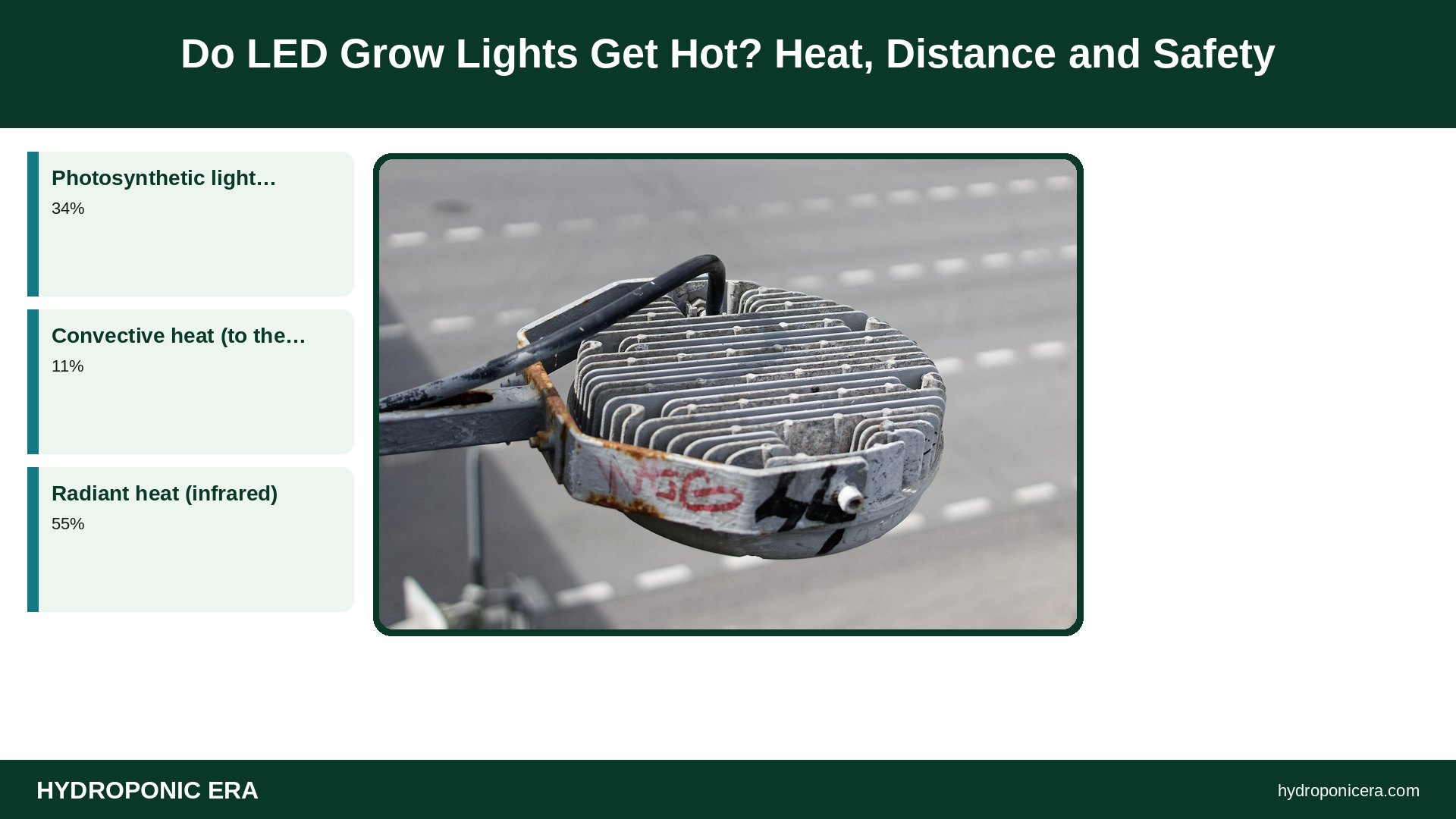
Why Do LED Grow Lights Get Hot?
No light source turns all its electricity into light. LEDs are more efficient than older lamps, but the rest becomes heat at the diode, and diodes don’t like heat, so fixtures mount them on aluminum heat sinks. In a 2021 Plants study by Palmitessa and colleagues comparing LED and HPS on tomato, the authors note that LED fixtures dissipate a large part of their heat through natural or forced convection, while HPS lamps run at a high temperature and radiate longwave infrared in the same direction as the light, toward the plants. That’s why an LED panel’s back is warm while the canopy stays cooler.
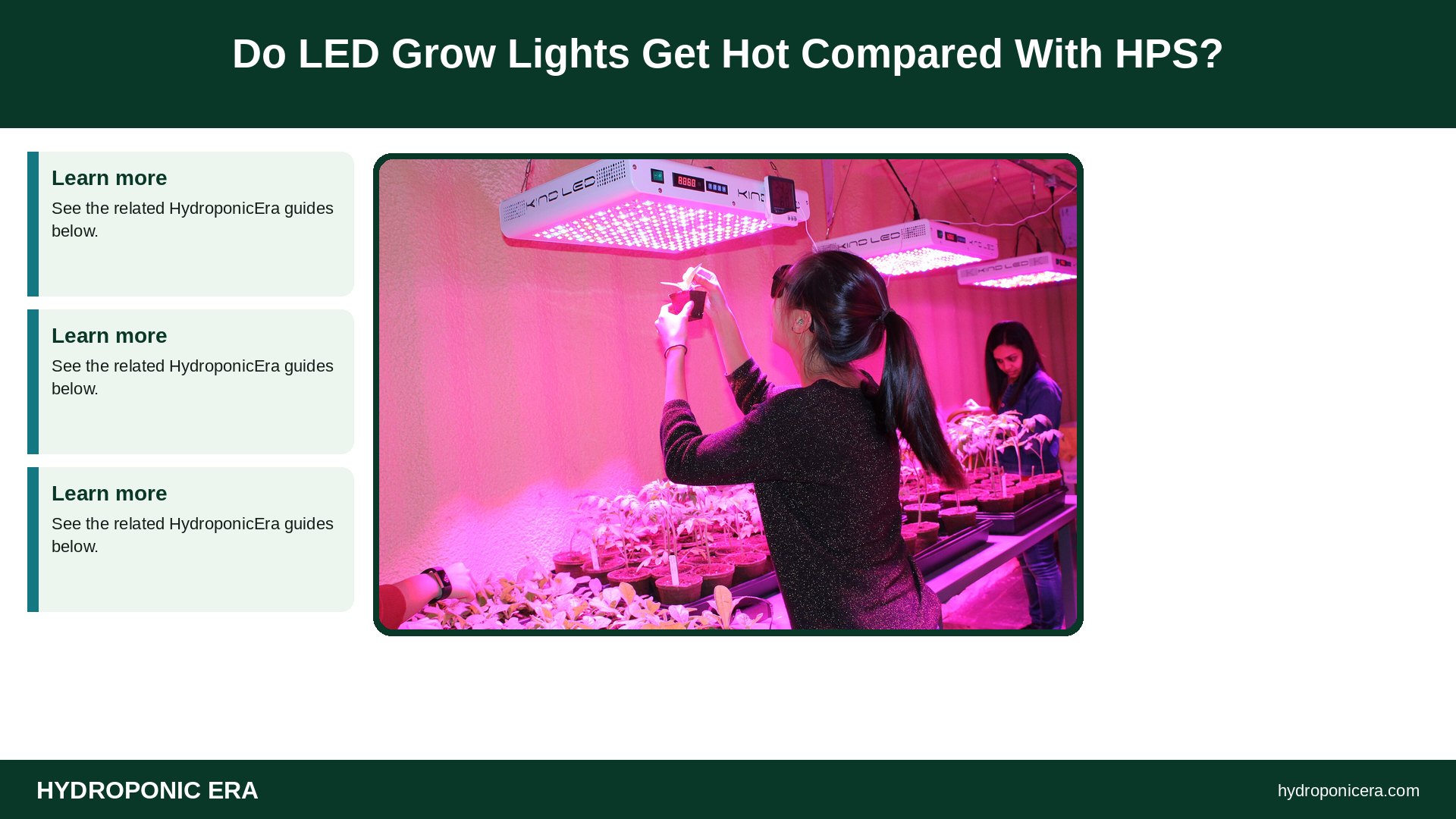
Do LED Grow Lights Get Hot Compared With HPS?
Per watt, LEDs make more light and less radiant heat. Michigan State floriculture specialist Erik Runkle notes the best HPS and LED fixtures were both around 1.7 µmol/J until 2014; by 2022, DesignLights Consortium-qualified LEDs ranged from 1.81 to 3.69 µmol/J. Produce Grower describes HPS as maxing out around 2.0 µmol/J, with ballasts drawing roughly 10% extra.
| Light type | Typical efficacy | Main heat path |
|---|---|---|
| HPS (best fixtures) | About 1.7–2.0 µmol/J | Radiant infrared toward plants |
| LED (DLC-qualified, 2022) | 1.81–3.69 µmol/J | Convection from heat sink |
So do LED grow lights get hot compared with HPS? Less so, per unit of light. The practical result: for the same light, an efficient LED draws fewer watts, so it adds less total heat, and less of that heat hits the leaves directly.
Do More Efficient LEDs Run Cooler?
For the same light output, yes. Efficacy decides how many watts you need, and every watt becomes heat. If an older fixture makes 1.7 µmol/J and a newer one makes 2.5 µmol/J, the newer one needs about 68% of the power (1.7 ÷ 2.5) for the same light, so it adds roughly a third less heat to the room. Runkle notes that in 2022 over half of the 600-plus DLC-listed horticultural LEDs reached at least 2.5 µmol/J, but only about 6% reached 3.0 µmol/J.
Spectrum matters too. Runkle explains that red LEDs are roughly 30% more effective than blue, and blue LEDs are about 20–25% more effective than white, so the most efficient fixtures are 90–95% red with 5–10% blue. White, full-spectrum home fixtures trade some efficiency for a light that’s easier on the eyes and makes plant problems easier to spot.
Do LED Grow Lights Get Hot to the Touch?
That depends on wattage, design and airflow, so there’s no single number. Small shelf lights and bulbs feel warm; high-watt panels and bar fixtures can make the heat sink too hot to hold comfortably. Diodes themselves can be damaged by heat, which is why quality fixtures use large passive heat sinks or fans. If a fixture smells hot, flickers or the driver feels very hot, switch it off and check airflow and wiring. See our electrical safety guide.
Do LED Grow Lights Get Hot Enough to Heat a Room?
Do LED grow lights get hot enough to matter for room temperature? They add heat, though less than HPS for the same light. Energy modeling in Energies (2023) notes that greenhouses switching from HPS to LED often need more supplemental heating, partly because LEDs use less power for the same light and partly because HPS radiant heat warms the crop. Indoors, nearly all electricity a light uses ends up as heat in the space, even the light itself, since plants convert less than 3% of light reaching them into biomass.
A handy rule: each watt drawn adds about 3.41 BTU per hour (1 W = 3.412 BTU/h). A 200 W LED adds roughly 680 BTU per hour to a tent, the same as any 200 W heater.
| Fixture wattage (wall draw) | Heat added (approx. BTU/h) |
|---|---|
| 50 W | About 171 |
| 100 W | About 341 |
| 300 W | About 1,024 |
| 600 W | About 2,047 |
How Do You Manage Heat From LED Grow Lights?
If the honest answer to “do LED grow lights get hot in my tent?” is yes, these steps help:
- Check wall-draw watts, not “equivalent” watts, to estimate heat.
- Give the heat sink open air; don’t pack fixtures against the tent roof.
- Add an exhaust fan near the top of the tent, where warm air collects.
- Use a small clip fan to move air across the canopy.
- Measure leaf-level temperature with a thermometer at plant height.
- Dim the fixture or raise it if leaves bleach or the space overheats.
- Run lights at night in hot weather, when room air is cooler.
For temperature targets, see our heat and cold stress guide.
Can LED Grow Lights Burn Plants Even If They Don’t Get Hot?
Yes. Because LEDs send little radiant heat to leaves, plants can sit close enough to get too much light without feeling heat, causing bleached, pale tops. That’s light burn, not heat burn. Follow the hanging height on the fixture and adjust by crop stage; see our light distance guide and our light burn guide.
Do LED Grow Lights Get Hot Enough to Be a Fire Risk?
A well-made, listed fixture running within its rating is a low fire risk, but heat plus water plus cheap wiring is a bad mix. The North American horticultural lighting safety standard, ANSI/CAN/UL 8800, covers fire and electrical shock hazards, so look for that listing. Keep drivers dry and off the floor of wet tents, avoid overloaded power strips and use GFCI outlets. Our grow light buyer’s guide covers choosing fixtures.
FAQ: Do LED Grow Lights Get Hot?
Do LED grow lights get hot enough to burn you?
High-watt heat sinks can be uncomfortably hot; avoid touching them.
Do LED grow lights get hot from infrared?
Some radiant heat, about 27% in models, versus 55% for HPS.
Can I leave LED grow lights on 24 hours?
Most plants need a dark period; heat builds up too.
Do LED grow lights need fans?
Larger ones often have fans or big heat sinks.
Do LED grow lights get hot when dusty?
Dust on heat sinks reduces cooling; keep them clean.
Sources
- Nauta A, Han J, Tasnim SH, Lubitz WD — Performance Evaluation of a Commercial Greenhouse in Canada Using Dehumidification Technologies and LED Lighting, Energies 16(3):1015 (2023)
- Katzin D, van Mourik S, Kempkes F, van Henten EJ — GreenLight: Heat Requirements under LED and HPS Lamps, Biosystems Engineering (2020)
- Palmitessa OD, Prinzenberg AE, Kaiser E, Heuvelink E — LED and HPS Supplementary Light Differentially Affect Gas Exchange in Tomato Leaves, Plants (2021)
- Runkle E, Michigan State University (via University of Kentucky) — A Closer Look at LED Efficacy
- Produce Grower — Lighting: The Design Phase
- Lopez RG, Michigan State University — Are there Risks of Working under LED Supplemental Lighting? e-GRO Alert (2022)
- Photo credits (Wikimedia Commons, edited with titles): Moscow, Novospassky Bridge – LED floodlights – heatsinks 02 by Retired electrician (CC0); Terramera scientists working in a climate-controlled growth chamber located in Vancouver, BC. The space uses LED lighting, which supports plant growth. (50188965171) by Simon Fraser University – Communications & Marketing (CC BY 2.0); Digital Thermometer @ top of Montauk Lighthouse by DanTD (CC BY-SA 4.0); HPS (High Pressure Sodium) grow light bulb by Plantlady223 (CC BY-SA 4.0); Led digital visuals-leds in grow box PNr°0082 by D-Kuru (CC BY-SA 3.0 at)