
Can you raise black soldier fly larvae as fish food for aquaponics? Yes. Black soldier fly larvae turn food scraps into protein-rich grubs that fish eat, and mature larvae crawl out of a bin on their own for easy harvest. Purdue Extension notes the adults do not feed and are not pests. Use them as a supplement.
Key takeaway: A simple tote with a ramp can supply live treats for fish, plus leftover digestate for soil gardens. Keep the bin warm and not too wet.
| Fact | Detail (Purdue / Oregon State Extension) |
|---|---|
| Scientific name | Hermetia illucens |
| Life cycle | About 38 days |
| Compost ready | In as little as 21 days |
| Feeding rate | About 3.6 lb (1.6 kg) of food per day per 10,000 larvae |
| Humidity | 50–70% relative humidity |
| Adults | Do not feed; live about two days |
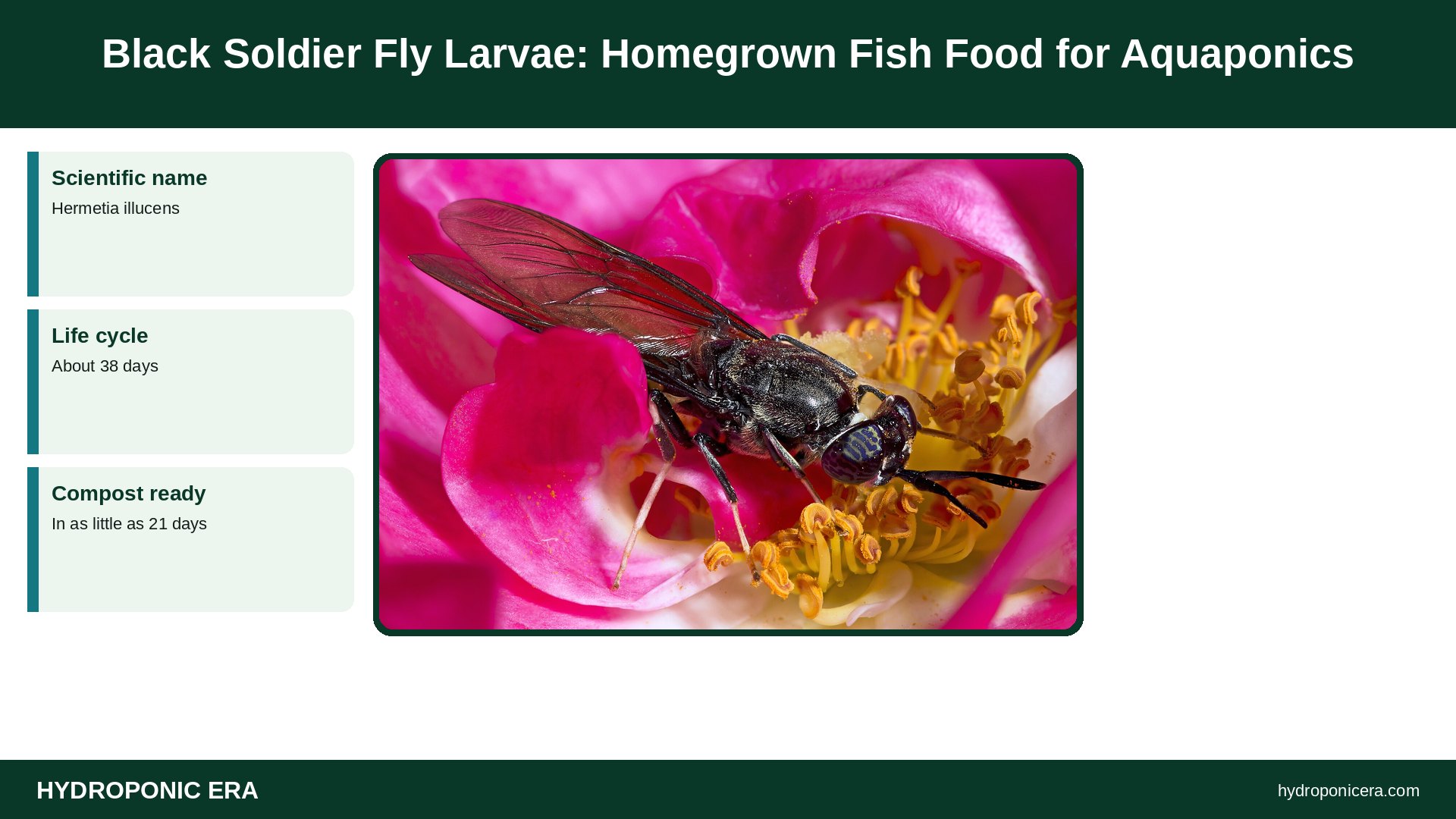
What Are Black Soldier Fly Larvae?
Black soldier fly larvae are the legless, grub-like young of Hermetia illucens, a fly now common across much of North America. Oregon State University Extension describes young larvae as gray-white and about 1 in (2.5 cm) long, turning dark brown and tougher as they mature. They eat food scraps, manure and other wet organic matter.
The adults look like black wasps but, per Oregon State, do not bite or carry disease. Purdue adds that adults do not feed at all, so they do not hang around kitchens like house flies.
Why Use Black Soldier Fly Larvae as Fish Food?
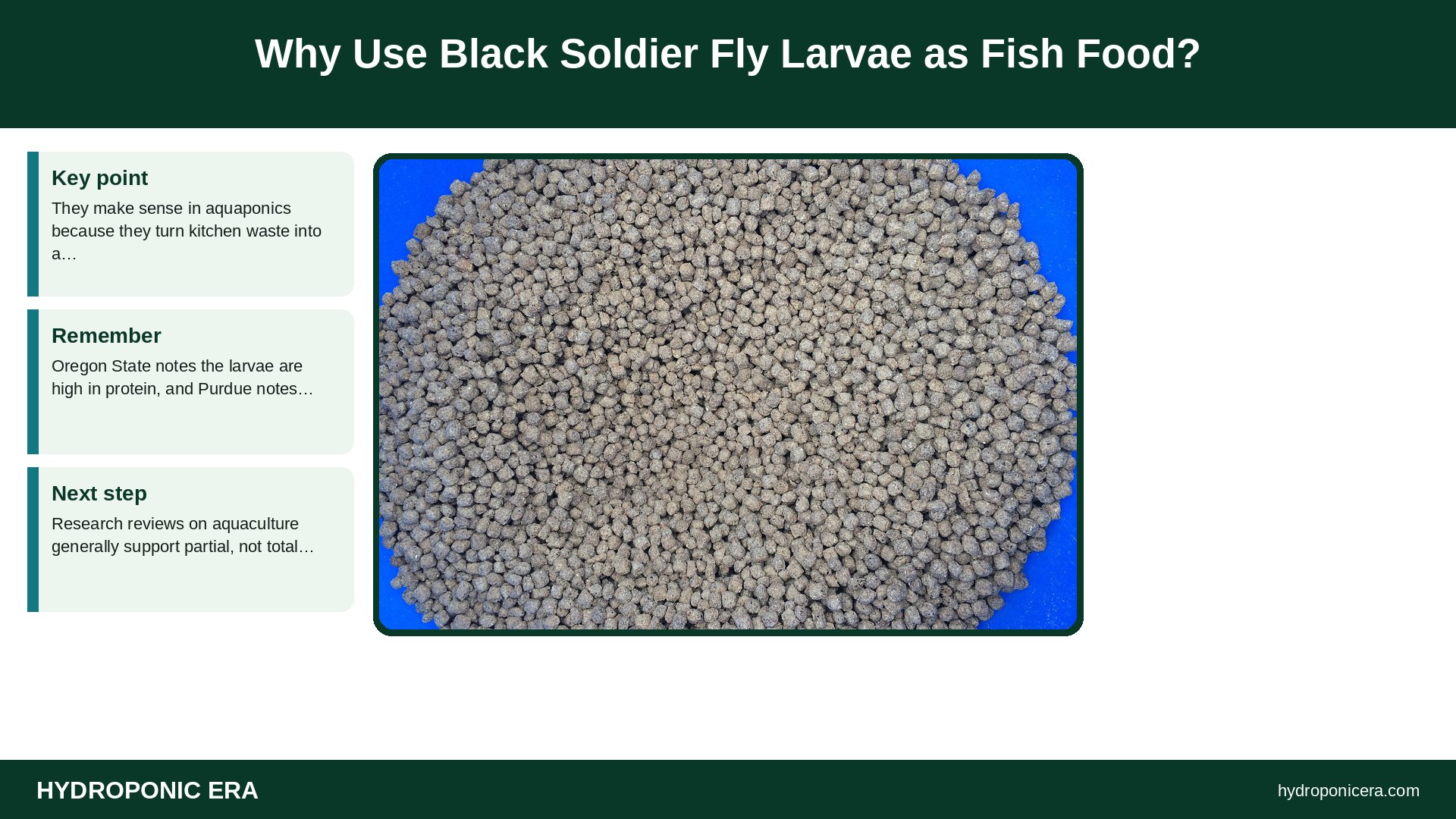
They make sense in aquaponics because they turn kitchen waste into a protein-rich feed you can grow at home, cutting some purchased pellet use. Oregon State notes the larvae are high in protein, and Purdue notes they are high in calcium. Research reviews on aquaculture generally support partial, not total, fishmeal replacement with larvae meal.
Treat them as a supplement for fish like tilapia, catfish and bluegill. Our fish farming for beginners guide covers balanced base feeds.
How Do You Set Up a Black Soldier Fly Larvae Bin?
To set up a bin, use a lidded plastic tote, add a little coir, coffee grounds or soil to hold moisture, add starter larvae, and fit a ramp at about 35 degrees so mature larvae can climb out into a collection cup. Purdue’s design uses an 18 gal (68 L) tote, PVC ramps, a drain valve and hanging cardboard for egg laying.
- Get a tote with a lid, or a cut 55 gal (208 L) food-grade drum for larger setups.
- Add bedding such as coir or coffee grounds.
- Install ramps at about 35 degrees leading to a cup.
- Add a drain so rain or excess liquid can be removed.
- Hang cardboard under the lid as an egg-laying spot.
- Stock larvae in spring; Purdue notes they do not overwinter outdoors in cold climates.
- Place it in a sheltered, warm spot away from heavy rain.
What Should You Feed Black Soldier Fly Larvae?
Feed a mix of food scraps rather than one or two items. Purdue says larvae accept table scraps, produce, spent coffee grounds, brewing grains and garden weeds, and that a single food type slows development. Its guideline is about 0.36 lb (0.16 kg) per day per 1,000 larvae, but watch how fast food disappears.
- Do: add food only after the last batch breaks down.
- Do: reduce feeding as larvae near maturity.
- Avoid: overfeeding, which brings odor and other insects.
- Avoid: letting the bin flood; drain and add dry material.
How Do You Harvest Black Soldier Fly Larvae for Fish?
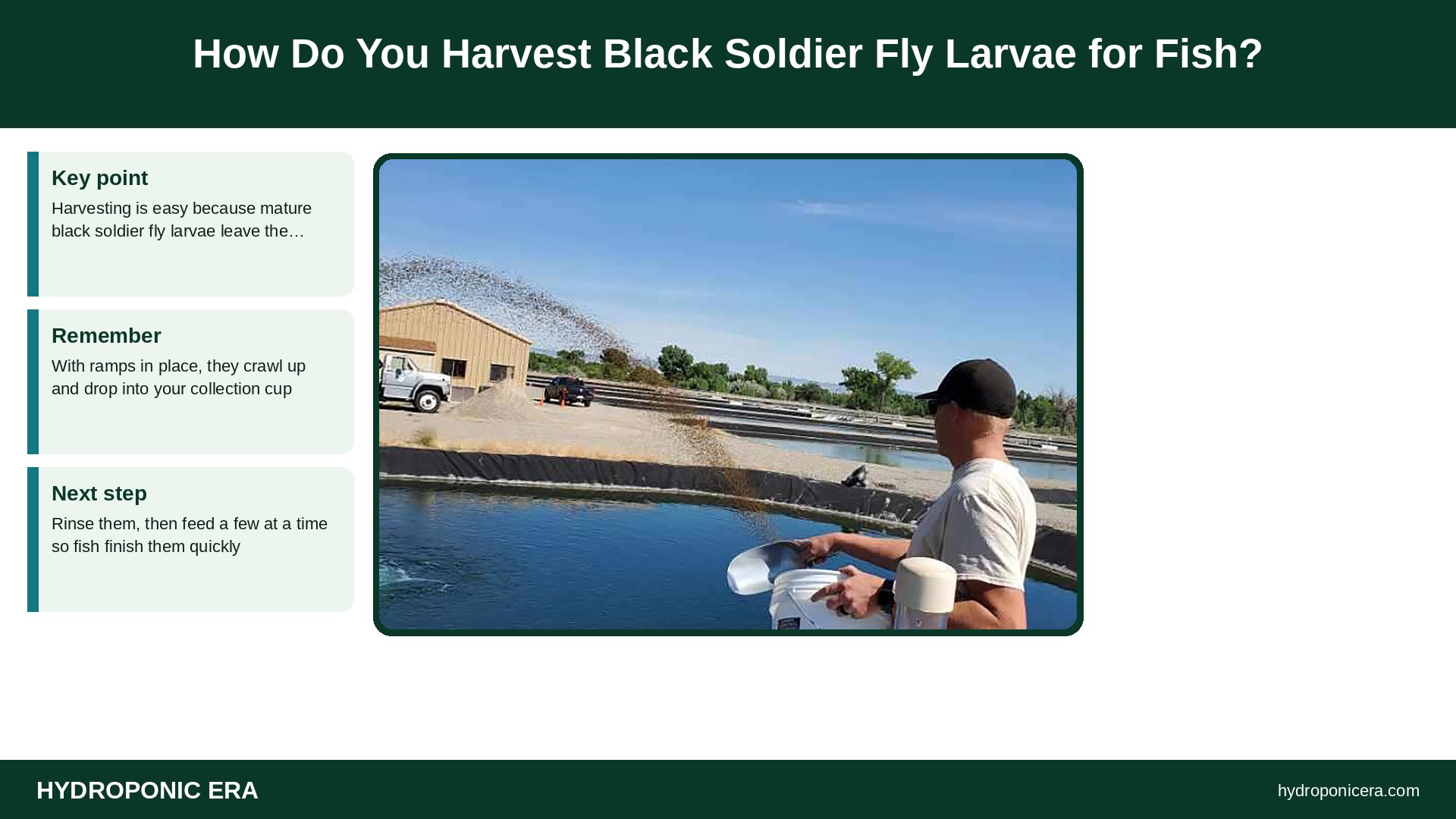
Harvesting is easy because mature black soldier fly larvae leave the food to find a dry place to pupate. With ramps in place, they crawl up and drop into your collection cup. Rinse them, then feed a few at a time so fish finish them quickly. Extra larvae can be frozen for later or returned to the bin.
Uneaten food rots, fouls water and lowers dissolved oxygen, so feed what fish clear in a few minutes. See our aquaponics for beginners guide for feeding basics.
How Much of the Fish Diet Can Hermetia Replace?
Use Hermetia as part of the diet, not all of it. Research reviews in aquaculture generally report that larvae meal can replace part of fishmeal in formulated feeds, while high inclusion levels need processing such as fat removal. Home-grown live larvae vary in nutrition, so keep a complete commercial pellet as the base.
| Feed role | Recommendation |
|---|---|
| Main diet | Complete commercial pellet |
| Supplement | Live or frozen larvae a few times a week |
| Small fish | Chop larvae or use young ones |
| Cold water | Feed less as fish slow down |
Are Black Soldier Fly Larvae Safe to Feed Fish?
Black soldier fly larvae are generally a safe treat for omnivorous fish when raised on clean food scraps and rinsed before feeding. What the larvae eat matters, so skip spoiled meat, treated wood, pesticides or anything you would not want in your fish. Start with a few grubs and watch how fish respond.
- Rinse off bin material before feeding.
- Size them to the fish’s mouth; chop for small fish.
- Freeze extras in small portions.
- Watch water quality after adding any new feed.
What Do You Do With the Leftover Digestate?
The leftover digestate, often called frass, can be used as a soil amendment in garden beds. Purdue says it is high in organic matter and contains N-P-K but does not replace fertilizers, and may be high in salts, so test it first. USDA ARS research has found insect frass can improve soil fertility.
Do not add frass to your aquaponics water or hydroponic reservoir; solids and salts can cloud water and stress fish.
What Problems Should You Watch For?
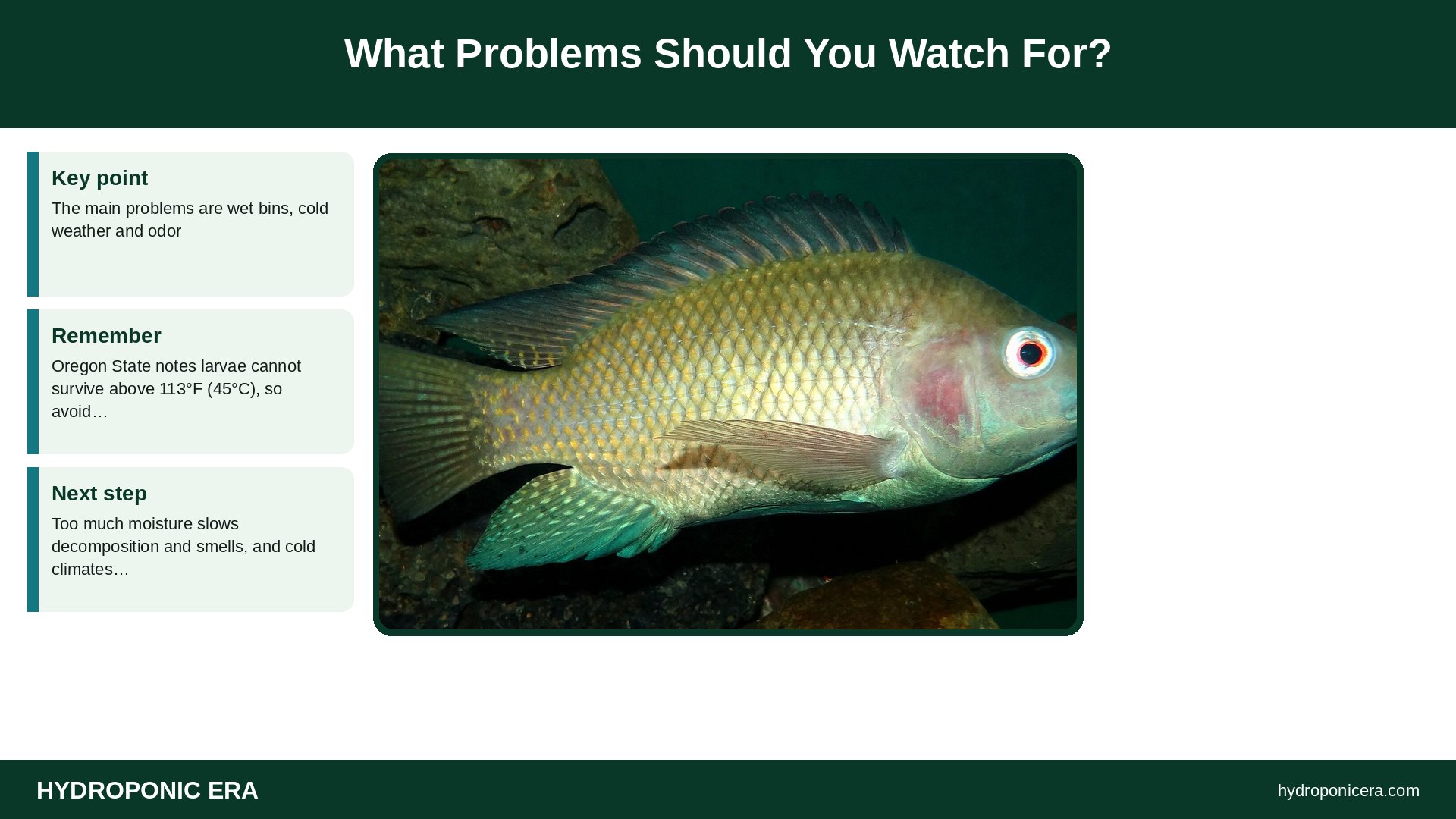
The main problems are wet bins, cold weather and odor. Oregon State notes larvae cannot survive above 113°F (45°C), so avoid full sun on dark bins. Too much moisture slows decomposition and smells, and cold climates need a sheltered spot. Keep the lid closed to limit other flies.
FAQ About Black Soldier Fly Larvae
Do they attract flies to my house?
Oregon State says soldier flies are rarely found indoors.
Can I feed them to all fish?
Most omnivores eat them; chop for small fish.
Can I buy starter larvae?
Yes; Purdue suggests buying larvae in spring.
Will they harm my plants?
Purdue says they will not feed on living plants.
How long until the first harvest?
Compost can be ready in about 21 days, per Purdue.
Sources
- Purdue Extension Entomology — Black Soldier Fly Composting Guide (E-276)
- Oregon State University Extension — Soldier Fly Larvae: Beneficial Compost Helpers
- USDA Agricultural Research Service — No Waste Left Behind: Insect Frass Can Improve Soil Fertility
- Asian Fisheries Science — Substitution of Fishmeal with Black Soldier Fly Larvae in Finfish Aquaculture: A Review
- Photo credits (Wikimedia Commons, edited with titles): Hermetia illucens MHNT Fronton by Didier Descouens (CC BY-SA 4.0); Fish Feed Pellets by Narek75 (CC BY-SA 4.0); Feeding fish (51250565367) by USFWS Mountain Prairie (Public domain); Oreochromis-niloticus-Nairobi by Bjørn Christian Tørrissen (CC BY-SA 3.0)