
How much food can aquaponics produce? Aquaponics yield depends on how much fish feed goes in each day, because feed drives the nutrients plants use. The well-studied UVI commercial system produced over 9,000 lb (4 t) of tilapia a year plus vegetables. Home systems yield far less, but leafy greens and herbs give the most food per square foot.
Key takeaway: Plan aquaponics yield from the feeding rate ratio, then pick fast crops like lettuce and basil for the best harvests.
| UVI result (SRAC 454) | Figure |
|---|---|
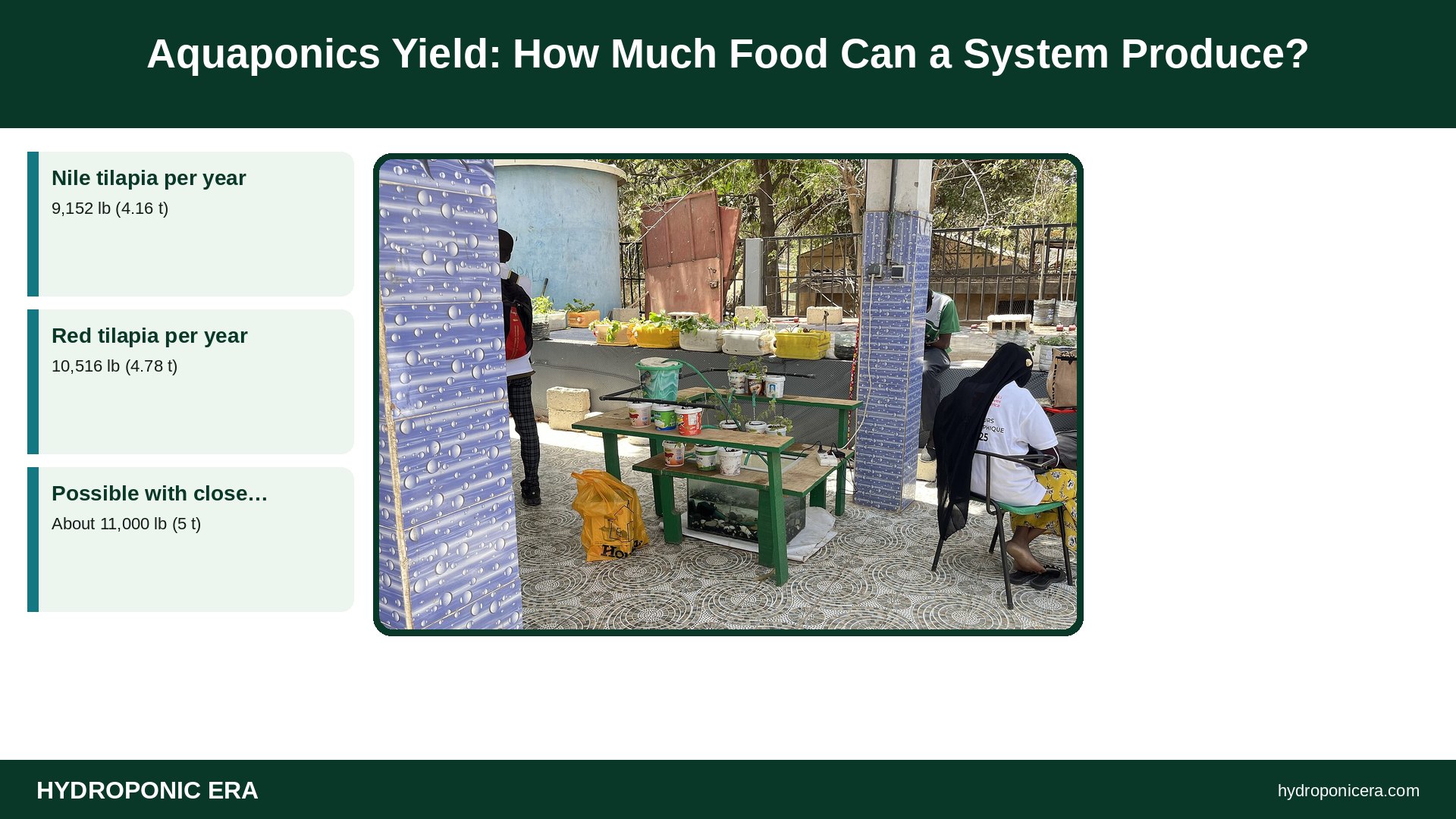
| Nile tilapia per year | 9,152 lb (4.16 t) |
| Red tilapia per year | 10,516 lb (4.78 t) |
| Possible with close feeding | About 11,000 lb (5 t) |
| Basil per year | About 11,000 lb (5,000 kg) |
| Okra per year | About 6,400 lb (2,900 kg) |
| Feed ratio guide | 60–100 g feed per m² of raft per day |
What Determines Aquaponics Yield?
Aquaponics yield is set mainly by daily fish feed, since uneaten feed and fish waste become plant nutrients. SRAC 454 recommends 60 to 100 grams of feed per square meter of raft area per day for raft systems. More feed supports more plants, but only if filtration, oxygen and fish stocking keep pace.
- Feed rate: the main driver of plant nutrients.
- Grow area: how much raft or bed space you have.
- Crop choice: fast greens beat slow fruiting crops.
- Light and temperature: limit growth indoors and in winter.
- Management: staggered planting keeps output steady.
How Much Fish Does a System Produce?
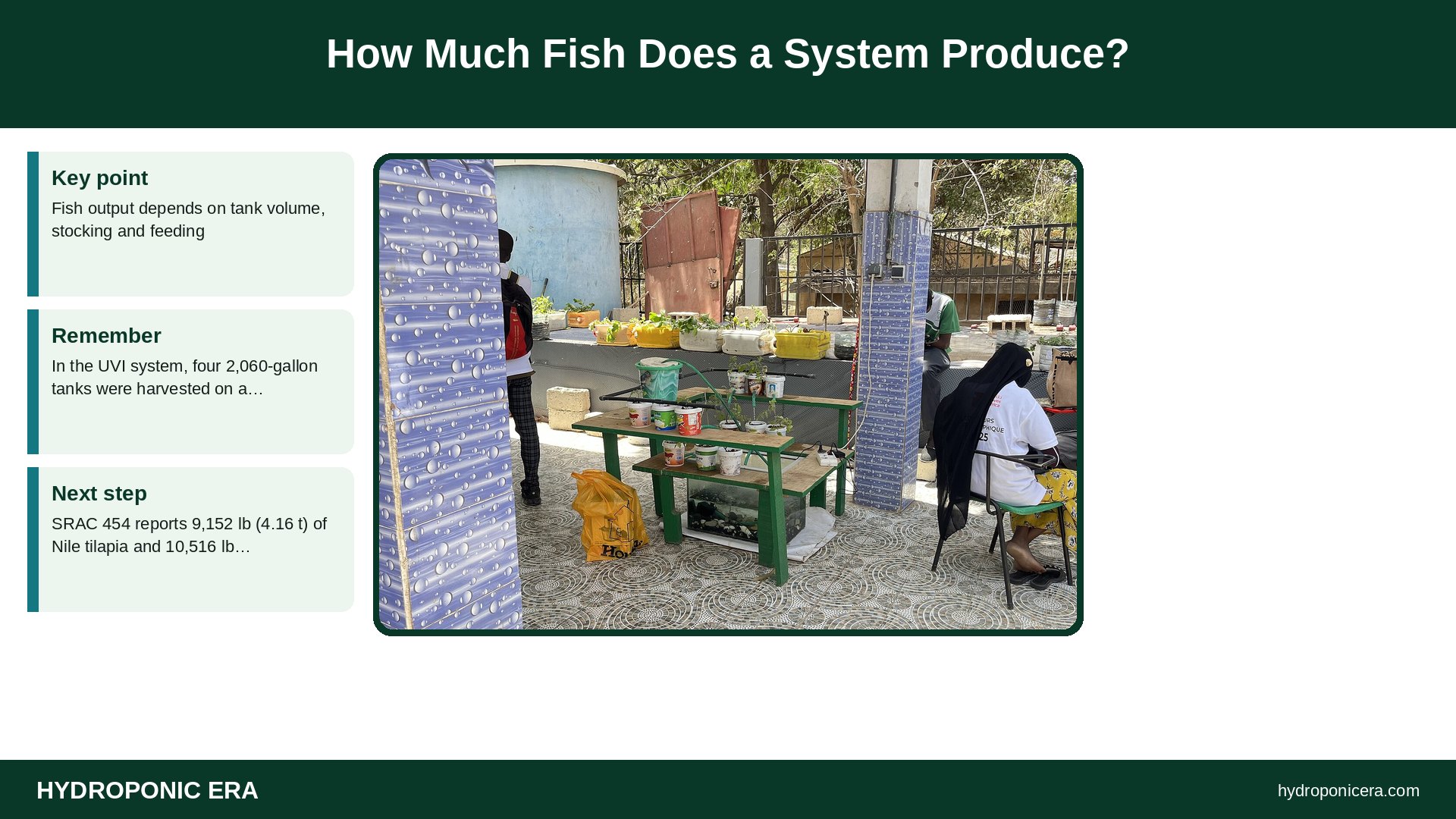
Fish output depends on tank volume, stocking and feeding. In the UVI system, four 2,060-gallon tanks were harvested on a staggered schedule, one every six weeks, on a 24-week cycle. SRAC 454 reports 9,152 lb (4.16 t) of Nile tilapia and 10,516 lb (4.78 t) of red tilapia a year, with about 11,000 lb (5 t) possible.
That is a commercial system with heavy aeration and full solids removal. A backyard tank produces a small fraction of that. See our fish farming for beginners guide.
Which Crops Give the Best Aquaponics Yield?
Leafy greens and culinary herbs give the best aquaponics yield per area and time. SRAC 454 says herbs such as basil, cilantro, chives, parsley and mint grow rapidly, and lettuce is ready in 3 to 4 weeks in the system. Fruiting crops like tomatoes need 90 days or more and have more pests.
| Crop type | Time in system | Yield notes |
|---|---|---|
| Lettuce | 3–4 weeks | Most of the plant is edible |
| Basil and herbs | Fast, repeat cuts | Top choice in UVI trials |
| Swiss chard, pak choi | Short | Good leafy options |
| Tomatoes, okra | 90+ days | Lower output per area |
How Much Basil Can Aquaponics Grow?
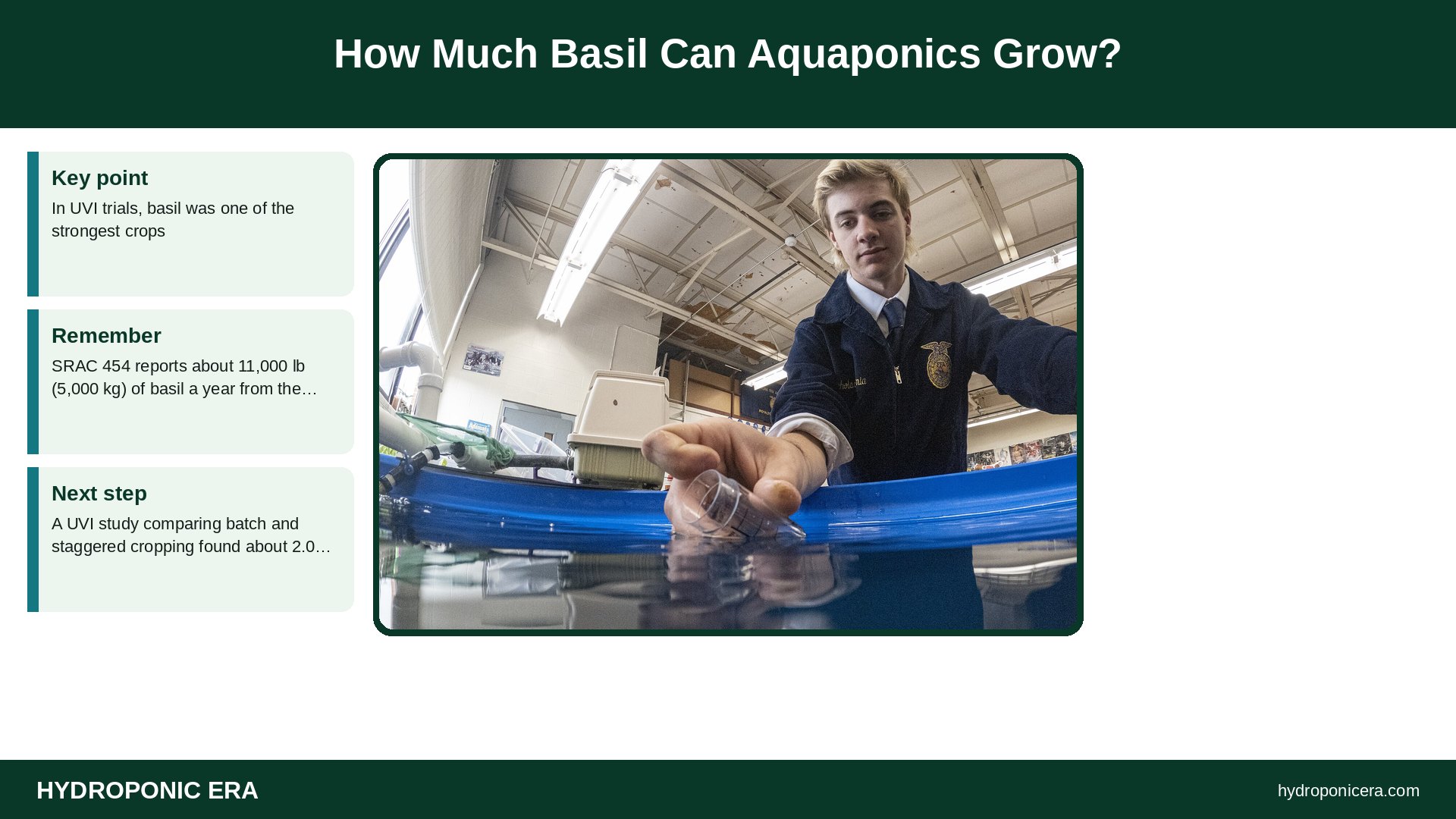
In UVI trials, basil was one of the strongest crops. SRAC 454 reports about 11,000 lb (5,000 kg) of basil a year from the commercial system, compared with about 6,400 lb (2,900 kg) of okra. A UVI study comparing batch and staggered cropping found about 2.0 kg/m² per harvest in batch culture and 1.8 kg/m² staggered.
That study found staggered planting was more sustainable, since batch planting drew nutrients down unevenly.
How Do You Estimate Aquaponics Yield at Home?
Estimate aquaponics yield at home by working back from your feed rate. Weigh the feed you give daily, divide by the SRAC 454 guide of 60 to 100 g per m² per day, and that gives a rough raft area your system can support. Then estimate harvests from crop spacing and cycle time.
- Weigh daily feed once fish are established.
- Divide by 60–100 g to get supported raft area in m².
- Convert to sq ft: multiply square meters by 10.8.
- Choose crops and plant spacing.
- Count cycles per year, such as lettuce every 3–4 weeks.
- Stagger plantings for steady harvests.
Example: about 1.8 oz (50 g) of feed a day supports roughly 5 to 9 sq ft (0.5 to 0.8 m²) of raft by this guide.
Why Does Staggered Planting Raise Yield?
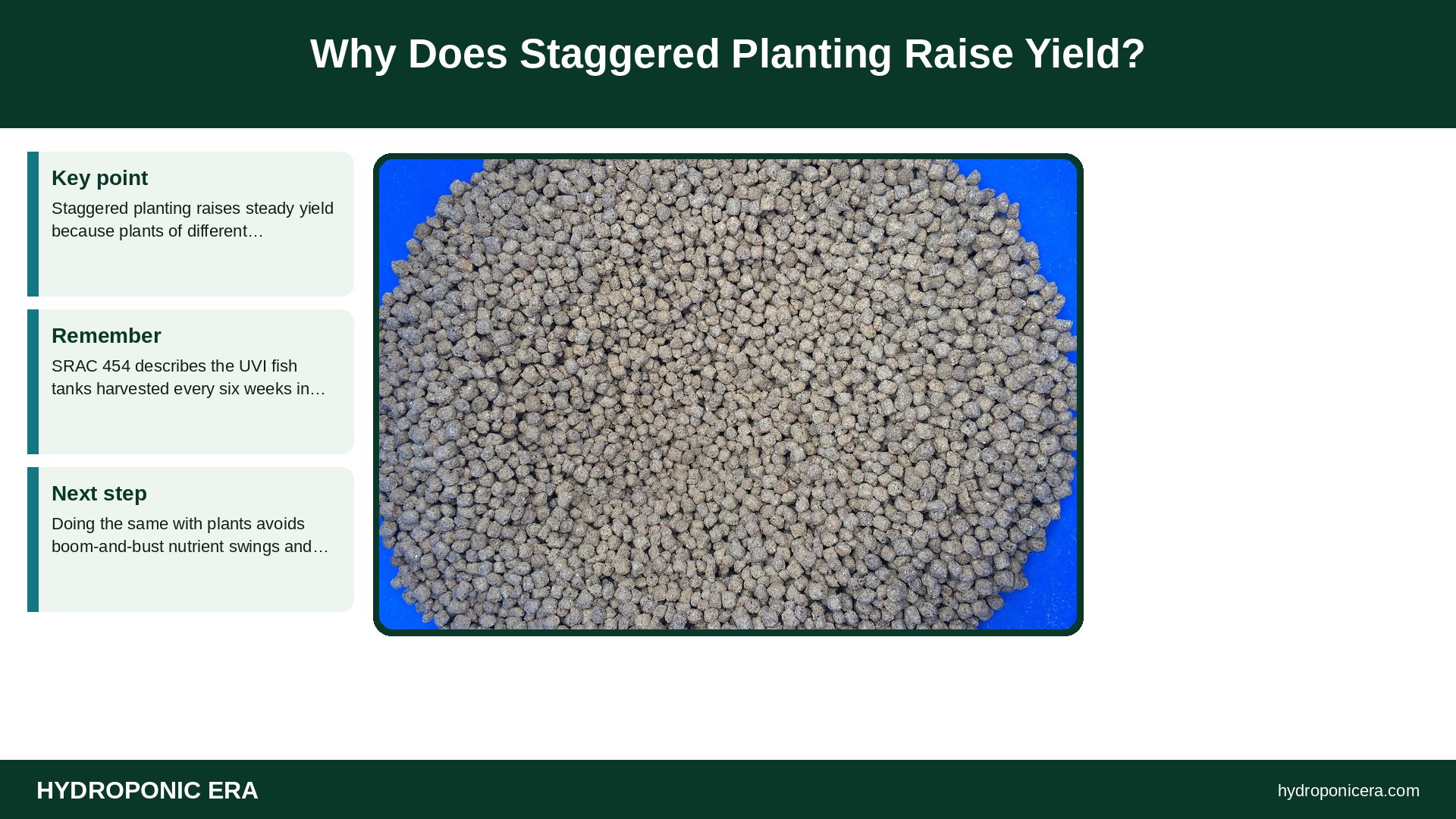
Staggered planting raises steady yield because plants of different ages draw nutrients evenly and you harvest a little each week. SRAC 454 describes the UVI fish tanks harvested every six weeks in rotation. Doing the same with plants avoids boom-and-bust nutrient swings and keeps fish feeding stable.
What Limits Aquaponics Yield Most Often?
The most common limits are low feed input, poor solids removal, low oxygen, and nutrient gaps. SRAC 454 notes the UVI system used rainwater and needed potassium, calcium and iron added. Cold water slows both fish and plants. Fix limits in order: oxygen, solids, feed rate, then nutrients.
See our guides to dissolved oxygen and rainwater for growing.
How Long Until a New System Reaches Full Yield?
A new system takes time to reach full output because nitrifying bacteria must establish and fish must grow before feeding rises. Expect light harvests at first. As fish grow and daily feed increases, you can add raft area in step with the feeding rate ratio and harvest more greens each week.
- Early weeks: cycle the system and stock lightly.
- Growing phase: raise feed as fish grow.
- Steady state: match plant area to daily feed.
- Ongoing: keep a simple log of feed and harvests.
A log lets you see which crops pay off and spot problems early.
Is Aquaponics Yield Higher Than Soil Gardening?
It can be for leafy greens in a well-run system, because plants get steady water and nutrients and can be spaced and replanted year-round. Results vary widely with light, climate and skill. For fruiting crops, a soil garden may match or beat a small home system. Compare on cost and effort too.
New growers should start with our aquaponics for beginners guide and deep water culture basics.
FAQ About Aquaponics Yield
How much feed per plant area?
SRAC 454 suggests 60–100 g of feed per m² of raft per day.
What is the fastest crop?
Lettuce, at 3–4 weeks in the system.
Can a home system feed a family?
It can add greens and herbs, but rarely all of a family’s food.
Do fruiting crops work?
Yes, but they take 90+ days and yield less per area.
Which fish did UVI use?
Nile and red tilapia.
Sources
- Oklahoma State University / SRAC — Aquaponics: Integrating Fish and Plant Culture (SRAC 454)
- University of the Virgin Islands — Aquaponic Production of Tilapia and Basil (PDF)
- Photo credits (Wikimedia Commons, edited with titles): AQUAPONIE by Hopeballa (CC BY-SA 4.0); AQUAPONIE by Hopeballa (CC BY-SA 4.0); FNS-Farm to School at Royalton-Hartland SD in Niagara County, NY (20220525-FNS-LSC-0796) by USDAgov (Public domain); Fish Feed Pellets by Narek75 (CC BY-SA 4.0)