
Are tea bags good for plants? Used tea bags for plants work best as compost, not as a direct fertilizer. Extension services list tea leaves and bags as nitrogen-rich “greens.” The catch is plastic: Garden Organic reports that most tea bags contain polypropylene, so tear them open, compost the leaves and bin the bag unless it is certified plastic-free.
Key takeaway: Spent tea leaves are a useful compost green. Many tea bags contain plastic that will not break down in a home heap, and steeping a plastic bag in hot water can shed billions of microplastic particles. Compost loose leaves, or empty bags first, and test soil before using any “acidifying” home remedy.
| Fact | What it means for gardeners | Source |
|---|---|---|
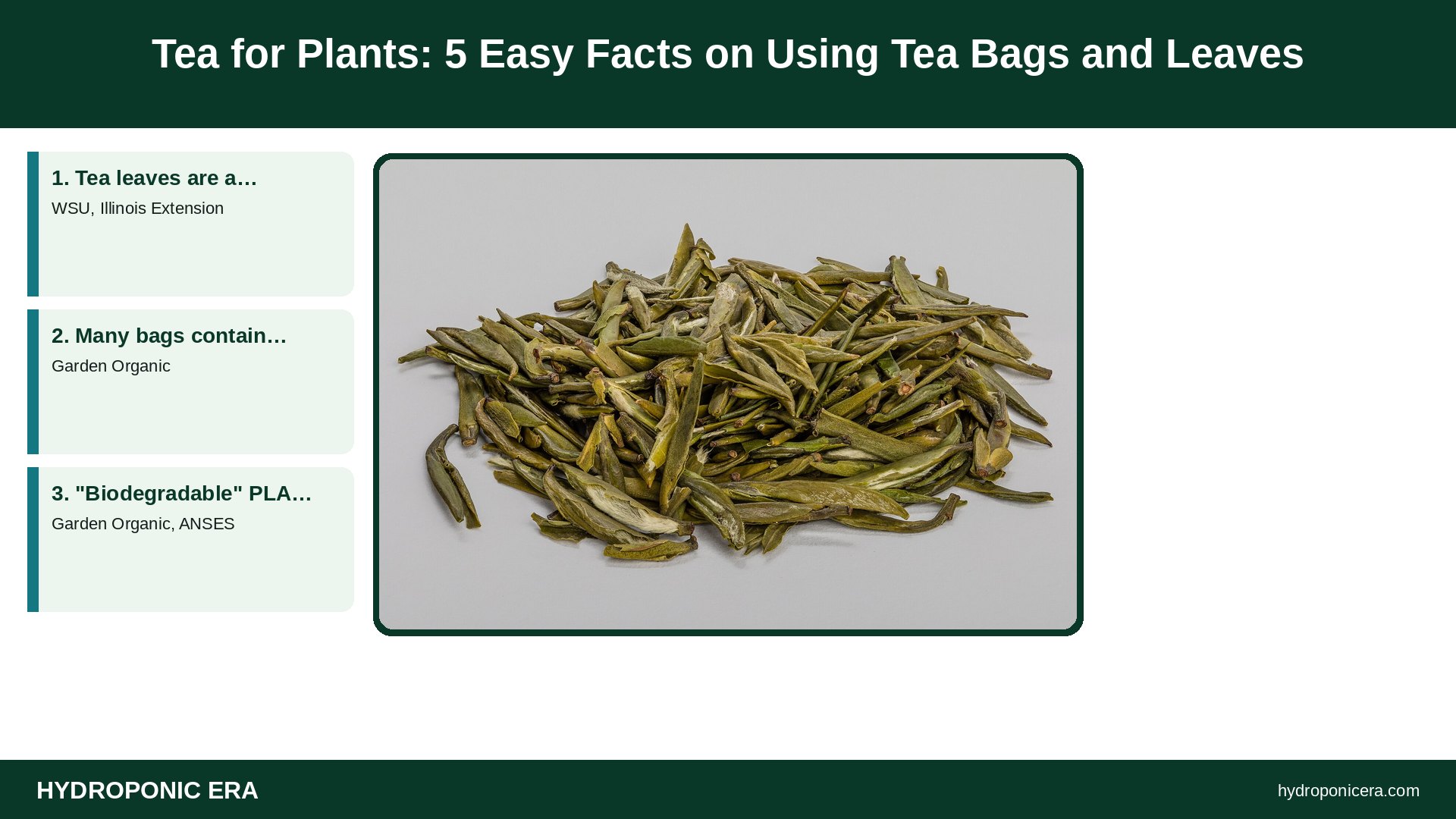
| 1. Tea leaves are a compost green | Mix them with browns such as dry leaves | WSU, Illinois Extension |
| 2. Many bags contain plastic | Polypropylene seals do not compost | Garden Organic |
| 3. “Biodegradable” PLA is slow | Home heaps rarely get hot enough | Garden Organic, ANSES |
| 4. Plastic bags shed particles | One bag at 203°F (95°C) released about 11.6 billion microplastics | Hernandez et al. 2019 |
| 5. Leaves are the safe part | Empty bags; compost loose leaf tea | Garden Organic |
Can You Put Tea Bags for Plants Directly in Soil?
Using tea bags for plants by burying them is the least useful method. You can scatter spent tea leaves on soil, but burying whole bags is a poor idea if they contain plastic. The leaves are organic matter that breaks down slowly, while plastic mesh or seals remain in the soil. Washington State University lists tea leaves and bags as compostable, but the safest habit is composting the leaves first.
Finished compost is easier to use than raw kitchen scraps. It spreads evenly, does not attract pests on the soil surface, and feeds soil life gradually. Our composting for beginners guide shows how to start a simple bin.
Are Tea Bags for Plants Better in Compost?
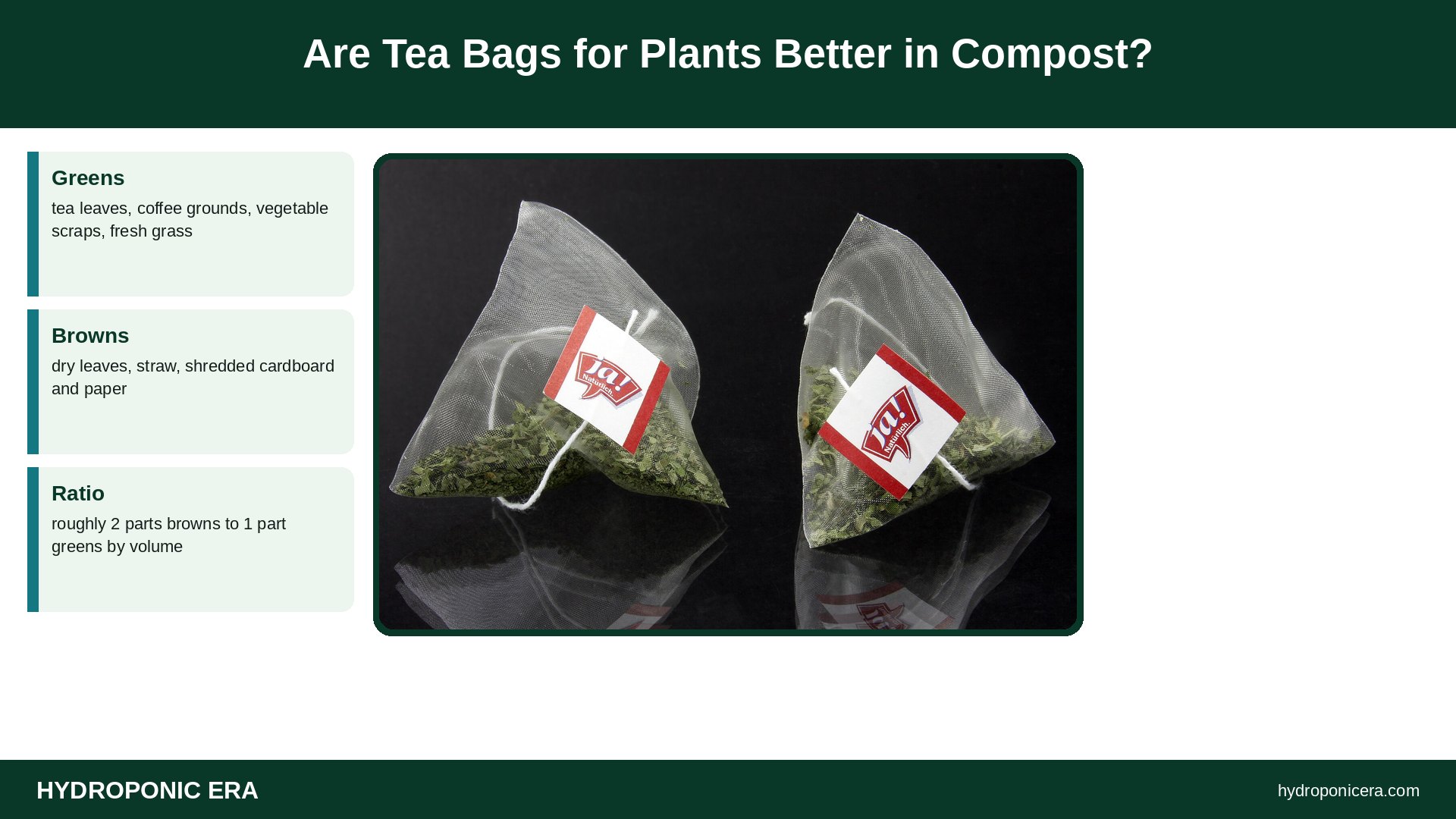
Yes, compost is the best route for tea bags for plants. University of Illinois Extension and Washington State University both classify tea leaves as “greens,” the nitrogen-rich side of the compost recipe. NC State Extension recommends a mix of about 2 parts browns to 1 part greens. So balance a pile of tea leaves and food scraps with dry leaves, straw or shredded paper.
- Greens: tea leaves, coffee grounds, vegetable scraps, fresh grass.
- Browns: dry leaves, straw, shredded cardboard and paper.
- Ratio: roughly 2 parts browns to 1 part greens by volume.
- Moisture: damp like a wrung-out sponge.
Tea leaves are small and break down readily, which makes them an easy, steady addition to any bin or worm farm.
Do Tea Bags for Plants Contain Plastic?
Many tea bags sold today do. Garden Organic, a UK organic gardening charity, reports that most tea bags contain a small amount of polypropylene used to seal them, and that some “plastic-free” bags are made with PLA, a plant-based plastic that breaks down slowly in a home heap. Check the brand’s packaging, or switch to loose leaf tea.
France’s food and environment agency, ANSES, goes further. It advises that plastics, including those labeled biodegradable or compostable, should not go into garden composters, because home heaps do not reliably reach the conditions needed to break them down. That is why pulling out the bag is the simplest fix when you save tea bags for plants.
How Do You Use Tea Bags for Plants Safely?
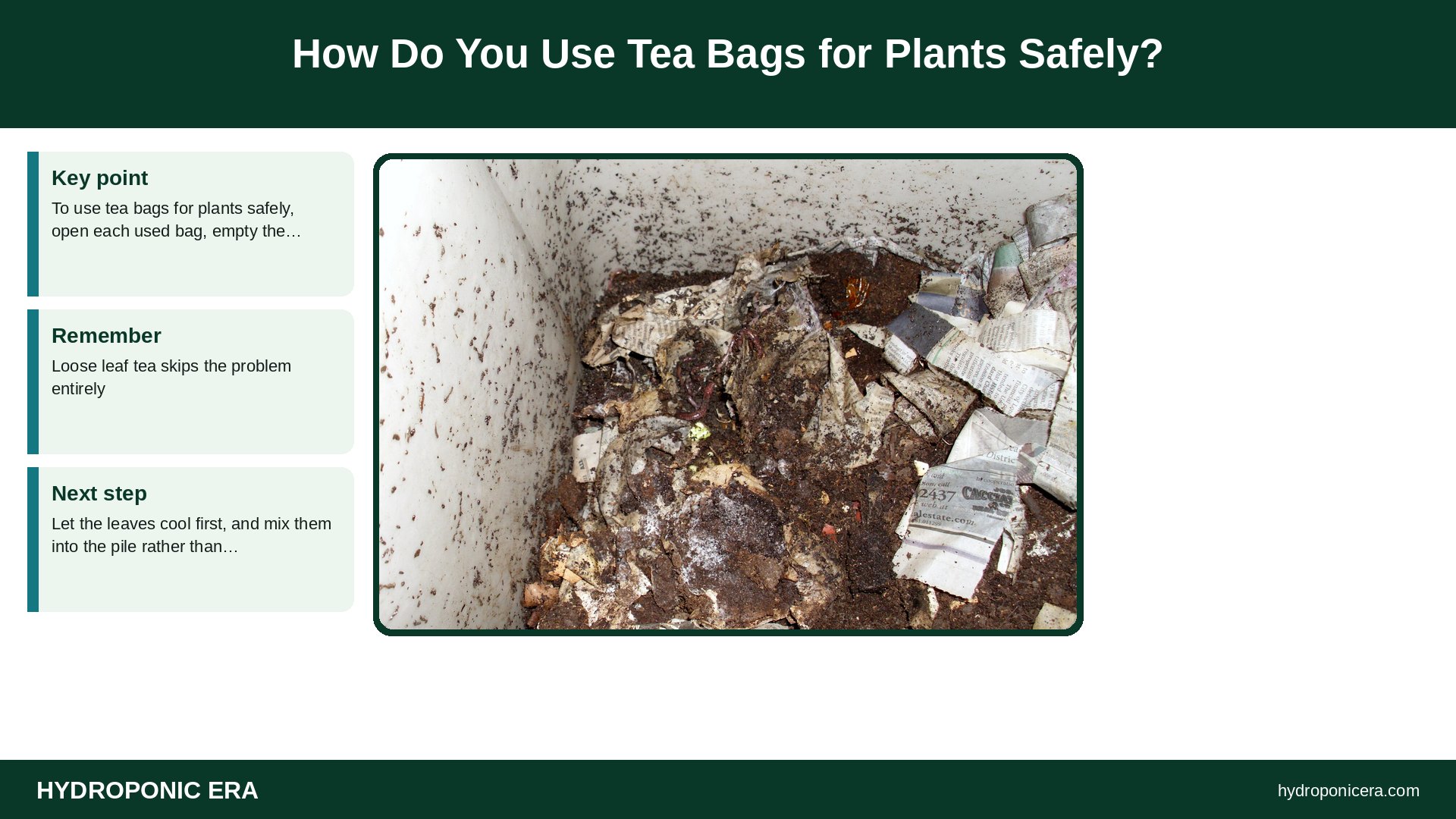
To use tea bags for plants safely, open each used bag, empty the leaves into the compost or worm bin, and throw the bag away unless the maker says it is plastic-free and home compostable. Loose leaf tea skips the problem entirely. Let the leaves cool first, and mix them into the pile rather than leaving a soggy layer on top.
- Let the used tea bag cool and drain.
- Tear or cut the bag open over the compost caddy.
- Shake out the leaves and add them with some brown material.
- Put the empty bag, string and staple in the trash.
- Use finished compost on beds and containers.
If you collect tea bags for plants all week, keep them in a lidded caddy and empty it every few days so it does not turn moldy. Paper tags and string are often fine in compost, but staples and plastic-coated tags are not.
Do Plastic Tea Bags for Plants Shed Microplastics?
Laboratory research says yes. A 2019 study by Hernandez and colleagues in Environmental Science and Technology found that steeping a single plastic tea bag at 203°F (95°C) released about 11.6 billion microplastic and 3.1 billion nanoplastic particles into the water. That is another reason to choose loose leaf tea or plastic-free bags.
The same plastic that sheds in hot water will not vanish in soil. Keeping it out of compost protects the garden and the worms and soil life that make compost work. Before you collect tea bags for plants, check which brands you buy.
Do Tea Bags for Plants Make Soil Acidic?
There is little evidence that tea bags for plants, or spent tea in general, is a practical way to change soil pH. None of the extension sources we reviewed recommends tea for acidifying soil. If you want to lower pH for blueberries or azaleas, test your soil first and follow your local extension service’s advice for amendments and rates.
Do not confuse brewed tea with compost tea. Compost tea is a liquid extract of compost, not a drink. Learn the difference in our compost tea guide.
| Way to use tea bags for plants | Good idea? | Why |
|---|---|---|
| Leaves in compost | Yes | Nitrogen-rich green material |
| Whole plastic bags in soil | No | Plastic does not break down |
| Brewed tea as fertilizer | Unproven | No extension guidance found |
| Tea as pH fix | Not recommended | Test soil and use proven amendments |
FAQ About Tea Bags for Plants
Do tea bags for plants attract pests?
Leaves buried in an active compost pile rarely do. Avoid leaving soggy heaps of bags on top of pots or beds.
Are tea bags for plants good for houseplants?
Small amounts are unlikely to help much. Plain water and a balanced fertilizer are more reliable.
Are paper tea bags compostable?
Some are. Check the packaging for a plastic-free claim and remove staples.
Can worms eat tea leaves?
Yes, spent tea leaves are a common worm-bin food in small amounts.
Is loose leaf tea better for compost?
Yes. It has no bag to remove, so all of it can go in the bin.
Can I grow a tea plant myself?
Yes. See our guide to growing the tea plant.
Sources
- Garden Organic. Are you composting your tea bags?
- ANSES. Plastics are not compatible with domestic composting.
- Hernandez L.M. et al. 2019. Plastic teabags release billions of microparticles and nanoparticles into tea. Environ. Sci. Technol.
- Washington State University Extension. Backyard composting of yard, garden, and food discards (PDF).
- University of Illinois Extension. Composting 101 (PDF).
- NC State Extension. Extension Gardener Handbook: Composting.
- Photo credits (Wikimedia Commons, edited with titles): Zhu-Ye-Qing-Tea-03 by CEphoto, Uwe Aranas (CC BY-SA 4.0); Teebeutel Polylactid 2009 by Elke Wetzig (elya) (CC BY-SA 3.0); Worm composting 2 by Quadell (CC BY 3.0)