
Is urea safe to use in hydroponics? Urea in hydroponics is risky. It is cheap and high in nitrogen (46-0-0), but microbes convert it to ammonium, which can build up to toxic levels when roots are cold or short of oxygen. Most recipes rely on nitrate instead. If you use urea at all, keep it a small share alongside nitrate.
Key takeaway: Urea is the world’s most used nitrogen fertilizer, yet it behaves very differently in water than nitrate does. These five facts explain why.
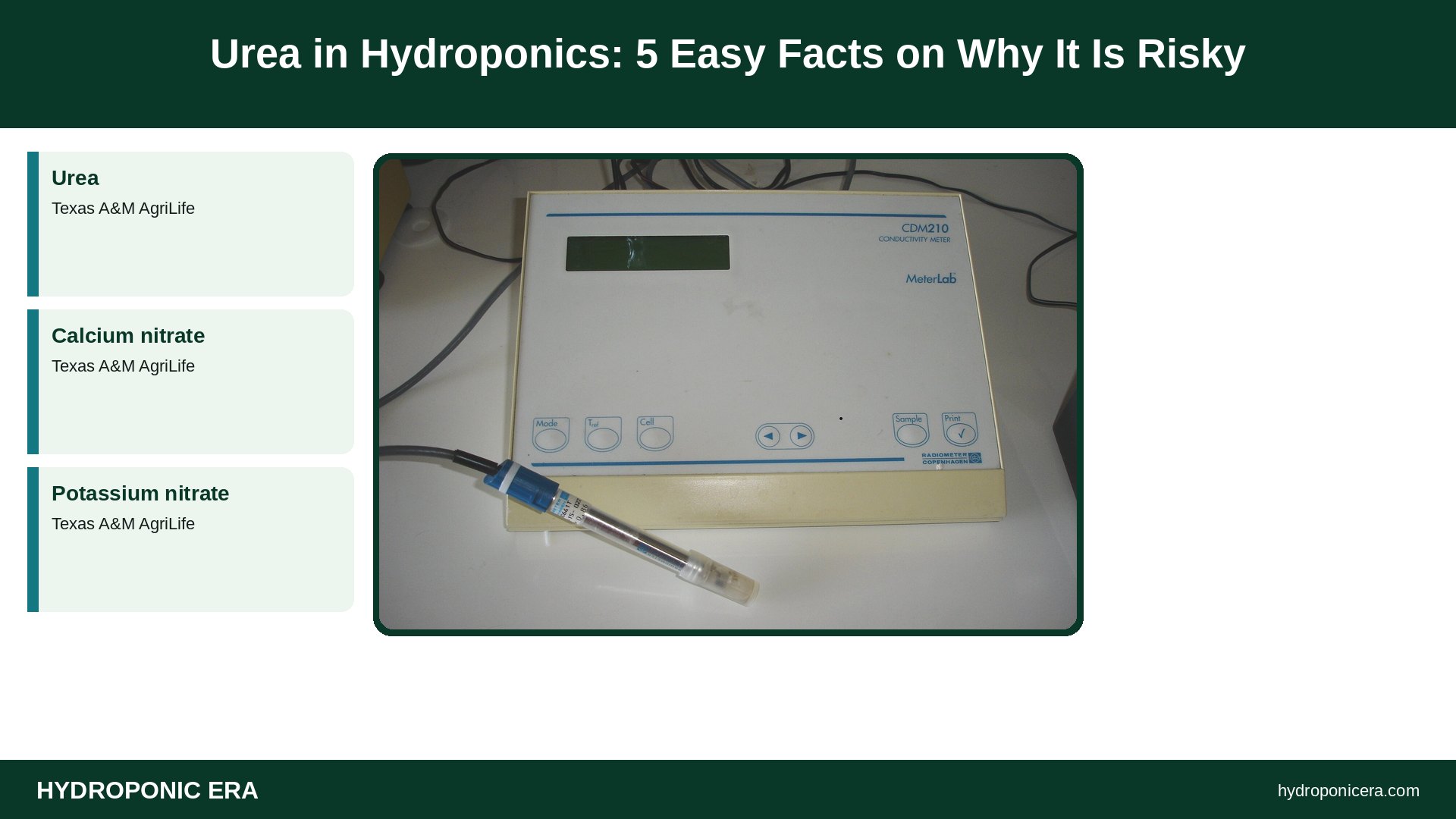
| Nitrogen source | Typical grade | N from 1 g per gallon | Source |
|---|---|---|---|
| Urea | 46-0-0 | About 55 ppm N | Texas A&M AgriLife |
| Calcium nitrate | 15.5-0-0 (19% Ca) | Adds 50 ppm Ca | Texas A&M AgriLife |
| Potassium nitrate | 13.75-0-44.5 | About 36 ppm N | Texas A&M AgriLife |
| Ammonium nitrate | 33.5-0-0 | About 41 ppm N | Texas A&M AgriLife |
| Ammonium sulfate | 21-0-0 (24% S) | About 88 ppm N | Texas A&M AgriLife |
What Is Urea and Why Is It So Common?
Urea is an organic nitrogen compound sold as a 46-0-0 fertilizer. A 2016 University of Udine review in Plant Signaling & Behavior says that, mainly because of its low price and high N content, urea is the most used N fertilizer in the world, at more than 50% of N fertilizer consumption. Field crops use it widely.
Urea in hydroponics is far less common. To understand why, it helps to know the three forms of nitrogen plants meet: nitrate, ammonium and urea. Our nitrogen deficiency guide explains what happens when N runs short.
What Happens to Urea in Hydroponics Once It Dissolves?
In soil, urease enzymes rapidly break urea down into ammonium, which can then become nitrate in aerobic soils, the PMC review explains. In a reservoir the same steps depend on microbes and oxygen, so the mix of urea, ammonium and nitrate keeps changing. Plants can also absorb some intact urea through a high-affinity transporter and aquaporins.
- Urea dissolves and enters the solution.
- Urease enzymes convert it to ammonium.
- Nitrifying bacteria convert ammonium to nitrate if oxygen is present.
- Roots take up nitrate, ammonium and some intact urea.
Why Is Urea in Hydroponics Risky?
The main risk is ammonium buildup. UMass Extension explains that cold, cloudy weather and saturated, low-oxygen root zones suppress the nitrifying bacteria that convert ammonium to nitrate, so ammonium can accumulate to toxic levels. Urea feeds that same ammonium pool. Poorly aerated reservoirs make urea in hydroponics hard to control.
The ammonia, nitrite and nitrate cycle works the same way in aquaponics, where bacteria must keep up with fish waste.
What Does Ammonium Toxicity Look Like?
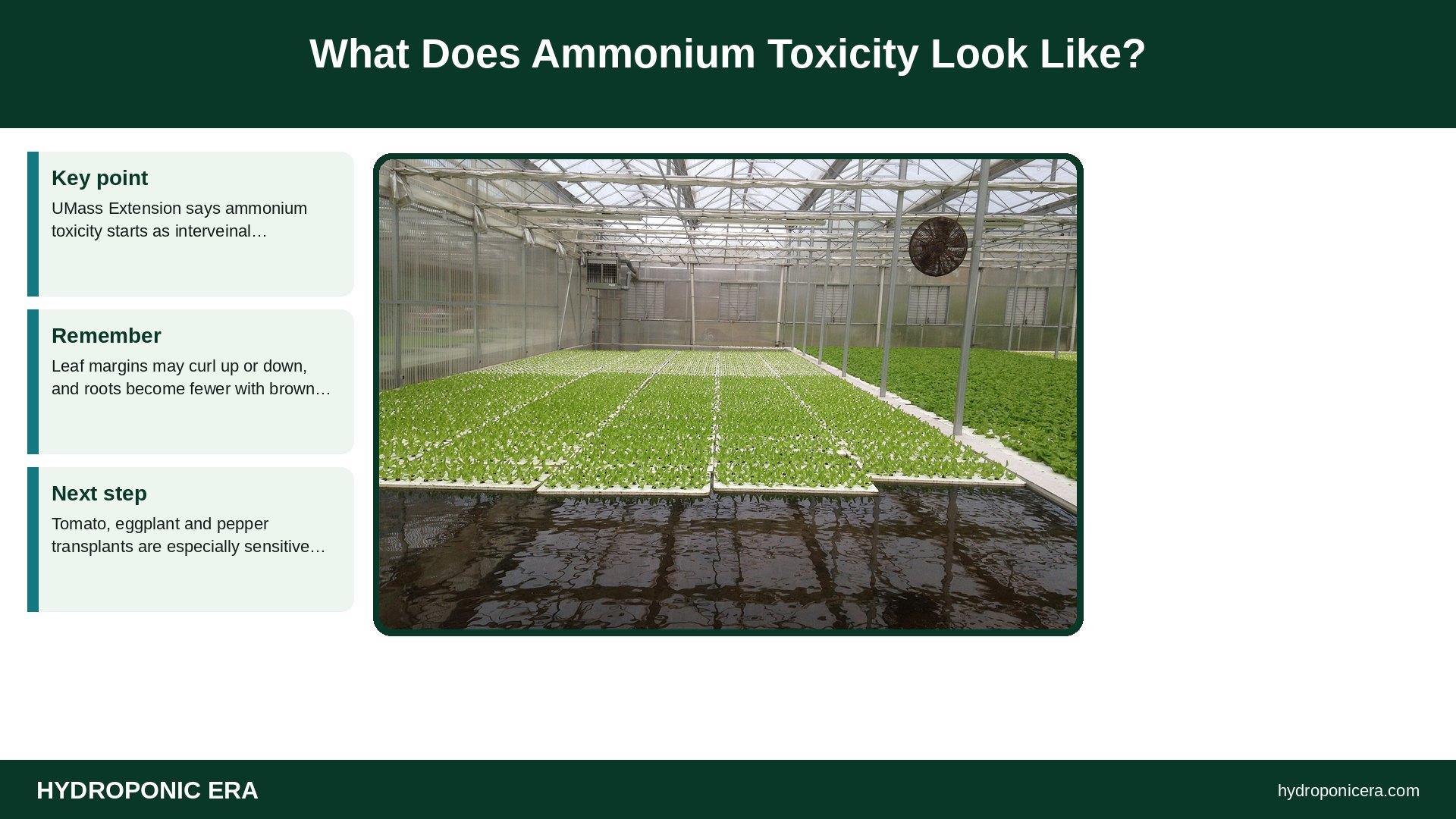
UMass Extension says ammonium toxicity starts as interveinal chlorosis, chlorotic blotches and pale green foliage, easily confused with iron deficiency. Leaf margins may curl up or down, and roots become fewer with brown, dead tips. Tomato, eggplant and pepper transplants are especially sensitive, along with lettuce and several bedding plants.
- Pale new leaves that look iron deficient.
- Curling leaf edges on mature plants.
- Few roots with brown tips.
- Worse after cold, cloudy spells.
Is Mixing Urea in Hydroponics With Nitrate Ever Useful?
Research suggests a blend can help, though not heavy urea in hydroponics. The PMC review reports that in the long term, supplying both urea and nitrate enhanced plant growth and N use compared with nitrate alone or, especially, urea alone. That was research, not a home recipe, so most growers still choose nitrate-based formulas like calcium nitrate and potassium nitrate.
How Do You Avoid Problems With Urea in Hydroponics?
Keep ammoniacal N low and roots warm. UMass Extension advises limiting ammoniacal fertilizers during cold, cloudy weather, using a balanced ammonium and nitrate fertilizer, keeping temperatures above 60°F (16°C), and switching to a fertilizer with no ammoniacal N if symptoms appear.
- Use urea only as a small part of total nitrogen.
- Keep root zone oxygen high with air stones or circulation.
- Avoid urea in cold, cloudy conditions.
- Check EC and plant color often; see our hydroponic ppm chart.
Why Do Hydroponic Nutrients Rely on Nitrate Instead?
Nitrate is stable in solution and ready for roots. The PMC review notes nitrate is taken up by specific transporters and that plants tightly regulate its absorption and assimilation. Texas A&M AgriLife lists calcium nitrate and potassium nitrate among the most common N sources for liquid feeding, and advises that no more than 50% of total N be in ammonium form.
What Should You Check Before Using a Fertilizer That Contains Urea?
Read the label. Many general-purpose fertilizers list part of their nitrogen as urea, and the guaranteed analysis shows how much. Texas A&M AgriLife advises considering both the source and amount of each fertilizer, because unbalanced nutrients can cause severe deficiencies or toxicities. Prefer a product made for hydroponics with mostly nitrate nitrogen.
- Look for “urea nitrogen” or “ammoniacal nitrogen” on the label.
- Compare it with the nitrate nitrogen share.
- Choose nitrate-dominant formulas for sensitive crops such as tomatoes and lettuce.
FAQ About Urea Fertilizer in Hydroponics
Can I use lawn fertilizer with urea in hydroponics?
It is not recommended; it is not a complete, balanced hydroponic formula.
Can plants absorb urea directly?
Yes, some intact urea enters roots through transporters and aquaporins.
How much N does 1 g of urea add per gallon?
About 55 ppm N, per Texas A&M AgriLife.
Does urea change pH?
Its conversion to ammonium and nitrate can shift pH, so monitor it.
What is a safer nitrogen source?
Calcium nitrate or potassium nitrate.
Sources
- Plant Signaling & Behavior (University of Udine) via PMC — Molecular and Physiological Interactions of Urea and Nitrate Uptake in Plants
- UMass Extension — Cold, Cloudy Weather Can Lead to Ammonium Toxicity
- Texas A&M AgriLife — Fertilizing Greenhouse Crops
- Photo credits (Wikimedia Commons, edited with titles): Electrical conductivity meter by Nuno Nogueira (Nmnogueira) (CC BY-SA 2.5); 20160617-AMS-LSC-9000 (61-sec.) (27334710733) by U.S. Department of Agriculture (Public domain); Deep water culture by ArcadiYay (CC BY-SA 4.0); Epsomite by WTucker (talk) (CC BY-SA 3.0)