
What does gibberellic acid do for plants? Gibberellic acid (GA3) is a natural plant hormone that drives stem elongation, flowering, fruit growth and seed germination. Growers soak hard-to-germinate seeds in it or apply tiny doses to crops. A little helps; too much causes stretched, pale, unmarketable plants. GA3 products are EPA-registered pesticides, so follow the label.
Key takeaway: Gibberellic acid works in tiny doses: it can wake stubborn seeds and boost growth, but excess causes stretch and bolting.
| Use | Typical research dose | Result | Source |
|---|---|---|---|
| Penstemon seed soak | 500–1,000 mg/L | Higher, faster germination; 1,000 best | HortScience 2009 |
| Lettuce and rocket, floating raft | 10^-6 M (about 0.35 mg/L) | More growth and yield | Agronomy 2019 |
| Lettuce and rocket, floating raft | 10^-4 M (about 35 mg/L) | Plants lost marketability | Agronomy 2019 |
| Crops in general | Per product label | Elongation, flowering, fruit growth | US EPA |

What Is Gibberellic Acid?
A plant growth hormone. The US EPA says gibberellins occur naturally in green plants and some microbes and help regulate growth. Applied to crops, they can bring dwarf plants to normal size, promote flowering and stem and root elongation, and stimulate fruit growth and maturation. The first GA3 product was registered in 1947.
Is Gibberellic Acid Safe?
At crop-use rates, EPA expects no harm. Its fact sheet says no adverse human effects are expected because the substances occur naturally and the tiny amounts applied barely change dietary exposure. EPA also expects no environmental risk, since gibberellins break down naturally. Still, gibberellic acid products are pesticides in the US, so read and follow the label.
How Does Gibberellic Acid Help Seeds Germinate?
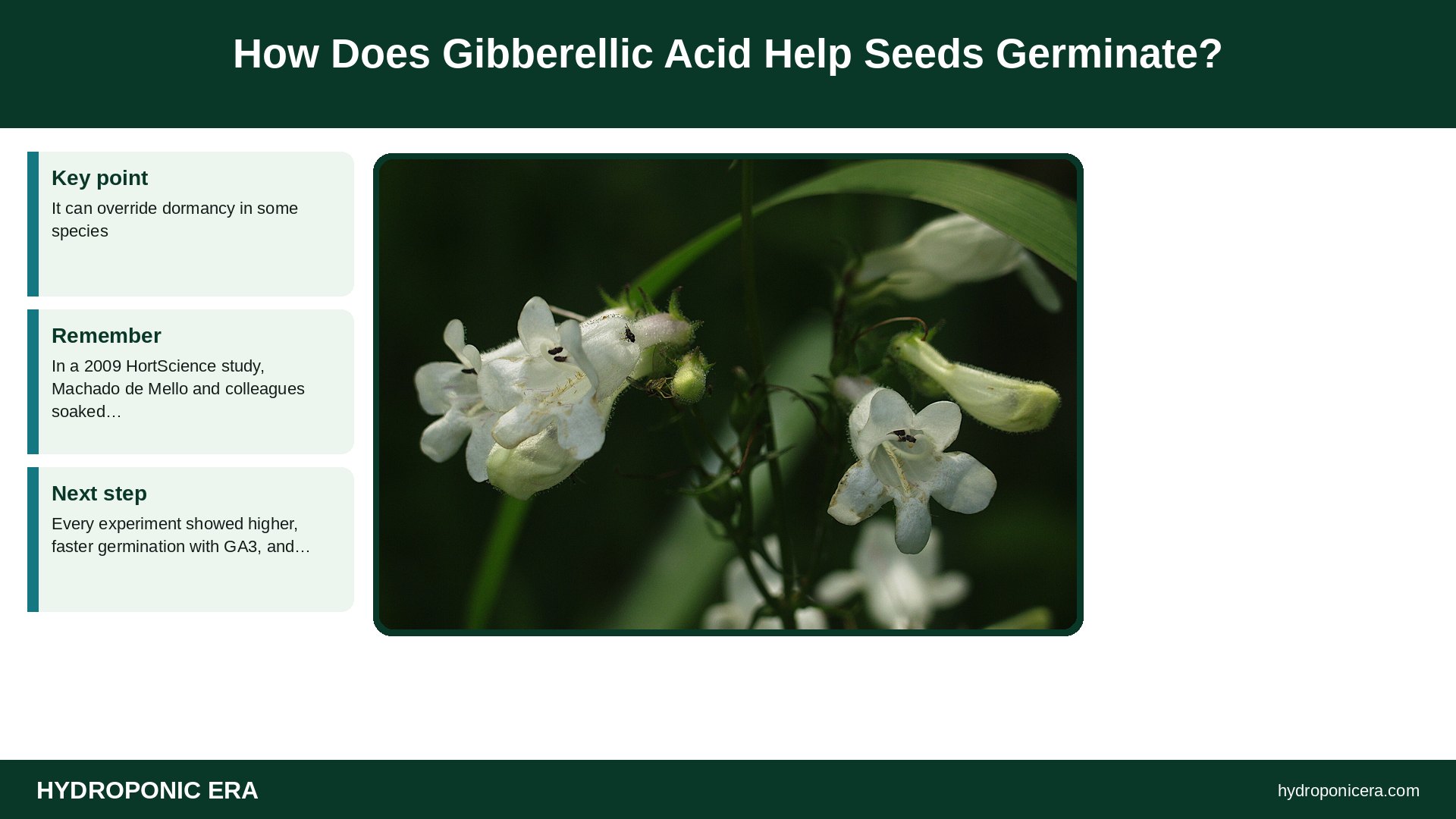
It can override dormancy in some species. In a 2009 HortScience study, Machado de Mello and colleagues soaked Penstemon digitalis ‘Husker Red’ seed in GA3 from 10 to 1,500 mg/L. Every experiment showed higher, faster germination with GA3, and 1,000 mg/L worked best. Responses vary widely by species, so test a small batch first.
- Buy a labeled GA3 product and read its directions and safety section.
- Mix the solution in clean water at the labeled or tested strength.
- Soak seeds for the time the label or study specifies.
- Sow at once and keep a control batch without GA3 for comparison.
For common sowing setups, see our guide to hydroponic germination methods.
Does Gibberellic Acid Cause Stretching and Bolting?
Yes, that is its core action. Gibberellic acid lengthens stems, so excess makes plants tall, weak and pale. In a 2016 Frontiers in Plant Science study, Han and colleagues found applied gibberellins promoted bolting in both a bolting-resistant and a bolting-sensitive lettuce line. Bolting turns leaves bitter.
Compare causes in our leggy seedlings guide and our lettuce bolting timeline.

Can You Add Gibberellic Acid to Hydroponic Nutrient Solution?
Researchers have, at very low doses. Miceli and colleagues added GA3 to the nutrient solution of a floating raft system growing leaf lettuce and rocket. At 10^-6 M, about 0.35 mg/L, growth, yield, water use efficiency and nitrogen use efficiency improved. At 10^-4 M, about 35 mg/L, plants lost marketability. The window is narrow.
Rocket is arugula; see how to grow arugula hydroponically before experimenting.

Should Home Growers Use Gibberellic Acid?
Only for a specific problem, and rarely in a home hydroponic system. Stubborn seeds with known dormancy are the clearest case. For everyday lettuce, herbs and tomatoes, good light, temperature and nutrition matter far more. Check that any product is labeled for your use, and never exceed label rates on food crops.
How Do You Measure Tiny Gibberellic Acid Doses?
Work in milligrams per liter and dilute in steps. One mg/L equals one part per million. For the 0.35 mg/L raft dose, first make a stronger stock solution, then dilute a measured amount into the reservoir. Use a scale reading to 0.01 gram, label containers, and keep stock solution away from children and pets.
What Else Changes When Plants Get Gibberellins?
More than height. In the floating raft study, low GA3 doses increased biomass, leaf expansion and stomatal conductance in both lettuce and rocket, and the trends matched across the two crops. Faster growth also raises nutrient and water demand, so watch EC and top up the reservoir more often if you trial it.
Keep conditions steady during any trial so you can tell what the hormone did and what the weather did. Change one variable at a time and record plant height, leaf count and harvest weight against untreated plants.
FAQ About Gibberellic Acid
Is it natural?
Yes. EPA notes it occurs naturally in plants and microbes.
What is GA3?
The most common form of gibberellic acid sold to growers.
Can it make lettuce bolt?
Yes. Applied gibberellins promoted bolting in lettuce trials.
What dose helped hydroponic lettuce?
10^-6 M, about 0.35 mg/L, in one study.
Does it work on every seed?
No. Responses vary by species and dose.
Sources
- US EPA — Biopesticides Fact Sheet: Gibberellins
- Agronomy (MDPI), Miceli et al. (2019) — Effect of Gibberellic Acid on Growth, Yield, and Quality of Leaf Lettuce and Rocket Grown in a Floating System
- Frontiers in Plant Science, Han et al. (2016) — MADS-Box Genes and Gibberellins Regulate Bolting in Lettuce
- HortScience, Machado de Mello et al. (2009) — Gibberellic Acid Promotes Seed Germination in Penstemon digitalis
- Photo credits (Wikimedia Commons, edited with titles): Микрокристаллы гибберелловой кислоты by Anatoly Mikhaltsov (CC BY-SA 4.0); Penstemon digitalis, 2020-06-21, Kane Woods, 01 by Cbaile19 (CC0); Starr-081031-0356-Lactuca sativa-lettuce bolting-Makawao-Maui (24296008504) by Forest and Kim Starr (CC BY 3.0 us); Deep water culture by ArcadiYay (CC BY-SA 4.0)