
Does Encarsia formosa work in hydroponics? Yes. Encarsia formosa is a tiny parasitic wasp used in greenhouse tomatoes and cucumbers to control greenhouse whitefly, and it works the same way over hydroponic crops. Cornell’s biological control guide says each female kills about 95 whitefly nymphs in her life. Release it early, while whitefly numbers are still low.
Key takeaway: Encarsia formosa lays its eggs inside whitefly nymphs, which turn black as the wasp develops. University of Vermont advises releasing it preventively or at low whitefly levels, with day temperatures above 72°F (22°C). It is sold as parasitized pupae on cards that you hang low in the canopy, out of direct sun.
| Fact | What sources report | Source |
|---|---|---|
| Adult size | About 0.02 in (0.6 mm) | Cornell University |
| Target pest | Greenhouse whitefly; weaker on sweetpotato whitefly | UVM; Cornell |
| Lifetime kill | About 95 nymphs over 12 days | Cornell University |
| Egg to adult | About 25 days at 70°F (21°C) | Cornell University |
| Preventive rate | About 1.5 wasps per 10.8 sq ft (1 m²) every 1–2 weeks | Danish EPA |
| Curative rate | 3–10 per 10.8 sq ft (1 m²) weekly, at least 5 weeks | Danish EPA |
What Is Encarsia Formosa?
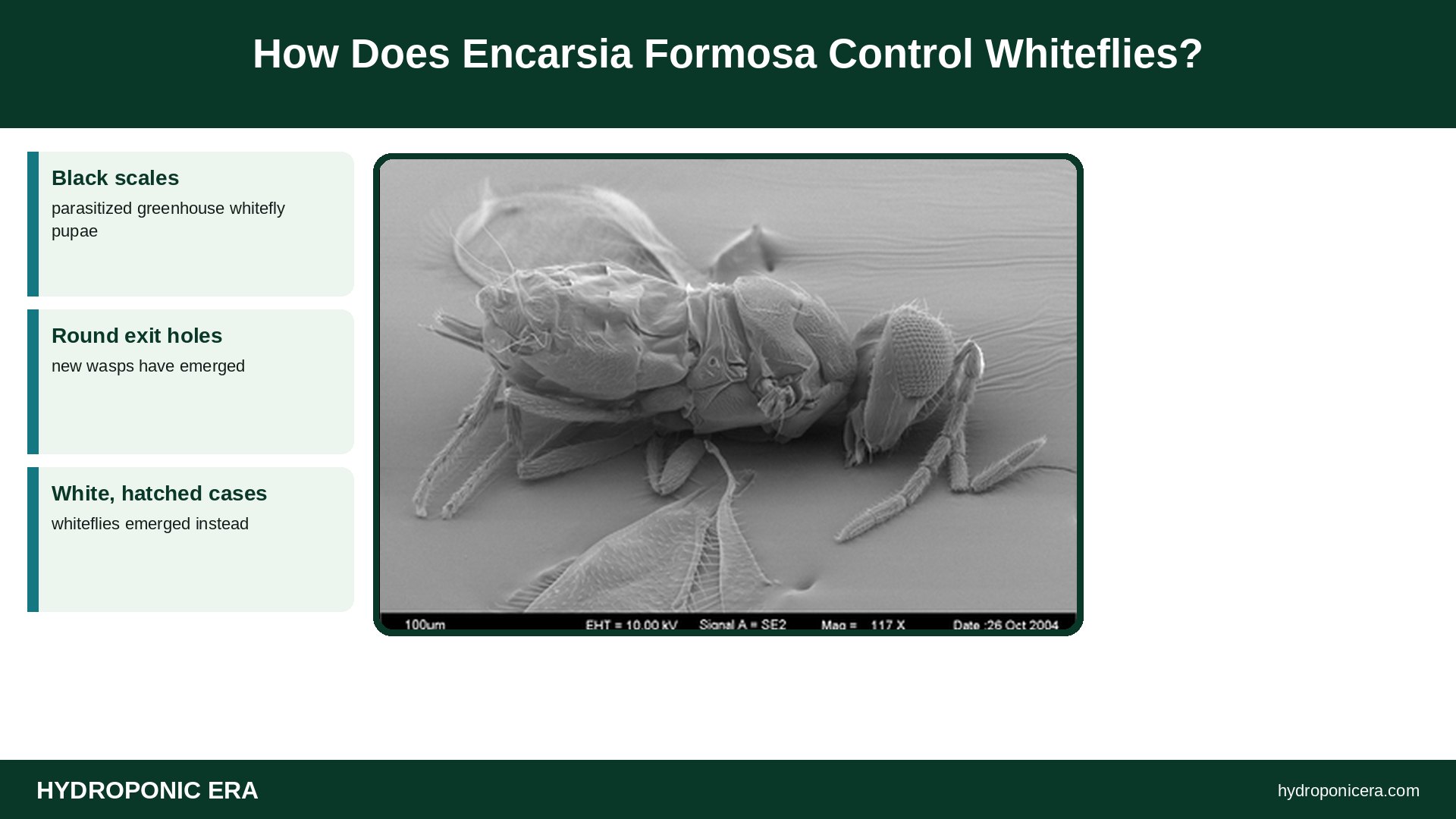
Encarsia formosa is a parasitoid wasp about 0.6 mm long with a black head and thorax and a yellow abdomen, according to Cornell University. Females lay eggs inside whitefly nymphs, preferring the third, fourth and prepupal stages. The wasp larva develops inside and kills the host, and an adult chews out through a round exit hole.
Adults also kill whiteflies by host feeding. Cornell reports each female kills on average 95 nymphs over a 12-day life expectancy. The Danish EPA reports a sex ratio of nearly 100% females, so populations can build fast where whiteflies are present.
How Does Encarsia Formosa Control Whiteflies?
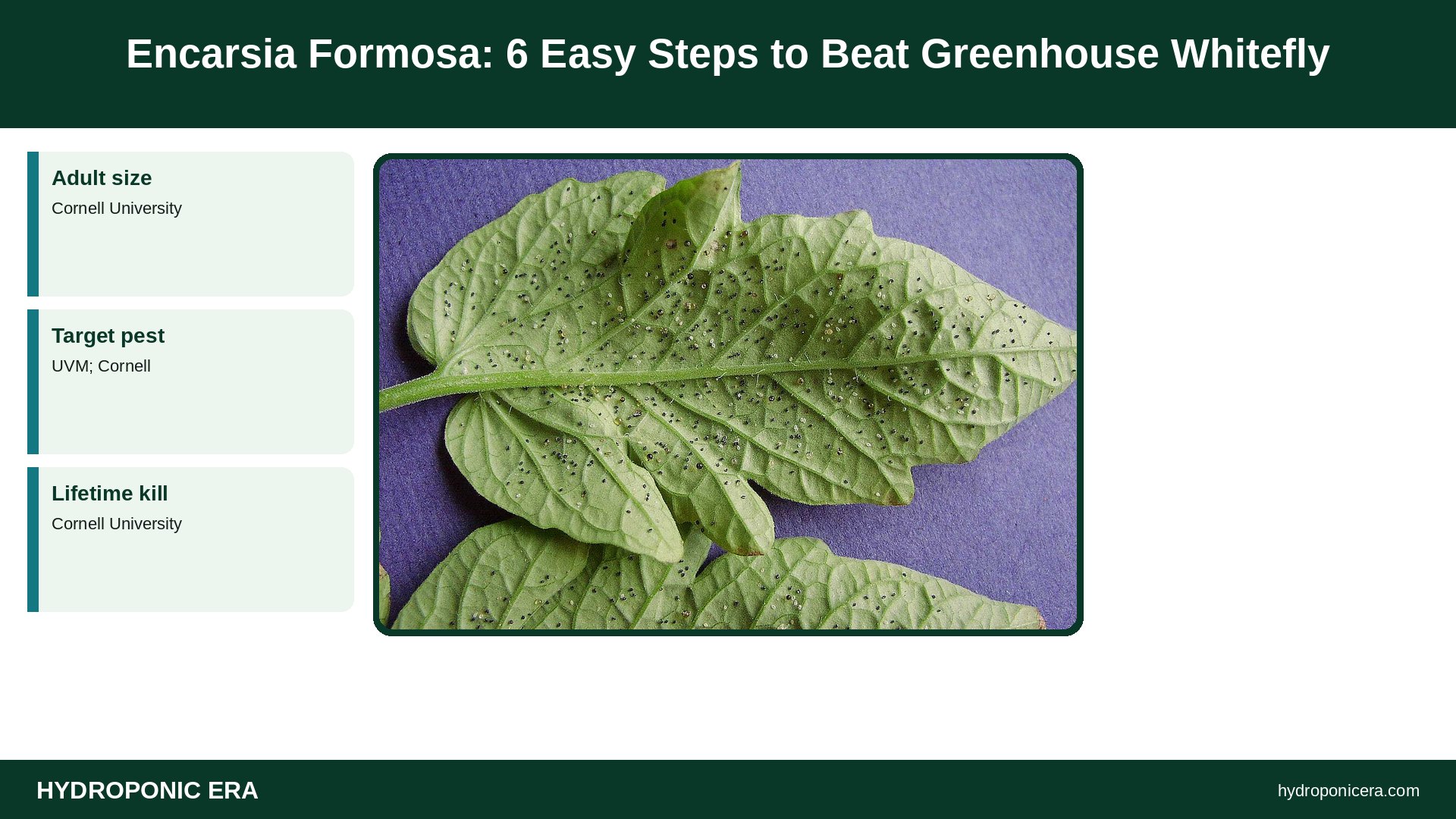
It parasitizes and feeds on immature whiteflies on leaf undersides. University of Vermont says parasitized greenhouse whitefly pupae turn black, while sweetpotato whitefly pupae turn a straw color. Black scales on lower leaves show the wasps are working. Encarsia works best on greenhouse whitefly; UVM notes less success against sweetpotato whitefly.
- Black scales: parasitized greenhouse whitefly pupae.
- Round exit holes: new wasps have emerged.
- White, hatched cases: whiteflies emerged instead.
Our guide to whiteflies in hydroponics covers identification and other controls.
How Do You Release Encarsia Formosa?
Hang the cards low in the plant canopy, out of direct sunlight, as soon as they arrive. UVM says Encarsia is sold as parasitized pupae stuck to small cards. The Danish Environmental Protection Agency reports cards carrying 100–500 pupae, hung evenly among plants. Adults emerge over the following days and search for whitefly nymphs.
- Open the package inside the growing area.
- Hang cards on lower leaves, shaded from direct light.
- Spread cards evenly; add more near hot spots.
- Repeat releases weekly or every two weeks.
- Check lower leaves for black scales.
UVM suggests setting aside a small portion of each shipment in a sealed container to watch emergence and confirm the wasps are alive.

What Is the Encarsia Formosa Release Rate?
Rates depend on whether you are preventing or treating whiteflies. The Danish EPA lists about 1.5 wasps per 10.8 sq ft (1 m²) every one to two weeks for prevention, and 3–10 per 10.8 sq ft (1 m²) weekly for at least five weeks when whiteflies are established. UVM gives an average of 1 wasp per 1–4 plants weekly for 4–6 weeks.
| Situation | Rate | Source |
|---|---|---|
| Prevention | About 1.5 per 10.8 sq ft (1 m²) every 1–2 weeks | Danish EPA |
| Established whiteflies | 3–10 per 10.8 sq ft (1 m²) weekly, 5+ weeks | Danish EPA |
| Hot spots | More than 10 per 10.8 sq ft (1 m²) | Danish EPA |
| Per-plant guide | 1 per 1–4 plants weekly, 4–6 weeks | University of Vermont |
UVM says releases may stop when 70–80% of plants contain parasitized pupae. Always check the supplier’s label rate too.
What Conditions Does Encarsia Formosa Need?
Warm days and bright light. UVM says the wasps do best when daily temperatures exceed 72°F (22°C) and advises against releases when days stay below 72°F (22°C) and nights fall below 59°F (15°C), because whiteflies then outbreed the parasite. Encarsia also lays more eggs in bright light. The Danish EPA lists a minimum development temperature of about 50–52°F (10–11°C).
- Day temperature: above 72°F (22°C) for best results.
- Light: bright light raises egg laying.
- Pesticides: avoid residual sprays that kill the wasps.
Track whitefly adults with a few yellow sticky cards so you can time releases; see sticky trap placement.

Which Release Method Works Best for Encarsia Formosa?
Cornell’s biological control guide describes four approaches. Three are inoculative and aim to build a breeding population: “pest in first,” the “dribble” method and banker plants. The fourth is inundative, with repeated high releases all season, and is used most often on ornamental crops. In a home hydroponic grow, the dribble method is the simplest choice.
| Method | How it works | Source |
|---|---|---|
| Dribble | Low releases from planting until parasitized nymphs appear | Cornell |
| Banker plants | Breeding colonies on earlier plants, e.g. 1 per 352 crop plants | Cornell |
| Pest in first | Whiteflies added deliberately, then wasps | Cornell |
| Inundative | Repeated high releases all season | Cornell |
Cornell notes that the inoculative methods have controlled greenhouse whitefly on cucumber and tomato. Adults also kill nymphs by host feeding, probing them with the ovipositor and feeding from the wound, so control comes from both parasitism and feeding. Heavy honeydew, dense leaf hairs and cool temperatures slow the wasps as they search leaves.
Can Encarsia Formosa Be Used With Other Biocontrols?
Yes. Cornell describes several release strategies, including the “dribble method,” where low-rate releases begin at planting before whiteflies build. Cornell also notes banker-plant systems that keep a reproducing wasp population in the crop. Keep pesticide use selective so the wasps survive. See our overview of predatory mites for other beneficials.
FAQ About Encarsia Formosa
How many whiteflies does one Encarsia formosa kill?
Cornell reports about 95 nymphs over a 12-day life.
How long until Encarsia formosa works?
Black scales take weeks; egg to adult is about 25 days at 70°F (21°C).
Does Encarsia formosa control sweetpotato whitefly?
UVM reports less success; higher rates are needed.
How long do Encarsia formosa adults live?
The Danish EPA reports released adults survive about 2–3 weeks.
Can I use Encarsia formosa indoors at home?
Yes, in warm, bright grow rooms with active whiteflies.
Sources
- Cornell University — Encarsia formosa, Biological Control guide
- University of Vermont Extension — Vegetable and berry newsletter: Encarsia formosa
- Danish Environmental Protection Agency — Biology of selected beneficial arthropods
- Photo credits (Wikimedia Commons, edited with titles): Tomate Blatt Eier Weiße Fliege parasitiert by Unknown (CC BY-SA 3.0); Encarsia formosa by Lars Krogmann (CC BY-SA 3.0)