
Hydroponic tulips are grown by chilling bulbs, then setting them on trays or vases with their base just touching water or a dilute calcium nitrate solution until they root and bloom. It’s a real commercial method: Cornell University’s flower bulb program notes that about 30–35% of the Dutch cut tulip crop is forced hydroponically. The key is cold. Cornell describes giving dry bulbs about 75–80% of their cold requirement first, often 12–14 weeks depending on the cultivar, then rooting them in water at about 40°F for 2–4 weeks before moving them to warmth to flower, about three weeks later.
Key takeaway: Buy pre-chilled bulbs or chill them yourself, keep the bulb base just above or touching the water, root them cold, then bring them into warmth.
| Stage (Cornell) | Conditions | Time |
|---|---|---|
| Dry chilling | Cold storage, unplanted | About 12–14 weeks (75–80% of cold need) |
| Rooting | In water or dilute calcium nitrate, about 40°F | 2–4 weeks |
| Forcing | Greenhouse or warm room | About 3 weeks to flower |
| Solution EC | Calcium nitrate, about 1.0–1.5 mS/cm | Through rooting and forcing |

How Hydroponic Tulips Work

Tulip bulbs store most of the energy the flower needs. What they need from you is a cold period to trigger flowering, water for roots, and a little calcium. Cornell’s commercial method roots bulbs in a dilute calcium nitrate solution at an EC of about 1.0–1.2 mS/cm, then maintains 1.2–1.5 mS/cm in the greenhouse. At home, plain water works for a single bloom, since the bulb supplies the rest. See growing bulbs in water.
Chilling Hydroponic Tulips
Tulips won’t bloom properly without cold. Options:
- Buy pre-chilled bulbs: many US suppliers sell bulbs ready for forcing.
- Chill your own: store dry bulbs in a refrigerator in a paper bag for about 12–14 weeks. Keep them away from ripening fruit, especially apples, which give off ethylene that can damage the flower bud.
Total cold requirement varies by cultivar, so check with your bulb supplier.
Setting Up Hydroponic Tulips
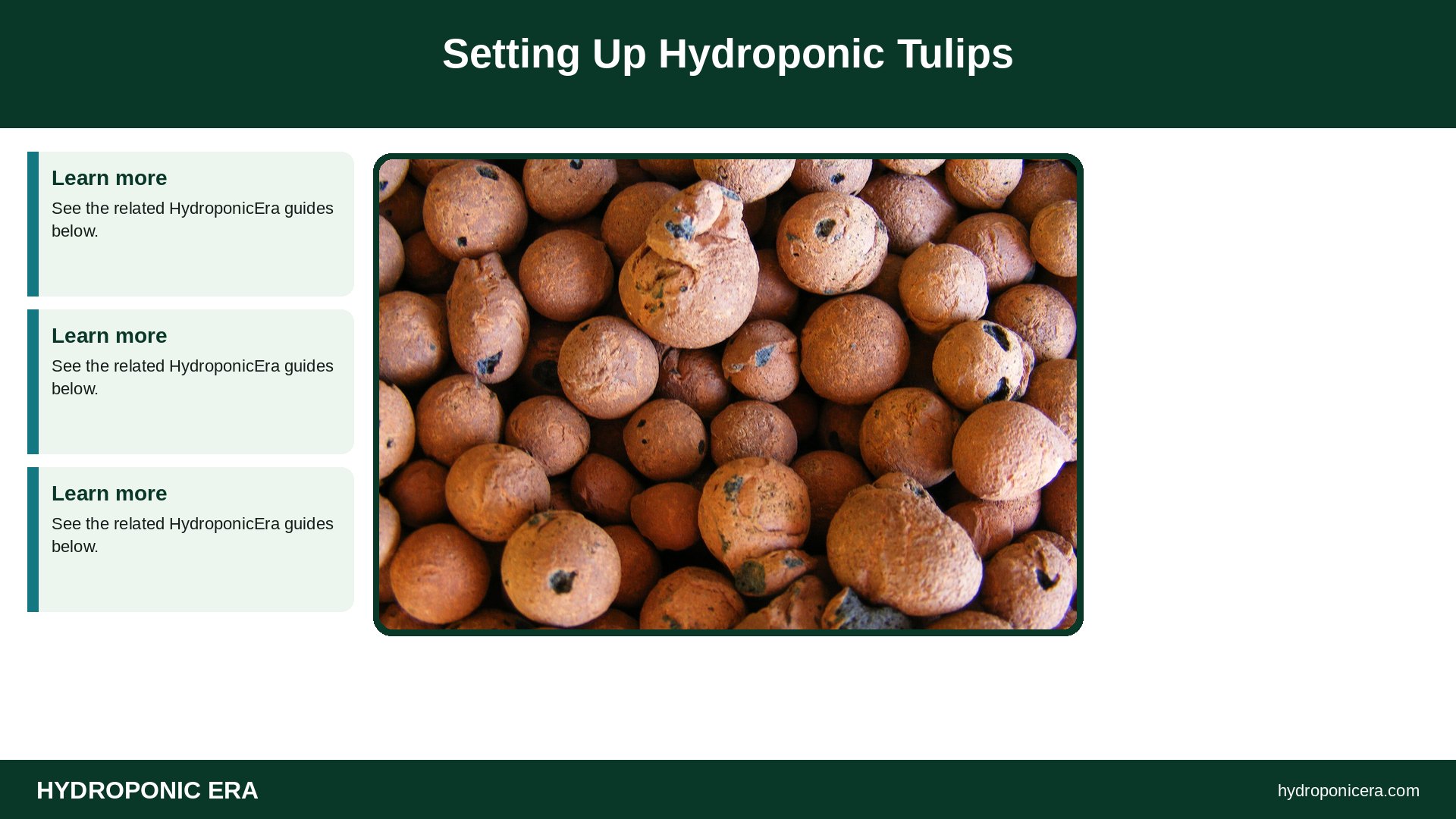
- Use a forcing vase, a glass with pebbles, or a tray with a grid that holds bulbs upright.
- Set the bulb so its base sits just above or barely touching the water. Cornell’s trays keep solution only about 1.5–2 inches deep.
- Keep the vase somewhere cool and dark, around 40°F (a refrigerator or cold garage), while roots grow, about 2–4 weeks.
- When roots are well developed and shoots are a few inches tall, move to a bright, cool room.
- Expect flowers in about three weeks.
Keep Rooting Short and Aerated
Cornell found that a longer rooting period lowers flower quality because long roots deplete oxygen faster and are more prone to disease. Their trials also showed tulips grew better with an aquarium pump and air stone, and they suggest tulips may have an especially high dissolved oxygen requirement. Change the water if it clouds or smells. See dissolved oxygen.
Hydroponic Tulips Indoors: Light and Temperature
After rooting, a bright, cool spot keeps stems short and flowers longer-lasting. Warm rooms make stems stretch and flowers fade faster. Turn the vase daily so stems grow straight.
Hydroponic Tulips vs Soil-Forced Tulips
Cornell reports hydroponic forcing is 3–5 days faster than soil forcing, needs less cooler space, and gives cleaner harvest with no soil waste. The trade-offs: hydro stems tend to be 1–2 inches shorter and 6–8% lighter, not all cultivars suit the method, and bulbs must be high quality and disease free.
Best Tulips for Hydroponic Forcing
Ask suppliers for cultivars recommended for water forcing; Cornell notes not all cultivars are suited. Cornell’s photos show cultivars like ‘Monte Carlo’ and ‘Friso’ grown in hydroponic trays. Choose large, firm, healthy bulbs.
After Flowering
Bulbs forced in water use up their stored energy and usually don’t bloom well again. Most growers compost them. For bulbs that rebloom in water year after year, try other plants that grow in water. Some plant tulips outdoors in fall, but expect weak or no flowers for a year or more.
Planning Tips: Hydroponic Tulips
Hydroponic tulips are a short project: you force one bloom per bulb and the bulb is usually spent afterward. Indoors, forced bulbs rarely rebloom well, so most growers compost them or plant them outdoors and accept they may take years to flower again.
Keep forced tulips cool and out of direct heat once in bloom to make the flowers last longer, and keep water just below the base of the bulb so it doesn’t rot.
Weekly Routine for Hydroponic Tulips
- Keep the water level just below the base of the bulb.
- Replace the water if it turns cloudy or smells.
- Check bulbs for soft spots or mold and remove any that rot.
- Turn the vase every few days once shoots grow so stems stay straight.
Beginner Mistakes With Hydroponic Tulips
The most common mistakes are skipping the cold period, letting the bulb sit in water, moving bulbs into warmth too soon, and leaving cloudy water unchanged. Each one is easy to fix once you know to check for it. Start with fewer plants than you think you need, learn the routine, and expand once the system runs smoothly.
Choosing Bulbs for Hydroponic Tulips
Choose large, firm bulbs with no soft spots or mold. Bigger bulbs store more energy, which helps since forced tulips rely almost entirely on what’s inside the bulb. Some sellers offer pre-chilled bulbs, which saves you the cold period at home.
Containers for Hydroponic Tulips
Forcing vases with a narrow neck hold one bulb above the water. A shallow dish filled with pebbles or marbles works for several bulbs; set them on the stones with water just below the base. Clear glass lets you watch roots grow, which is part of the appeal.
Hydroponic Tulips vs Other Forced Bulbs
Hyacinths and paperwhites are also commonly forced in water. Paperwhites need no chilling, making them easier than tulips for a first try.
FAQs: Hydroponic Tulips
Can tulips grow in just water?
Yes, after chilling. The bulb supplies most of the energy.
How long do tulips need to chill?
Cornell’s method gives about 12–14 weeks dry, then 2–4 weeks rooting at about 40°F.
Should the bulb touch the water?
Just the base, or slightly above, to prevent rot.
Why are my tulip stems flopping?
Too warm or too little light after rooting.
Will forced tulips bloom again?
Usually not well.
Can I use tap water for hydroponic tulips?
Yes; change it if it turns cloudy.
Sources
- Bill Miller, Cornell University Flower Bulb Research Program — A Primer on Hydroponic Cut Tulips (Greenhouse Product News)
- Photo credits (Wikimedia Commons, edited with titles): Bulbs and seeds (16561246721) by Griffith and Turner Company.; Henry G. Gilbert Nursery and Seed Trade Catalog Co (CC BY 2.0); Red and white tulip at Myddelton House, Enfield, London by Acabashi (CC BY-SA 4.0); Hydroton by Lucis (CC BY-SA 3.0); Water droplets on a late cotoneaster (Cotoneaster coriaceus) leaf, Jardim da Fundação Calouste Gulbenkian, Lisbon, Portugal julesvernex2 by Jules Verne Times Two (CC BY-SA 4.0); Dracaena sanderiana 132158060 by Beah Vega (CC BY 4.0)