
Can you grow a purple heart plant in water? Yes. Purple heart (Tradescantia pallida) roots easily from stem cuttings placed in water. University of Wisconsin Extension says cuttings from any part of the plant root readily in soil or in water. Use a 3 to 6 inch (8 to 15 cm) tip with several nodes, keep leaves above the waterline and give it bright light.
Key takeaway: A purple heart plant in water is one of the easiest cuttings you can root. UW–Madison Extension says purple heart roots from cuttings taken from any part of the plant, in soil or in water. It is hardy only in USDA zones 10–11 (NC State), so most US growers root it in water to overwinter it indoors. Full sun gives the deepest purple; shade turns leaves greener.
| Fact | What sources report | Source |
|---|---|---|
| Scientific name | Tradescantia pallida (formerly Setcreasea pallida) | UW–Madison, NC State |
| Native range | Northeast Mexico | UW–Madison |
| Hardiness | USDA zones 10–11 | NC State |
| Propagation | Cuttings from any part root in soil or water | UW–Madison |
| Cutting length | 3–6 in (8–15 cm) with several nodes | UVM Extension |
| Light | Full sun for best purple color | UW–Madison, NC State |
| Safety | Sap may irritate skin; low-severity poison | UW–Madison, NC State |

What Is a Purple Heart Plant?
Purple heart is Tradescantia pallida, a trailing perennial in the spiderwort family (Commelinaceae). University of Wisconsin–Madison Extension says it is native to northeast Mexico, from Tamaulipas to Yucatán, and was once named Setcreasea pallida. It has dark purple, lance-shaped leaves up to 7 inches (18 cm) long on fleshy stems.
The plant stays about 1 foot (30 cm) tall but spreads much wider. Its small pink or pale purple flowers have three petals. UW–Madison notes the stems are quite fragile and snap easily, which is good news for propagation: almost every broken piece can become a new plant.
Purple heart is a different species from the striped wandering dude types. If you grow those too, our tradescantia in water guide covers them.
Can You Root a Purple Heart Plant in Water?
Yes, and it is very reliable. UW–Madison Extension says the plant is easily propagated by taking cuttings from any part of the plant, and that a node pushed into potting mix or placed in water until roots develop will usually root. A purple heart plant in water lets you watch roots form at each node.
University of Vermont Extension gives the basic method for houseplant cuttings: take a 3 to 6 inch (8 to 15 cm) cutting from the tip of a healthy stem and include several leaf nodes. A node is the bump where the leaf meets the stem, and that is where new roots appear.
- Cut a healthy 3–6 inch (8–15 cm) tip just below a node with clean scissors.
- Strip the leaves from the lower 1–2 nodes so no foliage sits underwater.
- Stand the cutting in a clear jar of room-temperature tap water.
- Keep the jar in bright, indirect light, out of hot midday sun.
- Top up and change the water every few days.

How Long Does a Purple Heart Plant in Water Take to Root?
None of the extension sources give a fixed number of days. Purple heart has soft, fleshy stems like other tradescantias, so in warm, bright rooms you can usually expect the first white root tips within one to two weeks. Cool rooms, low light and old woody stems slow it down.
Before you move a purple heart plant in water, wait until roots are about 1 to 2 inches (2.5 to 5 cm) long before you move the cutting. UVM notes that rooting in water lets you watch roots develop, but the cutting must later be moved into soil, so do not leave it for months unless you plan to keep it in water.
- Warmth: room temperatures of about 65–75°F (18–24°C) speed rooting.
- Light: bright, indirect light; avoid dark corners.
- Water: fresh water every 3–4 days prevents slime and rot.
- Stem type: green tips root faster than old, bare stems.
How Do You Keep a Purple Heart Plant in Water Long Term?
A purple heart plant in water can keep growing for months if you change the water and feed it lightly. Plain water has almost no nutrients, so once roots form, add a liquid houseplant or hydroponic fertilizer at about one-quarter strength every few weeks. UW–Madison recommends feeding monthly while plants are actively growing.
Pinch the tips often. UW–Madison says pinching promotes more compact growth, and that plants should be cut back after flowering so they do not get spindly. Use those clippings to start each new purple heart plant in water. The same routine works for coleus in water and pothos in water.
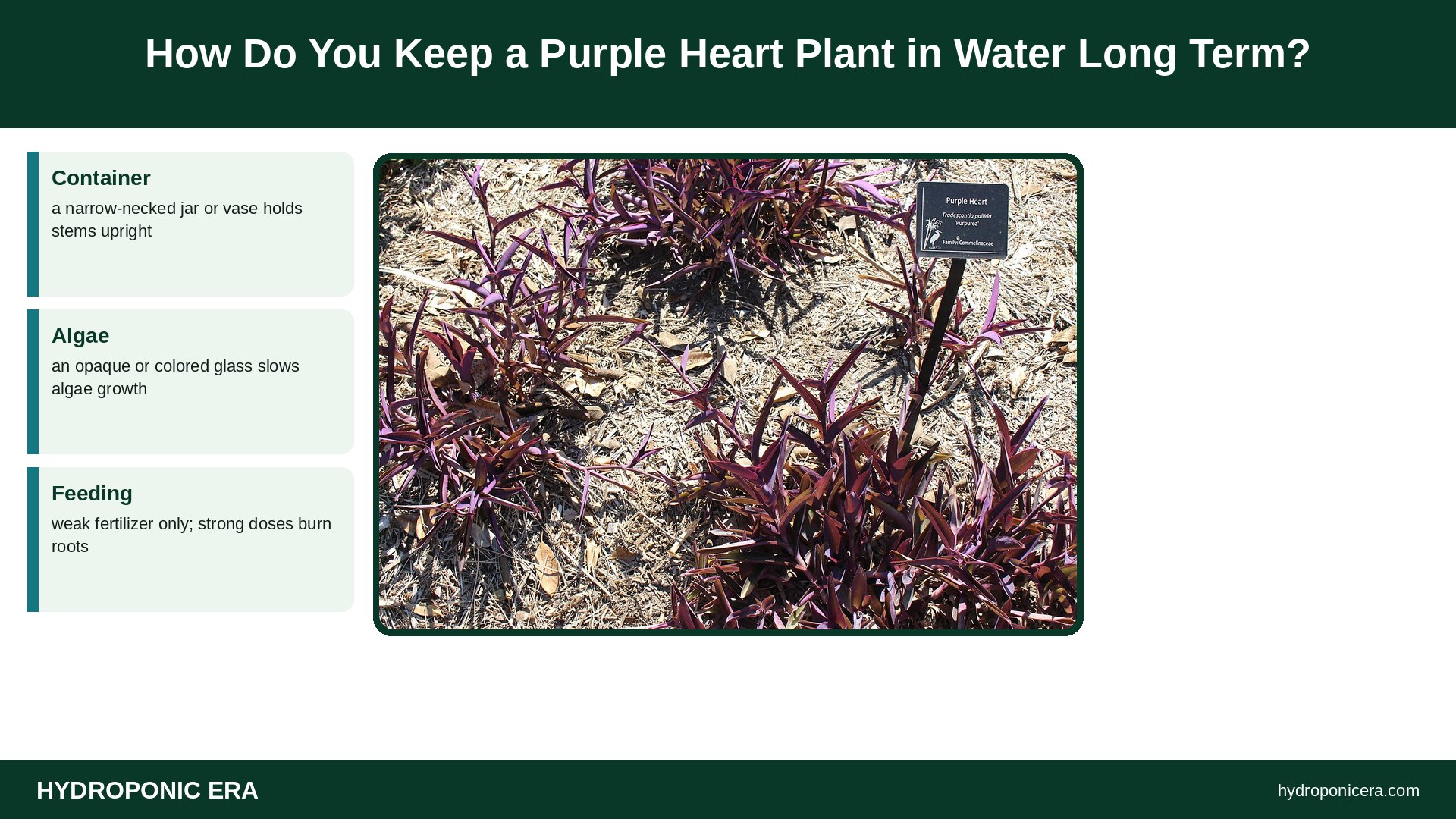
- Container: a narrow-necked jar or vase holds stems upright.
- Algae: an opaque or colored glass slows algae growth.
- Feeding: weak fertilizer only; strong doses burn roots.
- Winter: UW–Madison advises less water and no fertilizer until spring growth.
What Light Does a Purple Heart Plant in Water Need?
Give a purple heart plant in water as much light as you can. UW–Madison says to grow purple heart in full sun for best color, because plants in shade tend more toward green than purple. NC State Extension also says plants in shady spots take on a greener tint. Indoors, a south or west window or a grow light keeps the leaves purple.
While cuttings are rooting, though, use bright indirect light so the stems do not overheat in a glass jar. Once roots are established, move the purple heart plant in water to a brighter window or put it about 12 inches (30 cm) under an LED grow light for 12 to 14 hours a day.
When Should You Move a Purple Heart Plant in Water to Soil or Hydroponics?
Move it once the roots are 1 to 2 inches (2.5 to 5 cm) long. UVM notes that rooting directly in soil avoids having to transplant later, so move water-rooted cuttings soon rather than waiting until the roots become long and tangled. Water-grown roots are fragile, so handle them gently and keep the new mix lightly moist for the first week.
You can also move rooted cuttings into a passive hydroponic or semi-hydro pot filled with clay pebbles. Keep the reservoir low so only the bottom third of the pebbles sits in nutrient solution. Purple heart is drought tolerant and thrives on neglect, according to UW–Madison, so it does well in an easy setup.
- Fill a small pot with light potting mix or rinsed clay pebbles.
- Make a hole and lower the roots in without bending them.
- Firm the mix gently, water or add weak nutrient solution.
- Keep it out of strong sun for 3–5 days while it settles.
Is a Purple Heart Plant in Water Safe for Pets and Kids?
Handle it with some care. UW–Madison says juice from the leaves or stems may cause skin redness and irritation in some people and dogs, though this is not common. NC State Extension lists it as having low-severity poison characteristics and flags it as a problem for children, dogs and cats. Wear gloves if you have sensitive skin and keep jars out of reach of pets.
- Skin: wash hands after trimming stems.
- Pets: place jars on high shelves away from cats and dogs.
- Pests: UW–Madison notes scale and mealybugs can be a problem.
Why Is My Purple Heart Plant in Water Turning Green or Rotting?
Green leaves mean too little light, and mushy stems mean rot. Leaves on a purple heart plant in water lose color when light is weak, as both UW–Madison and NC State describe for shaded plants. Rot usually starts when leaves sit underwater or the water is not changed. Trim away soft brown sections, rinse the stem and start again in fresh water.
- Green leaves: move to brighter light or a grow light.
- Mushy base: cut above the rot and re-root the healthy tip.
- Leggy stems: pinch tips and give more light.
- Cloudy water: change it and rinse the jar.
For more easy water cuttings, see purple passion plant in water and lantana cuttings in water.

FAQ About Purple Heart Plant in Water
Can purple heart live in water permanently?
It can for months with fresh water and weak fertilizer, but it grows best potted.
How long do purple heart cuttings take to root?
Usually one to two weeks in warm, bright conditions.
Why are my purple heart leaves turning green?
Too little light; UW–Madison says shade makes leaves greener.
Is purple heart toxic to cats?
NC State flags it as a problem for cats and dogs; keep it out of reach.
What zone is purple heart hardy in?
USDA zones 10–11, per NC State Extension.
How long should a purple heart cutting be?
About 3 to 6 inches (8 to 15 cm) with several nodes.
Sources
- University of Wisconsin–Madison Extension — Purple Heart, Tradescantia pallida
- NC State Extension Plant Toolbox — Tradescantia pallida
- University of Vermont Extension — More, Please: Propagating Houseplants
- Photo credits (Wikimedia Commons, edited with titles): Tradescantia pallida ‘Purpurea’ kz01 by Krzysztof Ziarnek, Kenraiz (CC BY-SA 4.0); Coastal Georgia Botanical Gardens, Purple Heart Tradescantia pallida ‘Purpurea’ by Michael Rivera (CC BY-SA 4.0)