
Can you root a purple passion plant in water? Yes. Purple passion (Gynura aurantiaca) roots quickly from one- or two-node stem cuttings. Place the nodes in room-temperature water, keep the fuzzy leaves dry and above the surface, and give bright, indirect light. Roots usually form within a couple of weeks when kept warm. Pot cuttings once roots reach 2–3 inches (5–8 cm).
Key takeaway: A purple passion plant in water is an easy way to refresh a leggy plant. UF/IFAS Extension says cuttings root year-round with enough warmth and humidity, often in one to two weeks. Keep the hairy leaves dry, and move rooted cuttings into a light, airy mix for the best color.
| Purple passion plant in water factor | Target | Source |
|---|---|---|
| Cutting | 1–2 nodes; leaves above water | UF/IFAS |
| Warmth | About 75°F (24°C) for fastest rooting | UF/IFAS |
| Rooting time | About 1–2 weeks when warm | UF/IFAS |
| Light | Bright, indirect; no afternoon sun | NC State |
| Indoor humidity | 40–60% | UF/IFAS |
| Pot up when roots reach | 2–3 inches (5–8 cm) | UVM |
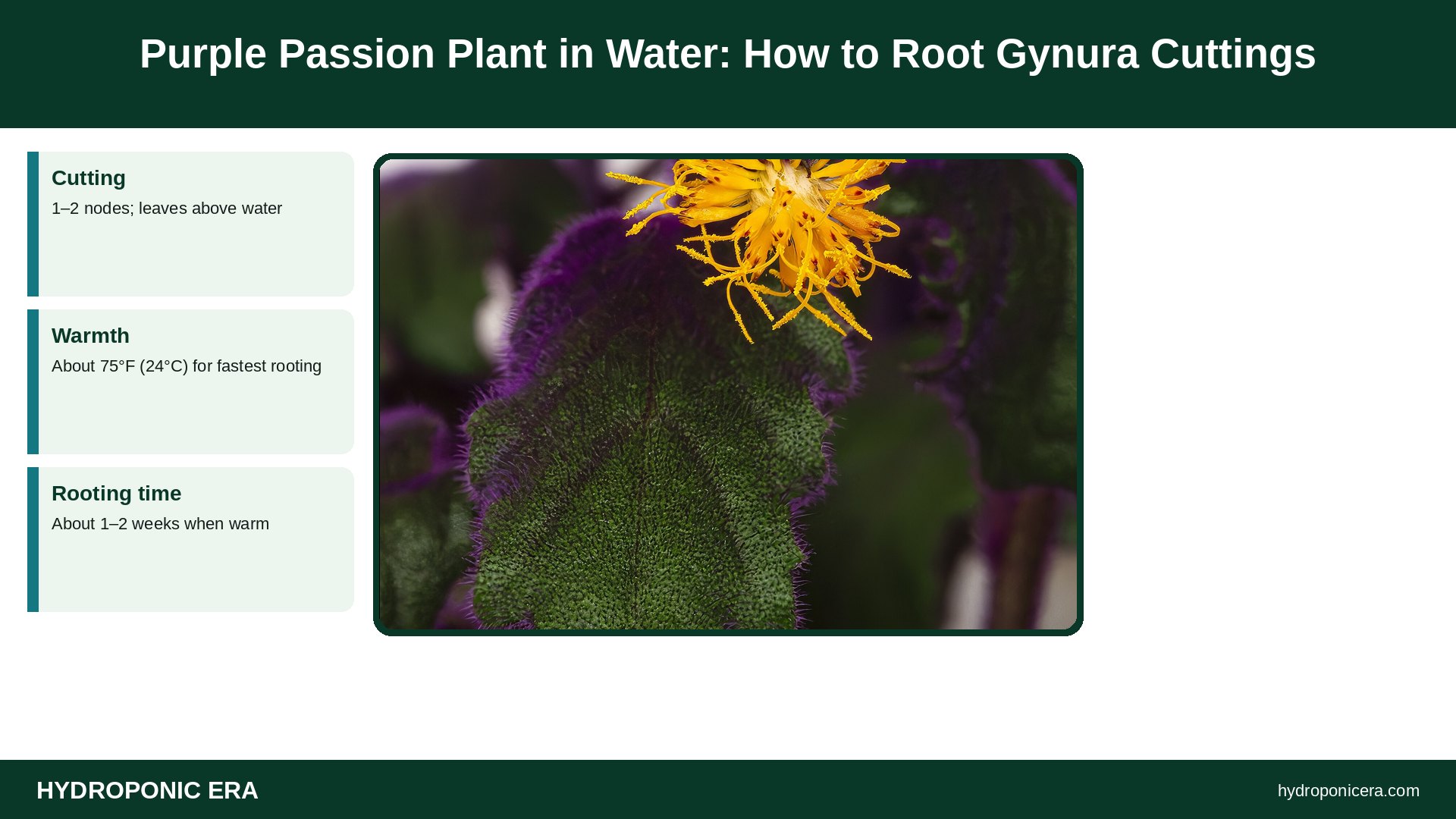
What Is a Purple Passion Plant?
Purple passion plant is Gynura aurantiaca, a fast-growing herbaceous perennial in the aster family (Asteraceae), native to Southeast Asia. NC State Extension notes its velvety purple leaves and stems, which come from dense purple hairs, and its weak, sprawling stems that suit hanging baskets. It is also called purple velvet plant or royal velvet plant.
UF/IFAS Extension lists two cultivars in production: the standard purple passion and a variegated form with green and white leaves. NC State lists the plant as non-toxic to cats and dogs.
Why Root a Purple Passion Plant in Water?
Rooting a purple passion plant in water is the easiest way to renew it, because older plants get leggy fast. UF/IFAS notes that with good light, water and fertilizer, purple passion grows very quickly and can look stretched. Snipping the tips and rooting them gives you compact new plants, and the clear glass lets you watch roots form.
Learn the basics of rooting stems in our guide to hydroponic cuttings and cloning.
How Do You Root a Purple Passion Plant in Water Step by Step?

- Choose healthy tips with bright purple color and no pests.
- Cut a short tip with one or two nodes, as UF/IFAS describes for single- or double-node cuttings.
- Remove leaves that would sit under water; wet, hairy leaves rot quickly.
- Pinch off flower buds. UF/IFAS notes the orange-yellow flowers smell unpleasant and drain energy.
- Set the nodes in water in a small, clean jar at room temperature.
- Keep it warm, ideally near 75°F (24°C), the minimum rooting temperature UF/IFAS gives for fast roots.
- Give bright, indirect light away from hot afternoon sun.
- Change the water whenever it turns cloudy.
How Long Does a Purple Passion Plant Take to Root in Water?
A purple passion plant in water often roots in about one to two weeks when kept warm. UF/IFAS Extension reports roots form in that window when the rooting medium stays at least 75°F (24°C) with proper moisture; in a cool room, water rooting can take longer. Rooting hormone may speed things up, UF/IFAS says, but is not required.
| Time | What you see | What to do |
|---|---|---|
| Days 1–5 | Slight droop | Keep out of direct sun |
| Week 1–2 | White roots at the nodes | Refresh water |
| Week 2–3 | Roots 1–2 inches (2.5–5 cm) | Prepare a small pot |
| Roots 2–3 inches (5–8 cm) | Branching roots | Pot up |
Can a Purple Passion Plant in Water Live There Long Term?
A purple passion plant can live in water for a while, but it usually keeps better color and form in potting mix. UF/IFAS describes its roots as fibrous and delicate; they need steady moisture but rot if the root zone stays saturated. In plain water, change it often, add only a very dilute nutrient solution, and watch for slime or a sour smell.
For long-term soil-free growing, compare options in our guide to plants that grow in water.
How Do You Feed a Purple Passion Plant in Water?
Feed a purple passion plant in water lightly and favor potassium. UF/IFAS Extension recommends a fertilizer with a 3:1:3 N-P-K ratio for commercial crops because the plant needs more potassium. For indoor plants, UF/IFAS suggests keeping the root-zone EC below 1.5 dS/m and adding diluted fertilizer only if readings fall below 1.0 dS/m. In a water jar, that means a weak, quarter-strength solution changed often, never a strong dose.
How Do You Pot a Rooted Purple Passion Cutting?
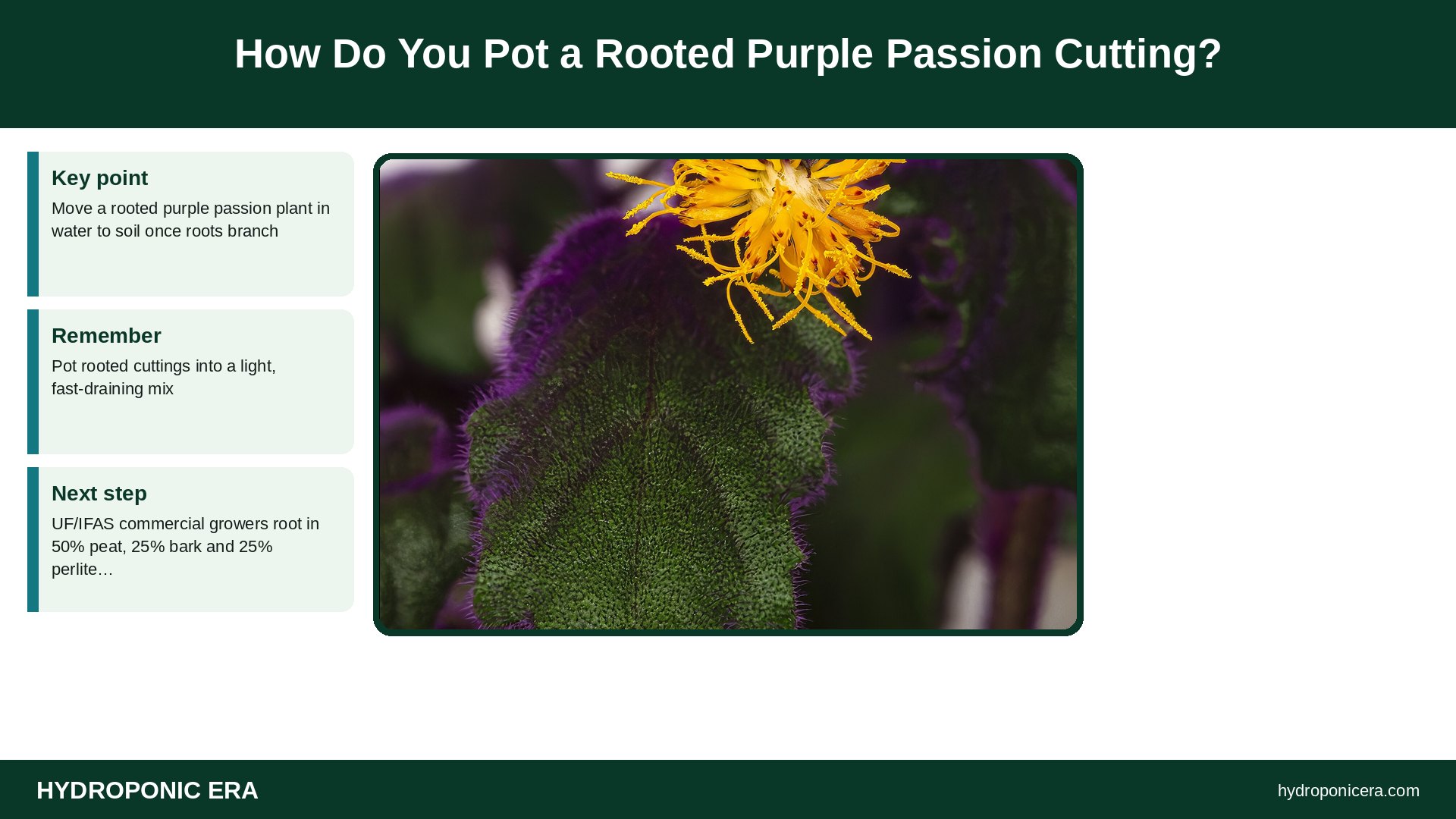
Move a rooted purple passion plant in water to soil once roots branch. Pot rooted cuttings into a light, fast-draining mix. UF/IFAS commercial growers root in 50% peat, 25% bark and 25% perlite at pH 5.5–6.0, a blend you can copy at home with peat-based mix, orchid bark and perlite. Plant several cuttings in one 4- to 6-inch (10–15 cm) pot or hanging basket for a fuller look. Keep the mix evenly moist but never soggy.
NC State advises watering less in winter, since overwatering causes rot.
How Do You Keep a Purple Passion Plant Purple?
Keep a purple passion plant purple with bright, indirect light. NC State Extension says too little light makes leaves look green rather than purple, while afternoon sun can scorch them. UF/IFAS says acclimated plants tolerate interior light as low as 150 foot-candles (about 1,600 lux), with 150–250 foot-candles (about 1,600–2,700 lux) ideal. Pinch stems regularly, as NC State suggests, to keep growth bushy.
Why Is My Purple Passion Plant in Water Rotting or Wilting?
- Black, mushy stem: rot. Cut above the damage, restart in fresh water, and keep leaves out of the water. See pythium root rot.
- Wilting: dry air or too much sun. Raise humidity with a clear cover; see humidity domes for cuttings.
- Green leaves: too little light.
- Sticky residue or tiny insects: NC State lists aphids, whiteflies, mealybugs, spider mites and scale. See mealybugs and scale.
How Do You Stop a Purple Passion Plant From Getting Leggy?

Stop legginess by pinching stem tips often and giving enough light. UF/IFAS says growth speeds up above 80°F (27°C), which can make plants stretch, and that pinching and pruning are the traditional fix. Remove flower buds too, since flowering and leggy growth together shorten the plant’s good looks. Root the trimmed tips in water to start fresh plants.
FAQs
Is purple passion safe for pets?
NC State lists it as non-toxic to cats and dogs.
Can I root a single leaf?
No. Include at least one node.
Why do the flowers smell bad?
UF/IFAS notes the blooms are malodorous; pinch them off.
Should I mist a purple passion plant in water?
No. Hairy leaves hold water; raise humidity around the plant instead.
How long does a plant last?
It declines as it gets leggy, so refresh it from cuttings.
Sources
- UF/IFAS Extension — Cultural Guidelines for Commercial Production of Purple Passion Plant (ENH1079/EP346)
- NC State Extension — Gynura aurantiaca (Purple Velvet Plant)
- University of Vermont Extension — More, Please! Propagating Houseplants
- Photo credits (Wikimedia Commons, edited with titles): (MHNT) Gynura aurantiaca – flower and leaf by Didier Descouens (CC BY-SA 4.0); Ficus cuttings with roots in a bottle, White background by Biusch (CC BY-SA 3.0); (MHNT) Gynura aurantiaca – flower and leaf by Didier Descouens (CC BY-SA 4.0); Ficus cuttings with roots in a bottle, White background by Biusch (CC BY-SA 3.0); Basilikum (Ocimum basilicum) Stecklinge — Josef Schlaghecken by Schlaghecken Josef (CC BY-SA 4.0)