
What is an LED grow light panel? An LED grow light panel is a flat fixture that spreads many diodes across one board to light a square or rectangular area. For most indoor plants, choose full-spectrum white light, plan about 25 watts per square foot (0.09 m²) for high-light crops, hang it 12–24 inches (30–60 cm) above foliage, and run it about 14–16 hours a day.
Key takeaway: Size an LED grow light panel to your growing area, not the box claims. Extension guides from Nebraska and Maine give roughly 25 W per square foot for high-light plants and 16 W for low-light plants. Then fine-tune height and hours by watching how plants grow.
| LED grow light panel factor | Starting point | Source |
|---|---|---|
| Power, high-light plants | About 25 W per sq ft (0.09 m²) | Nebraska, Maine |
| Power, low-light plants | About 16 W per sq ft (0.09 m²) | Nebraska |
| Height above foliage | 12–24 inches (30–60 cm) for most LEDs | Iowa State |
| Seedlings | 3–6 inches (8–15 cm), raise as they grow | Nebraska |
| Hours per day | 14 hours (range 8–16); 16–18 for many crops | Iowa State, Maine |
| Spectrum | Full-spectrum white, 400–700 nm | Maine, Nebraska |
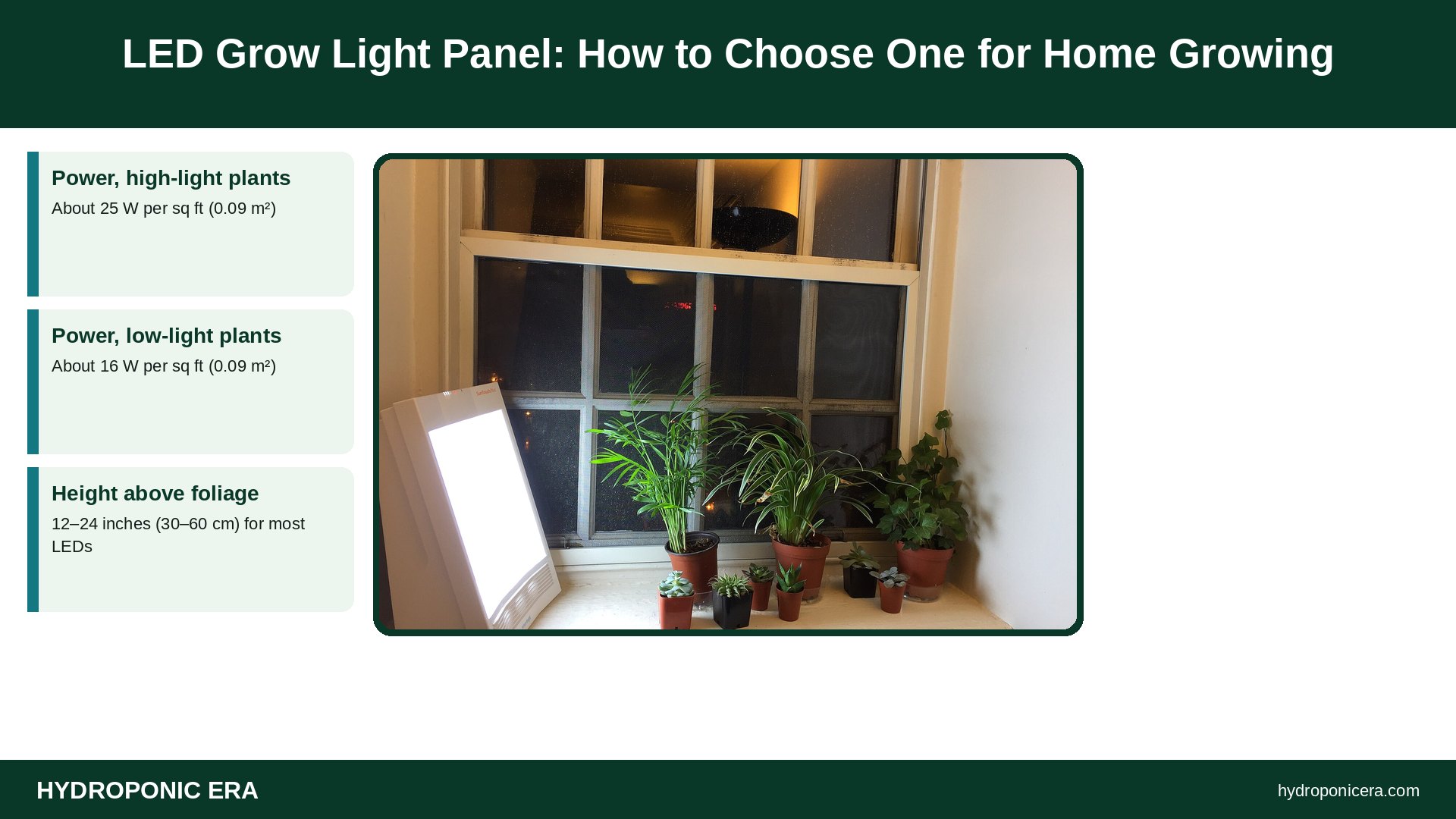
What Is an LED Grow Light Panel and How Is It Different From Bars?
An LED grow light panel packs diodes onto one flat board, while bar fixtures spread diodes along several narrow strips. Panels are compact and easy to hang over a single tent, shelf or tray. Bars spread light more evenly over larger areas and shed heat across more surface. For small spaces, a panel is often the simplest choice.
Compare fixture styles in our beginner’s guide to grow lights.
How Many Watts of LED Grow Light Panel Do You Need?
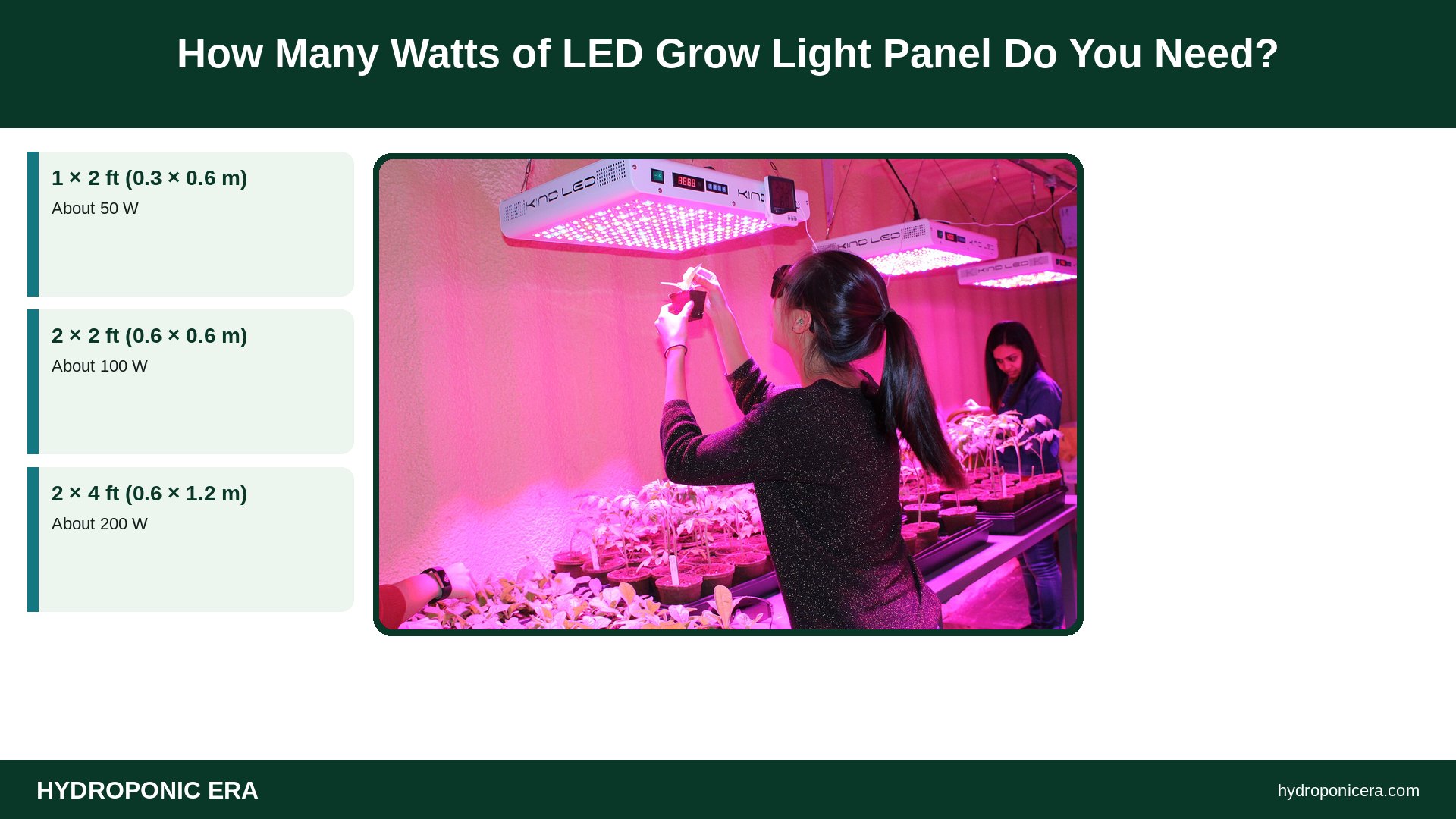
Plan about 25 watts of actual LED power per square foot (0.09 m²) for high-light plants such as vegetables, and about 16 watts for low-light houseplants. Nebraska Extension gives both figures, and University of Maine Extension also suggests about 25 W per square foot for LEDs. Use the real wall-plug wattage, not the “equivalent” number some listings print.
| Growing area | High-light plants (25 W/sq ft) | Low-light plants (16 W/sq ft) |
|---|---|---|
| 1 × 2 ft (0.3 × 0.6 m) | About 50 W | About 32 W |
| 2 × 2 ft (0.6 × 0.6 m) | About 100 W | About 64 W |
| 2 × 4 ft (0.6 × 1.2 m) | About 200 W | About 128 W |
| 4 × 4 ft (1.2 × 1.2 m) | About 400 W | About 256 W |
Which Spectrum Should an LED Grow Light Panel Have?
Choose a full-spectrum white LED grow light panel for most home growing. University of Maine Extension says full-spectrum, or white, light gives the best balance for growth, and that red-and-blue “blurple” lights look purple. Nebraska Extension notes plants use light between 400 and 700 nm, with blue near 440 nm and red near 660 nm especially important.
White light also makes it easier to spot pests, deficiencies and true leaf color. Maine Extension adds that LED color temperature is listed in Kelvin, from about 1,000 K (redder) to 10,000 K (bluer), and that seedlings, clones and leafy vegetative growth generally prefer a bluer light. A panel in the cool-white range is a practical pick for greens and herbs.
How High Should You Hang an LED Grow Light Panel?
Hang most LED grow light panels about 12–24 inches (30–60 cm) above the foliage, as Iowa State Extension suggests for LEDs. For seedlings, Nebraska Extension suggests 3–6 inches (8–15 cm) and raising lights as plants grow; follow your fixture’s instructions, since strong panels need more distance. Hanging on adjustable chains or ratchet hangers makes changes easy.
See stage-by-stage heights in our light distance guide.
How Do You Know If the Panel Is Too Close or Too Far?
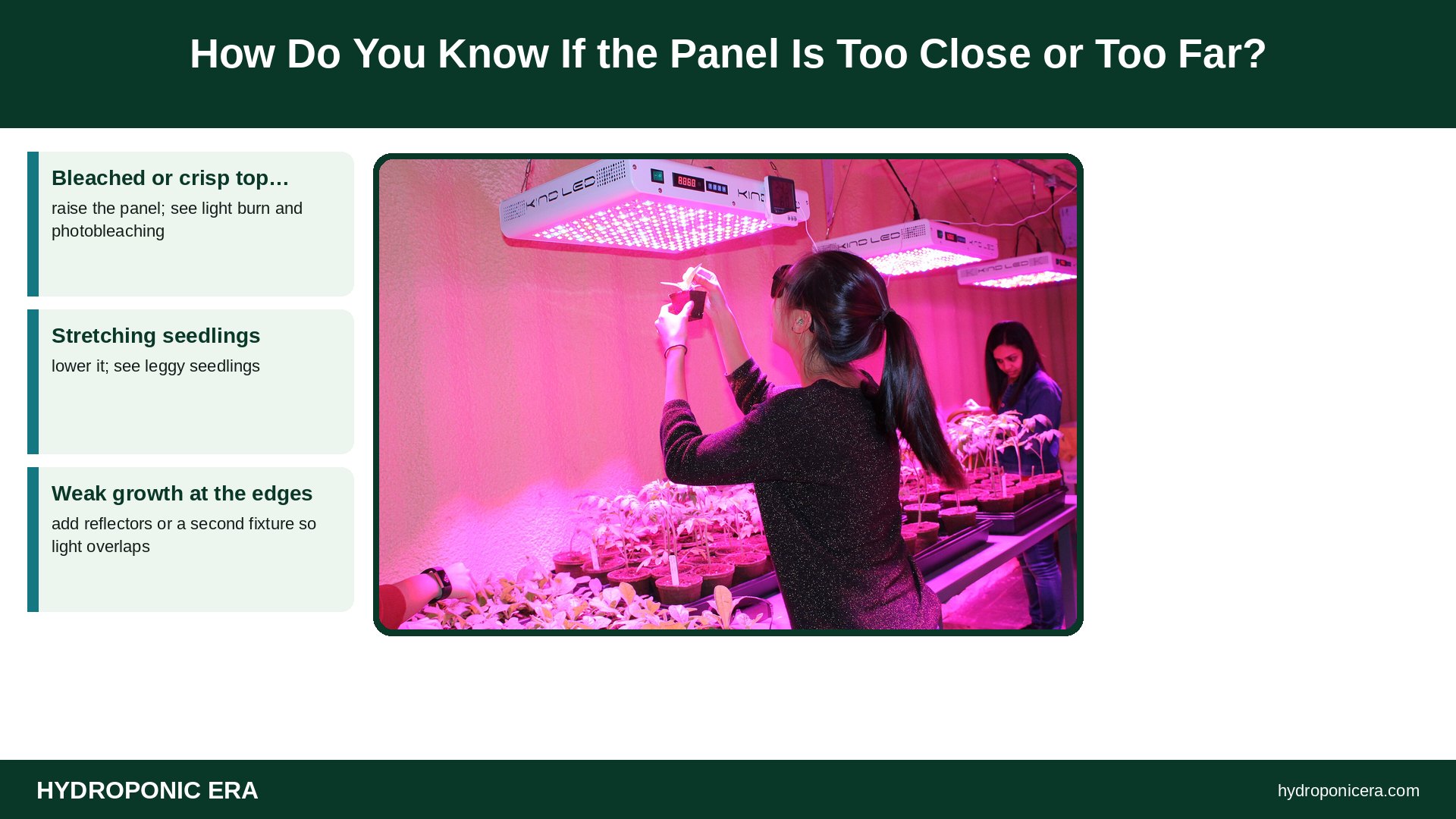
Your plants will tell you. University of Maine Extension says plants too close to the light have short petioles and crinkled, leathery leaves. Plants too far away show long internodes, thin, small, pale new leaves and long petioles. Nebraska Extension adds that low light causes small leaves, spindly stems and poor flowering.
- Bleached or crisp top leaves: raise the panel; see light burn and photobleaching.
- Stretching seedlings: lower it; see leggy seedlings.
- Weak growth at the edges: add reflectors or a second fixture so light overlaps.
How Many Hours Should an LED Grow Light Panel Run?
Start with about 14 hours a day on a timer, as Iowa State Extension recommends for grow lights, and stay between 8 and 16 hours. University of Maine Extension says 16–18 hours suits most plants. Short-day bloomers need real darkness, so keep room lights from breaking the night.
Set a reliable schedule with our guide to hydroponic light schedules.
How Do You Measure the Light From an LED Grow Light Panel?
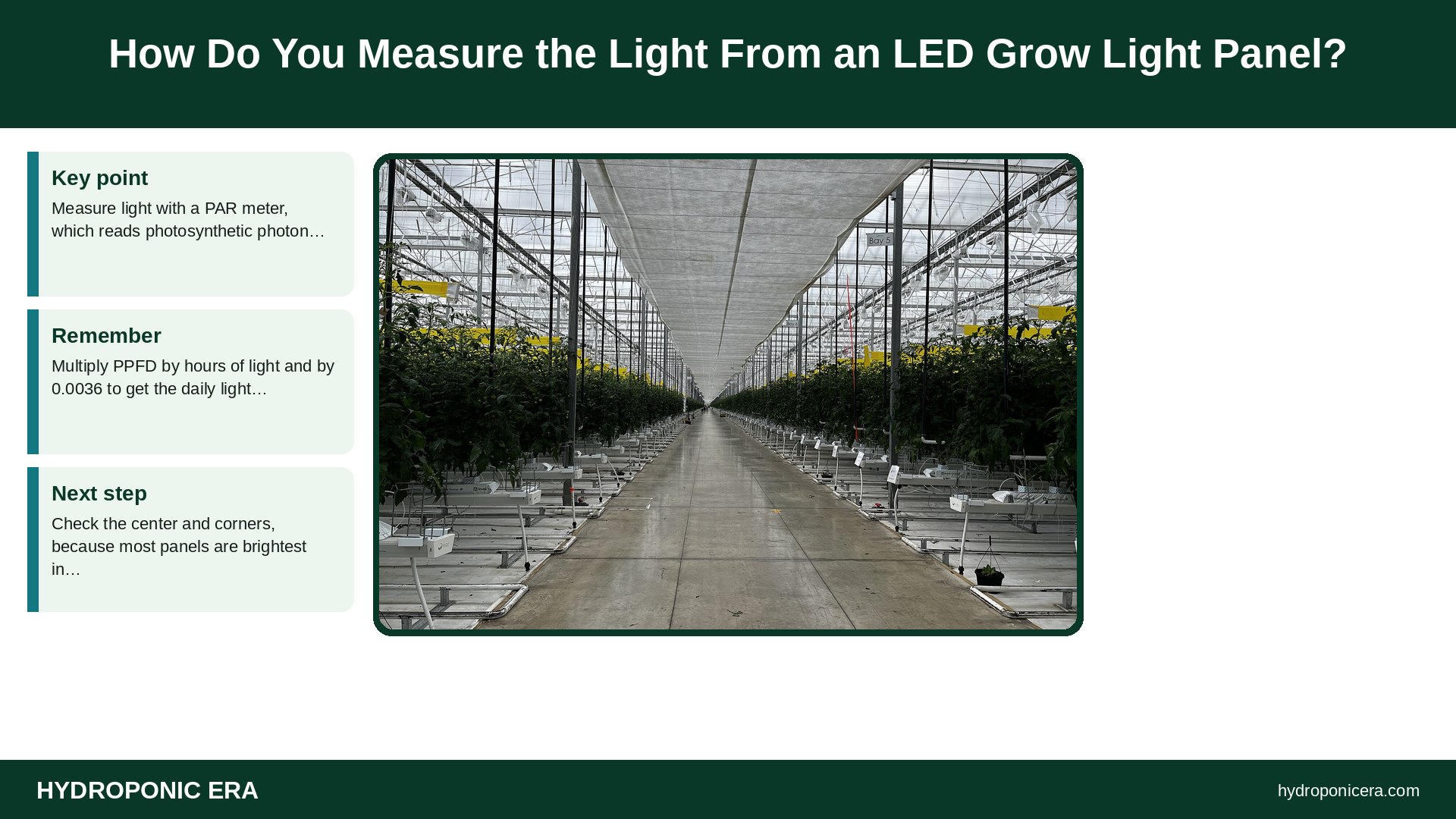
Measure light with a PAR meter, which reads photosynthetic photon flux density (PPFD) in µmol/m²/s, as University of Maine Extension explains. Multiply PPFD by hours of light and by 0.0036 to get the daily light integral (DLI) in mol/m²/day. Check the center and corners, because most panels are brightest in the middle.
Learn the method in our guides to PPFD and DLI and measuring canopy PPFD.
How Do You Set Up an LED Grow Light Panel Step by Step?
- Measure the growing area in square feet.
- Multiply by 16–25 W to size the panel.
- Hang it on adjustable hangers above the plants.
- Set the height to about 12–24 inches (30–60 cm), closer for seedlings if the maker allows.
- Plug it into a timer set for about 14 hours.
- Keep cords and drivers dry, away from reservoirs and spray.
- Watch new growth for a week and adjust.
Does an LED Grow Light Panel Get Hot?
An LED grow light panel runs much cooler than older lamps, but it still makes some heat at the board and driver. Nebraska Extension says LEDs emit almost no heat compared with traditional lights, and Maine Extension notes they give off little heat. Leave space around the fixture for airflow, and keep a small fan moving air across the canopy.
Are LED Grow Light Panels Worth It?
For most indoor growers, yes. Nebraska Extension says LEDs give off little heat, can last up to 50,000 hours and are now cost-effective, and cites Purdue research showing LEDs can deliver a better spectrum to greenhouse plants than conventional lights while using 75% less electricity. Maine notes HID lamps need about double the wattage of LEDs for similar results.
FAQs
Can an LED grow light panel burn plants?
Yes, if too close or too strong. Raise it if top leaves bleach.
Do I need a dimmer?
Not required, but it helps fine-tune light for seedlings.
Is a purple panel bad?
No, but white light is easier to work under and gives a fuller spectrum.
How long do LED panels last?
Nebraska Extension cites up to 50,000 hours.
Can I use one panel for two shelves?
No. Each shelf needs its own fixture.
Sources
- Nebraska Extension in Lancaster County — Using LED Lights for Houseplants and Transplants
- University of Maine Cooperative Extension — Bulletin #2614: Growing Houseplants Under Artificial Lights
- Iowa State University Extension — How to Set Up Supplemental Lights for Indoor Plants
- Photo credits (Wikimedia Commons, edited with titles): Potted plants succulents under grow light Nov 2016 by Asdfjrjjj (CC BY-SA 4.0); Terramera scientists working in a climate-controlled growth chamber located in Vancouver, BC. The space uses LED lighting, which supports plant growth. (50188965171) by Simon Fraser University – Communications & Marketing (CC BY 2.0); Terramera scientists working in a climate-controlled growth chamber located in Vancouver, BC. The space uses LED lighting, which supports plant growth. (50188965171) by Simon Fraser University – Communications & Marketing (CC BY 2.0); U.S. Department of Agriculture (USDA) Rural Development (RD) Ohio business program staff visited Mucci Farms, a 75-acre greenhouse production farm in Huron, Ohio on September 25, 2024 – 2 by USDAgov (Public domain); Sprague ED-122 Clear Closeup by WizzleLabs (CC BY-SA 4.0)