
How do you grow hydroponic butterhead lettuce? Start seeds in plugs, move seedlings into NFT channels, a raft or a Kratky jar after about 11 days, and harvest heads around day 35. Cornell’s lettuce handbook targets 75°F (24°C) days, 65°F (19°C) nights, pH 5.6–6.0, strong airflow and about 17 mol/m²/day of light.
Key takeaway: Hydroponic butterhead lettuce, sold as Bibb or Boston, is the main greenhouse lettuce type in the U.S., according to UF/IFAS. It grows fast in water, but it is delicate: keep the solution cool and well oxygenated, avoid excess light without airflow, and pick a tipburn-resistant cultivar.
| Hydroponic butterhead lettuce factor | Target | Source |
|---|---|---|
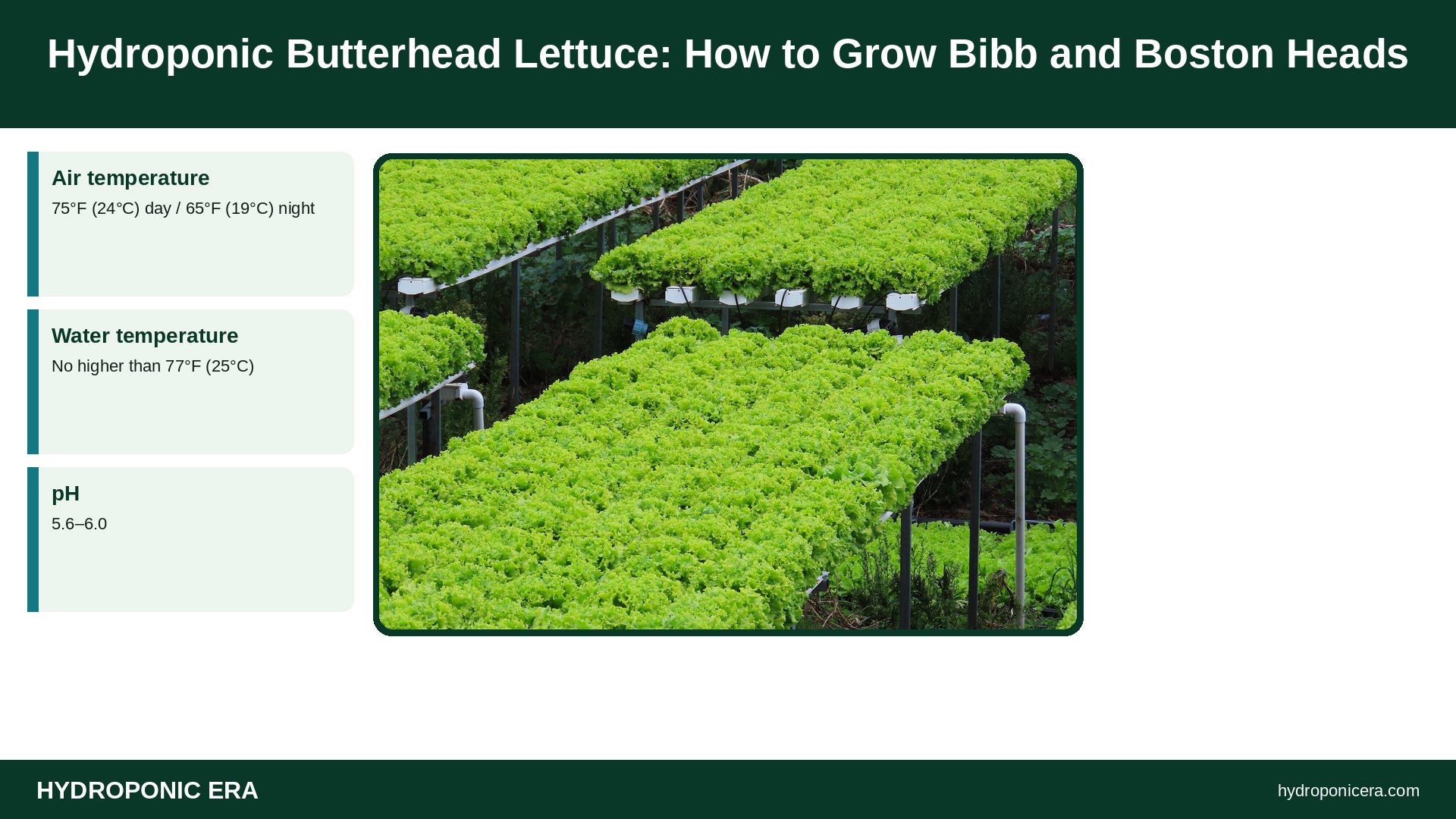
| Air temperature | 75°F (24°C) day / 65°F (19°C) night | Cornell |
| Water temperature | No higher than 77°F (25°C) | Cornell |
| pH | 5.6–6.0 | Cornell |
| EC | About 1.2–1.3 mS/cm | Cornell, Purdue |
| Dissolved oxygen | 7 ppm; failure below 3 ppm | Cornell |
| Light (DLI) | 17 mol/m²/day with airflow | Cornell |
| Harvest | About day 35 from seeding; 5 oz (150 g) heads | Cornell |
What Is Butterhead Lettuce?
Butterhead lettuce is a soft, loose-heading lettuce with tender, buttery leaves. UF/IFAS Extension groups butterhead, Boston and Bibb together and describes the type as creamy to light green inside, with loose, soft, ruffled green outer leaves. It is almost always grown to full-head size for harvest, unlike leaf lettuce, which is often cut young.
UF/IFAS calls butterhead “by far the primary greenhouse type overall,” ahead of leaf lettuce, while crisphead (iceberg) is not yet considered suitable or profitable for typical hydroponic production.
Which Hydroponic System Works Best for Butterhead Lettuce?
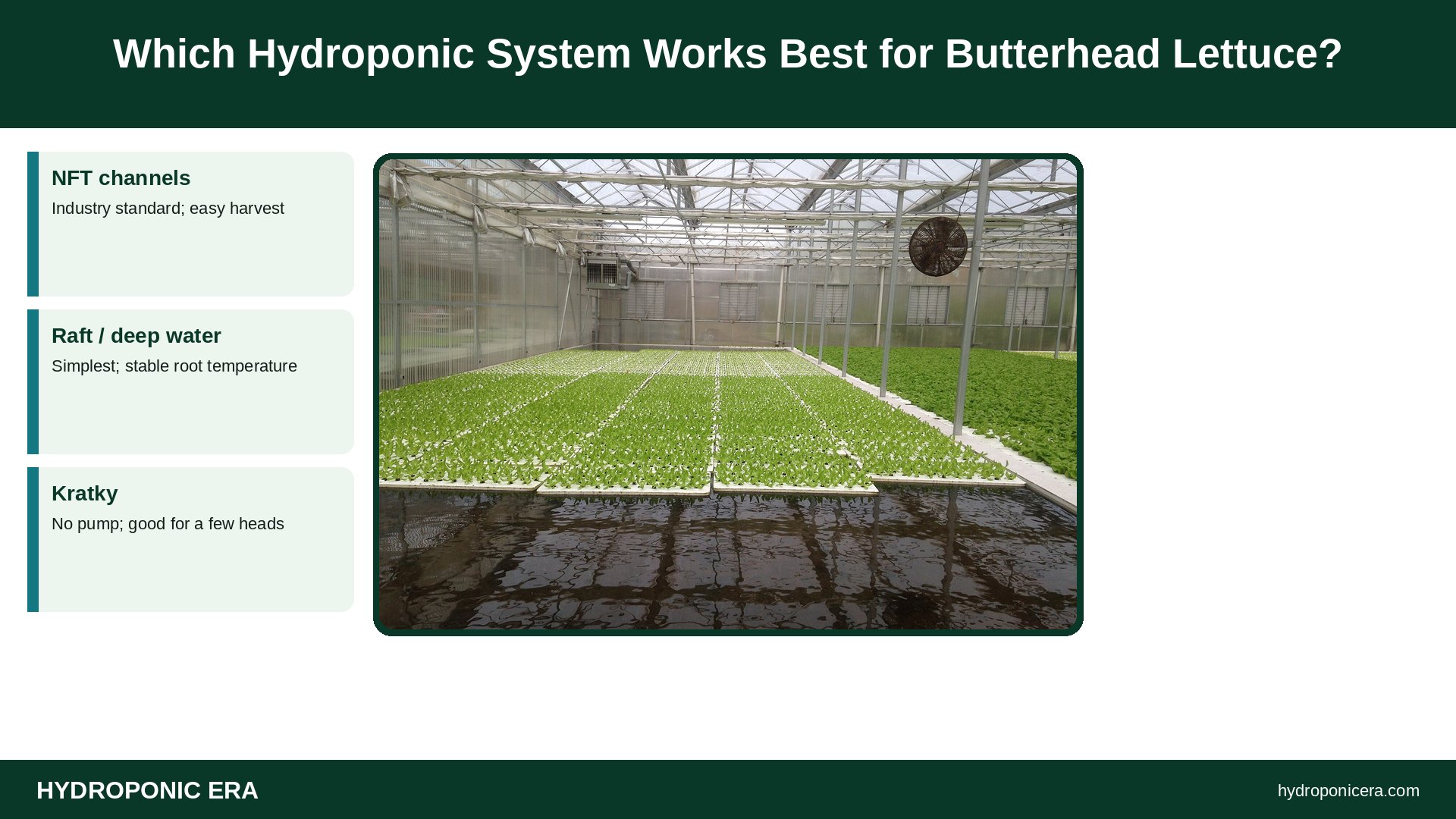
NFT and floating rafts work best for hydroponic butterhead lettuce. UF/IFAS says nutrient film technique (NFT) is the predominant greenhouse lettuce design, while the floating raft, a foam sheet on a tank of solution, is the simplest. Vertical towers and media-filled bags are also used. At home, a Kratky tote or small deep water culture bin grows a few heads easily.
| System | Why it suits butterhead | Home guide |
|---|---|---|
| NFT channels | Industry standard; easy harvest | NFT for beginners |
| Raft / deep water | Simplest; stable root temperature | DWC for beginners |
| Kratky | No pump; good for a few heads | Kratky method |
How Do You Grow Hydroponic Butterhead Lettuce Step by Step?
- Sow pelleted seed in rockwool or foam plugs, one seed per cell.
- Germinate under light. Cornell keeps seedlings at no less than 50 µmol/m²/s at first.
- Feed seedlings a mild solution from below for the first 11 days, as in Cornell’s system.
- Transplant plugs into net cups in NFT, a raft or a Kratky lid.
- Space plants about 6–7 inches (16 cm) apart for full heads, close to Cornell’s final density of about 3.5 plants per sq ft (38 per m²) after re-spacing at day 21.
- Hold pH 5.6–6.0 and EC near 1.2–1.3 mS/cm, checking every few days.
- Keep air moving over the leaves to prevent tipburn.
- Harvest at about day 35, cutting the head with roots attached for longer shelf life.
New to the basics? See our main guide to growing lettuce hydroponically.
What Is the Growing Timeline for Hydroponic Butterhead Lettuce?
Hydroponic butterhead lettuce takes about five weeks from seed to harvest in Cornell’s commercial schedule. Home systems under weaker light often take a little longer, so use the timeline as a guide and judge by head size.
| Day | Stage | Cornell practice |
|---|---|---|
| 0–11 | Germination and seedling | Plugs on a flood bench under light |
| 11 | Transplant | Move to the pond (raft) area |
| 21 | Re-spacing | From 97 to 38 plants per square meter |
| 35 | Harvest | About 5 oz (150 g) heads |
What Nutrient Strength Does Hydroponic Butterhead Lettuce Need?
Hydroponic butterhead lettuce grows best at a fairly low EC of about 1.2–1.3 mS/cm. Cornell’s handbook uses 1150–1250 µS/cm above the source water. Purdue Extension tested 24 lettuce varieties in NFT and flood-table systems and recommends 1.3 dS/m (mS/cm); growth dropped at 2.9 and 3.9 dS/m, likely from osmotic stress.
Subtract your tap water’s starting EC before you add nutrients. Our starting EC baseline guide walks through it.
How Much Light Does Hydroponic Butterhead Lettuce Need?
Butterhead lettuce needs about 17 mol/m²/day of light in Cornell’s system, which worked best for the Boston Bibb cultivar they grew. Indoors under LEDs, that equals roughly 295 µmol/m²/s for 16 hours a day. Cornell warns that some cultivars develop tipburn above about 15 mol/m²/day, and that without downward airflow they could not exceed 12.
Learn how to convert intensity to daily light in our PPFD and DLI guide.
How Do You Prevent Tipburn on Hydroponic Butterhead Lettuce?
Prevent tipburn by matching light to airflow and keeping growth steady. Tipburn is a calcium shortage at the tender inner leaf edges, and butterhead’s soft, enclosed heart is especially prone. Cornell found strong downward airflow was essential to reach 17 mol/m²/day without tipburn. UF/IFAS lists several butterhead-friendly cultivars bred for tipburn and bolting resistance.
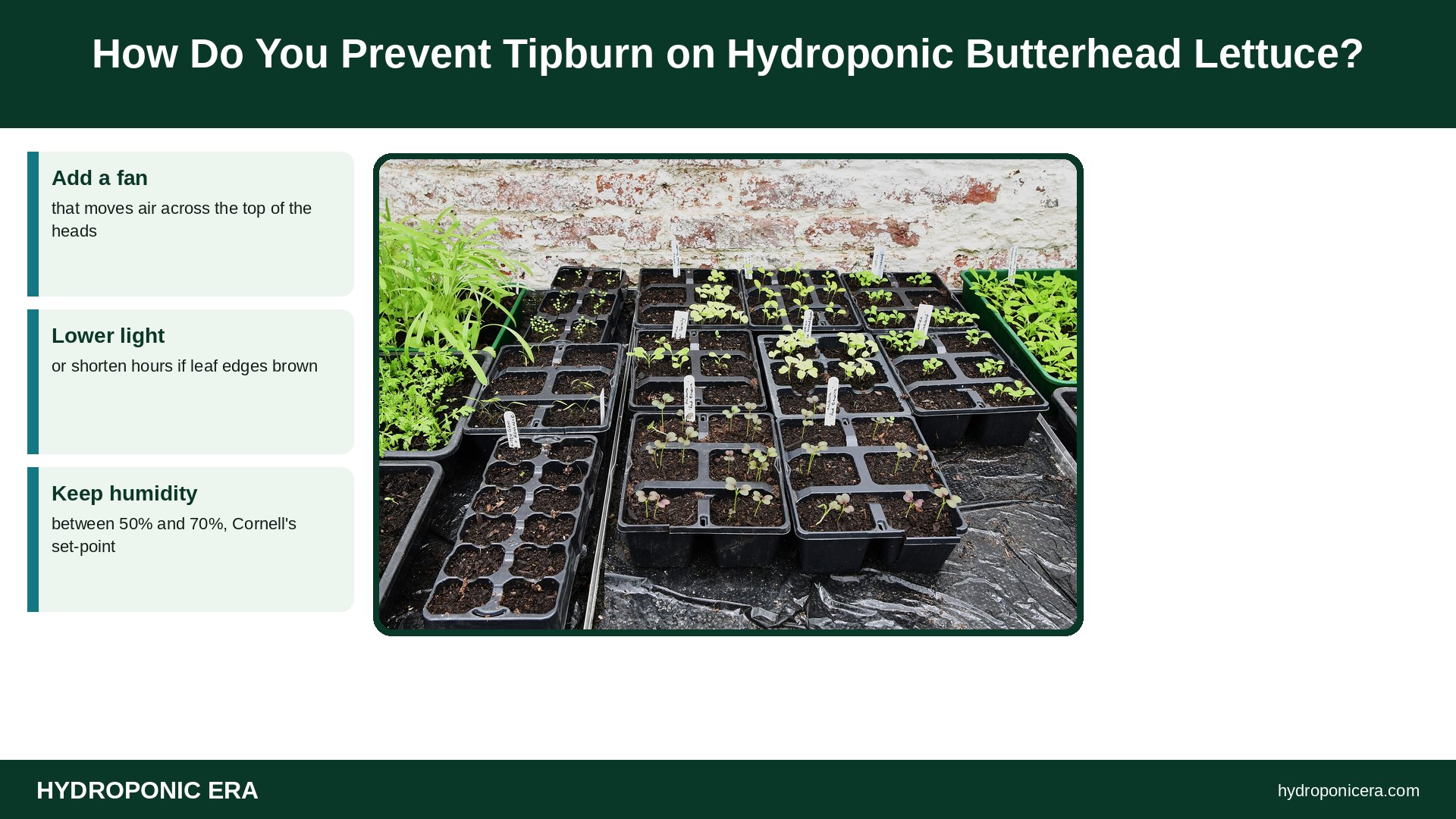
- Add a fan that moves air across the top of the heads.
- Lower light or shorten hours if leaf edges brown.
- Keep humidity between 50% and 70%, Cornell’s set-point.
- Choose resistant cultivars from seed catalogs.
See our tipburn prevention checklist for more.
Why Does Hydroponic Butterhead Lettuce Bolt or Turn Bitter?
Hydroponic butterhead lettuce bolts or turns bitter mostly from heat and long, warm days. Cornell’s day set-point is 75°F (24°C) and its solution is kept no higher than 77°F (25°C). Warmer roots also hold less oxygen; Cornell reports crop failure below 3 ppm dissolved oxygen. Harvest on time, since overmature heads turn bitter faster. Our lettuce bitterness and bolting timeline explains the signs.
How Do You Harvest and Store Butterhead Lettuce?
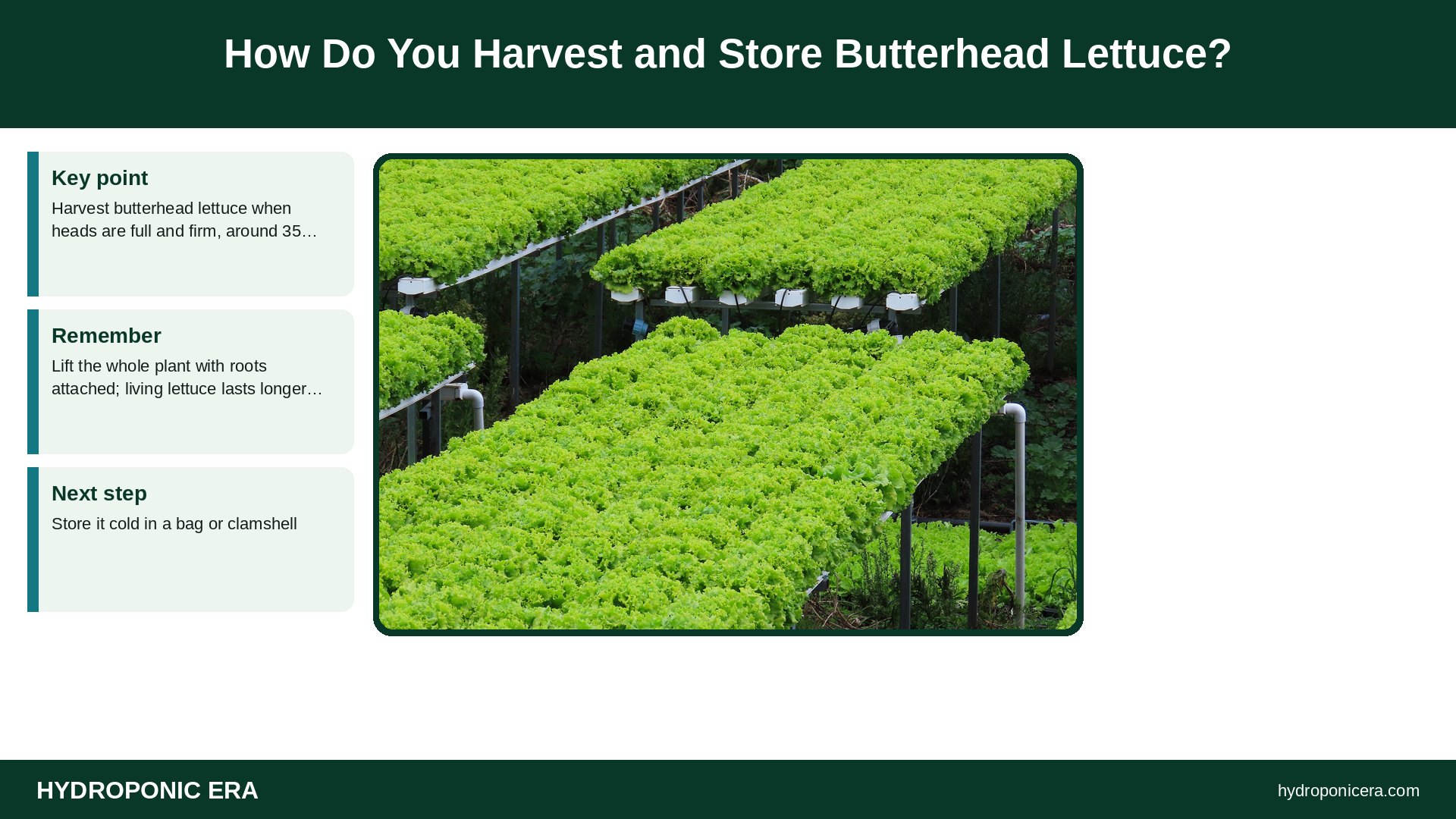
Harvest butterhead lettuce when heads are full and firm, around 35 days from seeding in Cornell’s system, at about 5 oz (150 g). Lift the whole plant with roots attached; living lettuce lasts longer in the fridge. Store it cold in a bag or clamshell. Our guide to storing hydroponic lettuce covers the details.
Which Butterhead Varieties Grow Well Hydroponically?
Butterhead varieties sold for greenhouse or hydroponic use grow best, because breeders select them for tipburn and bolting resistance. UF/IFAS lists many modern butterhead and leaf cultivars with traits such as heat tolerance and slow bolting. Look for those notes in seed catalogs. Compare types in our best lettuce varieties for hydroponics.
FAQs
Is Bibb the same as Boston lettuce?
Both are butterhead types; UF/IFAS groups them together.
Can I grow butterhead in a Kratky jar?
Yes. One head per quart (1 L) jar or larger works well.
Why are my heads loose?
Low light or crowding. Space plants and raise light gradually.
What pH is best?
Cornell uses pH 5.6–6.0.
How long until harvest?
About 35 days from seeding in Cornell’s system.
Sources
- Cornell University CEA Program — Hydroponic Lettuce Handbook
- UF/IFAS Extension — An Overview of Lettuce Production Systems and Cultivars Used in Hydroponics and Protected Culture in Florida (HS1258)
- Purdue Extension — Optimal Fertilizer Solution Concentration for Hydroponic Lettuce Production (HO-309-W)
- Photo credits (Wikimedia Commons, edited with titles): Hydroponic lettuce @ Plaine des Cafres 03 by Rémih (CC BY-SA 4.0); Deep water culture by ArcadiYay (CC BY-SA 4.0); Temple Sowerby, Acorn Bank, Mizuna and lettuce seedlings – geograph.org.uk – 7625183 by Michael Garlick (CC BY-SA 2.0); Hydroponic lettuce @ Plaine des Cafres 03 by Rémih (CC BY-SA 4.0); Deepwater Aquaponics Floating Rafts Growing Lettuce, Basil and Arugula by Alabama Extension (CC0)