
How do you grow subwassertang in an aquarium? Tie or wedge small pads of subwassertang onto rock or wood in low to medium light, then leave it alone. Dennerle lists 72 to 82°F (22 to 28°C), pH 6 to 8 and very slow growth. CO2 and liquid fertilizer make it denser, but it survives without them in a calm, clean tank.
Key takeaway: Subwassertang is the hobby name for Lomariopsis cf. lineata, a fern that grows only as a flat gametophyte (prothallus), not a moss or algae. Dennerle lists medium to low light, 72–82°F (22–28°C), pH 6–8, 10–30 mg/L CO2 and very slow growth. Tie or wedge it in place, split pads to propagate, and keep it away from plant-eating fish.
| Fact | What sources report | Source |
|---|---|---|
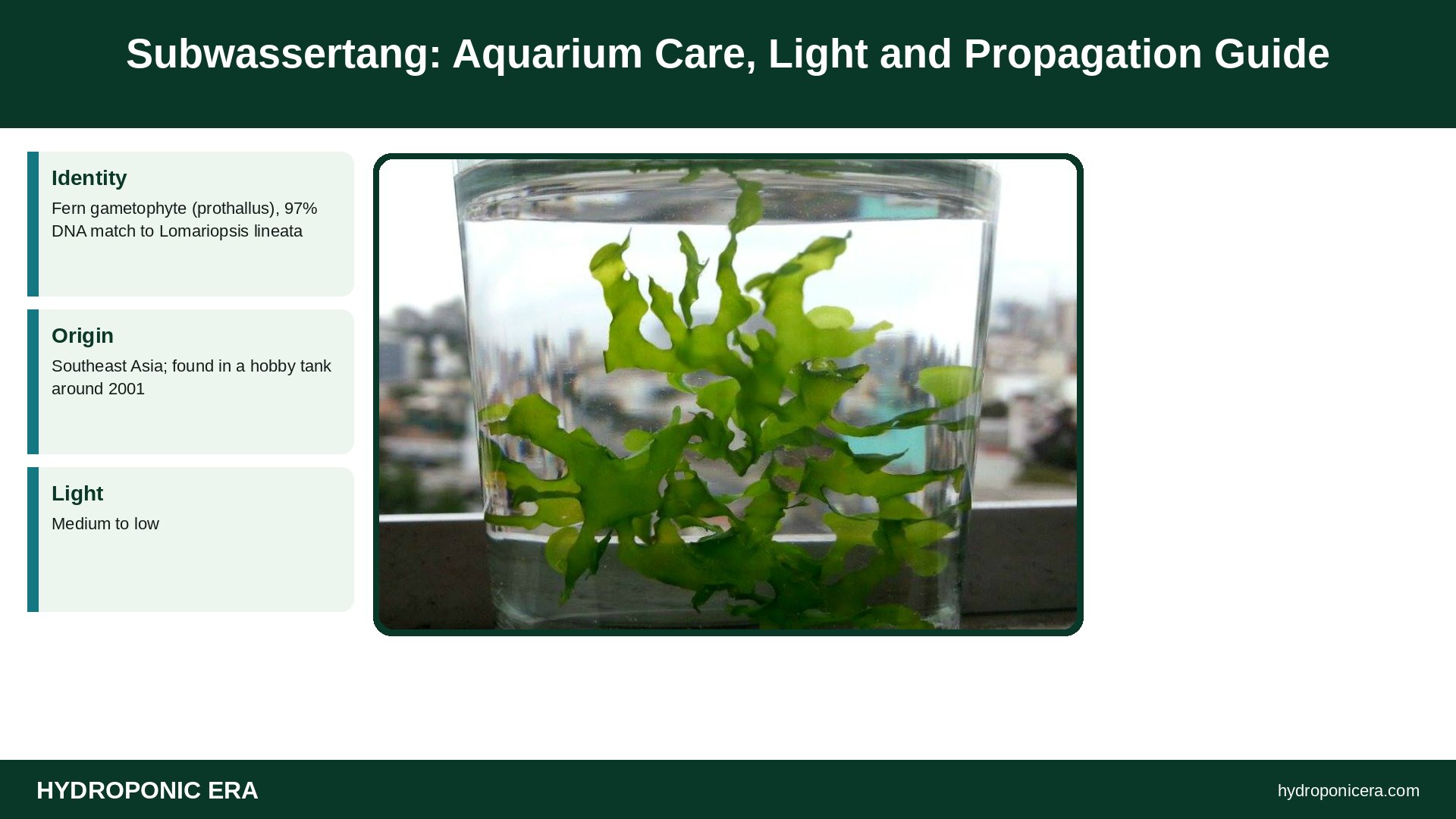
| Identity | Fern gametophyte (prothallus), 97% DNA match to Lomariopsis lineata | Flowgrow (Li et al.) |
| Origin | Southeast Asia; found in a hobby tank around 2001 | Dennerle, Flowgrow |
| Light | Medium to low | Dennerle |
| Temperature | 72–82°F (22–28°C) | Dennerle |
| pH and CO2 | pH 6–8; 10–30 mg/L CO2 | Dennerle |
| Height | 1.2–4 in (3–10 cm) | Dennerle |
| Propagation | Division | Dennerle |
What Is Subwassertang?
Subwassertang is a fern that never grows past its first stage. Flowgrow explains that it is the prothallus, or gametophyte, of a fern, not a moss or an alga. Christel Kasselmann found it in one of her own tanks around 2001 and shared it. A 2007 DNA study found 97% of the sequences matched Lomariopsis lineata from Southeast Asia.
That is why it is labeled Lomariopsis cf. lineata. No young fern plants (sporophytes) have been seen growing from it in aquariums. The name comes from a German seller’s term for “freshwater seaweed,” which Flowgrow calls botanically wrong but popular.
- Looks like: translucent green ribbons with round lobes.
- Not to confuse with: Monosolenium tenerum (“pellia”), which has a clear midrib; subwassertang does not.
- Best use: nano tanks, hardscape gaps and shrimp tanks.
How Do You Grow Subwassertang in an Aquarium?
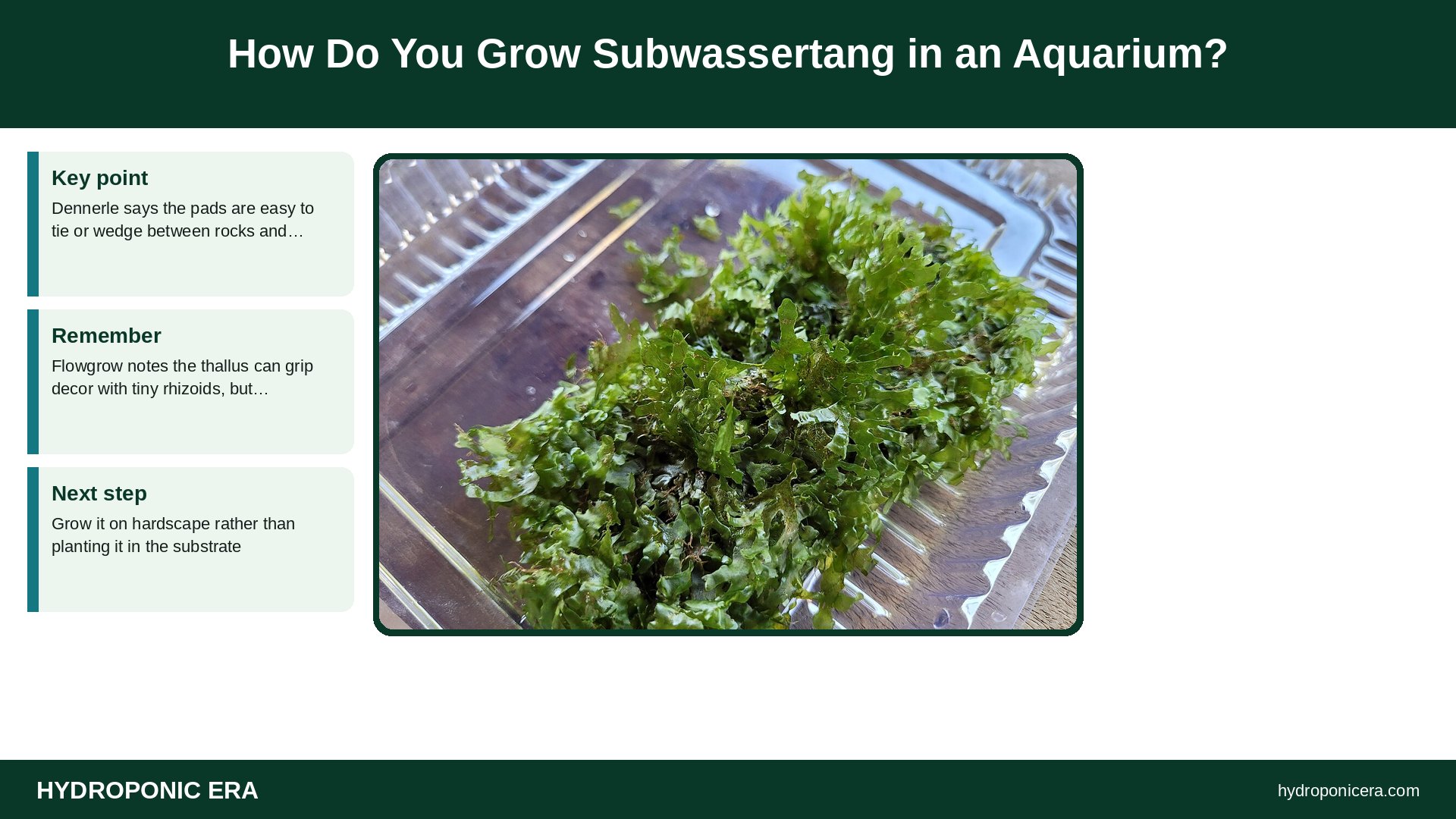
Attach it to hardscape. Dennerle says the pads are easy to tie or wedge between rocks and roots. Flowgrow notes the thallus can grip decor with tiny rhizoids, but that grip is weak, so tie it at first. Grow it on hardscape rather than planting it in the substrate. Keep it where strong currents will not tear it loose.
- Rinse the portion and remove any loose debris.
- Split it into pads about 1 inch (2.5 cm) wide.
- Tie pads to wood or stone with cotton thread or fishing line.
- Or wedge pads firmly into rock gaps.
- Check after a week and re-tie any loose pieces.
What Light, CO2 and Fertilizer Does Subwassertang Need?
It is undemanding. Dennerle lists medium to low light and 10 to 30 mg/L CO2, and Aquasabi says it looks best with at least medium light plus good CO2 and nutrients. In very low light, Flowgrow notes the lobes turn narrow and strap-like. A low-tech tank works; a planted tank with CO2 gives denser, rounder cushions.
- Light: low to medium; strong light invites algae on the pads.
- CO2: optional; see aquarium CO2 for plants.
- Feed: small weekly doses of aquarium plant fertilizer.
- No root tabs needed: it takes nutrients from the water.
What Water Parameters Does Subwassertang Like?
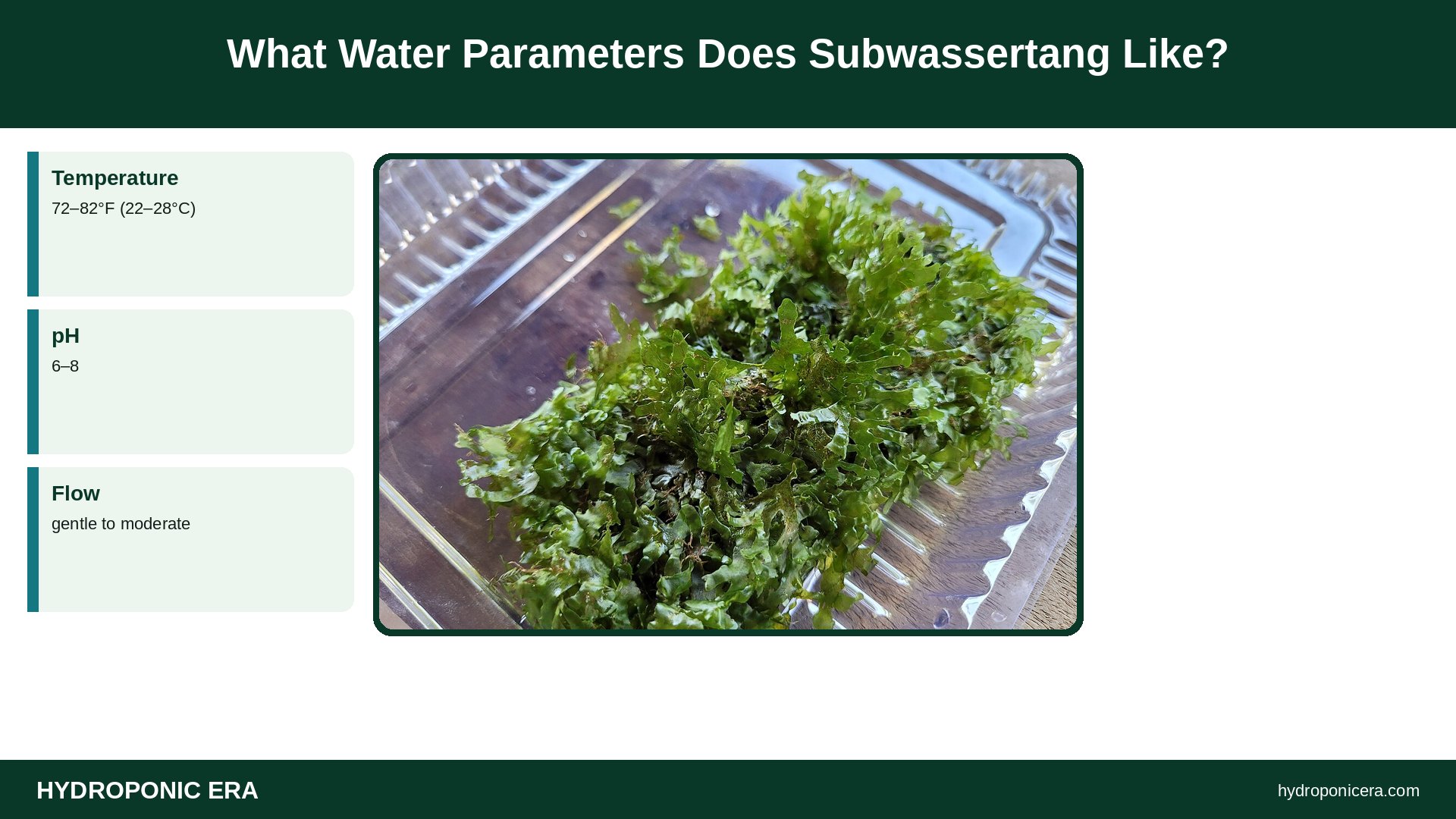
Dennerle lists 72 to 82°F (22 to 28°C) and pH 6 to 8, which suits most tropical community and shrimp tanks. Soft to moderately hard water is fine. Stability matters more than an exact number. Keep nitrate and phosphate low enough to avoid algae, because algae settles easily into the dense pads.
- Temperature: 72–82°F (22–28°C).
- pH: 6–8.
- Flow: gentle to moderate.
How Do You Trim and Propagate Subwassertang?
Pinch or cut. Dennerle lists division as the way to propagate it, and Aquasabi says big cushions are easily reduced by picking or cutting. Any healthy piece will grow into a new pad. Loose masses are also useful in breeding tanks, where fry and shrimp hide in them.
- Lift the pad or cut a section with scissors.
- Pull it apart into smaller pieces.
- Tie or wedge new pieces in place.
- Remove brown, old growth from the center of thick pads.
Why Is Subwassertang Melting or Not Growing?
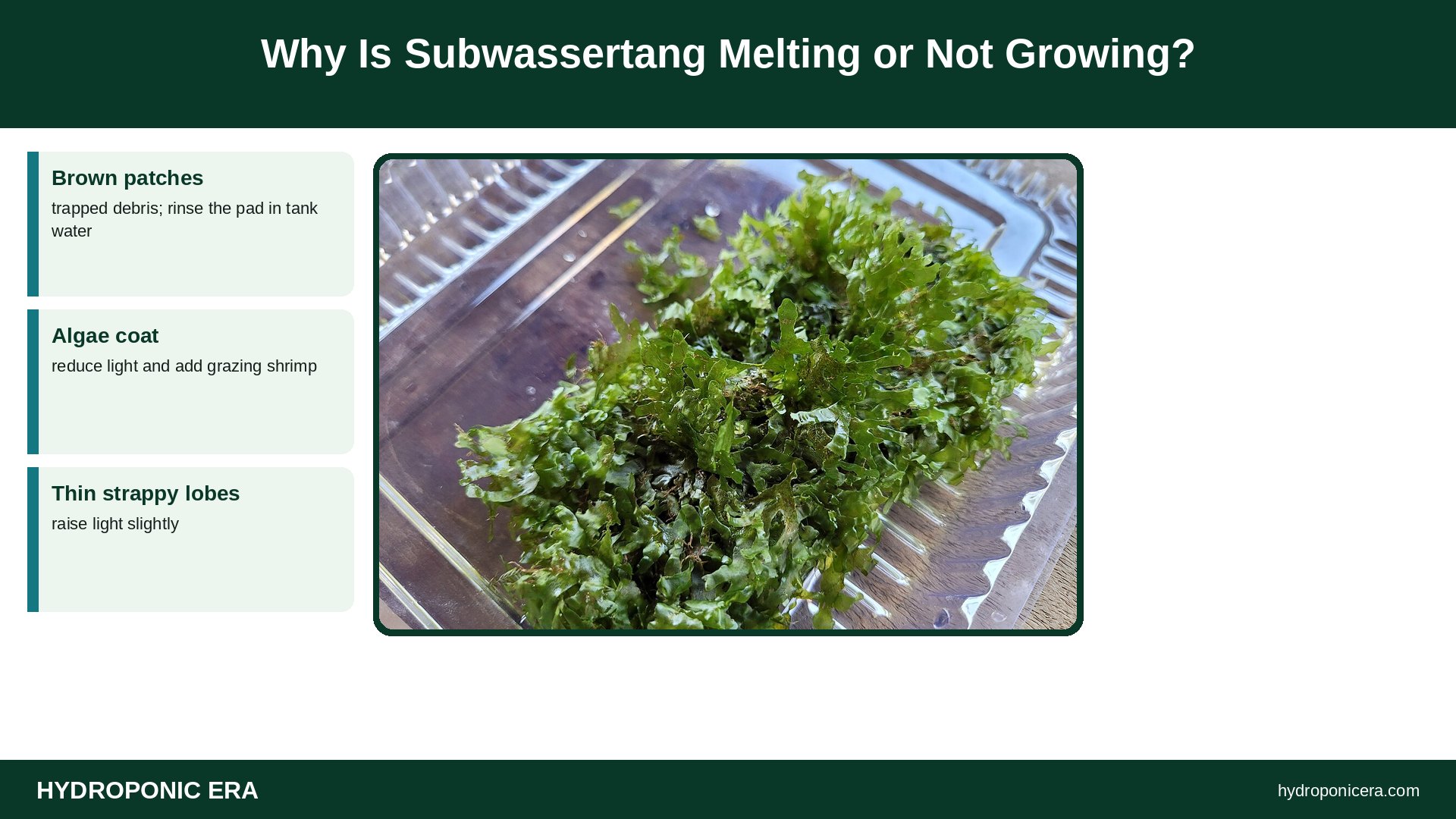
Slow growth is normal for this plant. Dennerle calls the growth very slow, though Aquasabi says it does not grow too slowly, so expect weeks before you see change. Real trouble comes from algae, debris trapped in the pads, warm water and fish that eat it. Goldfish, silver dollars and many cichlids will pull it apart.
- Brown patches: trapped debris; rinse the pad in tank water.
- Algae coat: reduce light and add grazing shrimp.
- Thin strappy lobes: raise light slightly.
- Shredded pads: plant-eating fish; move the plant.
For other shrimp-friendly mosses, see Java moss and Christmas moss.
FAQ About Subwassertang
Is it a moss?
No; it is the gametophyte stage of a Lomariopsis fern.
Does subwassertang need CO2?
No, but Dennerle lists 10–30 mg/L for best growth.
How fast does this fern grow?
Slowly; Dennerle rates it very slow.
Does subwassertang attach on its own?
Only weakly, so tie or wedge it in place.
What temperature does it like?
72–82°F (22–28°C).
Is it good for shrimp tanks?
Yes; shrimp graze and hide in the pads.
Sources
- Dennerle Plants — Lomariopsis lineata plant profile/27959)
- Flowgrow Aquatic Plant Database — Lomariopsis cf. lineata
- Aquasabi — Lomariopsis cf. lineata
- Photo credits (Wikimedia Commons, edited with titles): Lomariopsis gametophyte in water by Rǫgn (CC BY-SA 4.0); Lomariopsis gametophyte (“pelia moss”), Philippines 01 by Obsidian Soul (CC0)