
How do you grow Christmas moss in an aquarium? Tie or glue Christmas moss to driftwood, rock or mesh, keep the water at 72 to 82°F (22 to 28°C) and pH 6.0 to 7.5, and give it low to medium light. Christmas moss (Vesicularia montagnei) is slow growing, so trim it regularly to keep its layered, tree-like shape.
Key takeaway: Christmas moss is an easy, slow-growing aquarium moss. NParks Singapore lists water at 72 to 82°F (22 to 28°C), pH 6.0 to 7.5, semi-shade and propagation by division. Dennerle lists medium to low light, soft to hard water and growth up to about 2 inches (5 cm). The moss looks best attached to hardscape, where its triangular fronds stack like branches.
| Fact | What sources report | Source |
|---|---|---|
| Scientific name | Vesicularia montagnei | NParks, Dennerle |
| Water temperature | 72–82°F (22–28°C) | NParks, Dennerle |
| pH | 6.0–7.5 (Dennerle: 5–8) | NParks, Dennerle |
| Light | Semi-shade; medium to low | NParks, Dennerle |
| CO2 | 10–20 mg/L helps but is not essential | Dennerle |
| Height | Up to about 2 in (5 cm) | Dennerle |
| Growth and propagation | Slow; propagated by division | NParks, Dennerle |
What Is Christmas Moss?
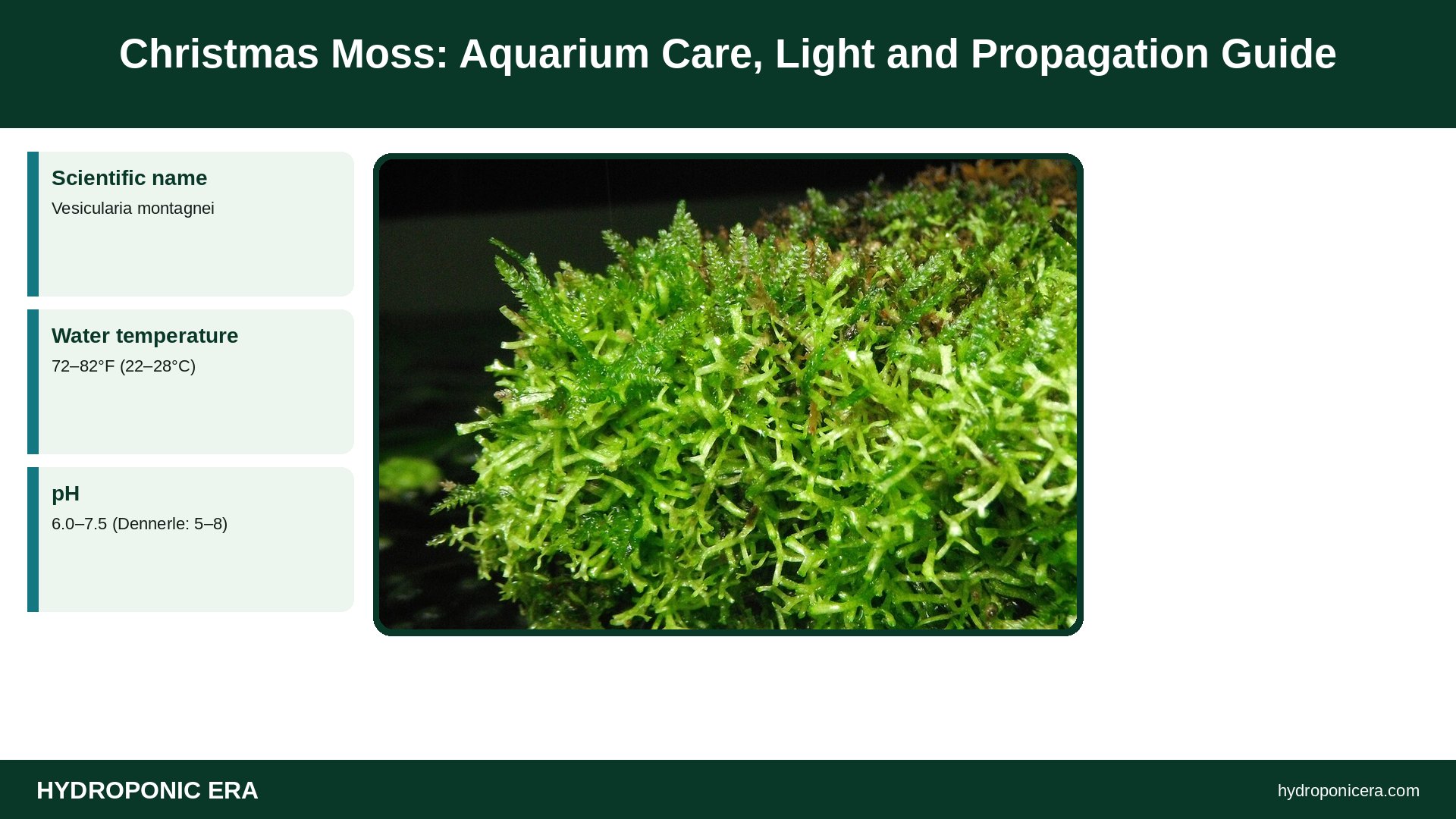
Christmas moss is an aquatic moss sold as Vesicularia montagnei. NParks describes it as an aquatic epiphytic moss with creeping rhizomes and long, triangular fronds whose regular side branches give it a Christmas tree look. Dennerle says the drooping branches gave it the name and calls it undemanding and very easy to cultivate.
You will also see it labeled Vesicularia dubyana ‘Christmas’ by some nurseries, and sources disagree on its native range. What matters for growers is that it behaves like other Vesicularia mosses, only with a neater, more layered shape than Java moss.
- Look: flat, triangular fronds that overlap like fir branches.
- Use: driftwood, rocks, moss walls and shrimp tanks.
- Growth: slow, so it stays tidy with occasional trims.
How Do You Grow Christmas Moss in an Aquarium?
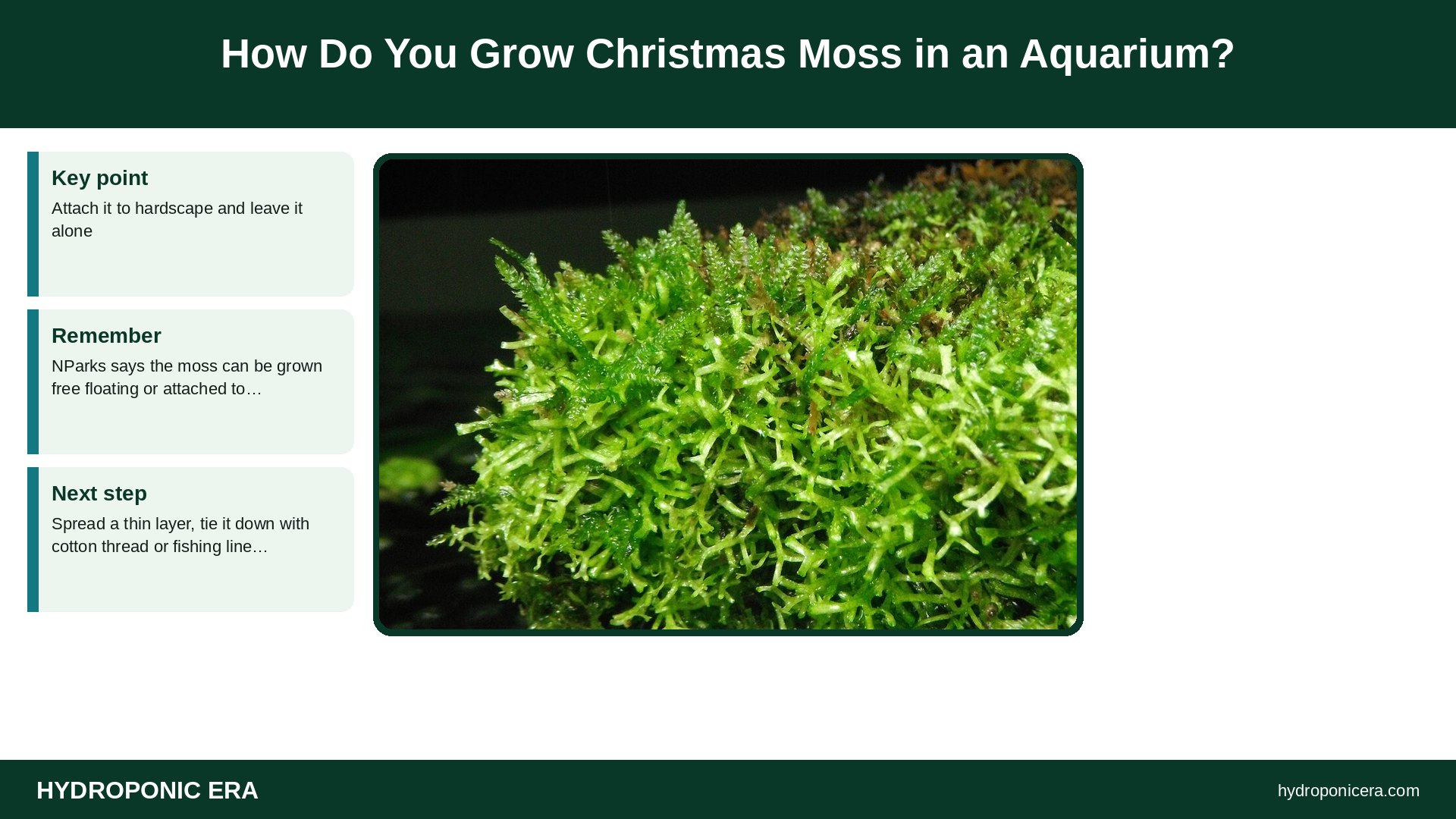
Attach it to hardscape and leave it alone. NParks says the moss can be grown free floating or attached to driftwood or rock, but its triangular fronds look far more defined when attached. Spread a thin layer, tie it down with cotton thread or fishing line, or use a gel superglue on dry wood.
- Rinse the moss and pick out old debris and snails.
- Spread a thin layer, about 1/4 inch (6 mm) thick, over the surface.
- Wrap with thread or glue small clumps in place.
- Place it where light is moderate and water flow is gentle.
A thin layer matters. Thick clumps shade the lower moss, which can turn brown underneath. The moss will grip the surface with rhizoids over a few weeks.
What Light Does Christmas Moss Need?
Low to medium light is enough. NParks lists semi-shade as its light preference, and Dennerle rates it medium to low. Christmas moss does not need a high-tech setup, and strong light without CO2 often grows algae on the moss faster than the moss itself grows, so shade it under taller plants if needed.
In practice, a standard aquarium LED on for 6 to 8 hours a day suits most moss tanks. If you see green fuzz or hair algae in the fronds, cut the photoperiod first. Our guide to black beard algae explains how to treat the toughest kind.
What CO2 and Fertilizer Does Christmas Moss Need?
CO2 is optional. Dennerle lists 10 to 20 mg/L of CO2 as helpful, and added CO2 makes fronds denser and greener, but the moss grows without it. Fertilizer needs are small. In a tank with fish, light dosing of a comprehensive liquid fertilizer once a week is usually enough for slow-growing mosses.
Overdosing feeds algae, which is the main enemy of moss. See our guides to aquarium CO2 for plants and aquarium plant fertilizer before adding either.
What Water Temperature and pH Does Christmas Moss Need?
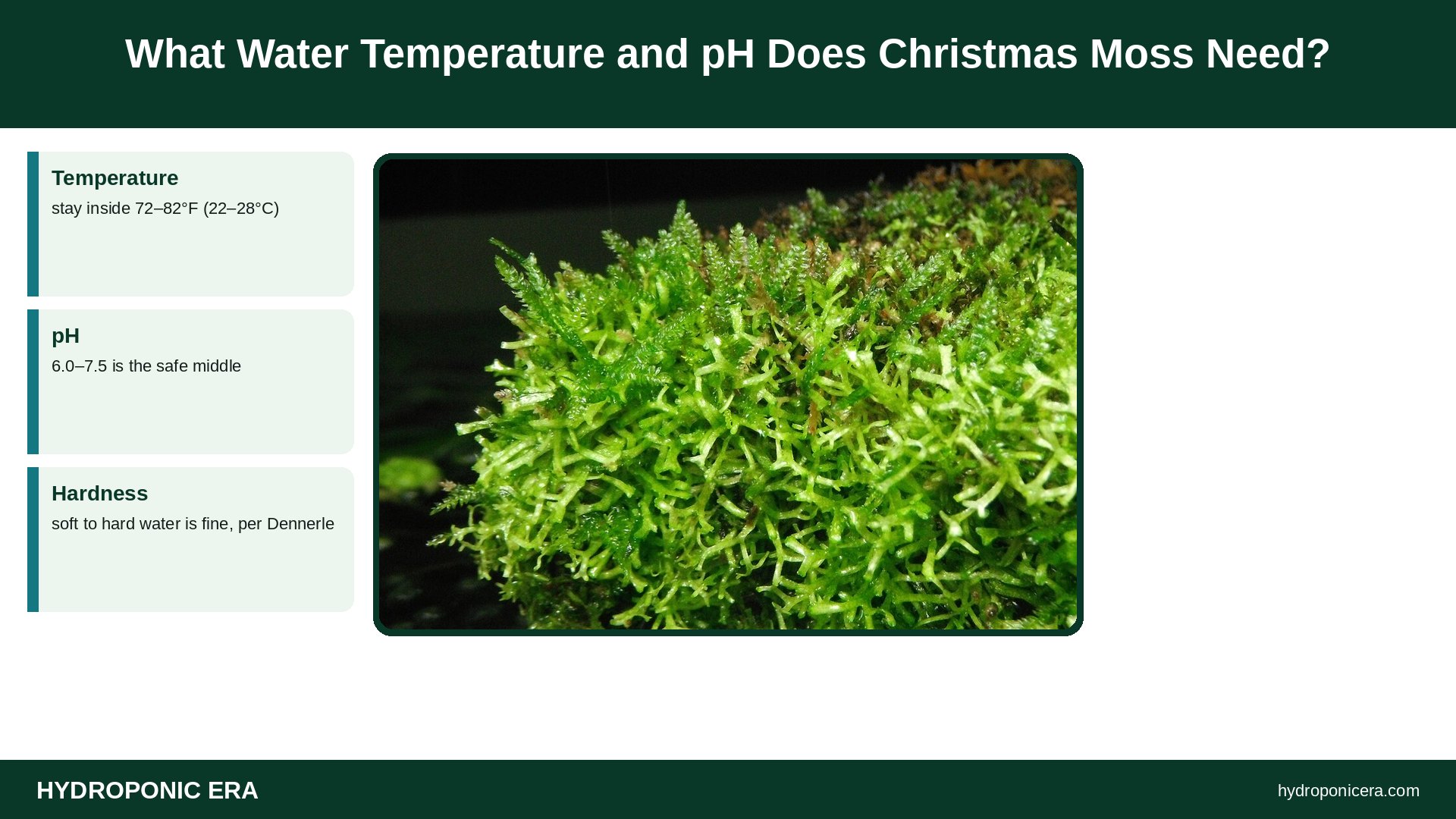
Keep the water at 72 to 82°F (22 to 28°C) with a pH of 6.0 to 7.5, the ranges NParks lists. Dennerle gives the same temperature and a wider pH range of 5 to 8, with soft to hard water. That makes Christmas moss suitable for most community and shrimp tanks.
- Temperature: stay inside 72–82°F (22–28°C).
- pH: 6.0–7.5 is the safe middle.
- Hardness: soft to hard water is fine, per Dennerle.
- Flow: gentle flow keeps debris from settling.
How Do You Trim and Propagate Christmas Moss?
Trim it with sharp aquarium scissors every few weeks and use the clippings to start new pieces. Both NParks and Dennerle list division as the way to propagate it. Dennerle notes it can be shaped by regular pruning, which keeps the outer fronds healthy and stops the inner layer from going brown.
- Trim the outer layer evenly, like pruning a hedge.
- Siphon out loose clippings so they do not drift around the tank.
- Tie the best clippings onto new wood or mesh.
NParks also notes it can be grown on plastic mesh to make a moss wall. Two layers of mesh with moss sandwiched between them is the usual method.
Why Is Christmas Moss Turning Brown or Not Growing?
The most common causes are low light at the base of a thick clump, debris trapped in the fronds, algae, and water outside its range. Because NParks calls it slow growing, some growers mistake normal pace for a problem. Thin the clump, rinse out debris, and check temperature, pH and light first.
- Brown underneath: clump too thick; trim and thin it.
- Covered in algae: too much light or fertilizer.
- Fading after a move: give it a few weeks to settle.
- Hot water: above about 82°F (28°C) is outside the listed range.
For a related brown film on glass and leaves, see brown diatom algae.
Is Christmas Moss Good for Shrimp Tanks?
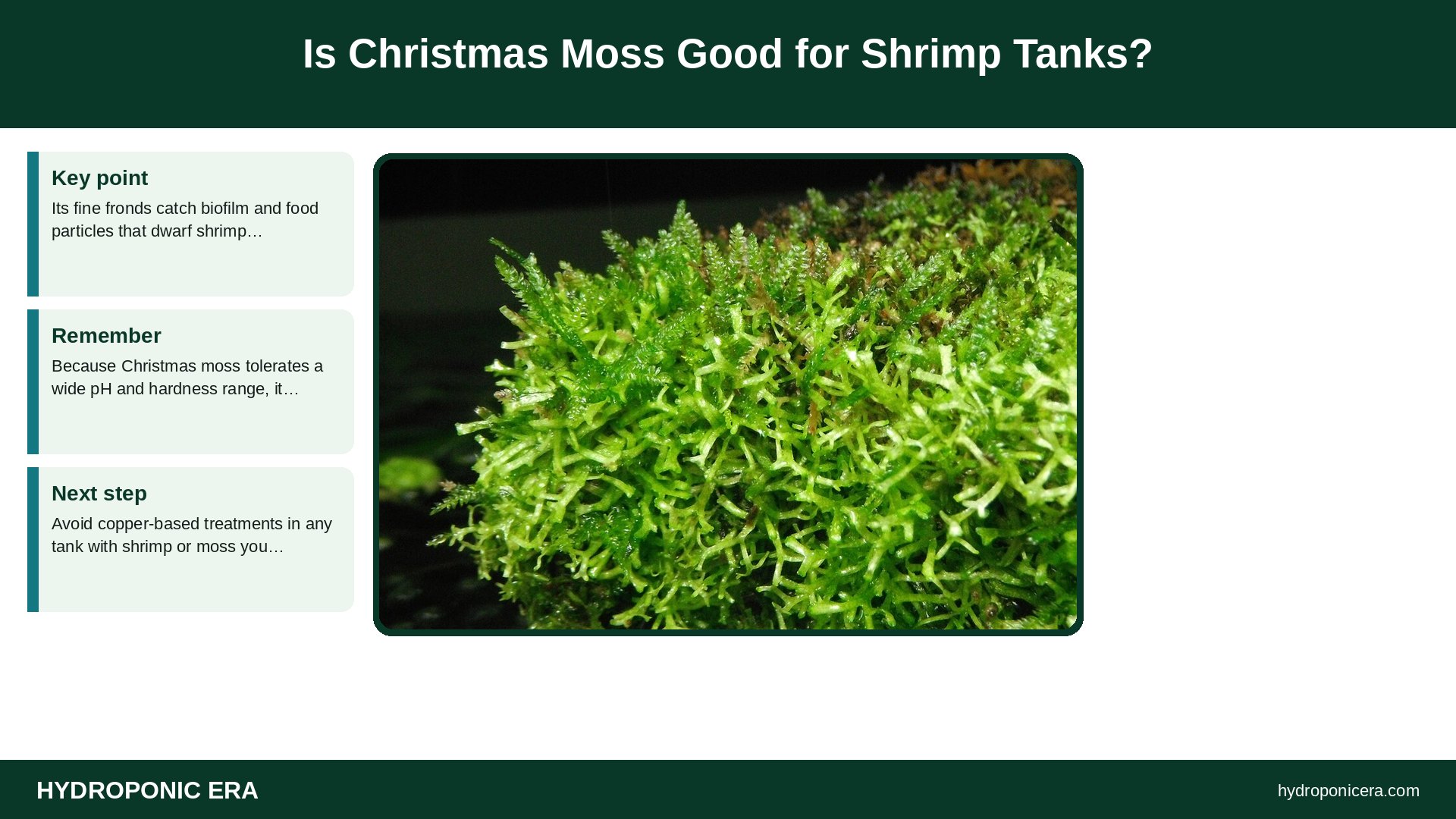
Yes. Its fine fronds catch biofilm and food particles that dwarf shrimp graze on, and it gives baby shrimp shelter. Because Christmas moss tolerates a wide pH and hardness range, it fits most shrimp setups. Avoid copper-based treatments in any tank with shrimp or moss you want to keep.
If you keep shrimp with plants in a food system, our shrimp aquaponics guide covers the basics.
FAQ About Christmas Moss
Is Christmas moss easy to grow?
Yes; Dennerle calls it undemanding and very easy to cultivate.
Does Christmas moss need CO2?
No, but 10–20 mg/L helps it grow denser.
How fast does Christmas moss grow?
Slowly; NParks describes it as slow growing.
Can Christmas moss float?
Yes, but it looks best attached to wood or rock.
What temperature does Christmas moss like?
72 to 82°F (22 to 28°C).
How tall does Christmas moss get?
Up to about 2 inches (5 cm), per Dennerle.
Sources
- National Parks Board Singapore, Flora & Fauna Web — Vesicularia montagnei (Christmas Moss)
- Dennerle Plants — Vesicularia montagnei plant profile/23047)
- Photo credits (Wikimedia Commons, edited with titles): Christmas moss and riccia (14441185564) by Storm from Canada (CC BY-SA 2.0)