
What is black beard algae and how do you remove it? Black beard algae (BBA, brush algae) is a red alga that forms dark, tough tufts on leaf edges, wood and rock. Remove it by cutting affected leaves, cleaning decor outside the tank, changing water often, and fixing the cause: low or unstable CO2 and excess nutrients.
Key takeaway: Black beard algae is a red alga, not a green one, and it clings too tightly to wipe off. Aquarium Science links it to high nitrate, phosphate or iron and says heavy water changes often control it. Trim infected leaves, clean decor outside the tank, add algae eaters, stabilize CO2 and lighting, and avoid in-tank algaecides.
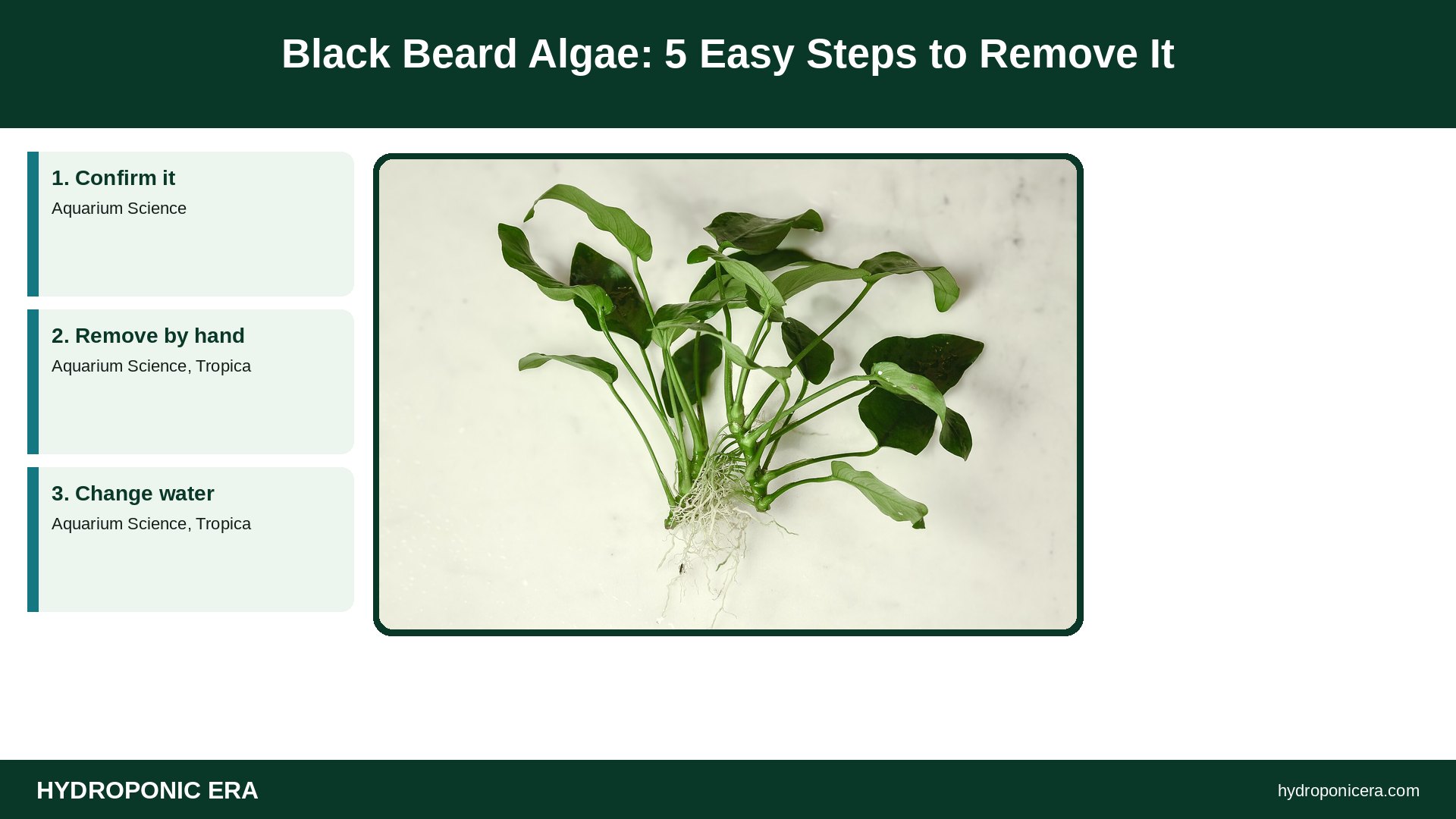
| Step | What to do | Source |
|---|---|---|
| 1. Confirm it | Tufts turn reddish in alcohol (red alga test) | Aquarium Science |
| 2. Remove by hand | Cut infected leaves; take decor out to clean | Aquarium Science, Tropica |
| 3. Change water | Large, frequent water changes | Aquarium Science, Tropica |
| 4. Add grazers | Siamese algae eaters, Amano shrimp, nerites | Aquarium Science, Tropica |
| 5. Fix the cause | Steady CO2, balanced light, less excess nutrient | Aquarium Science |
What Is Black Beard Algae?
Black beard algae is a red alga that grows as dense, fine tufts resembling a dirty, nearly black beard. Aquarium Science says it can also look green or purple, grows rapidly, and clings so tightly to plants that it cannot easily be removed by hand. Hobbyists also call it BBA or brush algae.
Tropica groups red algae with the filamentous algae and calls them among the hardest types to get rid of.
How Can You Tell If It Is Black Beard Algae?
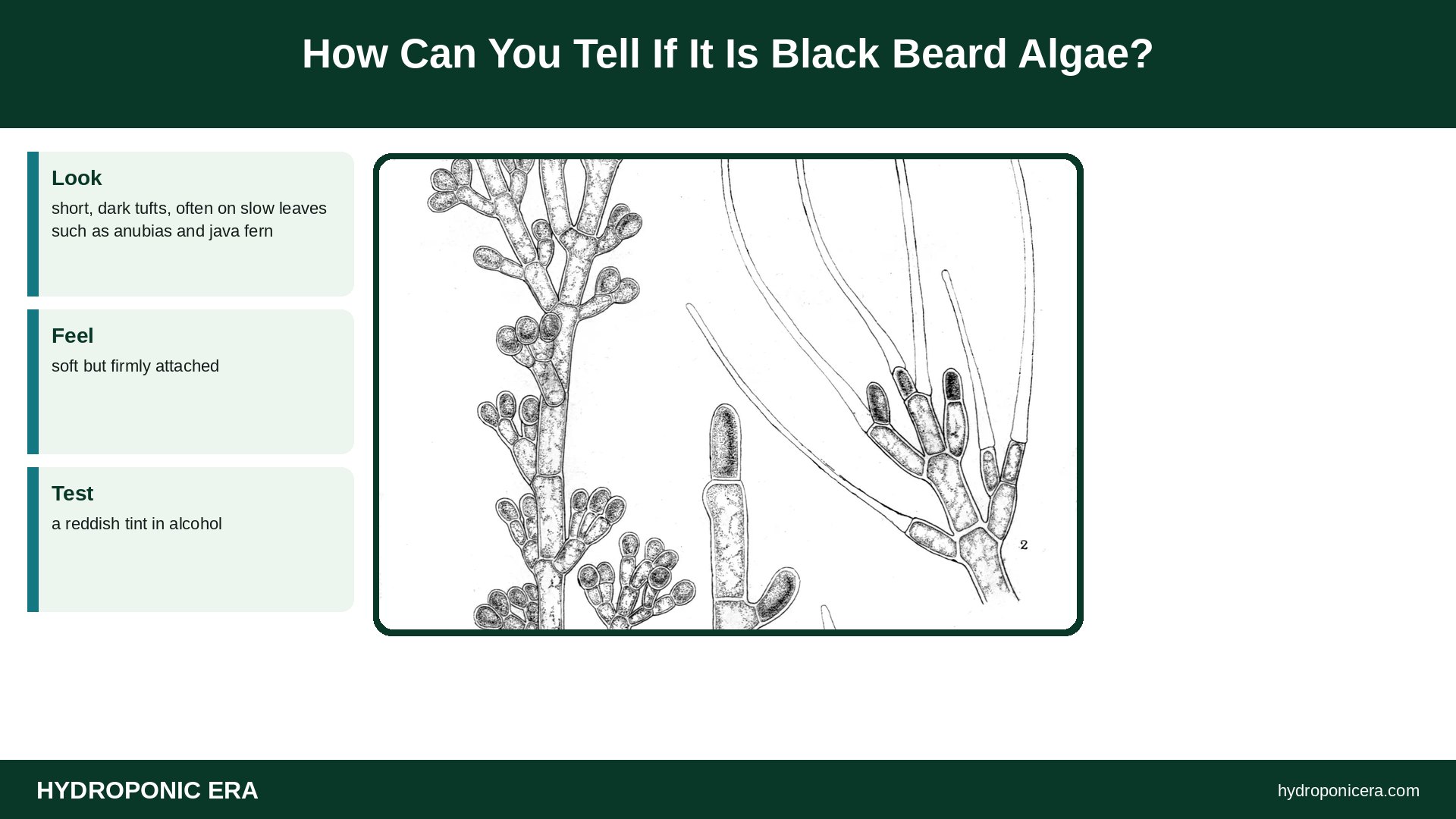
Check where it grows and test a tuft. Aquarium Science says it appears on the edges of plant leaves and almost any hard surface, such as wood, rock and filter pipes. It also gives a simple test: put a piece of the algae in rubbing alcohol, and red algae turn reddish, confirming you are dealing with BBA.
- Look: short, dark tufts, often on slow leaves such as anubias and java fern.
- Feel: soft but firmly attached.
- Test: a reddish tint in alcohol.
What Causes Black Beard Algae?
Black beard algae usually follows a nutrient and carbon imbalance. Aquarium Science says it generally comes with high nitrates, high phosphates or high iron, and that in low-tech planted tanks most algae problems trace back to too little CO2. It adds that even low-tech tanks do better with at least 10 ppm CO2.
Our CO2 enrichment guide explains how dissolved carbon affects plant growth.
How Do You Remove Black Beard Algae Step by Step?
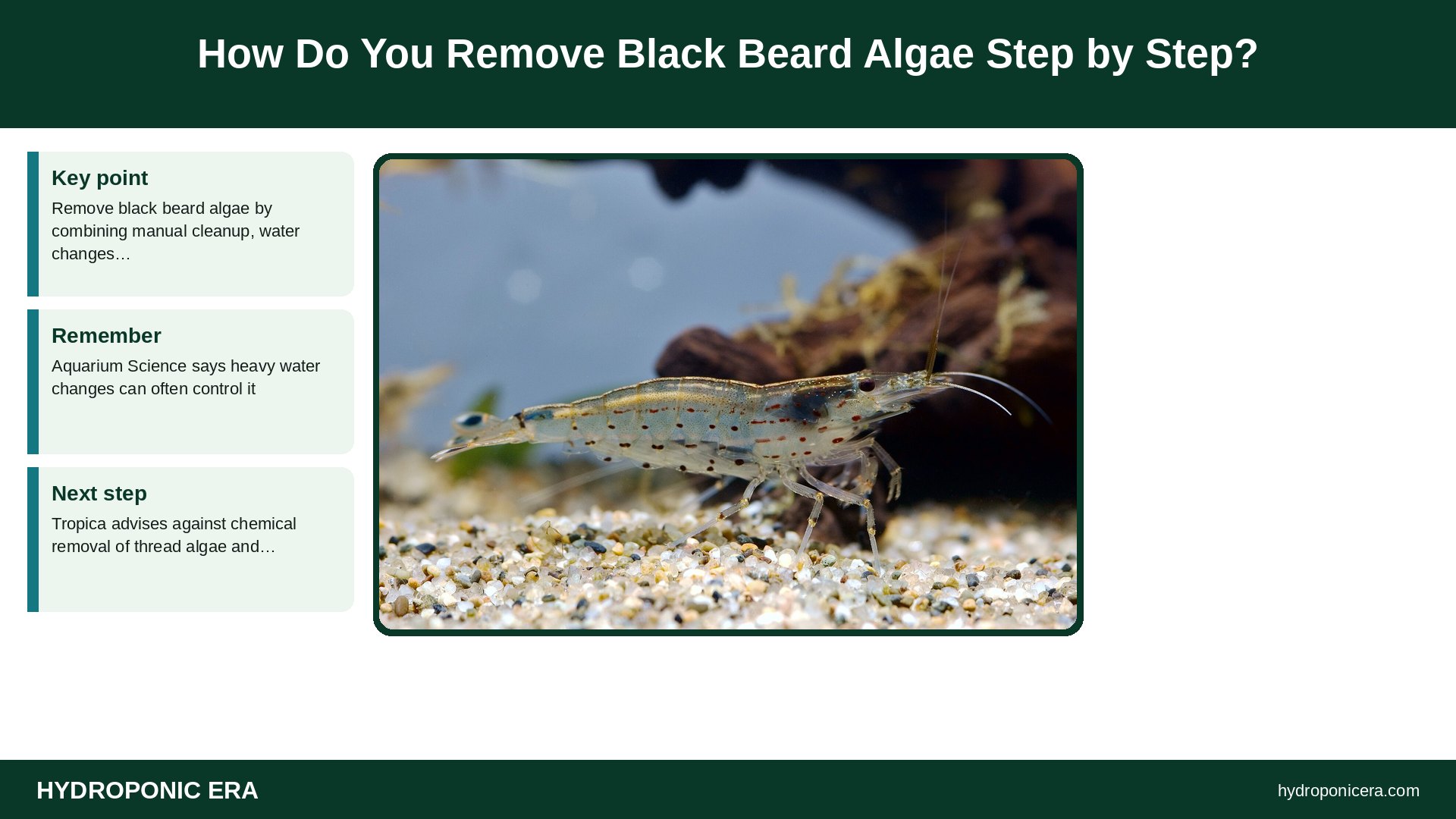
Remove black beard algae by combining manual cleanup, water changes and grazers, then fixing the cause so it does not return. Aquarium Science says heavy water changes can often control it. Tropica advises against chemical removal of thread algae and recommends changing water more often than usual with a large population of Amano shrimp instead.
- Cut off badly infected leaves at the base and siphon them out.
- Take rocks and wood out of the tank to scrub or soak them, then rinse well before returning them.
- Do large water changes and vacuum debris to cut excess nitrate and phosphate.
- Add algae eaters suited to your tank size.
- Keep CO2, light hours and fertilizer steady; see our aquarium grow light guide.
What Eats Black Beard Algae?
Several grazers help, but none is guaranteed. Aquarium Science lists Siamese algae eaters, silver flying fox, bristlenose plecos, nerite snails and shrimp among the best algae eaters, while warning that some algae species produce chemicals fish will not eat, so results cannot be predicted. Tropica found Amano shrimp the most efficient grazers it tested.
- Siamese algae eater: keep one adult or a school of 5 or more to limit aggression, per Aquarium Science.
- Amano shrimp: Tropica suggests up to 2 shrimp per 1.3 gallons (5 L) for a short period against thread algae.
- Avoid: Chinese algae eaters and common plecos, which Aquarium Science does not recommend.
Should You Use Chemicals on Black Beard Algae?
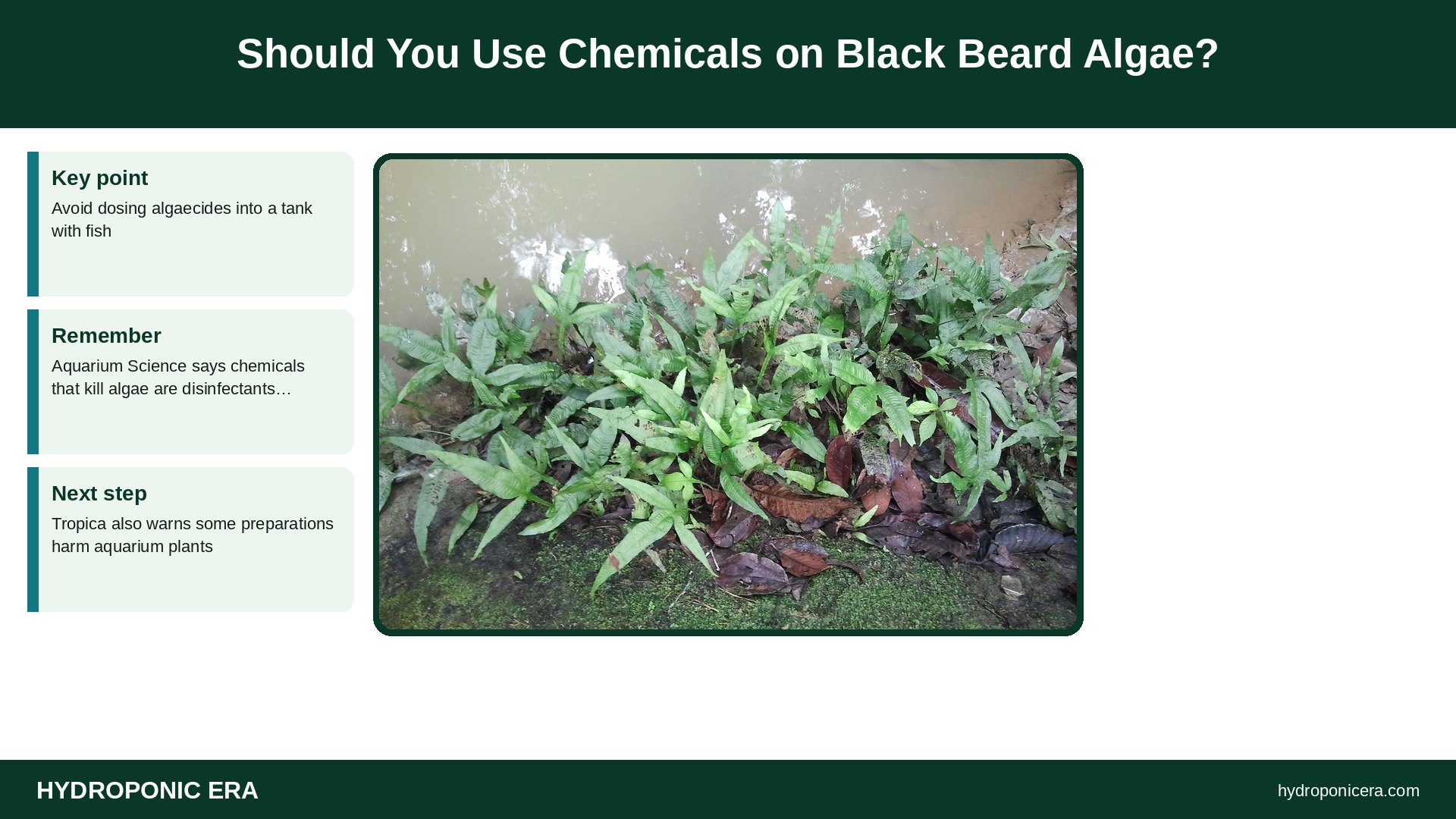
Avoid dosing algaecides into a tank with fish. Aquarium Science says chemicals that kill algae are disinfectants that can also harm fish gills and plants, that hydrogen peroxide and glutaraldehyde products are not harmless, and that algae return within a week or two if the cause is not fixed. Tropica also warns some preparations harm aquarium plants.
Cleaning hard decor outside the tank, then rinsing it, is a lower-risk option. For outdoor systems, see our aquaponics algae control guide.
How Do You Prevent Black Beard Algae?
Prevent black beard algae by keeping nutrients from building up and giving plants steady growing conditions. Tropica calls water changes one of the most efficient tools against algae, recommends no more than 10 hours of light a day on a timer, and names overfeeding or overstocking as the number one cause of algae problems.
- Stocking: Tropica suggests no more than about 1 in (2.5 cm) of fish per 0.67 gallon (2.5 L), preferably less.
- Temperature: Tropica says temperatures above about 79°F (26°C) almost always lead to algae problems.
- Variety: keep several kinds of algae eaters, since each prefers different algae.
Is black beard algae harmful to fish?
It is mostly a cosmetic and plant-health problem; the bigger risk to fish is the algaecides used against it, per Aquarium Science.
Why does black beard algae keep coming back?
Aquarium Science says chemical treatments are temporary and algae return if the underlying problem is not fixed.
Does black beard algae turn red when dead?
Red algae turn reddish in alcohol, which Aquarium Science uses as an identification test.
Can Amano shrimp eat black beard algae?
Tropica rates Amano shrimp the best grazers it tested on algae films, but results on BBA vary.
Will more light fix black beard algae?
No. Aquarium Science links algae control to thriving plants, CO2 and balanced light, not more light alone.
Sources
- Aquarium Science. 16.5. Black Beard Algae.
- Aquarium Science. 16.2.6. Chemical Algae Control.
- Aquarium Science. 16.2.4. Algae Eaters.
- Aquarium Science. 16.2. Controlling Algae.
- Tropica Aquarium Plants. Types of algae.
- Tropica Aquarium Plants. Preventing algae.
- Tropica Aquarium Plants. Test of algae eaters.
- Photo credits (Wikimedia Commons, edited with titles): Anubias barteri var. nana by Abhik.Mazumdar.73 (CC BY 4.0); Audouinella boweri as Chantransia boweri in Murray & Barton 1891 by del. Ethel Sarel Barton Gepp (1864–1922) (Public domain); Caridina multidentata(Hamamatsu,Shizuoka,Japan,2007) by Seotaro (CC BY-SA 3.0); Java Fern (Microsorum pteropus) growing in the wild. by Fhurzan (CC BY-SA 3.0)