
How do you find a pond leak? To find a pond leak, first rule out evaporation, then turn off the waterfall pump, mark the water level and watch it for 24 hours. If the level keeps falling, the leak is in the pond liner near where it stops. If it holds steady, check the waterfall, stream, plumbing and low edges.
Key takeaway: Most pond leak hunts end at the edges or the waterfall, not a hole in the liner. Turn off the pump, mark the level, wait 24 hours, and let the result point you to the liner or the plumbing. Penn State says evaporation alone can exceed 1/4 in (6 mm) a day on warm, breezy days, so rule that out first.
| Result after 24 h, pump off | Likely cause | Next step |
|---|---|---|
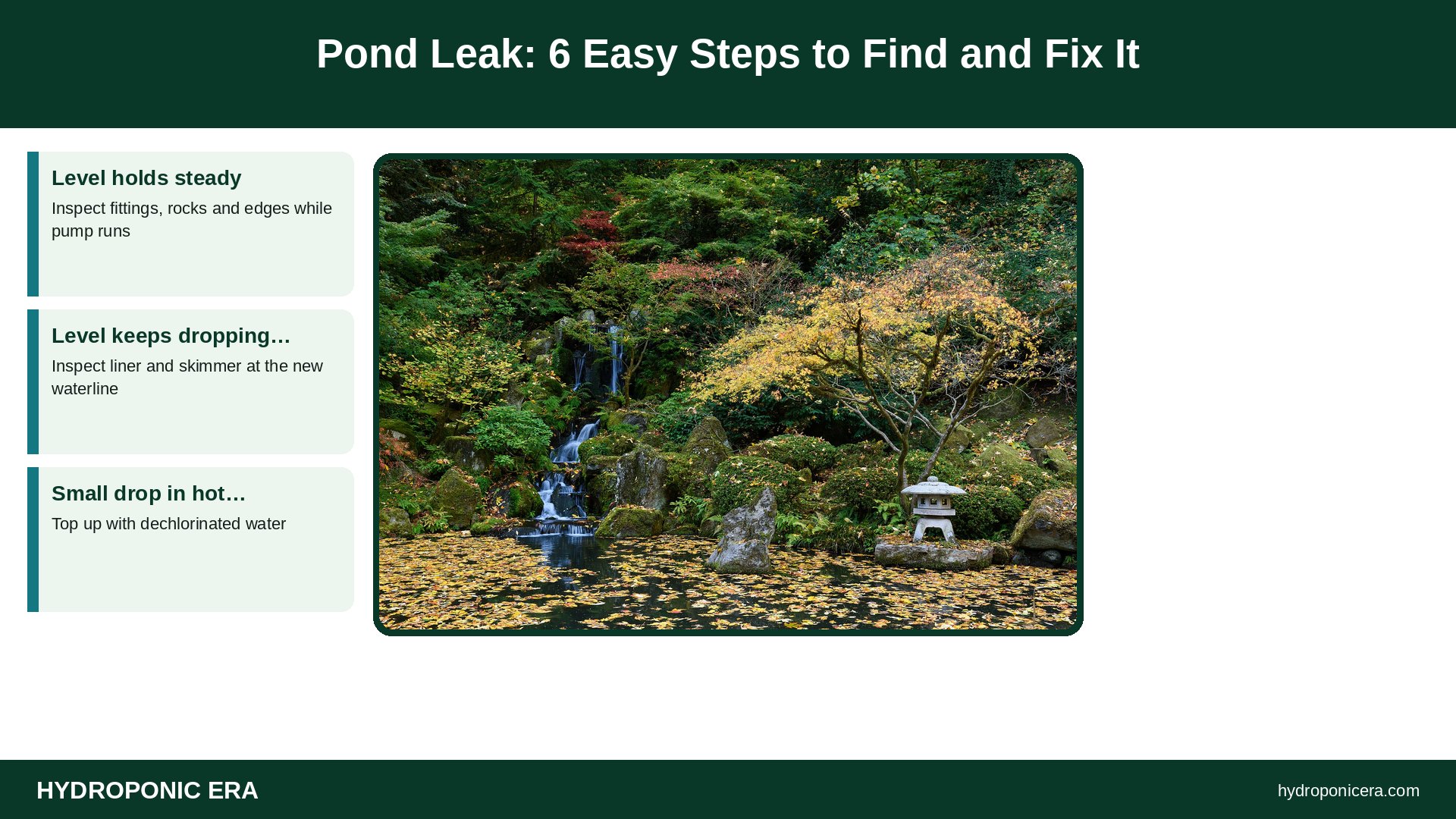
| Level holds steady | Waterfall, stream, plumbing or splash | Inspect fittings, rocks and edges while pump runs |
| Level keeps dropping, then stops | Hole or seam at that height | Inspect liner and skimmer at the new waterline |
| Small drop in hot, windy weather | Evaporation | Top up with dechlorinated water |
| Wet soil or lush plants outside pond | Edge or bank leak | Raise the low edge or patch the liner |
Is Your Pond Really Leaking or Just Evaporating?
Your pond leak may not be a leak at all. Penn State Extension says all ponds lose water to evaporation, and on breezy, warm, low-humidity summer days a pond can lose over 1/4 inch (6 mm) a day, or nearly 4 inches (10 cm) in two dry weeks. Aquascape also lists splashing, low edges and plumbing.
Penn State also notes that water-loving trees such as willows and maples along the banks can draw down pond water.
How Do You Do a 24-Hour Pond Leak Test?
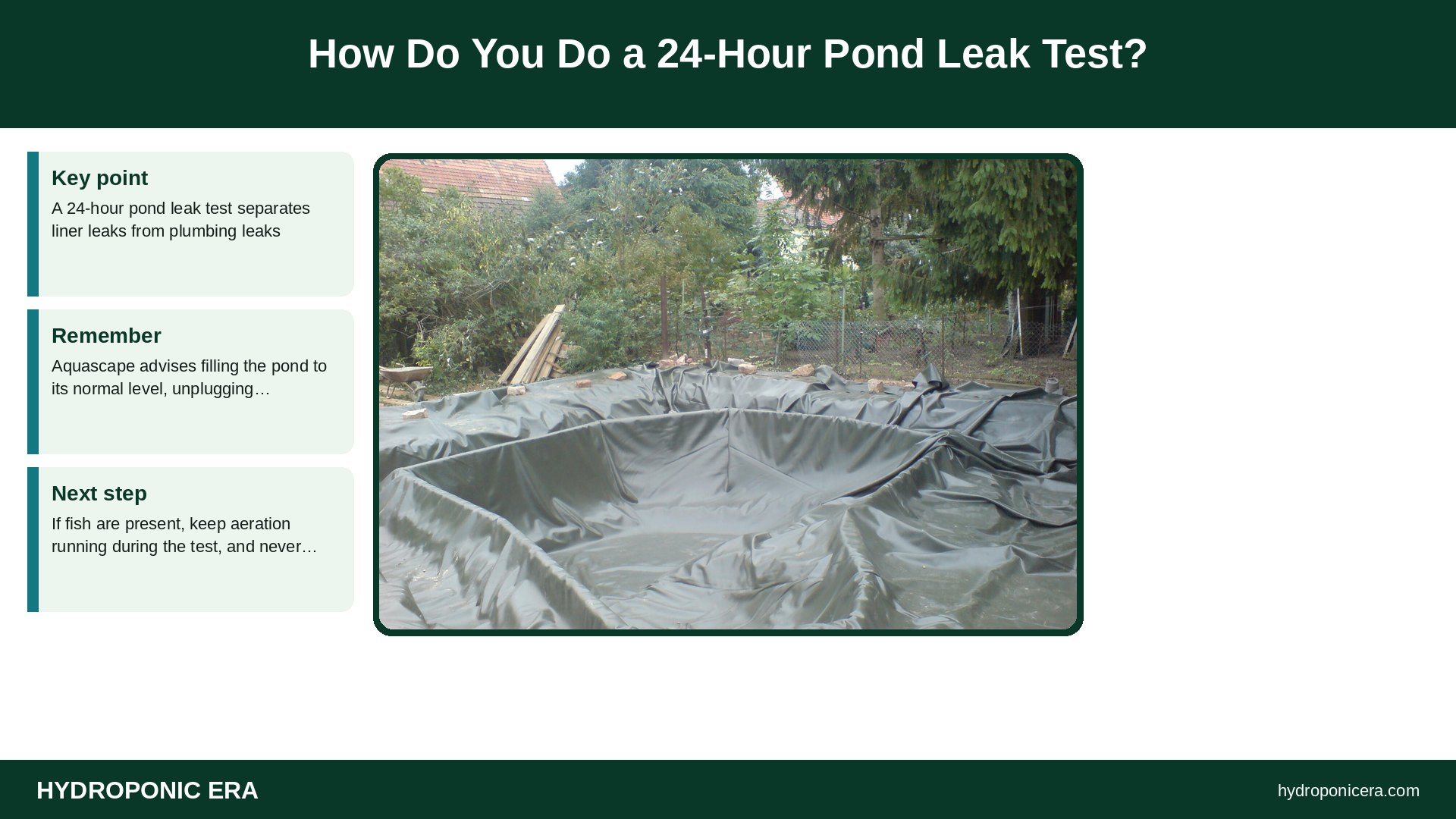
A 24-hour pond leak test separates liner leaks from plumbing leaks. Aquascape advises filling the pond to its normal level, unplugging the waterfall pump, marking the level on a rock, and checking it after 24 hours. If fish are present, keep aeration running during the test, and never let the water drop to an unsafe depth.
- Fill to the normal operating level.
- Turn off and unplug the waterfall pump.
- Mark the waterline on a stone or stake.
- Run an air pump for fish; see our aquaponics air pump guide.
- Compare the level with the mark after 24 hours.
How Do You Find a Pond Leak in the Liner?
If the level keeps falling with the pump off, Aquascape says the leak is likely in the pond itself. Let the water drop until it stabilizes, then inspect the liner at that height for punctures, tears or bad seams, plus the skimmer faceplate. Penn State agrees: a fast drop that then stops points to that waterline.
- Move rocks and gravel by hand; Aquascape warns against sharp tools.
- Look for wet soil or unusually green plants outside the pond.
- Sprinkle a small amount of food-grade dye near a suspected spot, as Penn State suggests, and watch where it drifts.
What If the Water Only Drops When the Pump Runs?
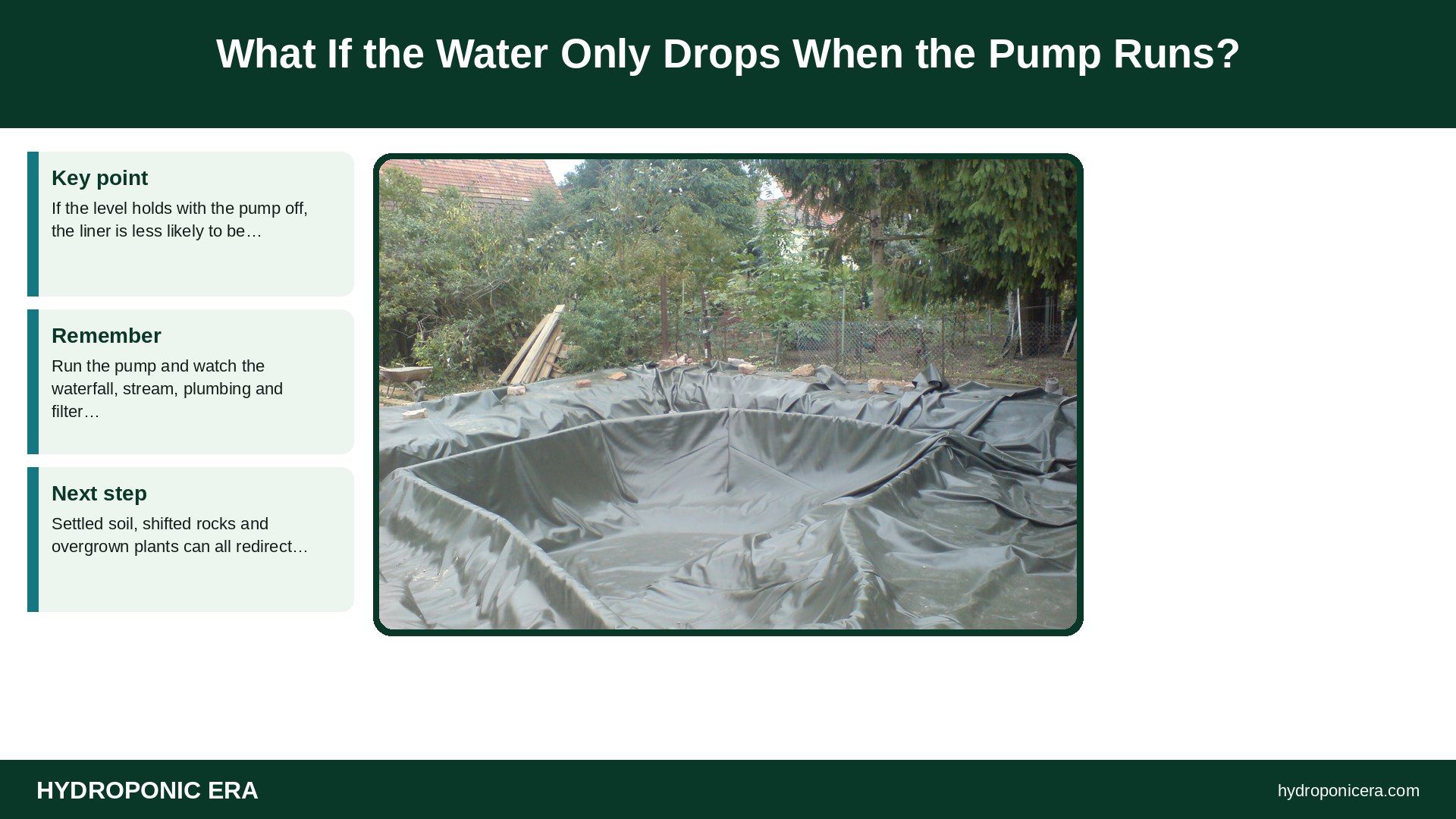
If the level holds with the pump off, the liner is less likely to be leaking, Aquascape says. Run the pump and watch the waterfall, stream, plumbing and filter connections for water escaping over low edges, splashing outside the liner, or leaking fittings. Settled soil, shifted rocks and overgrown plants can all redirect flow past the liner.
Oversized pumps splash more; see our aquaponics pump size guide for sizing flow.
How Do You Fix a Pond Leak?
Fix a pond leak according to the liner type. The RHS says flexible butyl rubber and PVC liners can usually be patched with specialist kits, and fibreglass moulds can be too, but moulded plastic usually cannot. Aquascape recommends a compatible EPDM repair patch for EPDM liners. Low edges need raising, not patching.
- Lower the water just below the damage and clean and dry the area.
- Apply a patch made for your liner type, following the kit directions.
- Raise any sunken edge with soil and re-set stones over the liner.
- Refill with dechlorinated water; see our dechlorinate water guide.
How Do You Prevent a Pond Leak?
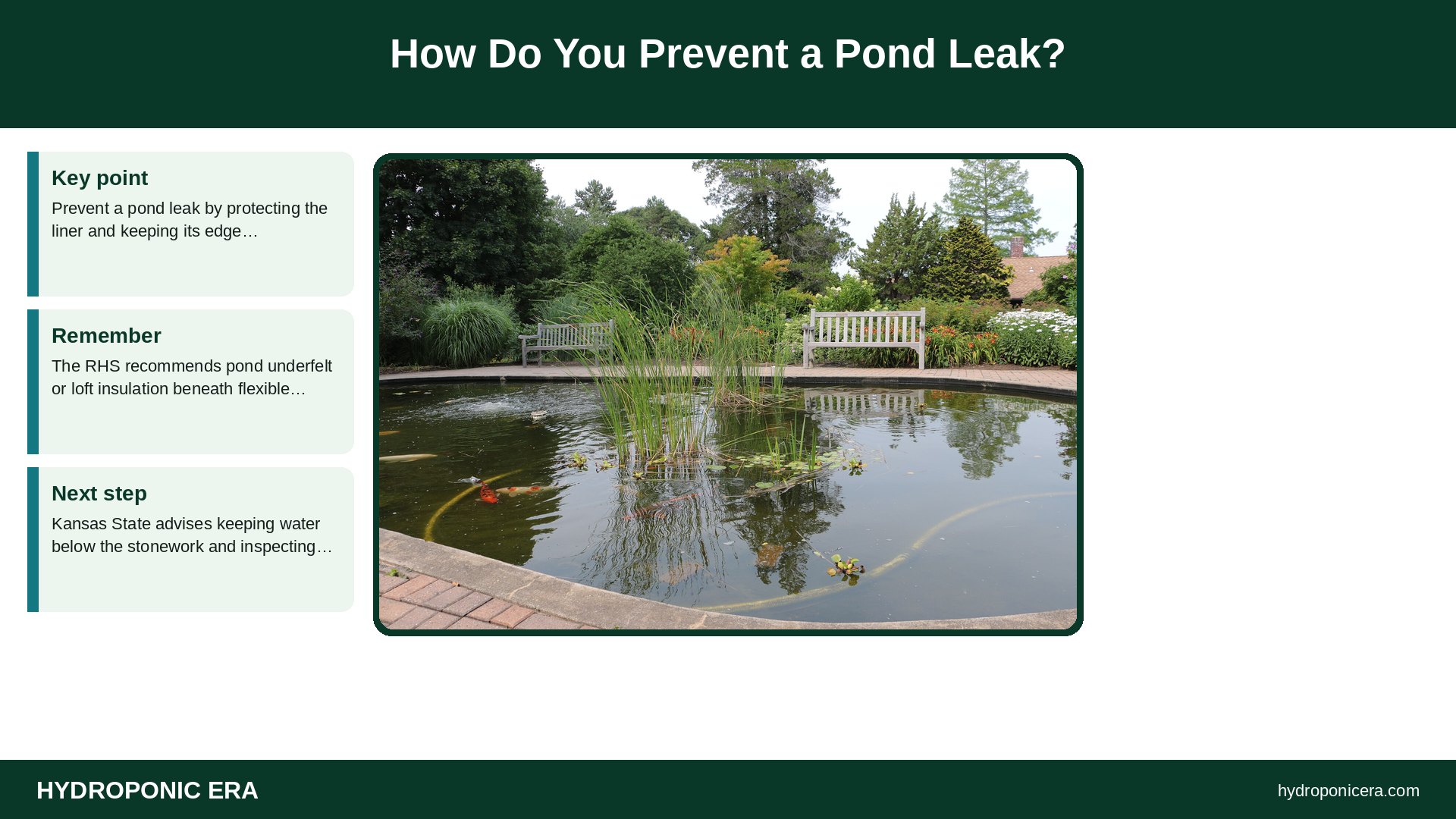
Prevent a pond leak by protecting the liner and keeping its edge above the water. The RHS recommends pond underfelt or loft insulation beneath flexible liners to guard against sharp stones, with the liner overlapping the edge by at least 6 inches (15 cm). Kansas State advises keeping water below the stonework and inspecting the pond regularly.
Penn State adds that tree roots and muskrat holes can cause leaks in banks, so keep trees off pond dams and berms.
When Should You Call a Professional About a Pond Leak?
Call a professional when you cannot locate the pond leak, the liner is badly torn, or the pond is a large earthen or dammed pond. Penn State says finding a leak can be very difficult, and if you cannot find the general area you may need to drain and reseal the whole bottom at significant expense.
- Ponds that needed a construction permit may need a permit review before repairs, per Penn State.
- Concrete cracks can be hard to repair, the RHS notes.
- Planted edges and marginal shelves hide leaks well; see our koi pond plants guide before replanting.
How much water loss is normal for a pond?
Penn State says over 1/4 in (6 mm) a day is possible from evaporation on warm, breezy, dry days.
Can a pond liner be repaired?
The RHS says butyl and PVC liners can usually be patched; rigid plastic moulds usually cannot.
Should I turn off the pump to find a leak?
Yes. Aquascape’s 24-hour test is done with the waterfall pump off.
Is it safe for fish during a leak test?
Keep aeration running and do not let the level drop too far, per Aquascape.
Where do most pond leaks occur?
Often at waterfalls, streams, plumbing and low edges rather than the liner itself, as Aquascape’s checklist shows.
Sources
- Aquascape Knowledge Base. How do I determine whether my pond liner is leaking?.
- Penn State Extension (Pond Facts #3, via Warren County Conservation District). Fixing a Leaking Pond.
- Royal Horticultural Society. How to make a new pond.
- Kansas State University. MF2913 Water Gardening: Maintenance.
- Photo credits (Wikimedia Commons, edited with titles): Portland Japanese Garden October 2019 005 by King of Hearts (CC BY-SA 4.0); Teichbau2-Teichfolie by A.Fiebig (Public domain); Teichbau2-Teichfolie by A.Fiebig (Public domain); Deep Cut Gardens Koi Pond by FossilDS (CC0)