
How do you make a bog garden? To make a bog garden, pick a sunny spot, dig 12–18 in (30–45 cm) deep, line the hole with a pond liner, pierce drainage holes, add a gravel layer, and backfill with moist, organic or peaty soil. Let the soil settle, then plant moisture-loving species such as cardinal flower, iris and pitcher plants.
Key takeaway: A bog garden is a lined, wet planting bed that stays waterlogged without pooling. The RHS digs 18 in (45 cm) and pierces the liner every 3 1/4 ft (1 m); Mississippi State and UF/IFAS dig about 12 in (30 cm) with holes along the sides and use 80% peat moss to 20% sharp sand. Give it at least 6 hours of sun.
| Step | Detail | Source |
|---|---|---|
| 1. Choose a site | Full sun, at least 6 hours a day | Mississippi State |
| 2. Dig | 12–18 in (30–45 cm) deep | UF/IFAS, RHS |
| 3. Line | Pond liner or polythene at least 0.5 mm thick | RHS |
| 4. Drain | Pierce holes; 1–2 in (2.5–5 cm) gravel base | RHS, Mississippi State |
| 5. Fill | Garden soil plus compost, or 80% peat : 20% sharp sand for carnivorous bogs | RHS, UF/IFAS |
| 6. Plant | After the soil settles | RHS |
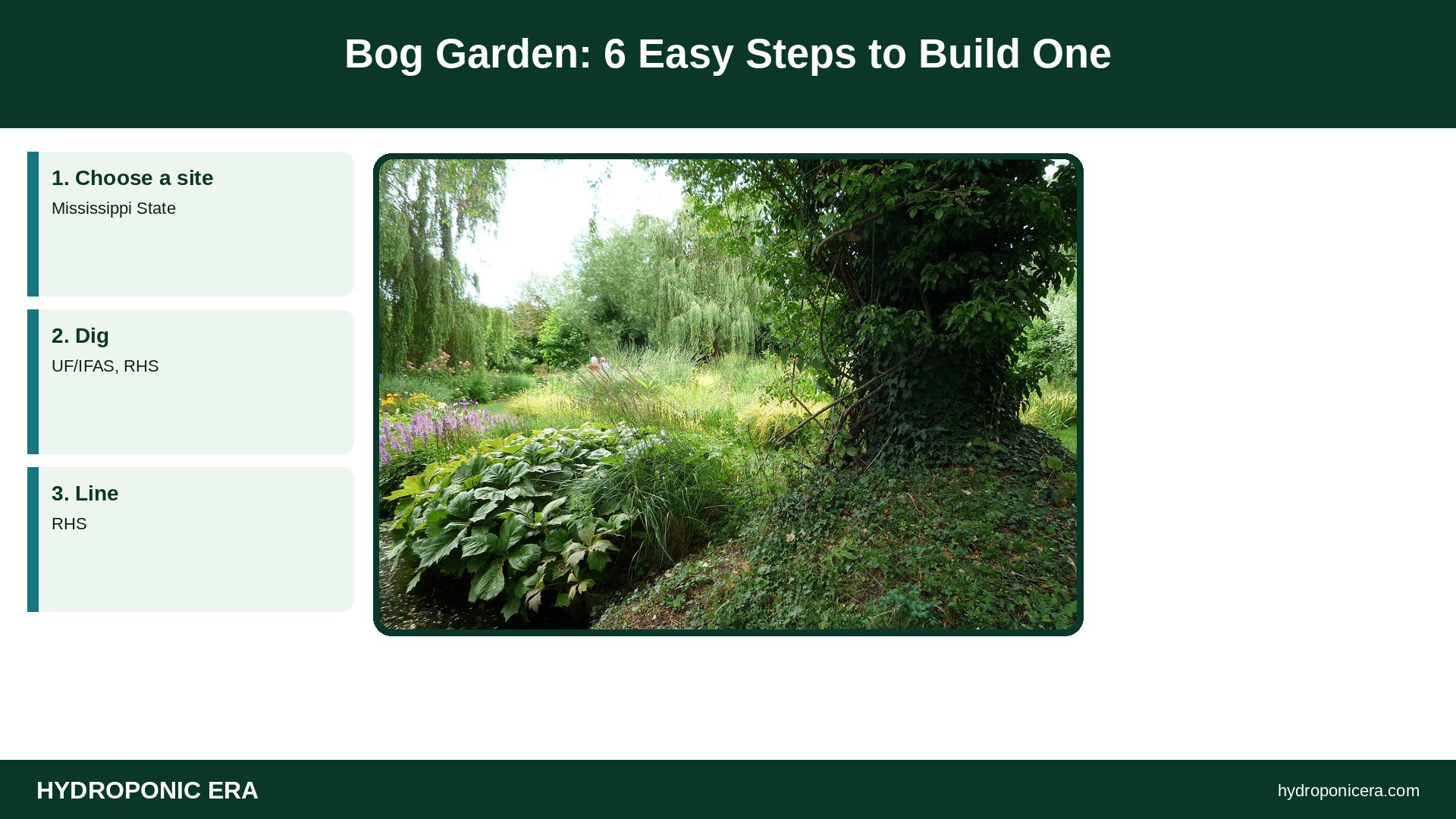
What Is a Bog Garden?
It is a planting area kept constantly moist, like a small wetland. UF/IFAS says bog plants withstand waterlogged soil and act as a sponge for rainwater runoff. The RHS calls it a perfect use for a leaky or redundant pond, an informal pond edge, or a naturally wet dip in the garden.
Bog gardens also make excellent wildlife habitat, the RHS notes, and they pair well with a pond’s bog filter design.
Where Should You Put a Bog Garden?
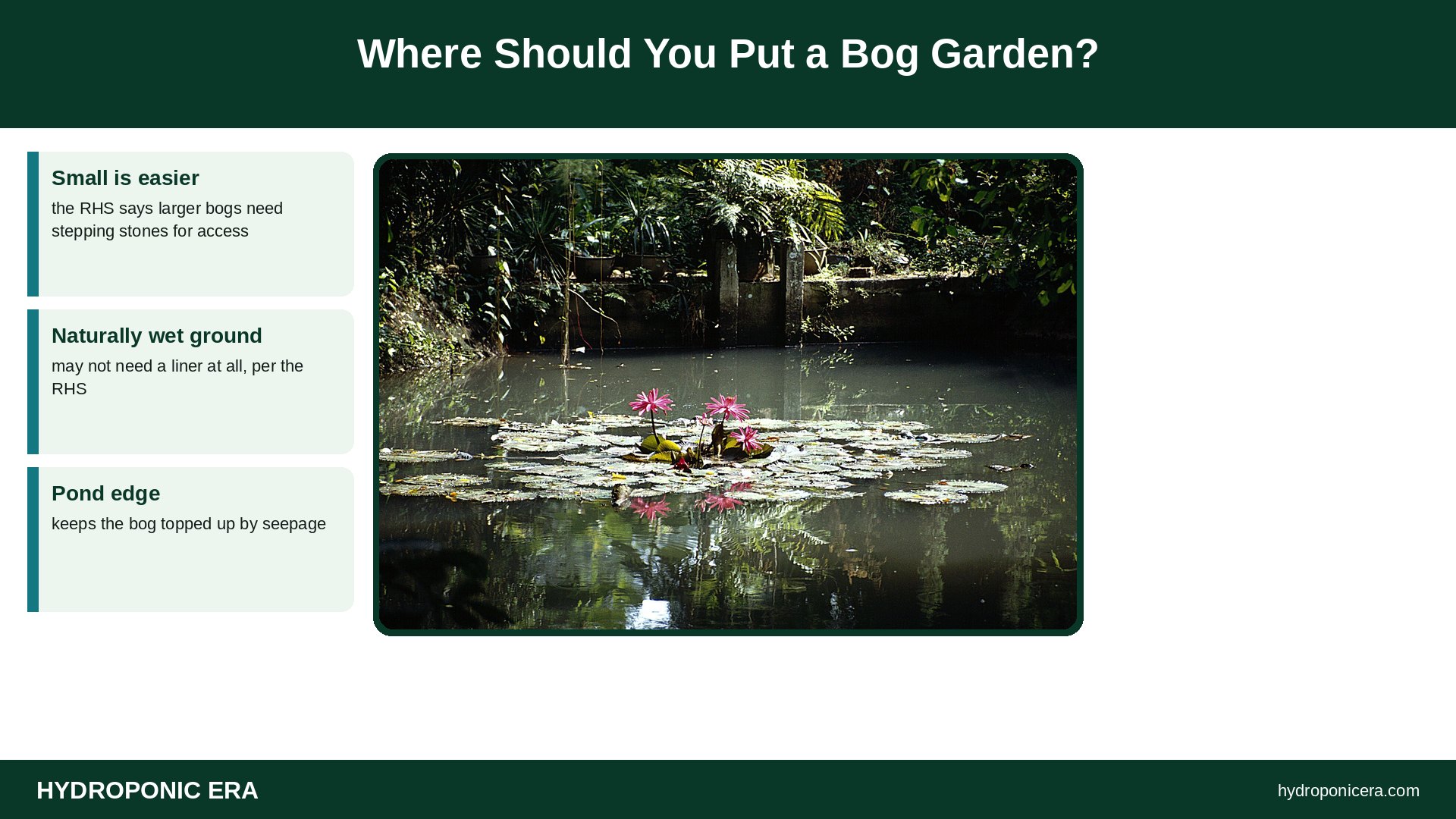
Choose an open, sunny spot. Mississippi State Extension says the most important factor is sunlight: bog plants need full sun for at least six hours a day and prefer moist, acidic soil with plenty of water in the growing season. UF/IFAS suggests a low area that collects rainwater, or the shallow edge of a pond.
- Small is easier: the RHS says larger bogs need stepping stones for access.
- Naturally wet ground: may not need a liner at all, per the RHS.
- Pond edge: keeps the bog topped up by seepage.
How Do You Build a Bog Garden Step by Step?
Build it by digging, lining, draining and backfilling. The RHS method digs 18 inches (45 cm) deep, lines the hole with butyl liner or polythene at least 0.5 mm thick, pierces it every 3 1/4 feet (1 m) with a fork, and adds 1–2 inches (2.5–5 cm) of coarse grit before refilling with soil.
- Mark the area and work out the soil volume (length × width × depth).
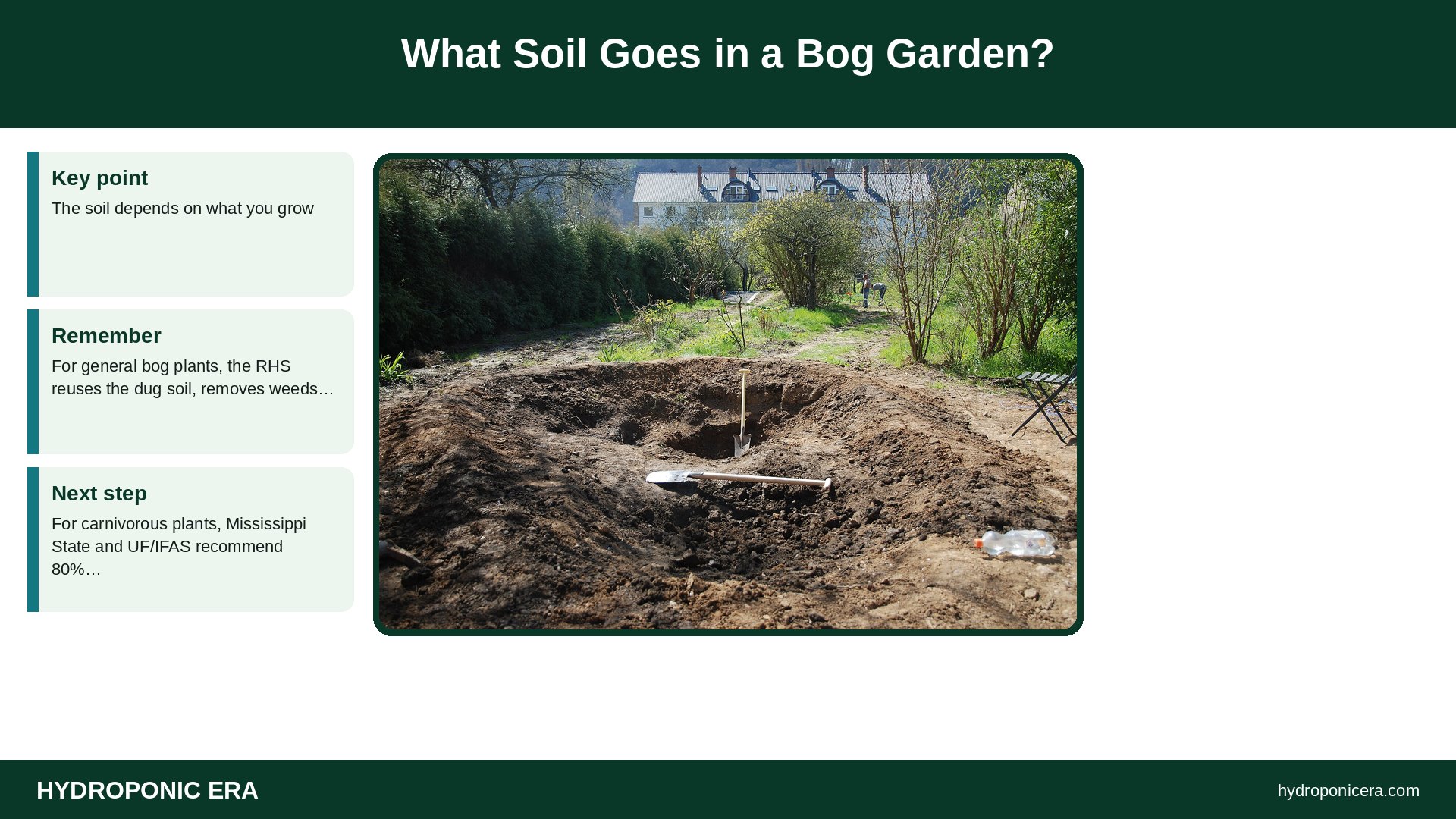
- Dig to 12–18 in (30–45 cm) and set the soil aside.
- Lay the liner and weigh the edges with bricks or stones.
- Pierce drainage holes in the base or along the sides.
- Optional: lay a leaky hose on the base for irrigation, as the RHS suggests.
- Cover with grit, then backfill and let the soil settle before planting.
What Soil Goes in a Bog Garden?
The soil depends on what you grow. For general bog plants, the RHS reuses the dug soil, removes weeds and stones, and adds compost, leaf mould or well-rotted manure if organic matter is low. For carnivorous plants, Mississippi State and UF/IFAS recommend 80% coarse peat moss and 20% sharp sand, wetted thoroughly before planting.
UF/IFAS says never fertilize, because fertilizer can harm the plants, and suggests rainwater from a barrel to keep the soil acidic.
What Plants Grow in a Bog Garden?
Choose plants that love wet roots. UF/IFAS lists blue flag iris, golden canna, cardinal flower, scarlet rosemallow, aquatic milkweed and swamp sunflower, plus carnivorous sundews, butterworts and pitcher plants. Mississippi State adds lady’s hatpin, red milkweed, yellow candyroot and pine lily. Golden canna, UF/IFAS notes, removes excess nitrogen and phosphorus from water.
- Very wet zones: American pitcher plants, per UF/IFAS.
- Moist, not flooded: sundews and butterworts.
- Pond edge: see our koi pond plants list for marginals.
Never remove native carnivorous plants from the wild, UF/IFAS warns.
How Do You Keep a Bog Garden Wet but Not Waterlogged?
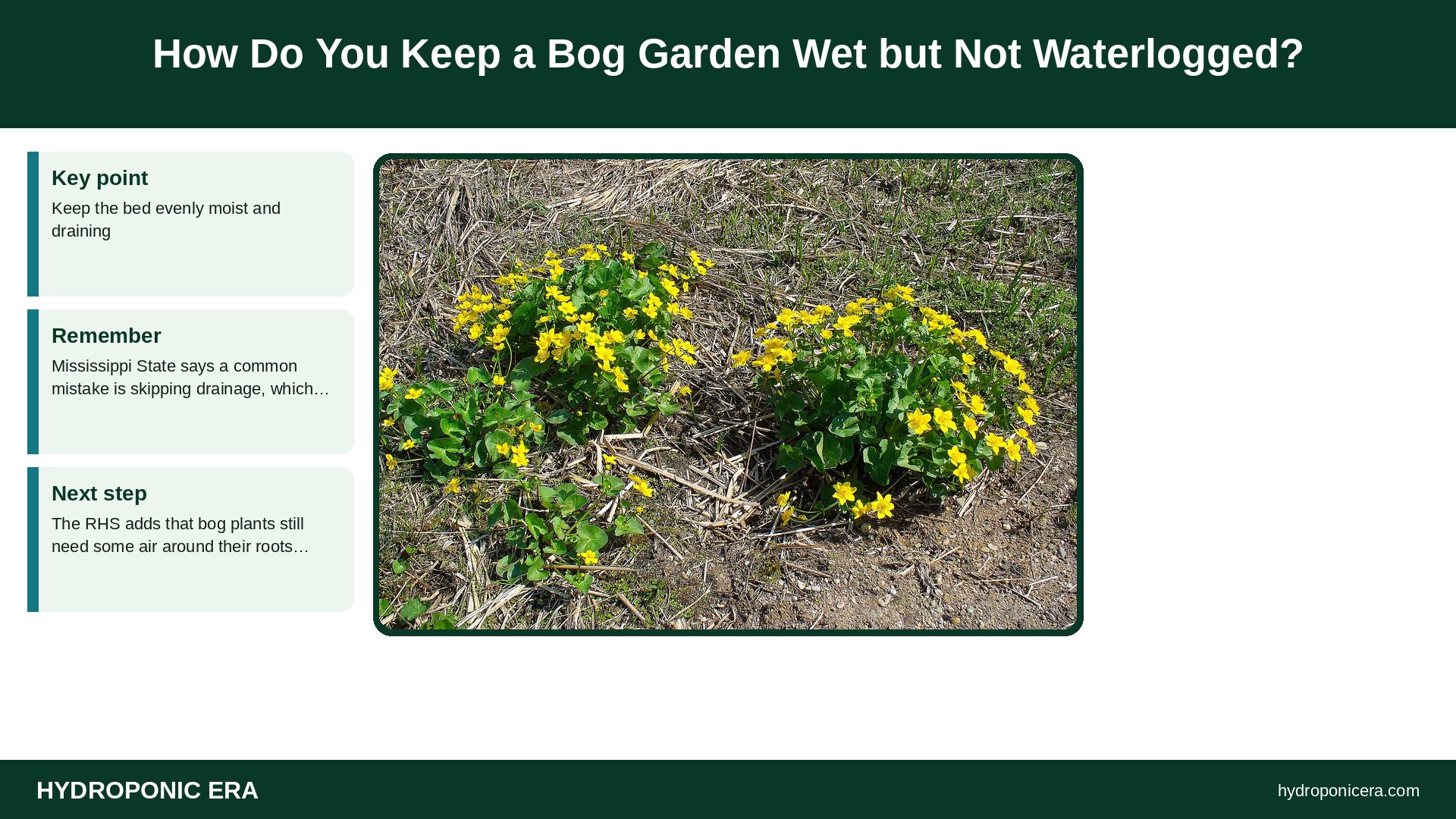
Keep the bed evenly moist and draining. Mississippi State says a common mistake is skipping drainage, which creates stagnant water where plants will not grow. The RHS adds that bog plants still need some air around their roots and can suffer Phytophthora root rot if soil stays so wet that water pools. Water regularly during dry spells.
A pond-edge bog fed by the pond is one way to recycle nutrients; our pond aquaponics guide covers more ideas.
How Do You Add a Bog Area Next to a Pond?
Add a bog area by lining the pond and bed under one liner, separated by a low ridge. The RHS leaves a soil ridge 3 inches (7.5 cm) lower than the pond edge, covers both areas with one butyl liner, adds 2 inches (5 cm) of grit in the bog side, and builds a rock wall backed with fine plastic mesh.
- Excavate the pond and bog areas together, leaving the ridge.
- Lay sand and geotextile, then a single butyl liner over both.
- Fill the pond to just below the ridge.
- Add grit and soil to the bog side, then the rock and mesh barrier.
- Top up the pond so water seeps through into the bog.
Marginal plants in that wet zone also take up nutrients that feed algae; see our aquaponics algae control guide.
How deep should a bog garden be?
About 12 in (30 cm) per Mississippi State and UF/IFAS, or 18 in (45 cm) per the RHS.
Does a bog garden need a liner?
Yes on dry sites; the RHS says naturally waterlogged ground may not need one.
Should a bog garden have drainage holes?
Yes. Every guide here pierces the liner so water does not stagnate.
Can I turn an old pond into a bog garden?
Yes. The RHS calls a leaky or redundant pond a perfect base for one.
Can I make a bog garden in a container?
Yes. Mississippi State suggests a pot at least 8 in (20 cm) deep and 12 in (30 cm) wide set in a water-filled saucer.
Sources
- Royal Horticultural Society. How to create a bog garden for wildlife.
- Mississippi State University Extension. Creating a Bog Garden.
- UF/IFAS Gardening Solutions. Bog Gardens.
- Photo credits (Wikimedia Commons, edited with titles): Bog Garden at Westonbury Mill Gardens – geograph.org.uk – 6411581 by Fabian Musto (CC BY-SA 2.0); RIBogorSeerose by Ziegler175 (CC BY-SA 4.0); Garden Pond 1 by Gilles San Martin (CC BY-SA 3.0); Caltha palustris 001 by H. Zell (CC BY-SA 3.0)