
To size an aquaponics air pump, match the pump’s airflow to your total water volume and fish load, and make sure its pressure rating beats the depth of your deepest air stone. Many hobby growers start with roughly 1 liter per minute (LPM) of air for every 10–20 gallons of total system water for lightly stocked systems, and double that for heavier fish loads or warm water. A 300-gallon IBC system, for example, usually runs well on a 30–60 LPM linear or diaphragm pump feeding stones in the fish tank, sump and raft beds.
Key takeaway: Size for the hottest week and the heaviest fish load you plan to carry, check output at your actual depth, and keep a battery or backup aquaponics air pump ready.
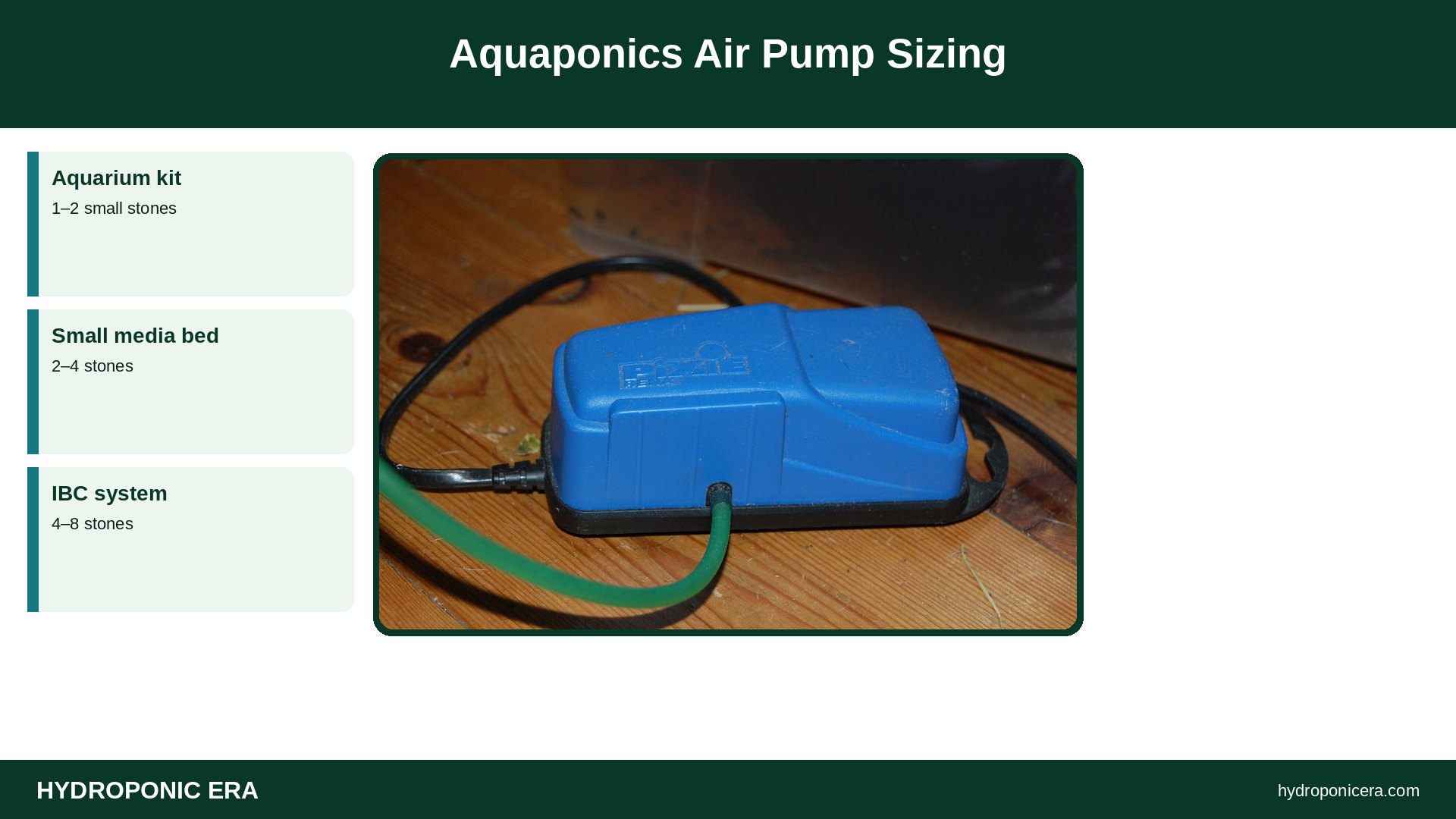
| System | Total water | Starting airflow | Stones |
|---|---|---|---|
| Aquarium kit | 10–40 gal | 2–5 LPM | 1–2 small stones |
| Small media bed | 50–150 gal | 5–15 LPM | 2–4 stones |
| IBC system | 250–400 gal | 30–60 LPM | 4–8 stones |
| Backyard raft system | 500–1,000 gal | 60–120 LPM | Stones every 2–4 ft in rafts |
| Commercial raft | Thousands of gal | Regenerative blower | Diffuser grid |
Why the Aquaponics Air Pump Matters

Fish, nitrifying bacteria and plant roots all need dissolved oxygen, and in most systems the air pump supplies most of it. When oxygen runs short, fish stop eating and bacteria slow down, so ammonia and nitrite can climb. SRAC Publication 454 notes that aeration is essential in aquaponics because fish, plants and bacteria all consume oxygen. See aquaponics dissolved oxygen.
Types of Aquaponics Air Pump
- Diaphragm pumps: cheap, common in aquarium and hydroponic sizes up to about 60–100 LPM. Diaphragms wear and need replacing every year or two.
- Linear piston pumps: quiet, efficient, long-lasting; popular for backyard systems from 40 to 200+ LPM.
- Regenerative blowers: high volume at low pressure for large or commercial systems.
- Battery backup pumps: small units that switch on automatically in a power cut.
Depth and Pressure
Every foot of water adds about 0.43 psi of back pressure. A stone at the bottom of a 4-foot fish tank needs the pump to push against about 1.7 psi before any air comes out, plus losses from tubing and the stone itself. Pump flow charts show output dropping as depth increases. Check the rated output at your stone depth, not the open-air number on the box, and keep air lines short.
How to Size an Aquaponics Air Pump
- Add up total water in the fish tank, sump, filters and grow beds.
- Consider the fish load. Light stocking (about 1 pound of fish per 10 gallons or less) needs less air than heavy stocking.
- Allow for heat. Warm water holds less oxygen, so add capacity for summer.
- Count the stones. Put at least one in the fish tank, one in the sump, and enough in DWC beds to cover the root area.
- Check depth. Choose a pump rated for your deepest stone.
- Add a margin of about 25–50% so you can open valves for hot days or extra fish.
See stocking density, fish to plant ratio and air stone vs air pump sizing.
Air Stones and Diffusers
Fine-bubble stones and diffusers transfer more oxygen than coarse bubbles, because smaller bubbles have more surface area and rise more slowly. They also clog faster, so clean or replace them every few months. Long bar diffusers work well in raft beds. Put stones near the bottom and spread them out. See air pumps and air stones.
Running and Balancing the Air Lines

Use a manifold with individual valves so each stone gets similar flow. Deep stones get less air than shallow ones on the same line, so open their valves more. Mount the aquaponics air pump above the water level, or add a check valve, so water can’t siphon back into the pump if it stops. Keep the intake in clean, dry air.
Water Pump vs Air Pump
The water pump moves water between the fish tank and grow beds; the air pump adds oxygen. Splashing returns and venturi fittings add some oxygen, but most systems still need dedicated aeration, especially in the fish tank and DWC beds. See aquaponics water pump size.
Power Use and Cost
Linear pumps typically use about 0.5–1 watt per LPM or less. A 60 LPM pump drawing 40–50 watts uses about 1–1.2 kWh a day, roughly $5–$6 a month at 16 cents per kWh. That is cheap insurance against fish losses. See electricity cost.
Backup Aeration

Your aquaponics air pump is the most important item to protect in a power cut. Options include a battery backup air pump that switches on automatically, a small inverter on a car or deep-cycle battery, or a generator. Test backup gear monthly. See backup power for pumps and pump redundancy.
Maintenance
- Clean intake filters monthly.
- Replace diaphragms or pistons when output drops.
- Clean or replace stones every few months.
- Check tubing for cracks and kinks.
- Keep a spare pump and a diaphragm kit.
Signs Your Air Pump Is Too Small
- Fish at the surface at dawn or on hot afternoons.
- DO readings below 5 mg/L.
- Rising ammonia or nitrite despite steady feeding.
- Brown, slimy roots in raft beds.
Aquaponics Air Pump Placement
Where you put the aquaponics air pump affects how long it lasts. Keep it dry, shaded and off the floor, ideally on a shelf above the water line. Pumps pull in the air around them, so a dusty or humid spot clogs the intake filter and shortens diaphragm life. In a greenhouse, avoid the hottest corner near the ridge. If noise is a concern, set the pump on a rubber pad and use a longer air line, but remember that every extra foot of tubing reduces output slightly.
Sizing an Aquaponics Air Pump for Raft Beds
Deep water culture beds hold a large share of the system water, and plant roots in them need oxygen just as fish do. Place a stone or diffuser every 2–4 feet along the bed, under the rafts, and count those stones when you add up airflow. A 4 by 8 foot raft bed often uses four to six stones on its own. Many growers run a separate aquaponics air pump for the beds and another for the fish tank, so a single failure doesn’t cut off all aeration at once.
When to Upgrade
Upgrade when you add fish, raise feeding, or move into a hotter season and DO readings start falling toward 5 mg/L. Moving to a larger linear pump or adding a second unit is cheaper than replacing lost fish.
FAQs
How big an air pump do I need for aquaponics?
Roughly 1 LPM per 10–20 gallons to start, more for heavy stocking or heat.
Can I use an aquarium air pump?
For small tanks, yes; larger systems need linear pumps or blowers.
Does depth matter?
Yes; deeper stones need more pressure.
Should the air pump run all the time?
Yes, 24 hours a day.
Where should air stones go?
In the fish tank, sump and raft beds.
Do I need a backup?
Yes; a battery air pump is the cheapest insurance.
Sources
- Southern Regional Aquaculture Center — Aquaponics: Integrating Fish and Plant Culture (SRAC 454)
- New Mexico State University — Important Water Quality Parameters in Aquaponics Systems
- FAO — Small-scale aquaponic food production
- Photo credits (Wikimedia Commons, edited with titles): Aquarium-air-pump by User:Corydoras-adolfoi (CC BY-SA 4.0); Air Stone Disk aquarium Germany 2024 by Nimmerwelk (CC BY-SA 4.0); Fish farming on Øksfjorden in Loppa, Troms og Finnmark, Norway, 2022 August by Ximonic (Simo Räsänen) (CC BY-SA 4.0); Recirculating Aquaculture System 1 by Narek75 (CC BY-SA 4.0); Intermediate Bulk Container (fcm) by Photograph: Frank C. Müller, Baden-Baden (CC BY-SA 4.0)