
Aquaponics stocking density for home and small-scale systems should stay at or below about 20 kg of fish per 1,000 liters of water, which works out to roughly 0.17 pounds of fish per gallon, or about 44 pounds in a 264-gallon tank. That’s FAO’s recommended maximum for new aquaponic farmers, with 10–20 kg per 1,000 liters as the normal working range. FAO advises halving the density (about 1 kg per 100 liters, or 0.08 lb per gallon) in tanks under 500 liters (about 132 gallons), and says tanks that small aren’t recommended for growing food fish at all. Measure aquaponics stocking density by fish weight, not by fish count, and plan for the weight at harvest.
Key takeaway: Plan your tank around the final harvest weight of your fish, stay under 0.17 lb per gallon, and stock below that while the system matures.
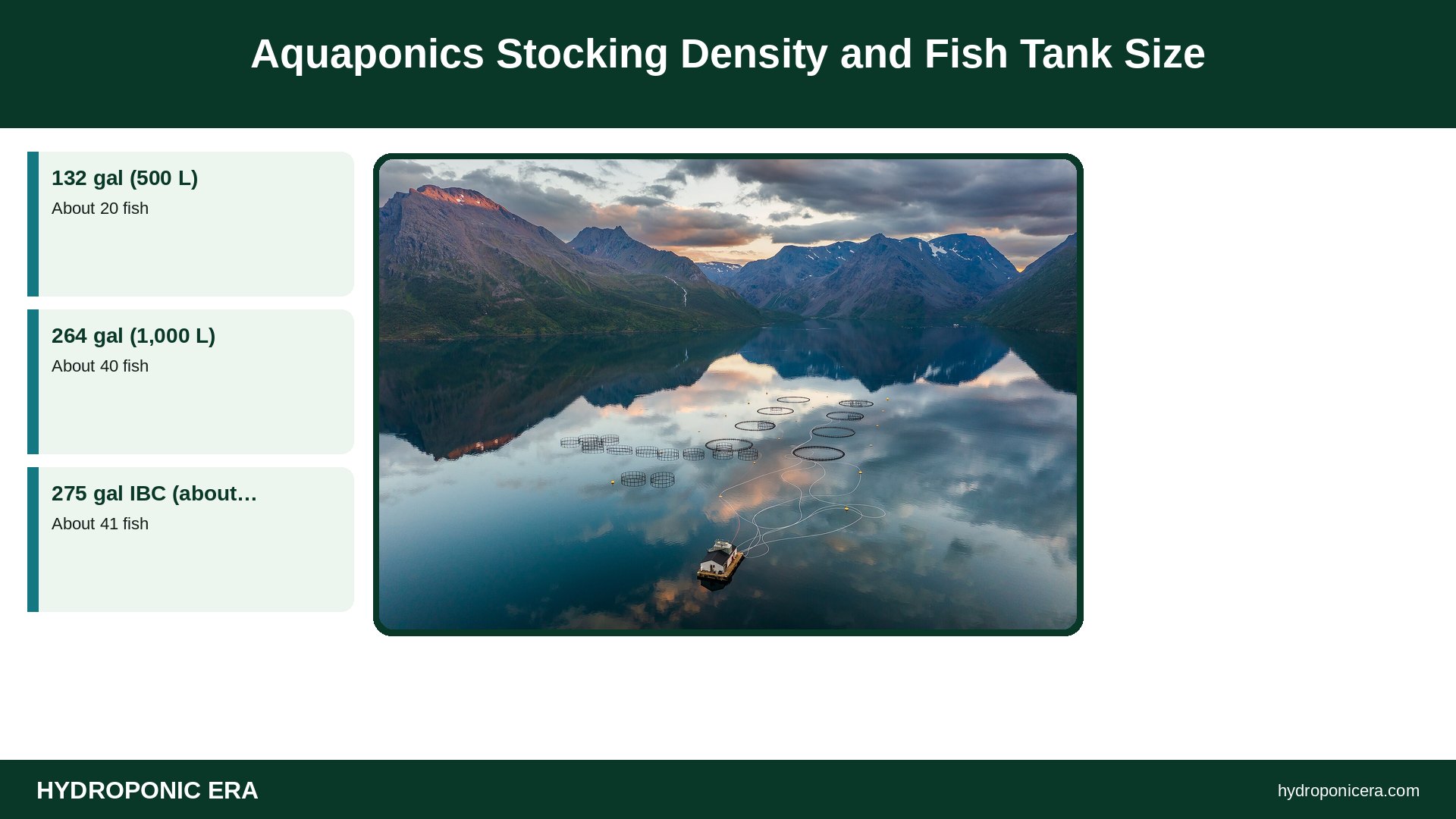
| Tank size | Max fish weight (FAO guideline) | Example: tilapia at 1.1 lb (500 g) harvest |
|---|---|---|
| 132 gal (500 L) | About 22 lb (10 kg) | About 20 fish |
| 264 gal (1,000 L) | About 44 lb (20 kg) | About 40 fish |
| 275 gal IBC (about 1,040 L) | About 46 lb | About 41 fish |
| Under 132 gal | Half density: about 0.08 lb per gallon | Not recommended for food fish |
Why Aquaponics Stocking Density Matters
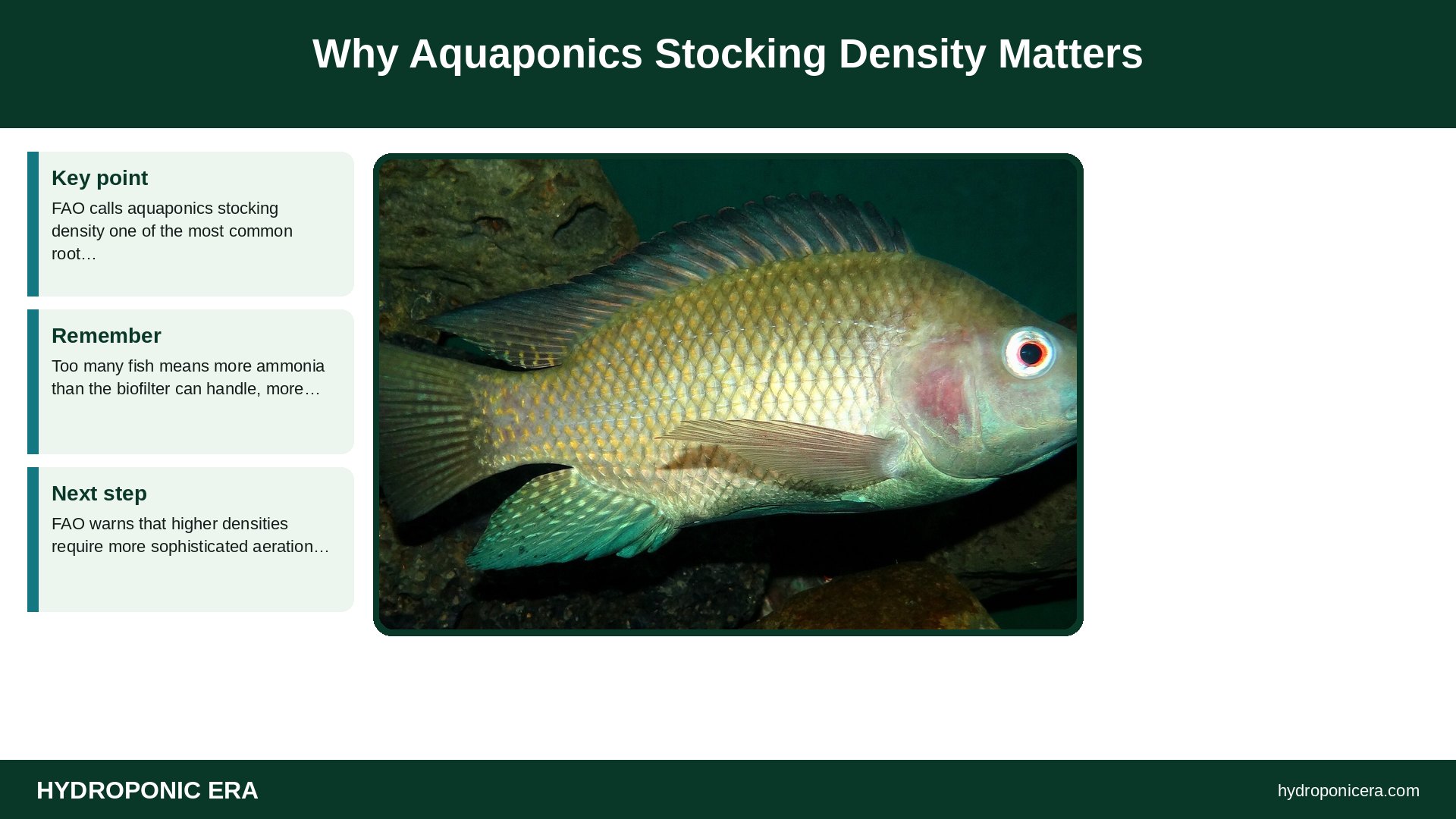
FAO calls aquaponics stocking density one of the most common root causes of fish stress. Too many fish means more ammonia than the biofilter can handle, more solid waste, and less dissolved oxygen per fish. FAO warns that higher densities require more sophisticated aeration and filtration, and that where power isn’t guaranteed, a brief outage can kill every fish in a heavily stocked tank within an hour. Keeping aquaponics stocking density moderate gives you a safety margin.
How to Calculate Aquaponics Stocking Density
- Find your water volume. FAO’s guideline is based on fish tank water.
- Multiply gallons by 0.17 to get the maximum pounds of fish (or liters × 0.02 for kilograms).
- Divide by the harvest weight of one fish. FAO uses an average tilapia harvest weight of 500 g (about 1.1 lb).
- Stock fewer fish at first while the biofilter matures, then build up.
Example: a 300-gallon tank × 0.17 = 51 lb maximum. At 1.1 lb per tilapia, that’s about 46 fish at harvest weight.
Small Tanks Need Lower Density
For tanks under 500 liters, FAO recommends cutting density in half, to about 1 kg per 100 liters, and says it isn’t recommended to grow fish for eating in a tank that small. Smaller water volumes change faster in temperature, pH, and ammonia, giving you less time to react. Small aquarium systems are better suited to ornamental fish like goldfish. See goldfish aquaponics.
Aquaponics Stocking Density and the Feed Rate Ratio

Aquaponics stocking density sets how much fish the tank can hold; the feed rate ratio sets how much fish your plants need. FAO’s ratio is 40–50 g of feed per m² per day for leafy greens and 50–80 g for fruiting crops, with fish eating about 1–2% of body weight daily. If your plant area needs more fish than your tank can safely hold, add tank volume rather than crowding. See aquaponics fish to plant ratio.
Aquaponics Stocking Density by Species
- Tilapia: hardy and tolerant of crowding, but still subject to FAO’s guideline in small systems. See tilapia aquaponics.
- Catfish: FAO notes they can be stocked higher with adequate mechanical filtration, but they need floor space. See catfish aquaponics.
- Trout: need more oxygen and cleaner water; stock well below the limit. See trout aquaponics.
- Goldfish and koi: ornamental, slow-growing, often kept at lower densities.
Staged Stocking for Steady Harvests
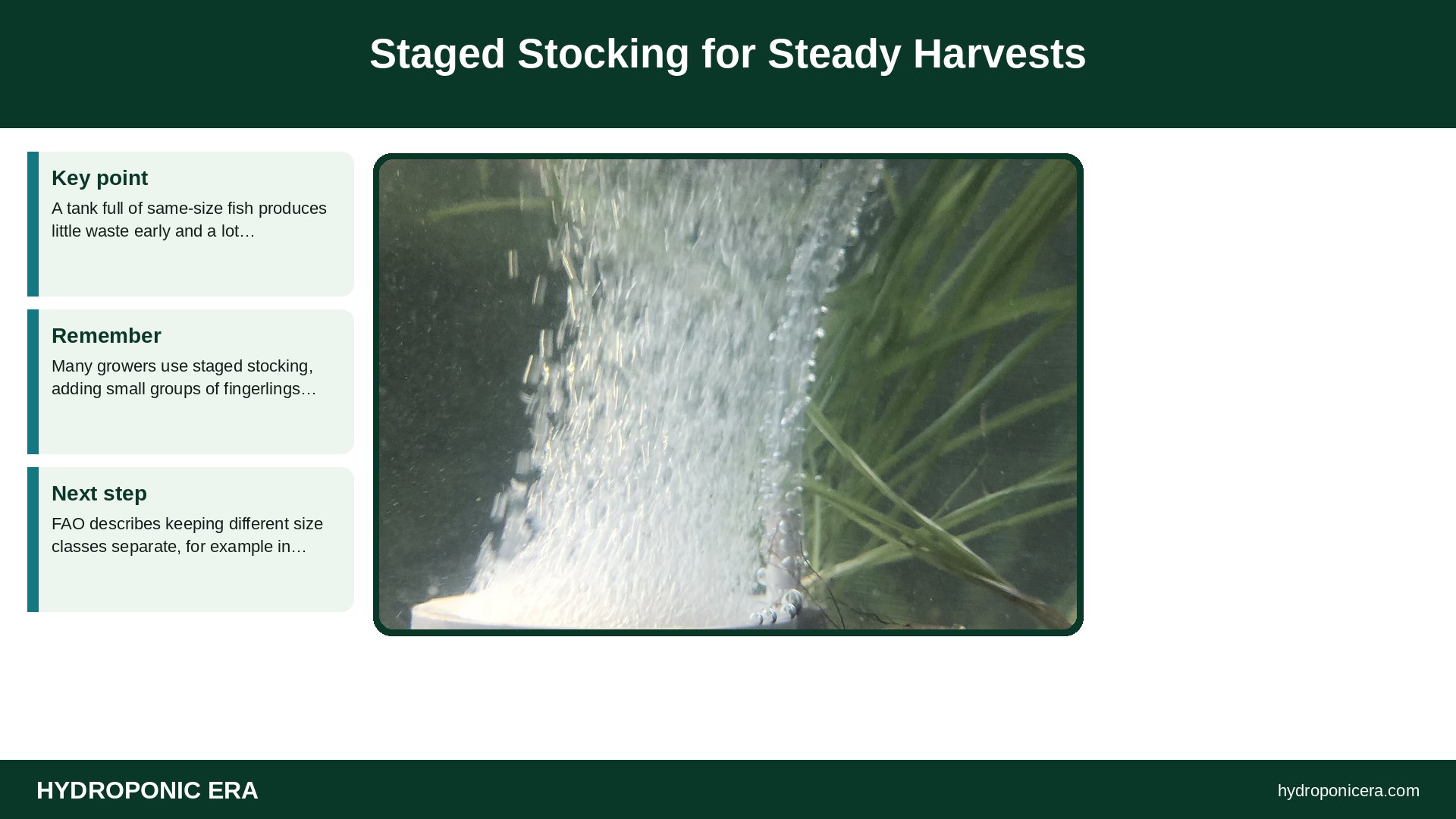
A tank full of same-size fish produces little waste early and a lot near harvest, which swings nutrient levels. Many growers use staged stocking, adding small groups of fingerlings every few months so the total biomass stays steadier. FAO describes keeping different size classes separate, for example in a floating mesh frame inside the main tank or in separate tanks, so larger fish don’t eat or bully smaller ones.
Signs Your Tank Is Overstocked
- Ammonia or nitrite readings won’t stay near zero.
- Fish gasping at the surface, especially early morning.
- Rapid solid buildup in filters and beds.
- Aggression, fin damage, or disease outbreaks.
- Nitrate climbing fast even with lots of plants.
Aeration and Backup Power

FAO suggests about 5–8 liters of air per minute for each cubic meter of water, from at least two air stones in different spots, and notes densely stocked units may need much more. Battery backups for air pumps have saved countless fish, according to FAO. See backup power for pumps and dissolved oxygen.
Stocking Fingerlings vs Harvest Weight
A common mistake is filling a tank to the limit with small fingerlings. Those fish grow. FAO uses a tilapia example of 50 g at stocking and 500 g at harvest, a tenfold increase. If you stock 40 fingerlings in a 264-gallon tank, they’ll be near FAO’s 20 kg limit at harvest, but the system barely feels them at first. Plan for the final weight, and remember that feed, ammonia, and oxygen demand rise as the fish grow.
Aquaponics Stocking Density, Water Volume, and Reaction Time
FAO points out that large water volumes help soften sudden changes in water quality, giving you more time to respond before fish are stressed, but they can also hide problems for longer. Small tanks swing quickly. That’s one reason FAO halves the recommended density below 500 liters. If you’re unsure, it’s safer to use a bigger tank with fewer fish than a small tank stocked to the limit. Larger volume also helps hold temperature steady overnight and during heat waves.
Keep in mind that the 20 kg per 1,000 liter guideline is a ceiling for beginners, not a goal. Growers with strong aeration, solids removal, and power backups run commercial systems at higher densities, but those systems also need more monitoring and carry more risk when something fails.
FAQs: Aquaponics Stocking Density
What aquaponics stocking density per gallon is safe?
Measure by weight: up to about 0.17 lb of fish per gallon (20 kg per 1,000 liters), per FAO.
How many tilapia in a 275-gallon IBC?
About 40 at 1.1 lb each, at FAO’s maximum; start with fewer.
Is a higher aquaponics stocking density possible?
Commercial systems go higher with advanced aeration and filtration, but FAO advises new growers not to exceed 20 kg per 1,000 liters.
What’s the minimum tank size for food fish?
FAO doesn’t recommend tanks under 500 liters (about 132 gallons) for food fish.
Should I stock all fish at once?
Staged stocking keeps nutrient levels steadier and gives regular harvests.
Sources
- FAO — Small-scale aquaponic food production
- Photo credits (Wikimedia Commons, edited with titles): Fish farming on Øksfjorden in Loppa, Troms og Finnmark, Norway, 2022 August by Ximonic (Simo Räsänen) (CC BY-SA 4.0); Oreochromis-niloticus-Nairobi by Bjørn Christian Tørrissen (CC BY-SA 3.0); Solanum lycopersicum in aquaponics at the NC Greenhouse Nursery by Gogerr (CC BY-SA 4.0); Air Stone Disk aquarium Germany 2024 by Nimmerwelk (CC BY-SA 4.0); AQUAPONIE by Hopeballa (CC BY-SA 4.0)
1 thought on “Aquaponics Stocking Density and Fish Tank Size”