
Aquaponics media bed systems grow plants in a tray of gravel or clay pebbles that also acts as the biofilter and solids filter. FAO’s aquaponics manual recommends a bed about 12 inches (30 cm) deep for large fruiting crops like tomatoes, or 6–8 inches (15–20 cm) for small leafy greens, filled with volcanic gravel or expanded clay pebbles (LECA) about 5/16 to 3/4 inch (8–20 mm) across. Avoid limestone, which raises pH. Standard beds are about 3 feet (1 m) wide and 3–10 feet (1–3 m) long. Water reaches the bed by trickle, constant flow, or flood-and-drain with a bell siphon or a timer.
Key takeaway: Use washed, pH-neutral media 8–20 mm in size, at least 12 inches deep for fruiting crops, and keep beds narrow enough to reach across.
| Media (FAO) | Surface area | Pros | Cons |
|---|---|---|---|
| Volcanic gravel (tuff) | About 300 m²/m³ | High surface area, often cheap, nearly inert | Heavy; dusty until washed |
| Expanded clay (LECA) | About 250–300 m²/m³ | Lightweight, easy to work, good for rooftops | More expensive |
| Limestone gravel | Lower | Cheap, common | Not inert; raises KH and pH |
| Organic (coco, peat, rice hulls) | Varies | Cheap | Can turn anoxic and clog as it breaks down |

How an Aquaponics Media Bed Works
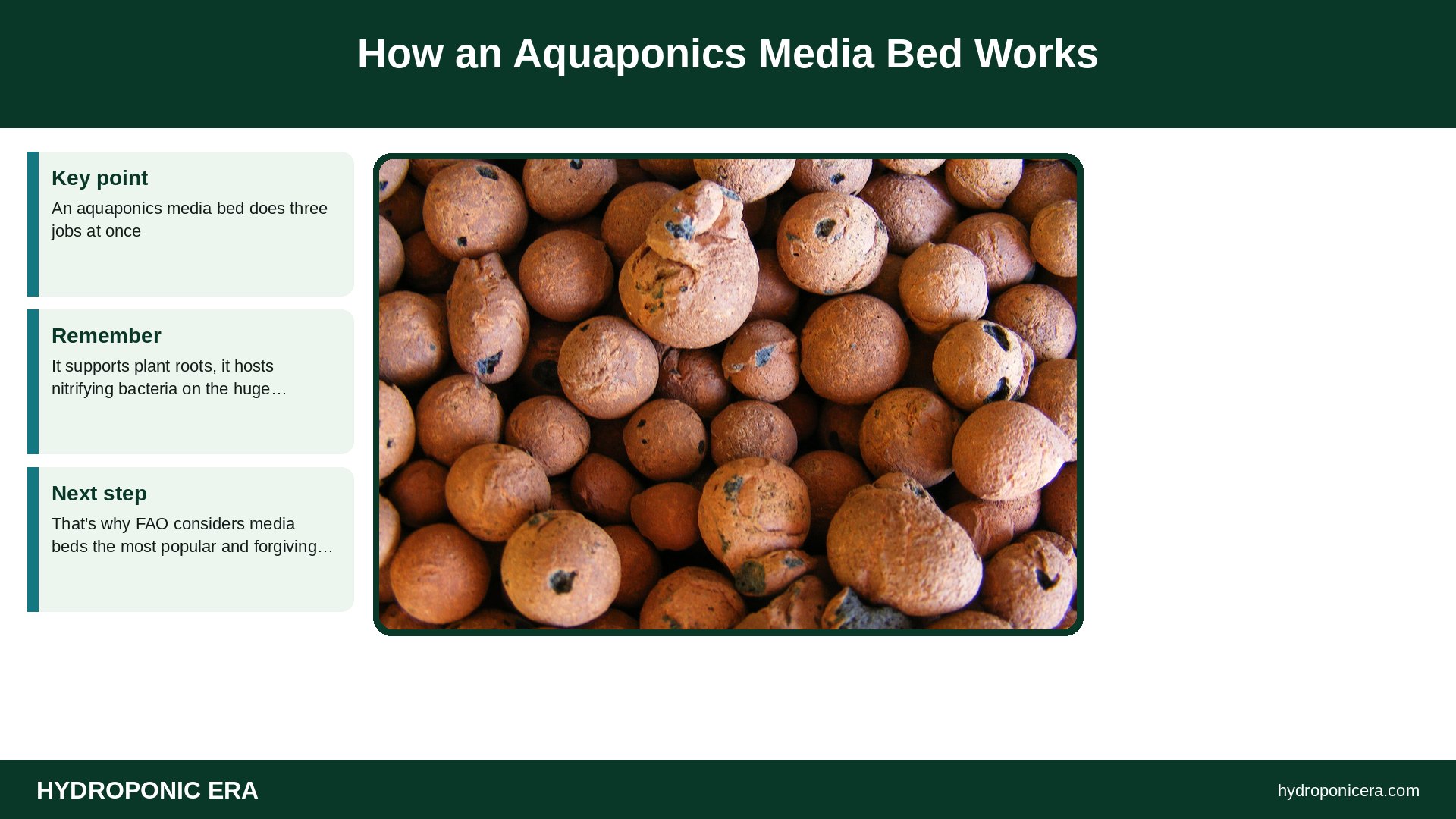
An aquaponics media bed does three jobs at once. It supports plant roots, it hosts nitrifying bacteria on the huge surface area of the gravel, and it traps solid waste where other organisms break it down. That’s why FAO considers media beds the most popular and forgiving method for small-scale aquaponics. Because the media also filters, many small media bed systems run without a separate biofilter or solids filter at moderate stocking density. FAO notes mechanical filters become necessary for media beds when stocking exceeds about 20 kg per 1,000 liters.
Choosing Aquaponics Media Bed Material
FAO says good media must have a large surface area, a neutral pH, and be inert, well-draining, easy to work with, available, and ideally light. Wash it thoroughly; dust from volcanic gravel can clog the system and harm fish gills.
- Volcanic gravel: FAO’s top pick where available. Its high surface area, about 300 m² per m³, gives bacteria plenty of room. Use 8–20 mm pieces; smaller gravel clogs with solids, and larger gravel doesn’t give enough surface area or plant support.
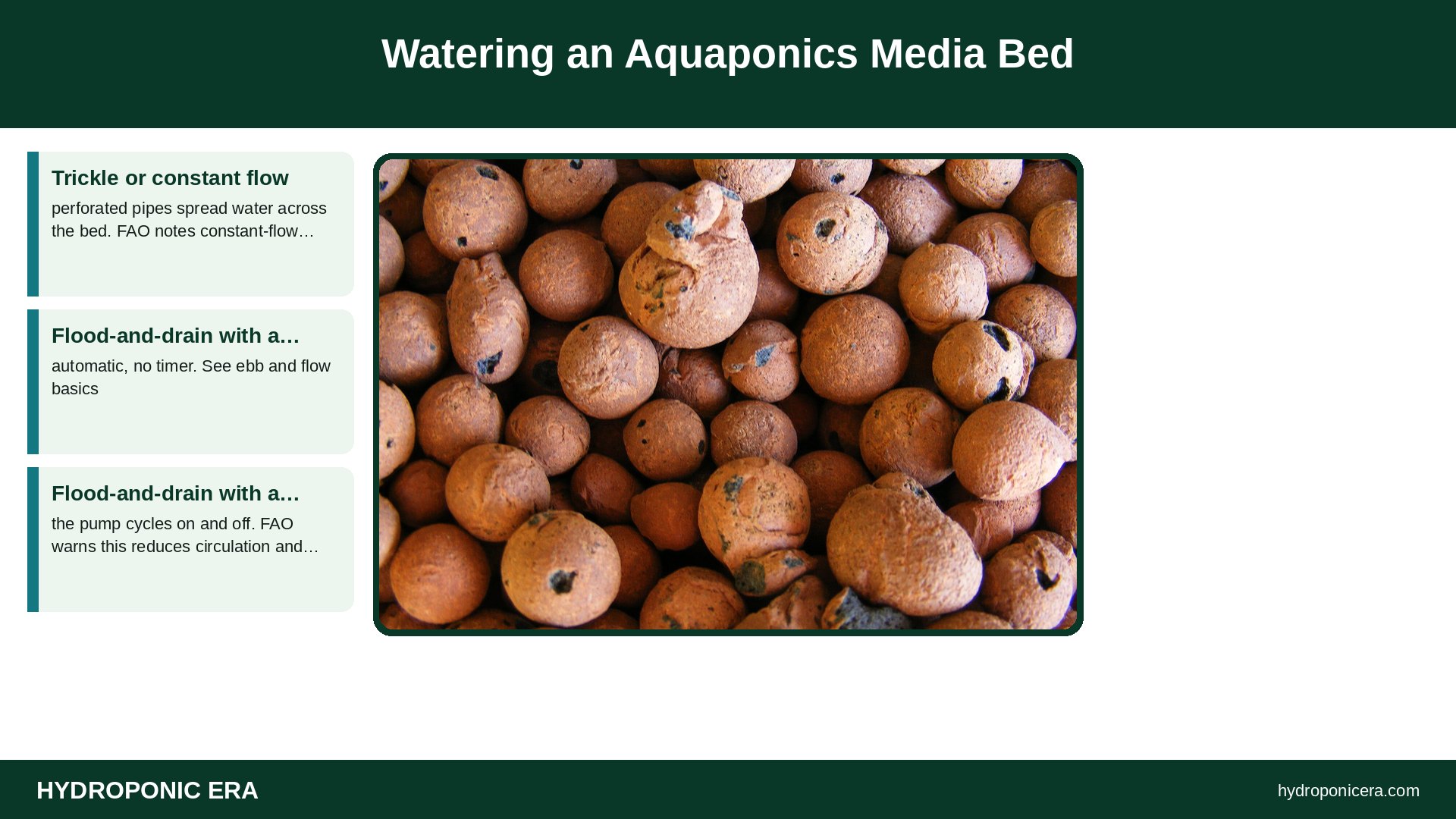
- Expanded clay (LECA): Lightweight and pleasant to handle, with about 250–300 m² per m³. Choose the larger 8–20 mm sizes. See clay pebbles.
- Limestone: FAO doesn’t recommend it because calcium carbonate dissolves and raises KH and pH. Only use it if nothing else is available or your water is very soft and acidic.
- Organic media: FAO says coconut fiber, sawdust, peat moss, or rice hulls can go anoxic and clog as they break down. They can be used temporarily, then composted.
Aquaponics Media Bed Size and Depth
FAO’s standard bed is a rectangle about 1 m (3.3 ft) wide and 1–3 m (3.3–10 ft) long. Longer beds can collect solids unevenly near the inlet and develop anaerobic spots. Keep beds narrow enough to reach at least halfway across.
Depth controls root space. FAO recommends 30 cm (about 12 inches) for large fruiting vegetables like tomatoes, okra, or cabbage, because shallower beds can cause root matting, deficiencies, and plants toppling over. Small leafy greens need only 15–20 cm (6–8 inches).
The Three Zones of an Aquaponics Media Bed
FAO describes three zones in a flood-and-drain bed:
- Dry zone (top 2–5 cm, about 1–2 inches): blocks light from the water to limit algae, keeps plant stems dry to prevent collar rot, and reduces evaporation.
- Wet/dry zone (about 10–20 cm, 4–8 inches): where the bed floods and drains. Most biological activity happens here: roots, nitrifying bacteria, and worms.
- Wet zone (bottom 3–5 cm): stays wet. Fine solids collect here, and heterotrophic bacteria mineralize them into plant nutrients.
FAO notes worms in the wet/dry zone help break down fish solids and dead roots, which keeps beds from clogging.
Watering an Aquaponics Media Bed
FAO lists several ways to water media beds:
- Trickle or constant flow: perforated pipes spread water across the bed. FAO notes constant-flow beds can grow plants as well as more complex methods, but the pipes need periodic clearing.
- Flood-and-drain with a bell siphon: automatic, no timer. See ebb and flow basics.
- Flood-and-drain with a timer: the pump cycles on and off. FAO warns this reduces circulation and aeration, so add supplemental air for fish.
FAO says flood-and-drain systems usually cycle 1–2 times an hour, though some successful systems cycle only 3–4 times a day.
What to Grow in Media Beds
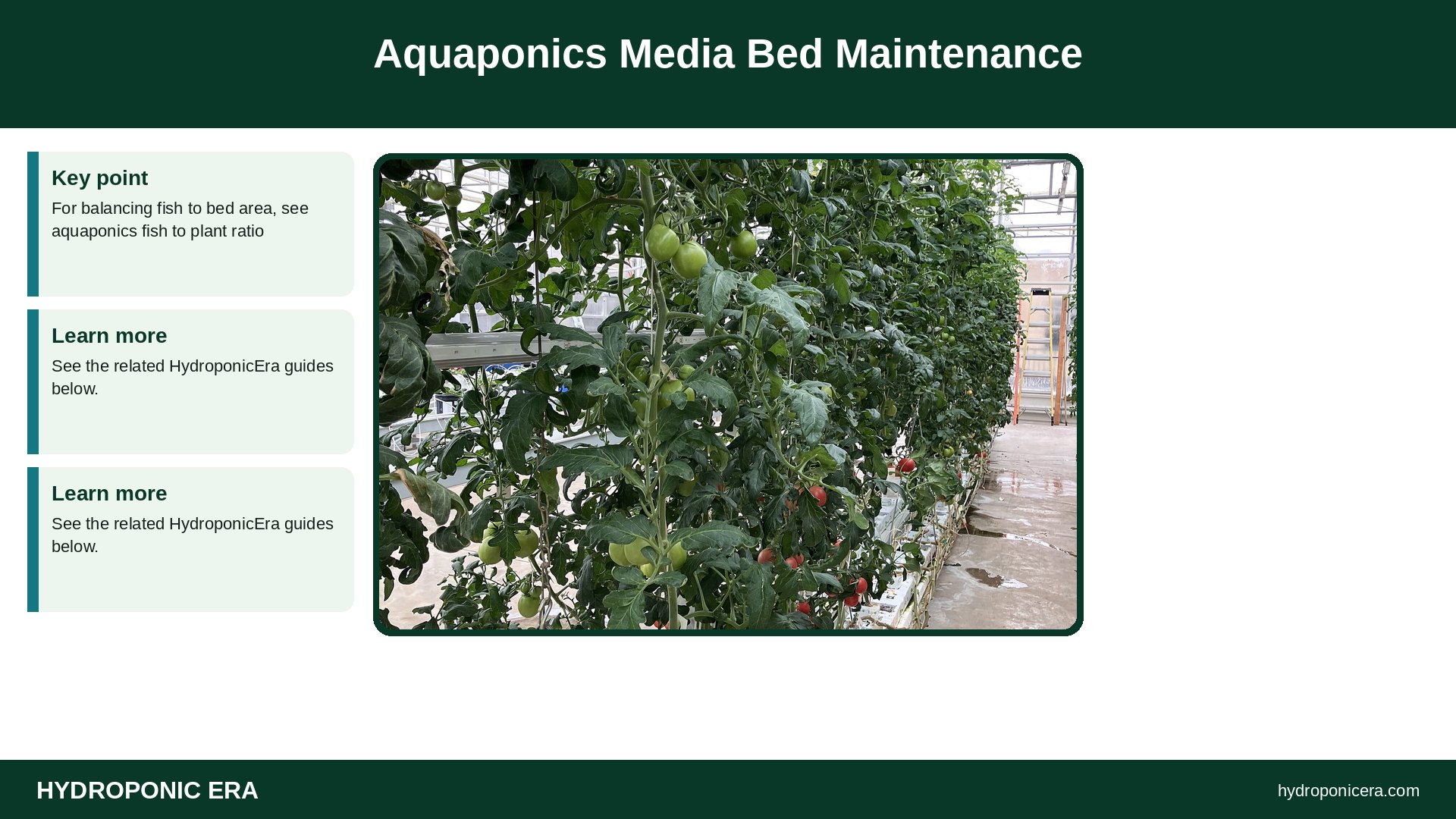
Media beds support almost anything: leafy greens, herbs, tomatoes, peppers, cucumbers, beans, and even root crops in deep beds. Their solid support helps tall plants stand up. Match depth to the crop: shallow beds for greens, 12 inches for fruiting crops.
Aquaponics Media Bed Maintenance
- Watch for solids building up at the inlet; spread inflow or add a solids filter at higher stocking.
- Remove dead roots and leaves after harvest.
- Check bell siphons and drains for clogged media or roots.
- Avoid digging up the whole bed; the bacteria live on the media.
- Add worms to help process solids.
For balancing fish to bed area, see aquaponics fish to plant ratio.
Aquaponics Media Bed Build Tips
- Use food-grade, UV-stable containers or lined frames that can carry the weight; wet gravel is heavy.
- Level the beds so water floods evenly.
- Wash media until the water runs clear before adding it, as FAO recommends.
- Fit a media guard around drains so gravel doesn’t clog them.
- Leave a dry top layer of media so water isn’t exposed to light.
FAQs: Aquaponics Media Beds
How deep should an aquaponics media bed be?
About 12 inches (30 cm) for fruiting crops, or 6–8 inches for leafy greens, per FAO.
What’s the best media for aquaponics?
FAO recommends washed volcanic gravel or expanded clay, 8–20 mm in size.
Can I use pea gravel?
Only if it’s not limestone. Test it with vinegar; if it fizzes, it contains carbonate and will raise pH.
Does an aquaponics media bed need a separate biofilter?
Usually not at moderate stocking; the media acts as the biofilter.
How often should an aquaponics media bed flood?
Usually 1–2 times an hour, though some systems cycle only 3–4 times a day.
Sources
- FAO — Small-scale aquaponic food production
- Photo credits (Wikimedia Commons, edited with titles): AQUAPONIE by Hopeballa (CC BY-SA 4.0); Hydroton by Lucis (CC BY-SA 3.0); South Sister lava flows, USGS by C. Dan Miller, USGS/Cascades Volcano Observatory (Public domain); Hydroton by Lucis (CC BY-SA 3.0); Solanum lycopersicum in aquaponics at the NC Greenhouse Nursery by Gogerr (CC BY-SA 4.0)