
To choose an aquaponics pump size, start with turnover: FAO’s aquaponics manual says densely stocked systems should cycle the total water volume about twice per hour, while lightly stocked systems need only once per hour. So a system holding 264 gallons (1,000 liters) needs roughly 264–528 gallons per hour (GPH) of actual flow. Then check that the pump delivers that flow at your head height, the vertical lift from the pump to the highest outlet. FAO’s small-scale designs use about 2,000 liters/hour (about 530 GPH) at about 5 feet (1.5 m) of head, which takes a submersible pump drawing roughly 25–50 watts.
Key takeaway: Size for 1–2 turnovers per hour at your real head height, add margin for pipe fittings, and use wide pipes.
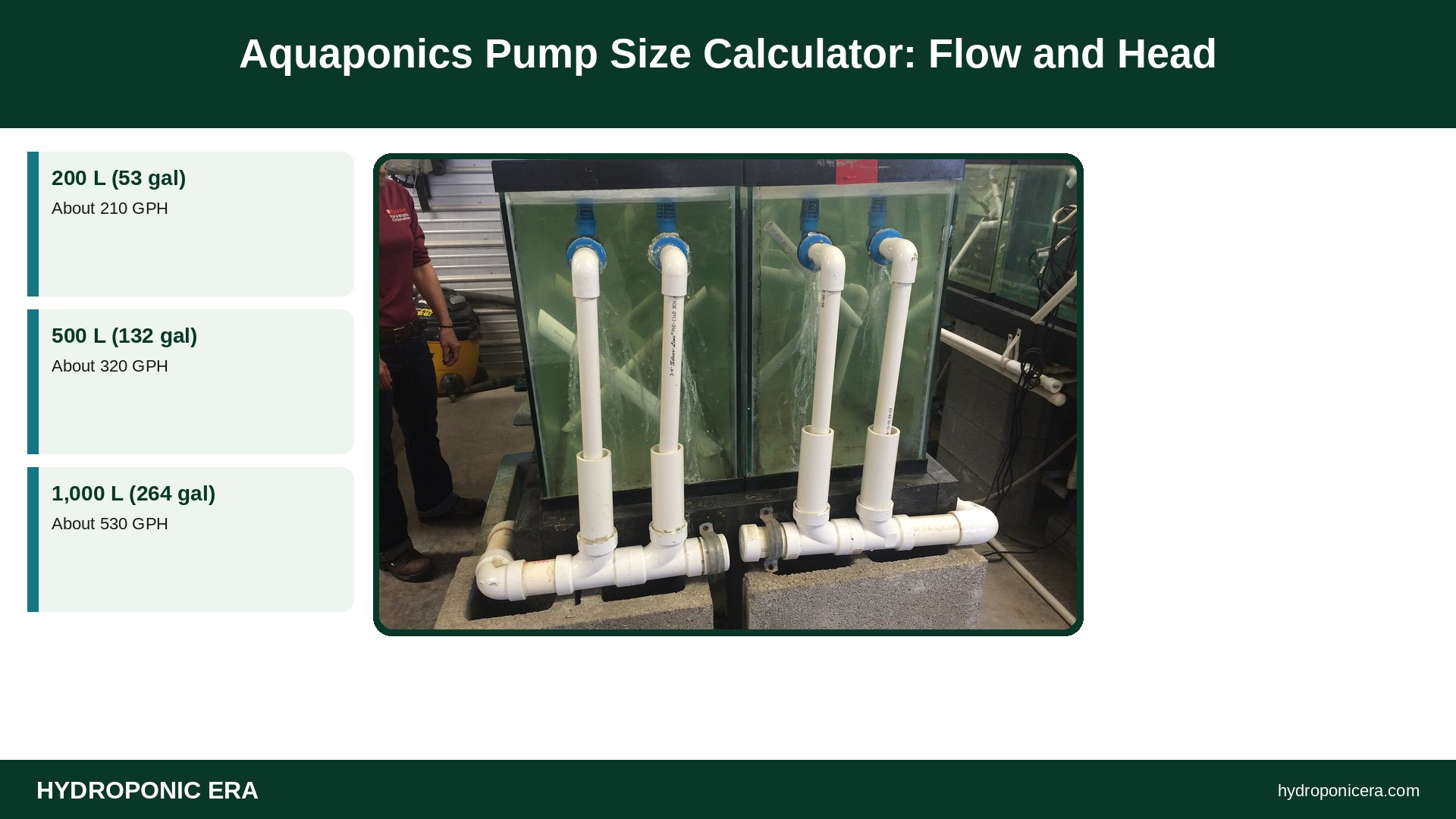
| Fish tank (FAO Table 8.1) | Pump flow (FAO) | Approx. US equivalent |
|---|---|---|
| 200 L (53 gal) | 800 L/h | About 210 GPH |
| 500 L (132 gal) | 1,200 L/h | About 320 GPH |
| 1,000 L (264 gal) | 2,000 L/h | About 530 GPH |
| 2,000 L (528 gal) | 3,200 L/h | About 845 GPH |
| 3,000 L (793 gal) | 4,500 L/h | About 1,190 GPH |
Step 1: Calculate Aquaponics Pump Size From Turnover
Add up the water in the fish tank, sump, grow beds, and filters. Then:
- Light stocking: flow = total volume × 1 per hour.
- Dense stocking: flow = total volume × 2 per hour.
Example: a 150-gallon system with moderate stocking needs about 150–300 GPH of delivered flow. See aquaponics stocking density.
Step 2: Measure Head Height for Aquaponics Pump Size
Head height is the vertical distance from the water surface where the pump sits to the highest point the water must reach. Pump boxes list maximum flow at zero head, but flow drops as head rises. Read the pump’s flow curve and find the flow at your head. If your head is 4 feet, choose a pump that still delivers your target GPH at 4 feet, not just at the surface.
Step 3: Allow for Pipe Losses in Aquaponics Pump Size
FAO warns that up to 5% of flow can be lost at each pipe fitting, and that narrow pipes cost far more flow: a 30 mm pipe carries twice the flow of a 20 mm pipe from the same pump. Practical rules:
- Use as few elbows and fittings as possible.
- Use wider pipes; they also clog less with solids.
- Add 20–30% margin to your target, then trim with a valve.
Step 4: Estimate Power Use
FAO’s rule of thumb: a submersible pump moves about 40 liters per hour per watt, about 10.5 GPH per watt, though some models claim twice that. A 530 GPH pump might draw about 25–50 watts. At US electricity prices, running a pump around the clock is a real cost, so efficient pumps pay back. See mag drive vs impeller pumps.
Submersible Pumps vs Airlifts
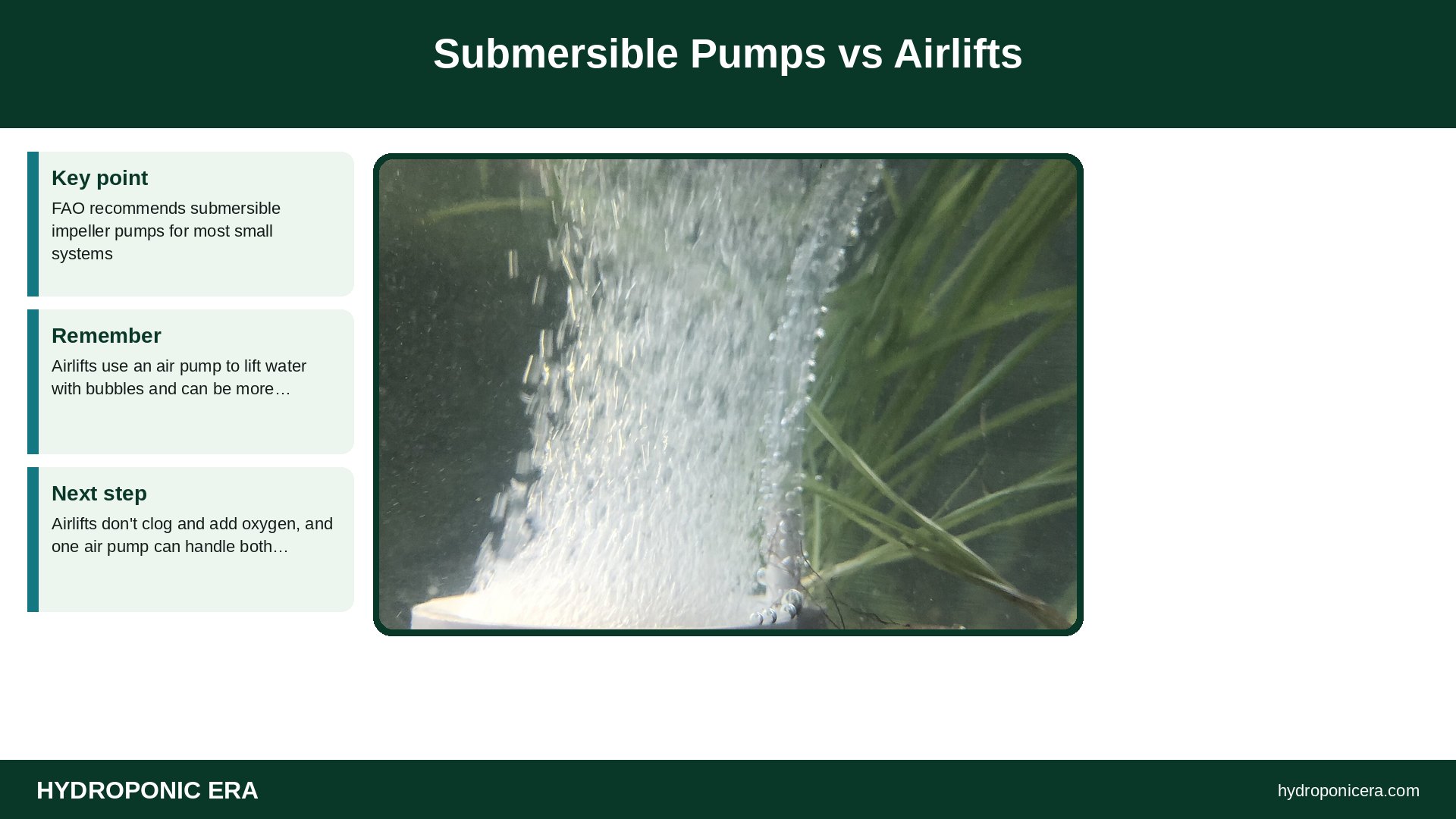
FAO recommends submersible impeller pumps for most small systems. Airlifts use an air pump to lift water with bubbles and can be more efficient, but only at small head heights of about 12–16 inches (30–40 cm), and they work best in tanks deeper than about 3 feet (1 m). Airlifts don’t clog and add oxygen, and one air pump can handle both aeration and circulation.
Aquaponics Pump Size for Media Beds and Bell Siphons
For flood-and-drain media beds, the pump must fill the bed faster than the bell siphon’s trickle but slower than the siphon can drain. Too little flow, and the siphon won’t start; too much, and it won’t break. See aquaponics bell siphon and media beds.
Aquaponics Pump Size for Timers
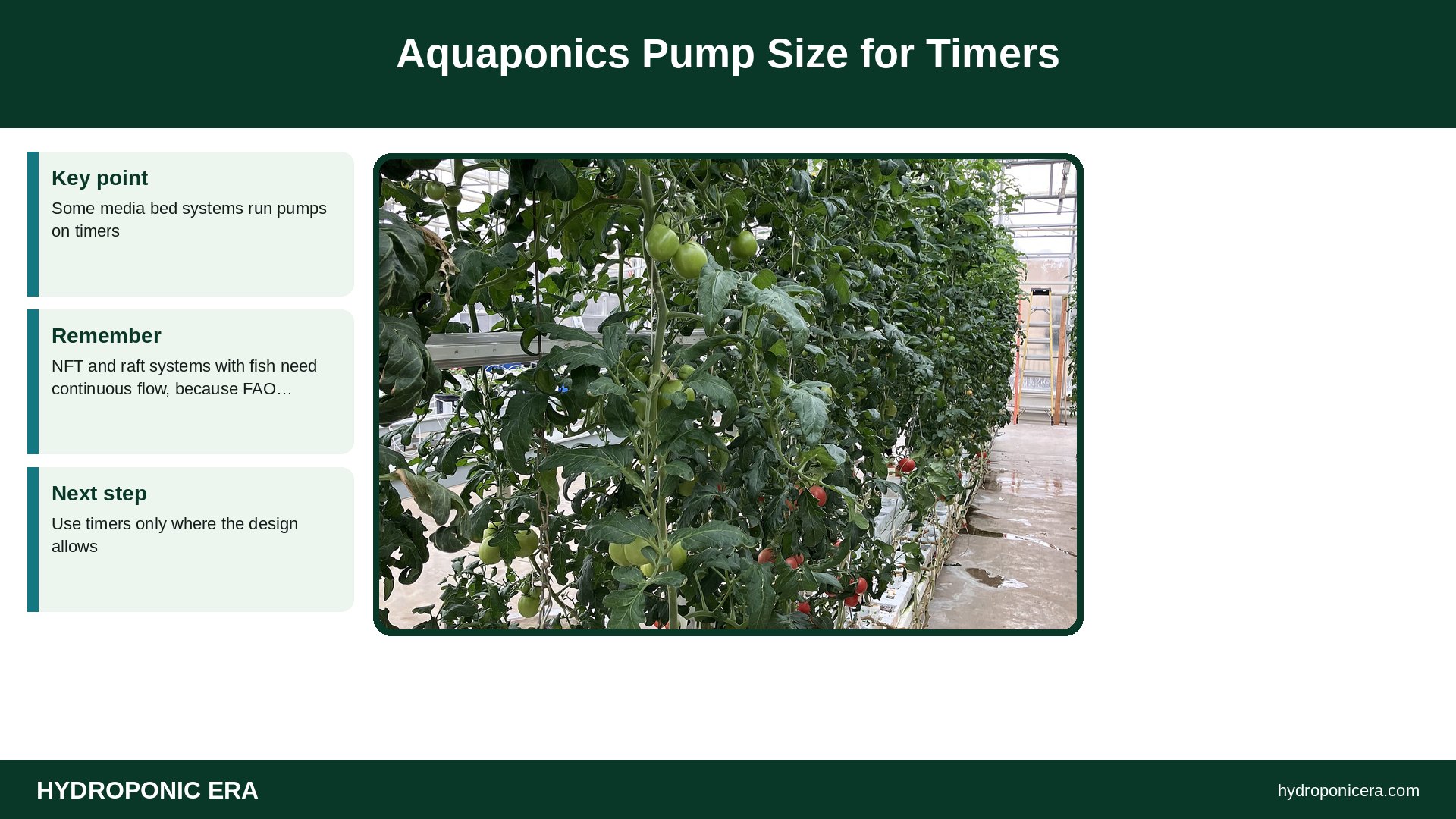
Some media bed systems run pumps on timers. NFT and raft systems with fish need continuous flow, because FAO notes fish can suffer and die within hours if water stops moving through filters. Use timers only where the design allows.
Pump Care After Choosing Aquaponics Pump Size
- Place the pump where you can reach it; FAO says the internal filter needs cleaning every 2–3 weeks.
- Never run a submersible pump dry; FAO notes it will break.
- Buy quality pumps; FAO says good ones keep capacity 1–2 years and last 3–5 years.
- Keep a spare pump on hand.
- Use a float switch to protect the pump from low water.
See aquaponics sump tank.
Aquaponics Pump Size Worked Example
Say your system holds a 150-gallon fish tank, a 50-gallon sump, and grow beds with about 60 gallons of water: 260 gallons total. With moderate stocking, aim for about 1.5 turnovers per hour, so roughly 390 GPH delivered. Your highest outlet is 4 feet above the sump water. Add about 25% for fittings, and look for a pump that delivers around 490 GPH at 4 feet of head on its flow chart. Install a ball valve on a bypass line to fine-tune the flow. That is the full aquaponics pump size process in four numbers: volume, turnover, head, and margin.
Aquaponics Pump Size Mistakes
- Choosing by the box’s maximum flow at zero head.
- Forgetting the water in grow beds and sumps.
- Using small-diameter tubing that chokes flow.
- Oversizing so much that the bell siphon never breaks.
- Not having a spare pump on hand.
Aquaponics Pump Size and Power Outages
FAO warns that if water stops moving, oxygen drops and wastes build up, and fish can suffer and die within a few hours. A battery-powered air pump keeps oxygen up during outages even if the water pump stops. Some growers run the main pump from a small battery backup or solar setup. FAO notes solar power is highly sustainable but needs a large initial investment for panels, an inverter, and batteries.
Choosing an Aquaponics Pump Brand
Look for a pump with a published flow curve, a warranty, low watts per gallon moved, and easy access to the intake for cleaning. FAO advises high-quality pumps, which keep their capacity longer. Magnetic-drive and direct-drive submersibles are both common.
FAQs: Aquaponics Pump Size
What aquaponics pump size do I need?
One that moves your total water volume 1–2 times per hour at your head height.
What is head height?
The vertical lift from the pump to the highest outlet.
How much power does an aquaponics pump use?
FAO estimates about 40 L/h per watt, so a 530 GPH pump uses about 25–50 W.
Can I use an airlift instead?
Yes, for low lifts of about 12–16 inches.
Do pipe fittings matter?
Yes. FAO says each fitting can cost up to 5% of flow.
Sources
- FAO — Small-scale aquaponic food production
- Photo credits (Wikimedia Commons, edited with titles): Recirculating Aquaculture System 1 by Narek75 (CC BY-SA 4.0); Intermediate Bulk Container (fcm) by Photograph: Frank C. Müller, Baden-Baden (CC BY-SA 4.0); AQUAPONIE by Hopeballa (CC BY-SA 4.0); Air Stone Disk aquarium Germany 2024 by Nimmerwelk (CC BY-SA 4.0); Solanum lycopersicum in aquaponics at the NC Greenhouse Nursery by Gogerr (CC BY-SA 4.0)