
An aquaponics greenhouse lets you grow year-round in cold US climates by trapping solar heat and keeping water warmer and more stable. FAO’s aquaponics manual notes greenhouses aren’t essential for small systems but are especially useful in cooler regions, where they can keep water warm through the cold months. The trade-offs are cost, the need for fans and ventilation to prevent overheating and high humidity, and more pest pressure. A good layout puts fish tanks in shade or the north side, grow beds where light is best, and covers water surfaces to control humidity.
Key takeaway: Plan for ventilation, humidity control, shade on fish tanks, and easy access before you pick a greenhouse size.
| Design factor (FAO) | Why it matters | What to do |
|---|---|---|
| Ventilation | Prevents overheating and humidity | Vents and fans for horizontal airflow |
| Humidity | Condensation causes plant disease | Cover fish tanks and DWC canals |
| Shade | Algae and heat in tanks | Cover and shade fish tanks |
| Pests | Confined space favors pests | Insect nets on doors and vents |
| Hot climates | Overheating | Net house with plastic roof |

Why Use an Aquaponics Greenhouse?

FAO explains that a greenhouse lets sunlight in and traps the heat, keeping air temperature warmer and more stable over 24 hours. It also protects from wind, snow, and heavy rain, keeps out animals, and adds some security. A greenhouse frame can support climbing crops and shade cloth. FAO says together these benefits mean higher productivity and a longer cropping season. See aquaponics winter.
Drawbacks to Plan For
- Cost: FAO notes initial costs can be high depending on technology.
- Running costs: fans are needed to prevent overheating and humidity.
- Pests and disease: FAO says these are more common in greenhouses.
- Summer heat: greenhouses can overheat quickly without shade and vents.
Aquaponics Greenhouse Layout Basics
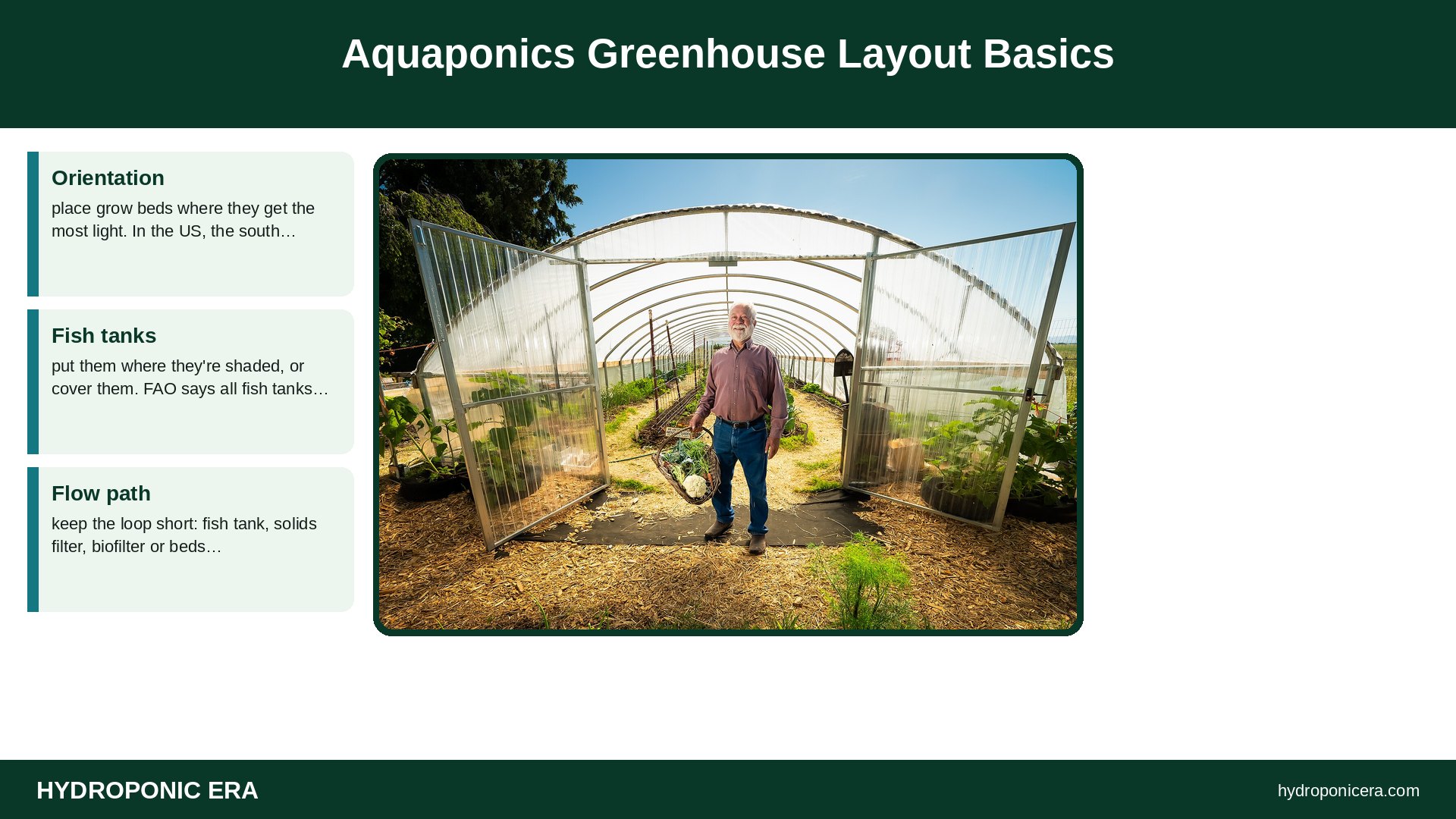
- Orientation: place grow beds where they get the most light. In the US, the south side usually gets the most sun.
- Fish tanks: put them where they’re shaded, or cover them. FAO says all fish tanks should be covered.
- Flow path: keep the loop short: fish tank, solids filter, biofilter or beds, sump, and back.
- Access: leave paths for feeding, harvesting, and maintenance.
- Utilities: plan power for pumps, aeration, and fans, with GFCI protection.
- Drainage: plan where overflow and cleanout water will go.
Aquaponics Greenhouse Humidity Control
FAO stresses humidity control in greenhouse aquaponics. Fans that create horizontal airflow mix the air and prevent cold spots where water condenses on plants. FAO also advises covering fish tanks and aerated DWC canals, because evaporation dramatically raises humidity. Media beds help because their top surface stays dry. See aquaponics media bed.
Aquaponics Greenhouse Temperature Control
- Ridge or side vents for passive cooling.
- Exhaust fans with thermostats.
- Shade cloth in summer.
- Insulation and a heater for cold nights.
- Water as thermal mass: fish tanks help buffer temperature swings.
FAO notes NFT pipes can overheat in the sun, so shade them or choose media beds or rafts. See NFT vs DWC.
Net Houses for Hot Climates
FAO notes that in hot regions, net houses can be better than closed greenhouses: a frame with insect mesh walls and a plastic roof that keeps out rain while letting air move. In the US South, this design can cut overheating.
Pest Management in a Greenhouse

FAO recommends insect nets on doors and windows and notes that the confined space favors some pest controls, such as beneficial insects and sticky traps. Avoid pesticides that could reach the fish. See hydroponic greenhouse for beginners.
Sizing Fish and Beds
Size the system by plant area and feed. FAO’s feed rate ratio is about 40–50 g of feed per m² per day for leafy greens and 50–80 g for fruiting crops. See fish to plant ratio.
Check Local Rules
Some towns require permits for greenhouses over a certain size. Check zoning and building rules, and your state’s aquaculture rules for fish. See aquaculture permit basics.
Aquaponics Greenhouse Size and Spacing
Plan the aquaponics greenhouse around your system, not the other way around. Measure the footprint of tanks, filters, and grow beds, then add aisles wide enough for a wheelbarrow and room to reach the middle of each bed. Fish tanks are heavy, so place them on a level, compacted base. Leave space for a work bench, feed storage, and a seedling nursery, which FAO recommends to keep a steady supply of healthy transplants.
Aquaponics Greenhouse Running Costs
Expect ongoing costs for fans, heating in winter, and replacement covers. FAO notes greenhouses add operating costs because fans are needed for air circulation. Cheaper options include roll-up sides, shade cloth instead of cooling equipment, and thermal mass from the fish tanks. Track electricity to see which parts of your aquaponics greenhouse cost the most.
Aquaponics Greenhouse Covering Options
- Polyethylene film: lowest cost, needs replacing every few years.
- Polycarbonate panels: more insulating and durable, higher cost.
- Glass: long-lasting and clear, but heavy and expensive.
- Shade cloth: used over covers in summer to cut heat and light.
Choose based on your climate: insulation matters most in the North, ventilation and shade in the South.
Aquaponics Greenhouse Water and Power
Plan a water supply for top-ups, a drain for cleanouts, and electrical circuits for pumps, aeration, and fans. Use outdoor-rated, GFCI-protected outlets. A battery backup air pump protects fish during outages.
Siting an Aquaponics Greenhouse
FAO advises choosing a site that is stable and level, protected from severe weather, and exposed to plenty of sunlight, and building the system in its final location because water and stone media are heavy and hard to move. In a greenhouse, that means pouring or leveling the floor before tanks go in, and putting fish tanks where they can be shaded while the plant beds get full light. FAO notes greenhouses are not essential for small units but can extend the season in cooler regions by keeping water warm through cold months, allowing year-round production.
FAQs: Aquaponics Greenhouse
Do I need a greenhouse for aquaponics?
No, but FAO notes it helps extend the season in cooler regions.
How do I control humidity?
Fans, vents, and covered fish tanks and DWC canals.
Where should fish tanks go?
In shade or covered, leaving the best light for plants.
Is a net house better in hot climates?
FAO says net houses can be more appropriate in hot regions.
What is the biggest greenhouse problem?
Overheating and humidity, followed by pests.
Sources
- FAO — Small-scale aquaponic food production
- Photo credits (Wikimedia Commons, edited with titles): CDC South Aquaponics Raft Tank 1 2010-07-17 by Bryghtknyght (CC BY 3.0); Greenhouse in Qingjing Small Swiss Garden 清境小瑞士花園溫室 – panoramio by lienyuan lee (CC BY 3.0); Oregon High Tunnel, NRCS EQIP (20260611-NRCS-KLS-0001) by USDAgov (Public domain); Living with the Land entrance by Michael Rivera (CC BY-SA 4.0); Solanum lycopersicum in aquaponics at the NC Greenhouse Nursery by Gogerr (CC BY-SA 4.0)