
Aquaponics sump tank is the collection tank at the lowest point of the system, where water drains by gravity and the pump sends it back up. FAO’s aquaponics manual recommends the pump sit in the sump, a design called CHIFT-PIST: constant height in fish tank, pump in sump tank. That way evaporation, leaks, and flood-and-drain cycles change only the sump level, never the fish tank. FAO says the sump should be smaller than the fish tank, about one-quarter to one-third of its volume, but large enough to hold all the water from flood-and-drain grow beds when they’re full.
Key takeaway: Size the sump to hold your grow bed flood volume with room to spare, keep the pump in it, and fit an alarm or float valve so a low sump never runs the pump dry.
| Factor (FAO) | Guideline |
|---|---|
| Location | Lowest point; all water drains to it |
| Size vs fish tank | About 1/4 to 1/3 of the fish tank volume |
| Flood-and-drain beds | At least the full water volume of the beds |
| Pump | In the sump (CHIFT-PIST) |
| Needed for small systems? | Optional under about 200 L (53 gal) fish tanks |

What an Aquaponics Sump Tank Does
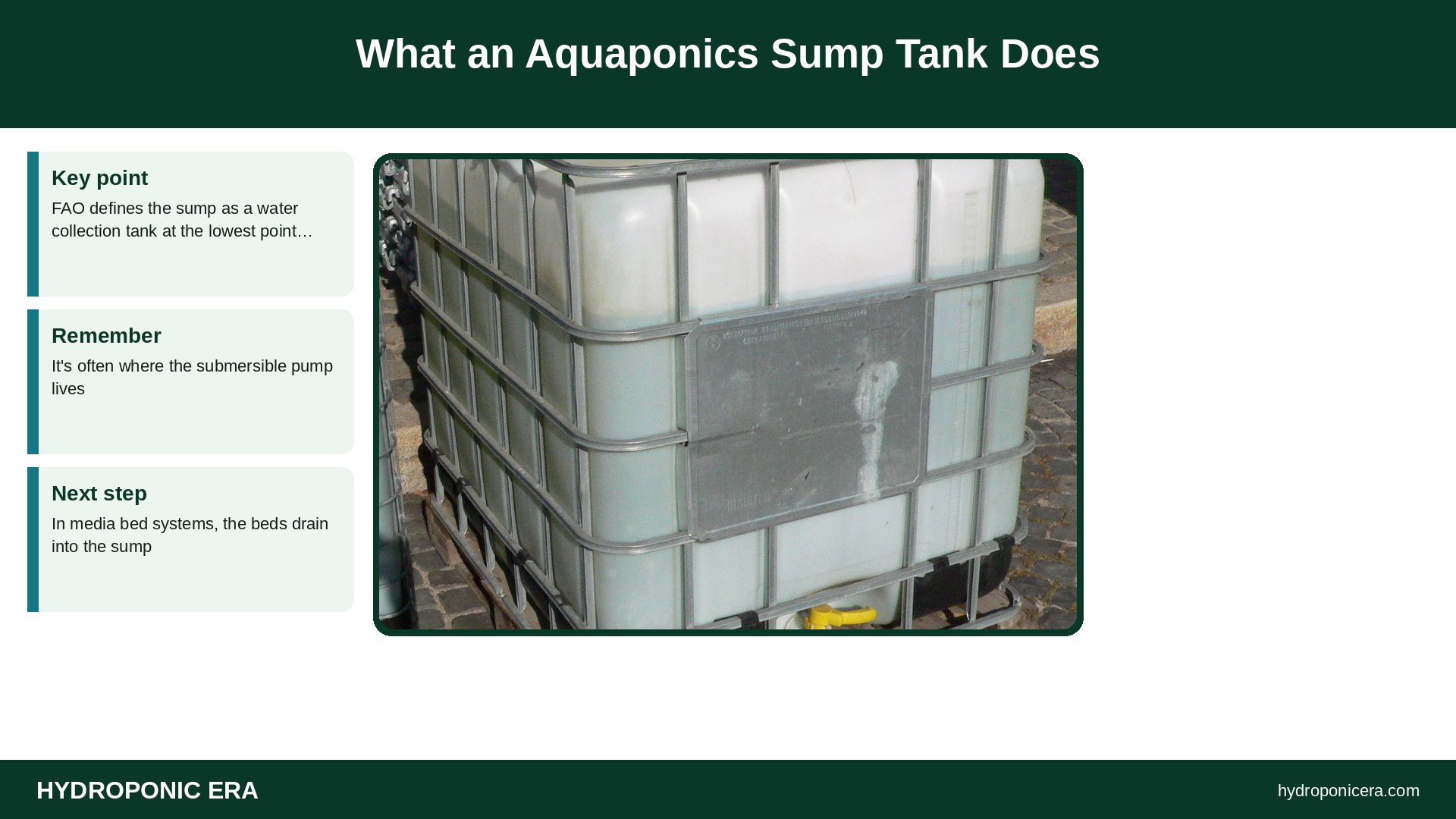
FAO defines the sump as a water collection tank at the lowest point of the system: water always runs downhill to it. It’s often where the submersible pump lives. In media bed systems, the beds drain into the sump. In FAO’s NFT and DWC designs, the sump doubles as the biofilter and sends water both to the fish tank and to the plants. FAO notes that very small units with fish tanks up to about 200 liters can skip the sump and pump straight from the fish tank, but larger units benefit from one.
CHIFT-PIST Explained
With the pump in the sump, the water path is:
- The pump lifts water from the sump to the fish tank.
- The fish tank overflows by gravity to the filters or grow beds.
- Water flows through the beds and drains back to the sump.
FAO lists the benefits: water losses from evaporation or leaks show only in the sump, so the fish tank stays full; it’s easy to measure evaporation and plan top-ups; you can spot leaks quickly; and, most importantly, a leak in the plant side won’t drain the fish tank.
How Big Should an Aquaponics Sump Tank Be?

FAO gives two checks:
- Relative to the fish tank: about one-quarter to one-third of fish tank volume. For a 264-gallon fish tank, that’s about 66–88 gallons.
- Relative to the beds: for flood-and-drain media beds, at least the full volume of water held in the beds when flooded. If all beds might drain at once, the sump must catch it all without overflowing, and still keep the pump submerged when the beds are full.
Estimate bed water: a flooded gravel bed holds roughly a third to half of its volume as water, depending on the media. When in doubt, go bigger. FAO’s example IBC design uses the bottom 70 cm of a tote as the sump. See IBC aquaponics.
Sump Tank Materials
Use the same materials FAO recommends for fish tanks: strong, inert, food-grade, UV-resistant plastic or fiberglass. Stock tanks, food-grade barrels, and cut IBC totes are common. FAO’s photo shows a sump buried in the ground so beds can drain by gravity. Cover the sump to block light, reduce evaporation, and keep out leaves and animals. See food-grade barrels and stock tanks.
Aquaponics Sump Tank Pump Placement and Care
- Place the pump where you can reach it; FAO says internal pump filters need cleaning every 2–3 weeks.
- Raise the pump slightly off the bottom so it doesn’t suck up settled solids.
- FAO warns submersible pumps break if run dry. Never let the sump fall below the pump intake.
- Use as few fittings as possible; FAO notes each fitting can cost up to 5% of flow.
See pump sizing.
Protecting the Aquaponics Sump Tank Level
Because all losses show up in the sump, it’s the place to automate safety:
- Float valve top-up: adds dechlorinated water as the level drops. See auto top-off float valves.
- Low-level alarm or float switch: shuts off or alerts before the pump runs dry.
- Overflow: a safe overflow route if a siphon fails and beds drain at once.
Using the Aquaponics Sump Tank for Extra Jobs

A sump is a handy spot for:
- Heaters in cool weather, away from fish.
- Carbonate buffer bags, as FAO suggests for raising pH with crushed shells or limestone grit. See aquaponics pH.
- Extra biofilter media in a mesh bag near an air stone.
- Test sampling, since it’s mixed water from the whole system.
Common Aquaponics Sump Tank Problems
| Problem | Likely cause | Fix |
|---|---|---|
| Sump overflows | Too small for bed drain volume | Bigger sump or stagger bed cycles |
| Pump sucks air | Level too low when beds are full | Add water, raise sump capacity, or lower pump |
| Sludge builds up | Solids passing the beds or filter | Siphon out solids; improve solids filtration |
| Algae in sump | Light reaching water | Cover the sump |
Aquaponics Sump Tank Maintenance
An aquaponics sump tank collects fine solids over time because it’s the lowest point in the loop. Siphon or drain the bottom every few weeks, clean the pump intake, and check the float switch if you use one. FAO notes the pump’s internal filter needs cleaning every 2–3 weeks, and that a submersible pump must never run dry. Keep the sump covered to stop algae, and top it up with dechlorinated water as evaporation lowers the level. A sump also makes a convenient place to add buffers or iron, because dosing there mixes gently before water reaches the fish.
Aquaponics Sump Tank Materials
Any opaque, food-safe container can serve as an aquaponics sump tank: a cut IBC tote, a stock tank, a food-grade barrel, or a heavy plastic tub. Avoid containers that held chemicals, and paint or cover translucent ones to block algae. Because the sump sits at the lowest point, place it where you can reach the pump and drain it easily, and make sure it can hold the water that drains back from the beds when the pump stops, so it never overflows during a power cut.
FAQs: Aquaponics Sump Tanks
Do I need a sump tank in aquaponics?
Not for very small systems (fish tanks up to about 53 gallons), but FAO says larger units benefit from one.
How big should an aquaponics sump tank be?
About 1/4 to 1/3 of the fish tank, and at least the full flood volume of the grow beds.
What is CHIFT-PIST?
Constant height in fish tank, pump in sump tank: the pump sits in the sump so the fish tank level never changes.
Where should the pump go in an aquaponics sump tank?
In the sump, slightly off the bottom and easy to reach for cleaning.
Can the sump hold a heater?
Yes. It’s a good place for heaters, buffers, and extra bio-media.
Sources
- FAO — Small-scale aquaponic food production
- Photo credits (Wikimedia Commons, edited with titles): Recirculating Aquaculture System 1 by Narek75 (CC BY-SA 4.0); Intermediate Bulk Container (fcm) by Photograph: Frank C. Müller, Baden-Baden (CC BY-SA 4.0); Solanum lycopersicum in aquaponics at the NC Greenhouse Nursery by Gogerr (CC BY-SA 4.0); Fish farming on Øksfjorden in Loppa, Troms og Finnmark, Norway, 2022 August by Ximonic (Simo Räsänen) (CC BY-SA 4.0); AQUAPONIE by Hopeballa (CC BY-SA 4.0)