
IBC aquaponics uses intermediate bulk containers, the caged 275- or 330-gallon plastic totes common on farms, to build a fish tank, grow beds, and sump cheaply. FAO’s aquaponics manual includes a full build plan from three IBC totes: one whole tote becomes the fish tank (about 1,000 liters, or roughly 264 gallons), and two more are cut into three 12-inch-deep (30 cm) media beds plus a sump. The most important rule is to use only totes that held food-grade or non-toxic contents, wash them thoroughly, and shade the translucent plastic so algae doesn’t take over.
Key takeaway: A three-tote IBC aquaponics system gives you about 264 gallons of fish water and roughly 3 m² (about 32 sq ft) of grow beds for a modest cost, if you source clean totes.
| Component (FAO plan) | Made from | Size |
|---|---|---|
| Fish tank | 1 full IBC tote, top cut open | About 1,000 L (264 gal) |
| Media beds (×3) | Cut from 2 totes | 30 cm (12 in) deep, about 1 m² each |
| Sump tank | Bottom 70 cm of the third tote | Holds drain water from the beds |
| Supports | Cut-down IBC steel cages plus wood | Keep beds level |
| Fish capacity | FAO guideline | 10–20 kg (22–44 lb) of fish |

Why Use IBC Aquaponics Totes?
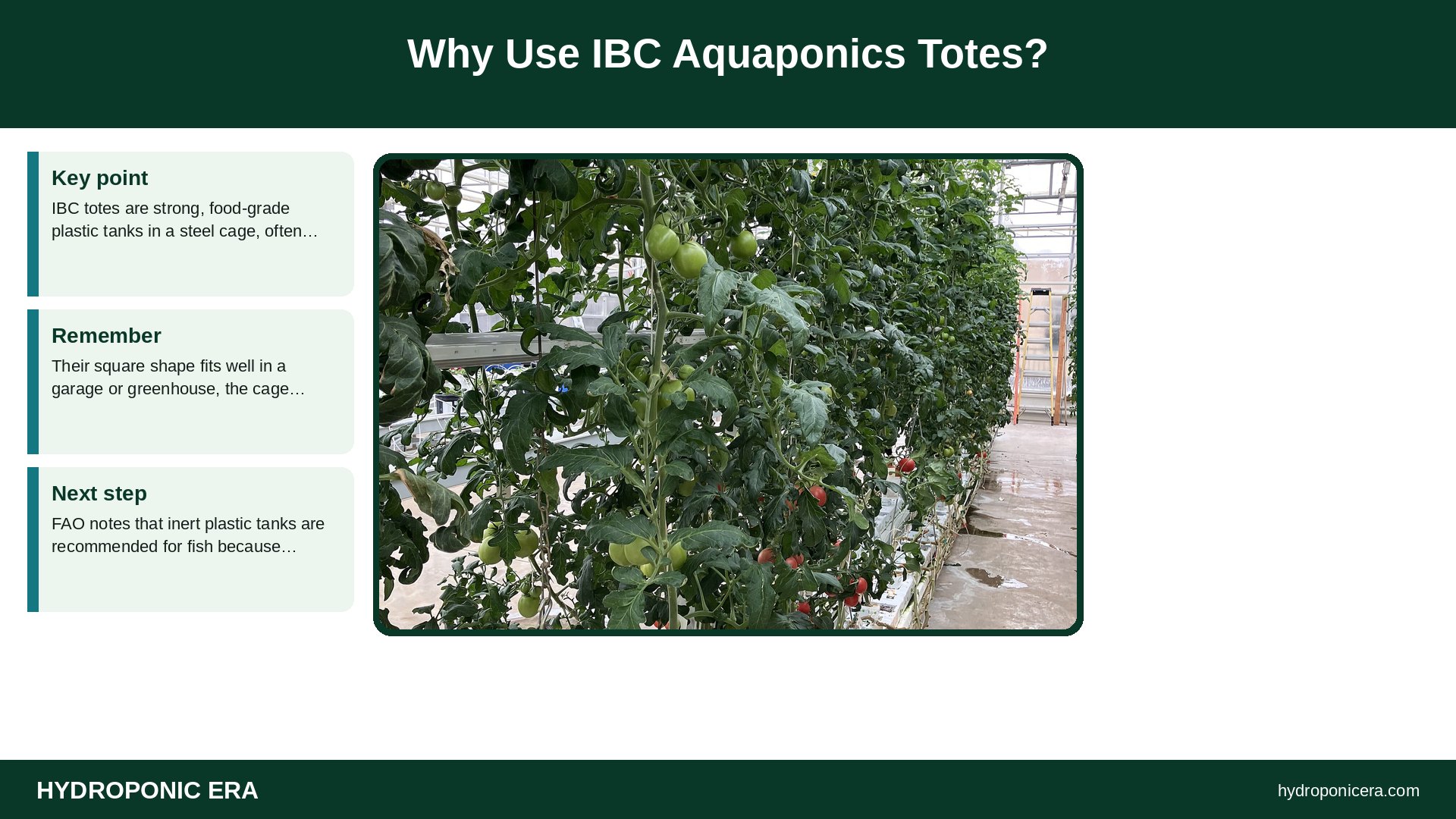
IBC totes are strong, food-grade plastic tanks in a steel cage, often sold used for much less than a new stock tank of the same size. Their square shape fits well in a garage or greenhouse, the cage provides built-in support, and one tote holds about the volume FAO uses for its small-scale units. FAO notes that inert plastic tanks are recommended for fish because metal rusts, and that low-density polyethylene is preferred for its strength and food-grade properties.
Choosing a Safe Tote
This is the step you can’t skip. Many IBCs carry chemicals. FAO stresses that plumbing and containers must never have held toxic substances. When shopping:
- Ask what the tote held and look for the label or placard. Choose totes that held food products such as syrups, juices, or vegetable oil, or new/unused totes.
- Avoid totes that held pesticides, solvents, fuels, or unknown chemicals, even after washing.
- Check for UV damage: chalky, brittle plastic cracks under load.
- Make sure the valve and cage are intact.
FAO’s build washes each cut container with natural soap and warm water and leaves it to dry in the sun for 24 hours.
FAO’s Three-Tote Build at a Glance
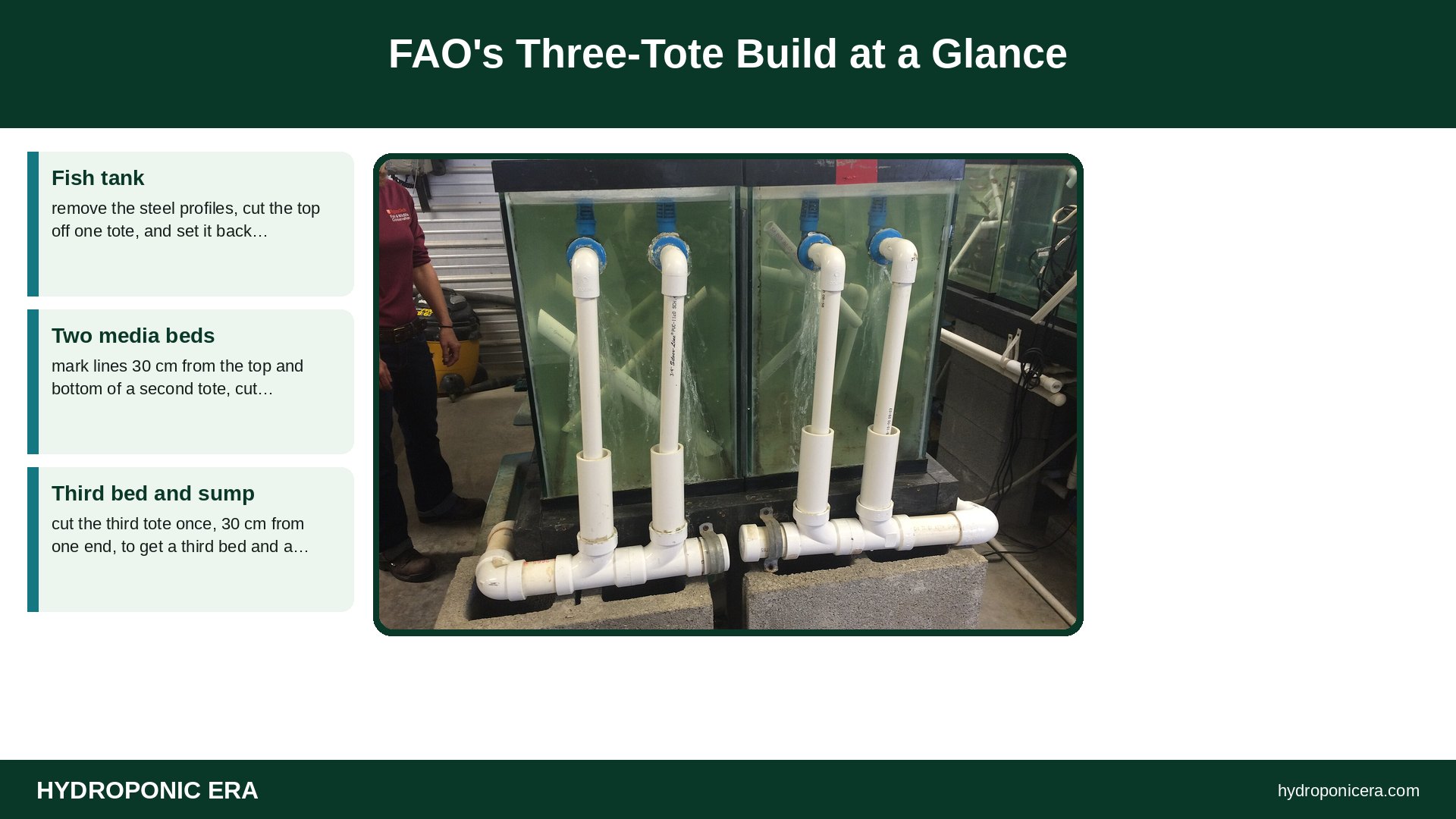
- Fish tank: remove the steel profiles, cut the top off one tote, and set it back in its cage. Add a standpipe outlet with a small anti-siphon hole; FAO says this hole stops the tank draining if the pump fails, and calls it “not optional.”
- Two media beds: mark lines 30 cm from the top and bottom of a second tote, cut through, and get two 30 cm deep trays. Cut matching sections of the cage for support.
- Third bed and sump: cut the third tote once, 30 cm from one end, to get a third bed and a 70 cm deep sump.
- Level the beds: FAO uses wood lengths on the cut cages so beds sit level, which is vital for bell siphons.
- Plumb and test: fit drains, siphons, and the pump in the sump, run water to check leaks, then add washed media to 30 cm.
See aquaponics bell siphons and media beds for those parts.
Water Flow in an IBC Aquaponics System
FAO recommends the pump sits in the sump, a layout known as CHIFT-PIST (constant height in fish tank, pump in sump tank). The pump lifts water to the fish tank, the fish tank overflows into the grow beds, and the beds drain back to the sump. Leaks and evaporation show up only in the sump, so the fish tank never drains. FAO’s small units use about 2,000 liters per hour (about 530 GPH) at a 1.5-meter (about 5-foot) head. See pump sizing.
Shade the Tote
IBC plastic is translucent, so light reaches the water and algae grows quickly. FAO advises reducing light in fish tanks to limit algae while avoiding total darkness, which stresses fish. Wrap the tote with tarp, paint the outside, or build a wood surround, and cover the top with shade cloth or a lid with an opening for feeding. Covering also limits UV damage to the plastic.
Stocking an IBC Aquaponics Fish Tank
For a 1,000-liter tank, FAO’s guideline is 10–20 kg of fish (about 22–44 lb). With tilapia at about 1.1 lb at harvest, that’s roughly 20–40 fish. Start below the limit while the system cycles and the beds mature. See aquaponics stocking density and aquaponics cycling.
How Much IBC Aquaponics Can Grow
Three IBC beds give about 3 m² (about 32 sq ft). Using FAO’s feed rate ratio of 40–50 g of feed per m² per day for leafy greens, the system can take about 120–150 g of feed daily, enough for about 60–75 heads of lettuce in the beds at once at FAO’s 20–25 plants per m². See aquaponics fish to plant ratio.
Common IBC Aquaponics Mistakes

- Buying a tote with unknown or chemical contents.
- Leaving the tank unshaded.
- Skipping the anti-siphon hole on the fish tank outlet.
- Beds that aren’t level, so siphons misbehave.
- Overstocking before cycling is complete.
- Putting the system on soft ground; a full fish tote weighs over a ton.
IBC Aquaponics Weight and Placement
A full 264-gallon tote of water weighs about 2,200 pounds, before fish, the cage, and the beds. Place the system on a level concrete slab or well-compacted base, never on a deck or upper floor without an engineer’s check. In hot climates, a shaded spot helps keep water within your fish’s range.
IBC Aquaponics Safety Checks Before You Fill
Used totes are cheap, but an IBC aquaponics build is only as safe as the tote. FAO’s manual uses IBCs for its small media bed unit and notes their life span increases when they’re protected from sunlight with paint or another cover. Before building, check:
- Previous contents: use only food-grade totes that held food products, never chemicals or oils.
- Cleaning: scrub and rinse several times, then fill and let stand before stocking.
- Light: cover or paint the translucent walls to block algae and UV damage.
- Cage strength: a cut-down tote used as a grow bed holds heavy wet media; keep the steel cage intact.
- Level base: a full IBC aquaponics fish tank weighs over 2,000 pounds, so build on a level, solid surface.
IBC Aquaponics Costs
FAO’s cost estimate for a 1,000-liter (264-gallon) IBC aquaponics media bed unit with about 32 square feet (3 m²) of grow space was about $700 in materials, including about $200 for tanks. US prices for used totes vary widely by region. See aquaponics media bed for bed depth and media choice.
FAQs: IBC Aquaponics
How big is an IBC aquaponics fish tank?
A standard tote holds about 275 gallons; FAO’s plan treats it as about 1,000 liters of fish water.
Are IBC totes safe for fish?
Only if they held food-grade or non-toxic contents and are washed well.
How many fish in IBC aquaponics?
About 22–44 pounds of fish, per FAO’s 10–20 kg per 1,000 liters guideline.
How many IBCs do I need?
FAO’s plan uses three: one fish tank, plus two cut into three beds and a sump.
Do I need to cover the IBC?
Yes, to block light and limit algae and UV damage.
Sources
- FAO — Small-scale aquaponic food production
- Photo credits (Wikimedia Commons, edited with titles): Intermediate Bulk Container (fcm) by Photograph: Frank C. Müller, Baden-Baden (CC BY-SA 4.0); Solanum lycopersicum in aquaponics at the NC Greenhouse Nursery by Gogerr (CC BY-SA 4.0); Recirculating Aquaculture System 1 by Narek75 (CC BY-SA 4.0); South Sister lava flows, USGS by C. Dan Miller, USGS/Cascades Volcano Observatory (Public domain); AQUAPONIE by Hopeballa (CC BY-SA 4.0)
1 thought on “IBC Aquaponics: Build a System From an IBC Tote”