
Aquaponics cycling is the process of growing a colony of nitrifying bacteria in a new system before you add fish, so the bacteria can turn toxic ammonia into nitrite and then into nitrate that plants use. FAO’s aquaponics manual says aquaponics cycling normally takes 3–5 weeks, or about 25–40 days in good conditions, and up to two months in cool water. You add a steady ammonia source to reach about 1–2 mg/L, test every 2–3 days, and call the cycle complete when nitrite reads 0, ammonia is below 1 mg/L, and nitrate is steadily rising. Fishless aquaponics cycling with ground fish food or pure ammonia is the safest method.
Key takeaway: Be patient. Keep ammonia around 1–2 mg/L, never let it pass 3 mg/L, and stock fish slowly only after nitrite reaches zero.
| Stage (FAO) | What happens | Typical timing |
|---|---|---|
| 1. Ammonia added | Ammonia-oxidizing bacteria (AOB) start forming a colony | Days 1–7 |
| 2. Nitrite rises | AOB convert ammonia to nitrite; nitrite-oxidizing bacteria (NOB) arrive | About days 7–14 |
| 3. Nitrite falls, nitrate rises | NOB convert nitrite to nitrate | About weeks 2–5 |
| 4. Cycle complete | Nitrite 0, ammonia <1 mg/L, nitrate rising steadily | About 25–40 days; up to 2 months if cool |

Why Aquaponics Systems Need Cycling
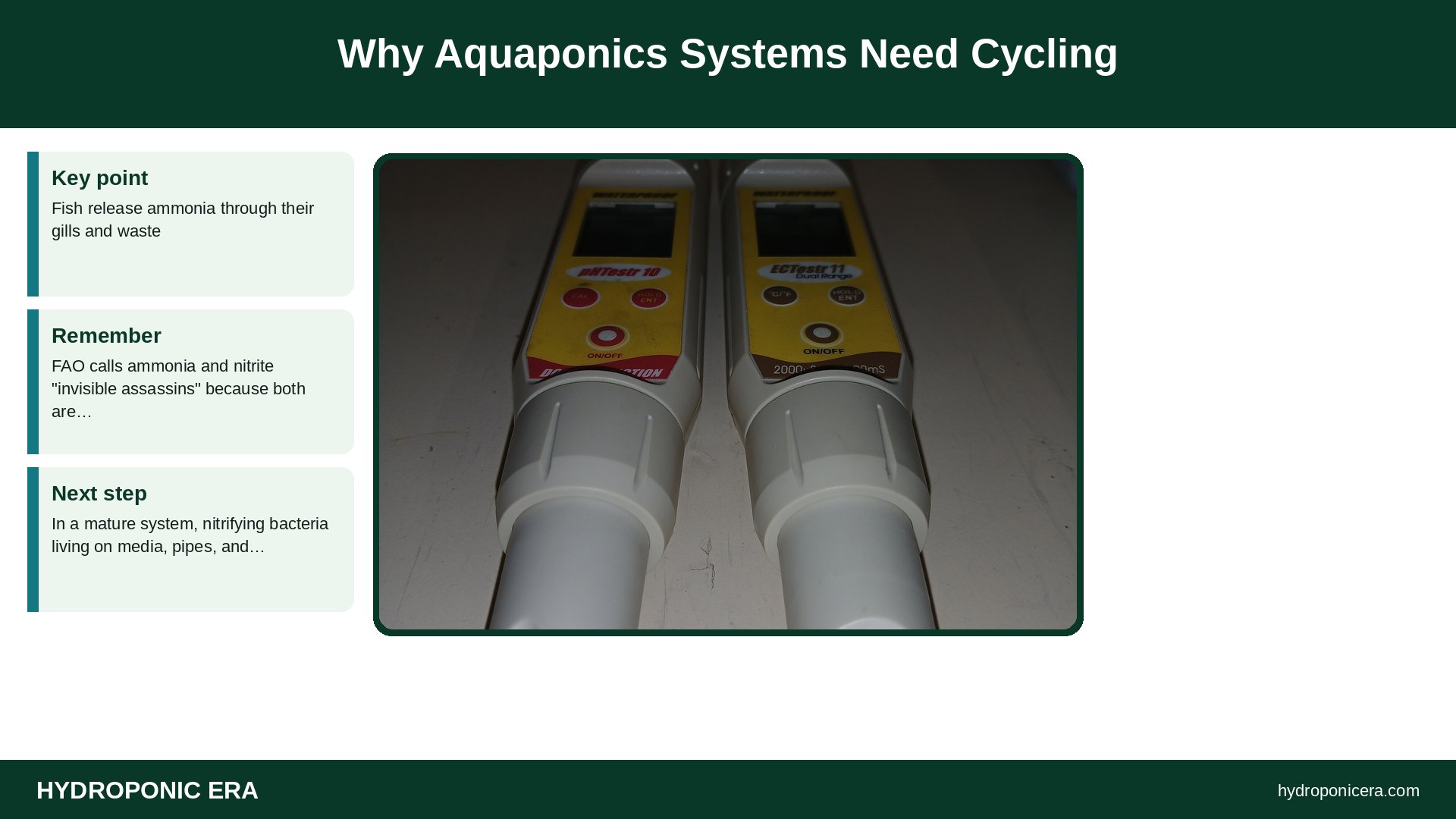
Fish release ammonia through their gills and waste. FAO calls ammonia and nitrite “invisible assassins” because both are toxic to fish above about 1 mg/L, and any detectable level adds stress. In a mature system, nitrifying bacteria living on media, pipes, and tank walls convert ammonia to nitrite and then to nitrate, which is far less toxic and is the main nitrogen source for plants. A new system has almost none of these bacteria. Cycling builds them up first so fish don’t suffer what aquarists call “new tank syndrome.”
Why Aquaponics Cycling Takes Weeks
FAO explains that aquaponics cycling is slow because nitrifying bacteria grow slowly, needing about 10–15 hours to double their population. By comparison, some heterotrophic bacteria can double in about 20 minutes. That slow growth is why you can’t rush the process with extra ammonia; too much actually inhibits the bacteria.
Fishless Cycling: Step by Step

- Build and run the system. Aquaponics cycling starts with clean, moving water. Fill with dechlorinated water, run pumps and aeration, and check for leaks.
- Shade the tanks and biofilter. FAO says to protect the fish tank and biofilter from direct sunlight before you start.
- Choose an ammonia source. FAO says finely ground fish food is the best source because it’s biologically safe and easy to control. Pure household ammonia also works if it’s 100% ammonia with no detergents, colorants, or scents. Avoid raw manure; FAO warns chicken waste can carry E. coli and Salmonella and any manure must be sterilized.
- Add ammonia slowly. Target about 1–2 mg/L. If ammonia goes above 3 mg/L, FAO says do a water exchange to dilute it.
- Test every 2–3 days. Record ammonia, nitrite, and nitrate on a chart.
- Keep feeding the bacteria. Keep adding small amounts of ammonia as levels fall.
- Watch for the finish line. Nitrite at 0, ammonia under 1 mg/L, and nitrate rising steadily.
Fish-In Aquaponics Cycling
Many people cycle with fish as the ammonia source, but FAO notes those fish suffer high ammonia and nitrite during the process. If you choose fish-in cycling:
- Use a very low stocking density; FAO recommends 1 kg per cubic meter or less (about 1 pound per 120 gallons).
- Feed lightly.
- Test daily and do partial water changes if ammonia or nitrite rise above 1 mg/L.
- Choose a hardy species, such as tilapia or goldfish. See goldfish aquaponics.
Speeding Up Aquaponics Cycling Safely
- Seed from a mature system. FAO says sharing part of an existing biofilter greatly decreases cycling time.
- Pre-start media. FAO describes trickling a 2–3 mg/L ammonia solution over media in a crate for a few weeks before building the system.
- Bottled bacteria. FAO notes retail products of live nitrifying bacteria can colonize a system quickly, but they may be expensive or unnecessary.
- Keep water warm. FAO lists 17–34°C (about 63–93°F) as the range for good nitrification; cool water can stretch cycling to two months.
- Keep pH 6–7 and oxygen high. FAO lists pH 6–7 and dissolved oxygen 4–8 mg/L among the five key factors.
Read more about bacteria in beneficial bacteria.
When to Add Plants
FAO says plants can go in a little before the cycle finishes, but expect nutrient deficiencies because other nutrients take time to build up. Fast, forgiving leafy greens such as lettuce and kale handle this best.
When to Add Fish
FAO says it’s safe to begin stocking once ammonia and nitrite are below 1 mg/L, and the cycle is complete once nitrite is 0 and nitrate is rising. Stock slowly. FAO also notes a second, smaller ammonia and nitrite spike is common after stocking, because the new fish produce more ammonia than you were adding. Keep testing and be ready for water exchanges if either rises above 1 mg/L. See best fish for aquaponics.
Troubleshooting Aquaponics Cycling

| Problem | Likely cause | Fix |
|---|---|---|
| Ammonia stays high, no nitrite | Too much ammonia, cool water, or low pH | Partial water change, warm water, raise pH toward 7 |
| Nitrite stuck high for weeks | NOB slower to establish; very high nitrite | Stop adding ammonia briefly, water change, keep oxygen high |
| No change at all | Chlorinated water, very cold water, or a test kit issue | Dechlorinate, warm water, check test kit dates |
| pH crashes during cycling | Nitrification consumes carbonate buffer | Buffer with calcium or potassium carbonate, as FAO suggests |
A Sample Aquaponics Cycling Log
Writing readings down makes the cycle easy to follow. FAO recommends charting ammonia, nitrite, and nitrate every 2–3 days. A typical fishless cycle in warm water looks roughly like this:
| Week | Ammonia | Nitrite | Nitrate | Action |
|---|---|---|---|---|
| 1 | 1–2 mg/L | 0 | 0 | Keep dosing small amounts; don’t exceed 3 mg/L |
| 2 | Falling | Rising | Trace | Keep dosing; watch nitrite |
| 3 | Low | Peaks | Rising | Be patient; water change if nitrite is very high |
| 4–5 | <1 mg/L | Falling to 0 | Rising steadily | Add plants; plan fish stocking |
Real systems vary with temperature, pH, and how much media you have, so trust the test results, not the calendar. FAO notes cool water can stretch cycling to two months.
FAQs: Aquaponics Cycling
How long does aquaponics cycling take?
Usually 3–5 weeks, or about 25–40 days in good conditions, and up to two months in cool water.
What ammonia level should I target?
About 1–2 mg/L. Dilute with a water change if it passes 3 mg/L.
How do I know cycling is done?
Nitrite is 0, ammonia is under 1 mg/L, and nitrate is rising steadily.
Is fishless aquaponics cycling better?
It’s safer for fish. Fish-in cycling works with very low stocking and careful testing.
Can I add plants during aquaponics cycling?
Yes, a little early, but expect some deficiencies at first.
Sources
- FAO — Small-scale aquaponic food production
- Photo credits (Wikimedia Commons, edited with titles): Solanum lycopersicum in aquaponics at the NC Greenhouse Nursery by Gogerr (CC BY-SA 4.0); PH- und Leitfähigkeitsmessgeräte by Rotkaeppchen68 (CC0); Fish Feed Pellets by Narek75 (CC BY-SA 4.0); Water droplets on a late cotoneaster (Cotoneaster coriaceus) leaf, Jardim da Fundação Calouste Gulbenkian, Lisbon, Portugal julesvernex2 by Jules Verne Times Two (CC BY-SA 4.0); AQUAPONIE by Hopeballa (CC BY-SA 4.0)