
The best fish for aquaponics in most US home systems are tilapia (if you can keep the water warm and your state allows them), channel catfish, bluegill and other sunfish, yellow perch for cooler water, rainbow trout for cold water, and goldfish or koi if you want ornamental fish rather than food. The right choice depends on three things: your water temperature year-round, what your state allows you to keep, and whether you plan to eat the fish. Pick the species that suits the water you can hold without expensive heating or chilling, then size the plant beds to match how much you feed.
Key takeaway: Match the fish to your water temperature and local rules first. A hardy fish that thrives at your natural temperature beats a “perfect” species you have to heat all winter.
| Fish | Best water temp (approx.) | Edible? | Good for | Watch out for |
|---|---|---|---|---|
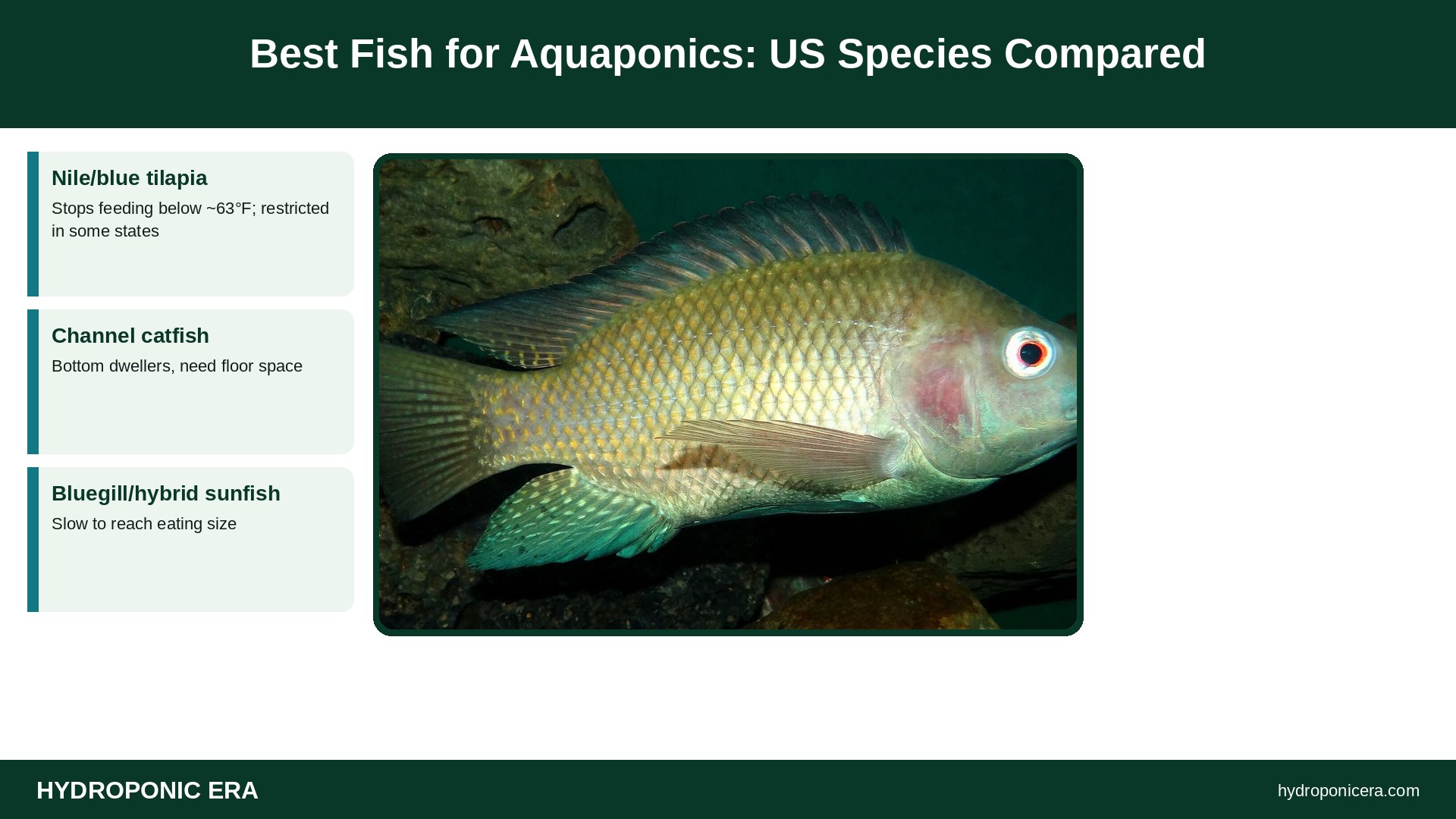
| Nile/blue tilapia | 81–86°F | Yes | Warm climates, heated greenhouses | Stops feeding below ~63°F; restricted in some states |
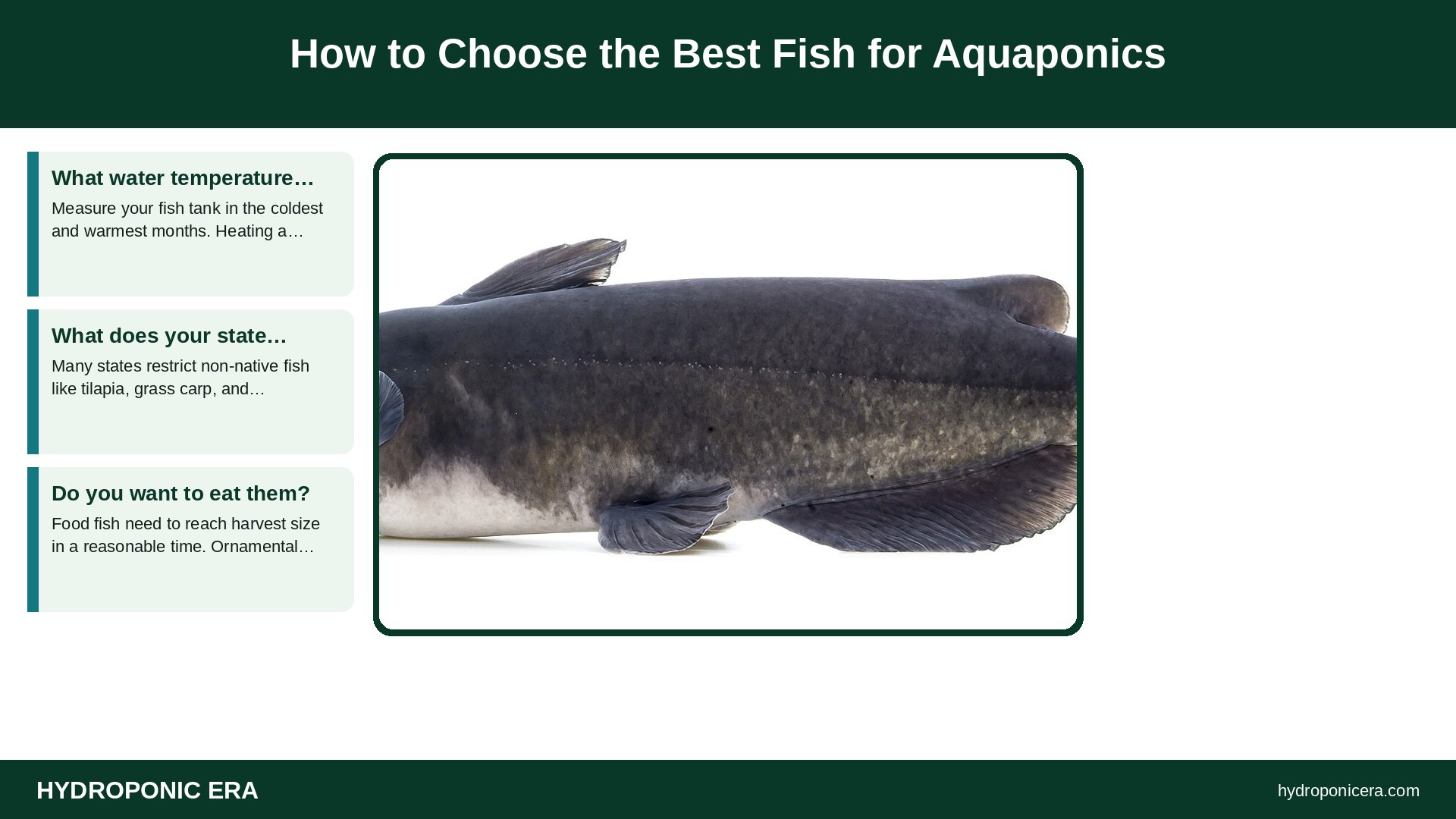
| Channel catfish | 75–86°F | Yes | Hardy, native to much of the US | Bottom dwellers, need floor space |
| Bluegill/hybrid sunfish | 68–86°F | Yes | Native, legal in most states | Slow to reach eating size |
| Yellow perch | 72–75°F | Yes | Northern states, cooler rooms | Stress above ~79°F |
| Rainbow trout | 50–64°F | Yes | Cold climates, winter systems | Needs very high oxygen and clean water |
| Goldfish | Wide range | No (ornamental) | Small indoor systems | Messy, can overload small tanks |
| Koi | Wide range | No (ornamental) | Ponds and large tanks | Grow large, expensive |
How to Choose the Best Fish for Aquaponics
Choosing a fish is mostly about matching biology to your setup. The UN Food and Agriculture Organization’s guide to small-scale aquaponics lists tilapia, carp, catfish, trout, largemouth bass, and freshwater prawns among species that grow well in aquaponic units, but it stresses that local availability and conditions matter as much as the species itself. Work through these questions in order:
- What water temperature can you hold? Measure your fish tank in the coldest and warmest months. Heating a tank through a northern winter or chilling it through a southern summer costs money every month.
- What does your state allow? Many states restrict non-native fish like tilapia, grass carp, and some crayfish. Check before you buy fingerlings; see our guide to fish farming for beginners for the basics.
- Do you want to eat them? Food fish need to reach harvest size in a reasonable time. Ornamental fish just need to stay healthy.
- Where can you buy healthy fingerlings? A species is only practical if a hatchery near you sells disease-free stock.
- How much tank space do you have? Fish that grow large or live on the bottom need more room.
Tilapia: The Classic Best Fish for Aquaponics in Warm Water
Tilapia are popular because they tolerate crowding, handling, and a wide range of water quality. According to FAO, they briefly survive extremes but don’t feed or grow below about 63°F (17°C), and they die below about 54°F (12°C). Their ideal range is roughly 81–86°F (27–30°C), where they can grow from fingerling to plate size in about six months. That makes them excellent in the South, in heated greenhouses, or indoors, and a poor fit for unheated northern systems. Tilapia are also restricted or regulated in several states, so confirm the rules first.
Channel Catfish: Hardy and Native
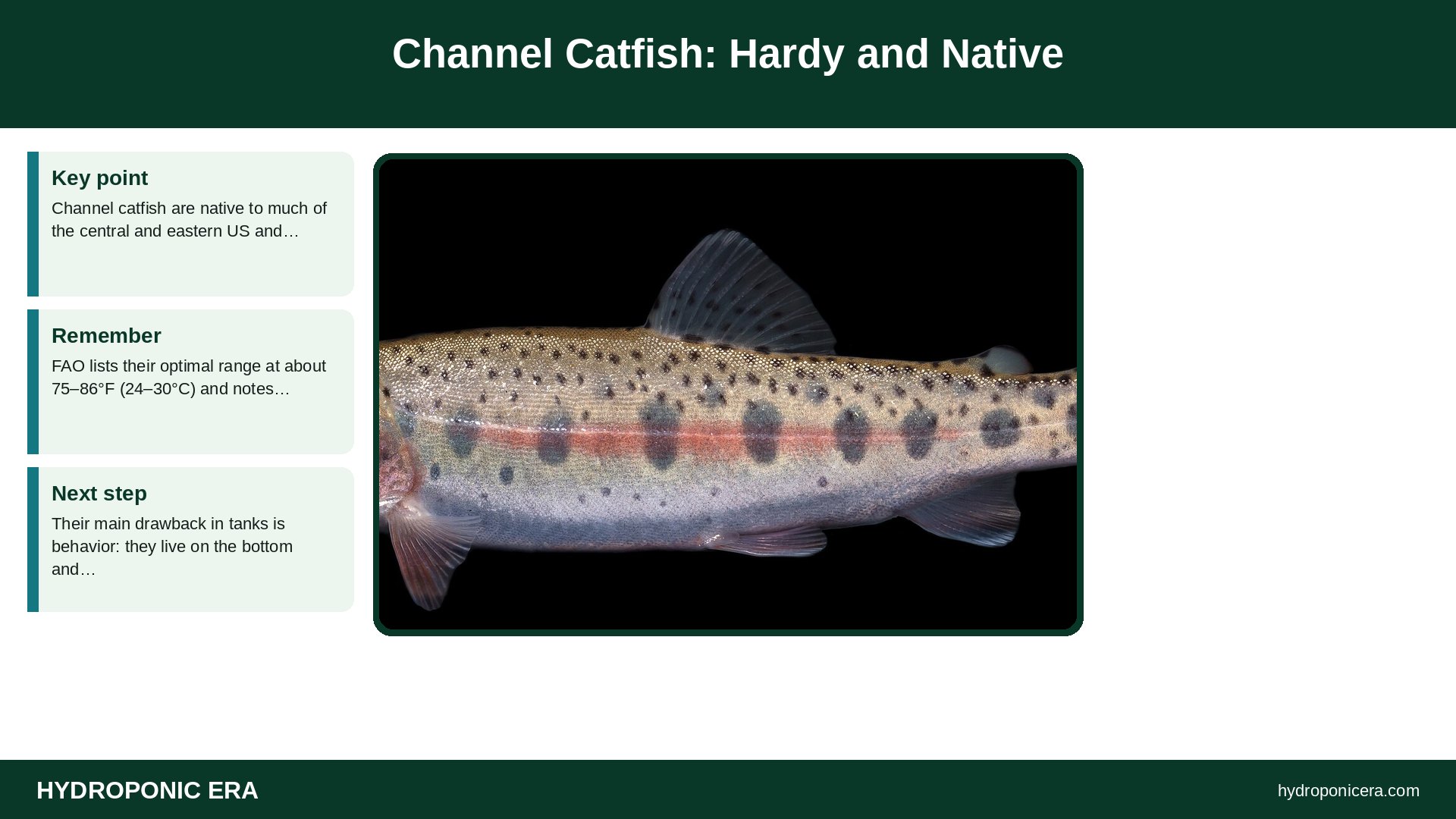
Channel catfish are native to much of the central and eastern US and are farmed widely. FAO lists their optimal range at about 75–86°F (24–30°C) and notes they tolerate swings in oxygen and temperature better than many species. Their main drawback in tanks is behavior: they live on the bottom and don’t spread through the water column, so a wide, shallow tank works better than a tall one. Many growers pair them with a mid-water fish such as bluegill or tilapia.
Bluegill and Hybrid Sunfish: The Legal-Almost-Everywhere Option
Bluegill are native across much of the US, which makes them easier to obtain and keep legally than exotic species. The Southern Regional Aquaculture Center’s species profile puts optimal sunfish growth at 68–86°F (20–30°C). Hybrid sunfish (often green sunfish crossed with bluegill) are commonly used in culture because they grow faster and accept pellets. The trade-off is time: University of Missouri Extension notes that reaching a food-sized bluegill has traditionally taken years, although improved stocks and feeding have shortened that.
Yellow Perch: Best Fish for Aquaponics in Cool Northern Water
Yellow perch suit northern growers whose water stays cool. The SRAC species profile and the North Central Regional Aquaculture Center culture guide describe a physiological optimum of about 72–75°F (22–24°C), with growth slowing below 59°F and declining above about 79°F. Perch tolerate crowding and are a respected table fish, but they grow more slowly than tilapia.
Rainbow Trout: The Best Fish for Aquaponics in Cold Water
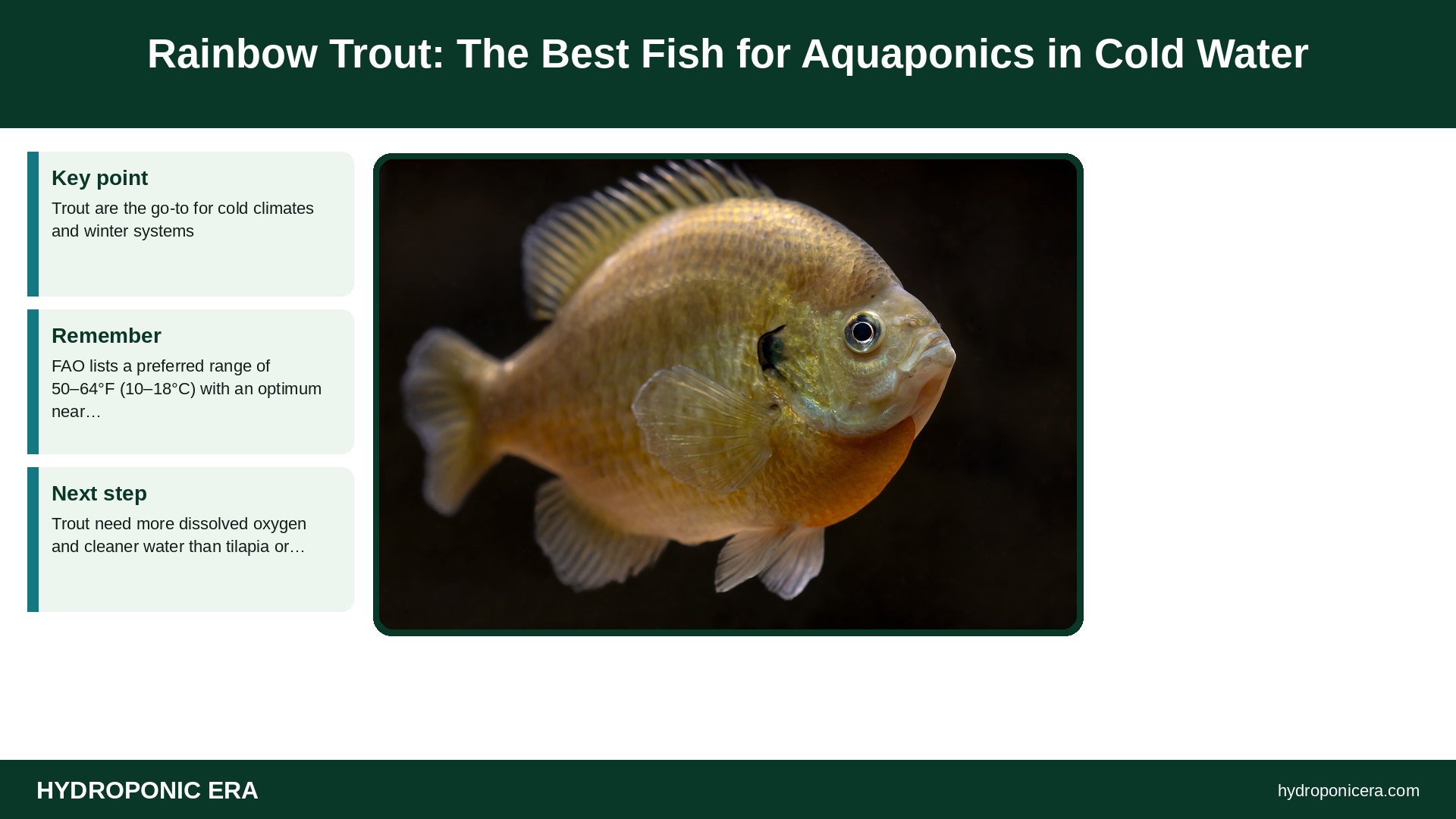
Trout are the go-to for cold climates and winter systems. FAO lists a preferred range of 50–64°F (10–18°C) with an optimum near 59°F (15°C), and growth drops sharply above about 70°F. Trout need more dissolved oxygen and cleaner water than tilapia or catfish, so they demand good aeration and reliable backups. Their high-protein feed releases plenty of nitrogen, which suits leafy greens.
Goldfish and Koi: Best Fish for Aquaponics Without Eating Them
If you don’t want to harvest fish, goldfish and koi are hardy, widely available, and tolerate a broad temperature range. FAO notes that ornamental carp are a popular choice in aquaponics because they can be sold or kept long-term. They produce plenty of waste for plants, but they grow large, so plan tank size accordingly.
Are Bass, Crayfish, or Prawns the Best Fish for Aquaponics?
Largemouth bass are native and tolerate low oxygen and nitrite, but they’re carnivores that eat smaller tankmates and need high-protein feed. Freshwater prawns and crayfish can be added as cleanup crews, though FAO notes prawns can’t be stocked densely enough to feed plants alone and may eat plant roots, so keep them in the fish tank. Many crayfish species are also regulated, so check your state’s list.
Best Fish for Aquaponics by Climate

| Your situation | Good starting fish |
|---|---|
| Warm South or heated greenhouse | Tilapia (if legal), channel catfish, bluegill |
| Indoor room at 68–75°F | Bluegill, yellow perch, goldfish |
| Northern garage or basement | Yellow perch, trout in winter, goldfish |
| Ornamental only | Goldfish, koi |
| Seasonal outdoor system | Warm-water fish in summer, trout or perch in cool months |
FAO also describes a seasonal strategy for temperate climates: raise tilapia in the warm months and switch to cold-water fish such as trout in winter.
Water Quality for the Best Fish for Aquaponics
Whatever you choose, the system has to keep ammonia and nitrite low and oxygen high. FAO’s general aquaponic targets are pH 6–7, ammonia and nitrite below 1 mg/L, and dissolved oxygen above 5 mg/L, with trout needing stricter limits. A reliable air pump and backup power matter more than species choice. See dissolved oxygen and backup power for pumps.
How Many of the Best Fish for Aquaponics to Start With
New growers often overstock. FAO recommends small-scale units stay below about 20 kg of fish per 1,000 liters of water (about 0.17 lb per gallon). Start with fewer fish than the limit, let the biofilter mature, and add plants in proportion to how much you feed. Our guide to aquaponics for beginners covers how the fish, bacteria, and plants work together.
FAQs: Best Fish for Aquaponics
What is the best fish for aquaponics beginners?
For warm water, tilapia and channel catfish are very forgiving. For ornamental systems, goldfish are hard to beat. For cool rooms, bluegill and perch are good choices.
What is the best fish for aquaponics in a cold climate?
Rainbow trout in cold water, yellow perch in cool water, or a seasonal switch between species.
Can I eat fish from my aquaponics system?
Yes, if you raise food species, feed a proper diet, and keep water clean. Follow your state’s rules if you plan to sell.
Is tilapia, often called the best fish for aquaponics, legal everywhere?
No. Some states restrict or prohibit certain tilapia species or require permits. Check with your state fish and wildlife or agriculture agency.
Can I mix the best fish for aquaponics in one tank?
Yes, if they share a temperature range and won’t eat each other. Catfish with bluegill or tilapia is a common pairing.
Sources
- FAO — Small-scale aquaponic food production: Integrated fish and plant farming
- Southern Regional Aquaculture Center — Species Profile: Hybrid Sunfish
- Southern Regional Aquaculture Center — Species Profile: Yellow Perch
- University of Missouri Extension — Bluegill Sunfish Production in Missouri
- Photo credits (Wikimedia Commons, edited with titles): Oreochromis-niloticus-Nairobi by Bjørn Christian Tørrissen (CC BY-SA 3.0); Channel Catfish (Ictalurus punctatus) white background by USFWS Mountain Prairie (Public domain); Rainbow Trout (Oncorhynchus mykiss) Gavins Point by USFWS Mountain Prairie (Public domain); Bluegill (Lepomis macrochirus) black background by USFWS Mountain Prairie (Public domain); Solanum lycopersicum in aquaponics at the NC Greenhouse Nursery by Gogerr (CC BY-SA 4.0)