
Crayfish aquaponics means adding crayfish to the fish tank as bottom scavengers and a bonus harvest. The two common choices in the US are Australian red claw (Cherax quadricarinatus) and native species such as red swamp crayfish (Procambarus clarkii). The Southern Regional Aquaculture Center (SRAC) says red claw grow best in 75–85°F water, slow sharply below 70°F, and die below 50°F, while native crayfish tolerate a wider temperature range. Legality is the biggest hurdle: SRAC notes most states restrict exotic species, and red swamp crayfish are prohibited in states such as Michigan and Washington. Check your state before buying any live crayfish.
Key takeaway: Keep crayfish in the fish tank, give them plenty of hiding places, and confirm legality first. They supplement fish rather than replace them.
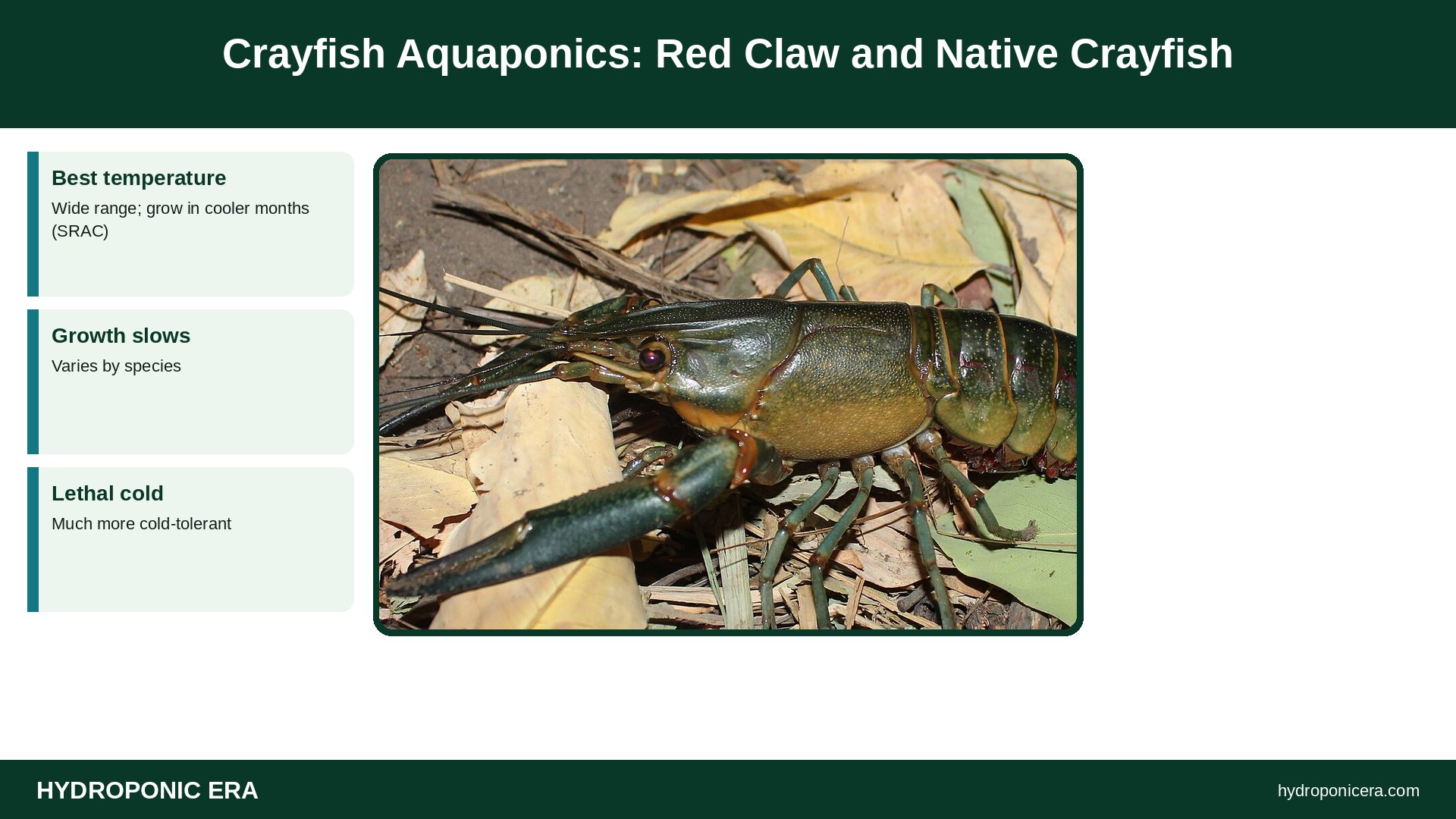
| Factor | Red claw (SRAC 244) | Native crayfish |
|---|---|---|
| Best temperature | 75–85°F | Wide range; grow in cooler months (SRAC) |
| Growth slows | Below 70°F | Varies by species |
| Lethal cold | Below 50°F | Much more cold-tolerant |
| Burrowing | Considered nonburrowing | Many species burrow |
| Crowding tolerance | High; adults show limited cannibalism | Varies |
| Size | 2–4 oz in 5–7 warm months (Southeast ponds) | Varies |
| Legal status | Exotic; restricted in many states | Some species prohibited outside native range |
Why Try Crayfish Aquaponics?
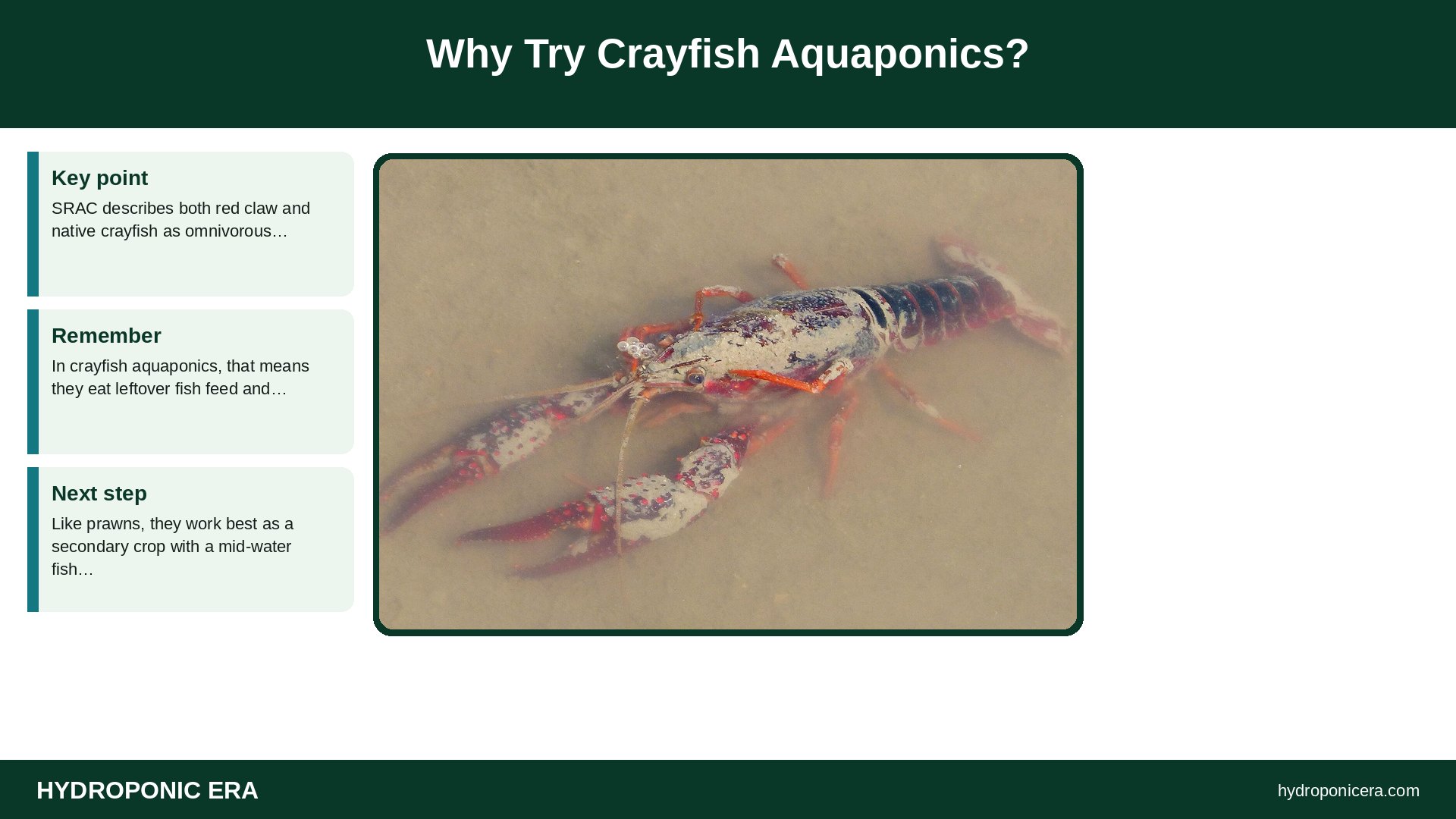
SRAC describes both red claw and native crayfish as omnivorous detritivores that prefer decaying plant or animal matter. In crayfish aquaponics, that means they eat leftover fish feed and settled organic waste at the tank bottom. Like prawns, they work best as a secondary crop with a mid-water fish that supplies most of the nutrients. A home tank won’t hold enough crayfish to fertilize a large plant area on its own.
Red Claw vs Native Crayfish
Red claw come from tropical northern Australia. SRAC says they tolerate crowding to an unusual degree for a large-clawed crustacean, with limited adult cannibalism even above 50 per square yard, and they don’t burrow. Those traits suit tanks well. The downside is temperature: they need warm water, so most US systems need heat for at least part of the year.
Native crayfish come from temperate climates. SRAC notes they generally tolerate a wide range of temperatures, grow during cooler months, and often spend hot summers in burrows. They’re more cold-hardy, but burrowing and aggression can be challenges in tanks, and some species are banned outside their home range.
Crayfish Aquaponics Legality: Check First
This is the most important step in crayfish aquaponics. SRAC states that most states restrict the introduction of exotic species and advises contacting your state conservation department before buying red claw or any non-native species. Examples:
- Florida: The Florida Department of Agriculture and Consumer Services (FDACS) says red claw culture is limited to tank culture in an enclosed structure, and commercial aquaculture in Florida requires an Aquaculture Certificate of Registration.
- Michigan: Red swamp crayfish are a prohibited species; it’s illegal to knowingly possess, import, or sell them live, apart from limited permitted uses.
- Washington: Red swamp crayfish are classified as a prohibited nonnative aquatic species.
Rules change, so confirm with your state agency even for native species. Never release crayfish into ponds or streams.
Housing Crayfish in the Fish Tank
In crayfish aquaponics, keep crayfish in the fish tank rather than grow beds, where they could damage roots. Provide hiding places: SRAC recommends netting or screening in juvenile tanks to reduce cannibalism, and notes juveniles seek shelter in suspended substrate like burlap, shade cloth, or onion-bag mesh. Short pipes and mesh shelves give molting crayfish safe spots. Screen drains and overflows because crayfish climb and wander.
Crayfish Aquaponics Temperature
For red claw, keep water at 75–85°F for growth. Below 70°F, SRAC says growth drops significantly, and below 50°F it’s lethal. In northern states, red claw need an indoor or heated system. Pairing red claw with tilapia is a natural fit because both like similar warm water. See tilapia aquaponics and tank heaters.
Feeding Crayfish
Crayfish scavenge, but in crayfish aquaponics they may need extra food in a lightly fed tank. SRAC recommends sinking crayfish or shrimp feed with at least 28% protein at about 3% of body weight per day for red claw broodstock, and a higher-protein (above 33%) shrimp diet for juveniles. Feed small amounts and remove leftovers to protect water quality.
Crayfish Aquaponics Water Quality
Use the general aquaponics targets from FAO: ammonia and nitrite near zero, dissolved oxygen above 5 mg/L, and pH around 6–7. Like prawns, crayfish need minerals to build their shells, so watch water hardness, which tends to fall in aquaponics as nitrification consumes carbonate. See dissolved oxygen.
Breeding Crayfish
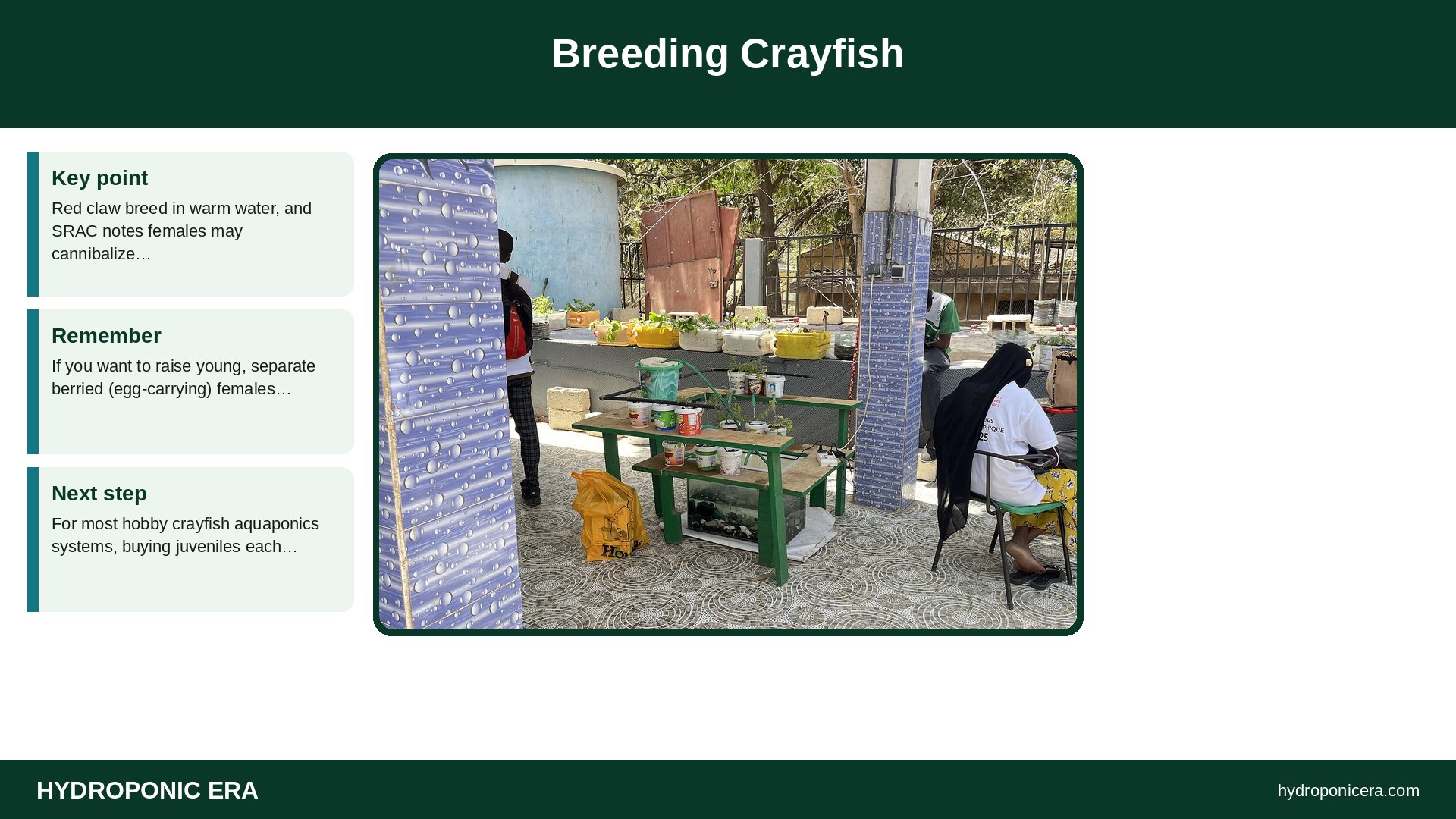
Red claw breed in warm water, and SRAC notes females may cannibalize their young when crowded in small tanks, and larger juveniles eat smaller ones. If you want to raise young, separate berried (egg-carrying) females, provide lots of mesh habitat, and grade juveniles by size. For most hobby crayfish aquaponics systems, buying juveniles each season is simpler.
Crayfish With Fish: What Works
- Pair with mid-water fish such as tilapia or bluegill.
- Avoid large predatory fish that will eat crayfish.
- Expect crayfish to nip at slow or sick fish.
- Give each crayfish enough floor area and shelter.
Compare animals in best fish for aquaponics and shrimp aquaponics.
Crayfish Aquaponics Setup Checklist
- Confirm your state’s rules for the species before you buy.
- Run the system with fish until ammonia and nitrite stay near zero.
- Fit lids and screen every drain; crayfish climb hoses and cords.
- Add pipe sections, mesh, or shade-cloth “curtains” for shelter.
- Keep red claw above 70°F for growth, and never below 50°F.
- Plan your harvest before water cools in fall in outdoor systems.
FAQs: Crayfish Aquaponics
Is crayfish aquaponics worth trying?
Yes, as a secondary crop in the fish tank, where it’s legal.
Are red claw legal in the US?
It depends on the state. Many restrict exotic species, and Florida limits red claw culture to tanks in an enclosed structure.
What temperature do red claw need?
SRAC lists 75–85°F for best growth; below 50°F is lethal.
Do crayfish eat plant roots?
They can damage roots, so keep them in the fish tank.
What do crayfish eat?
Leftover feed and detritus, plus sinking shrimp or crayfish pellets.
Sources
- Southern Regional Aquaculture Center — Australian Red Claw Crayfish (SRAC 244)
- FDACS — Aquaculture: Crustaceans
- Michigan Invasive Species — Invasive Species: Crustaceans
- Washington Department of Fish & Wildlife — Red swamp crawfish
- Photo credits (Wikimedia Commons, edited with titles): Australian red claw crayfish (Cherax quadricarinatus) by nature.catcher (CC BY-SA 4.0); Procambarus clarkii. White-clawed Crayfish (32290492333) by gailhampshire from Cradley, Malvern, U.K (CC BY 2.0); Solanum lycopersicum in aquaponics at the NC Greenhouse Nursery by Gogerr (CC BY-SA 4.0); Fish farming on Øksfjorden in Loppa, Troms og Finnmark, Norway, 2022 August by Ximonic (Simo Räsänen) (CC BY-SA 4.0); AQUAPONIE by Hopeballa (CC BY-SA 4.0)