
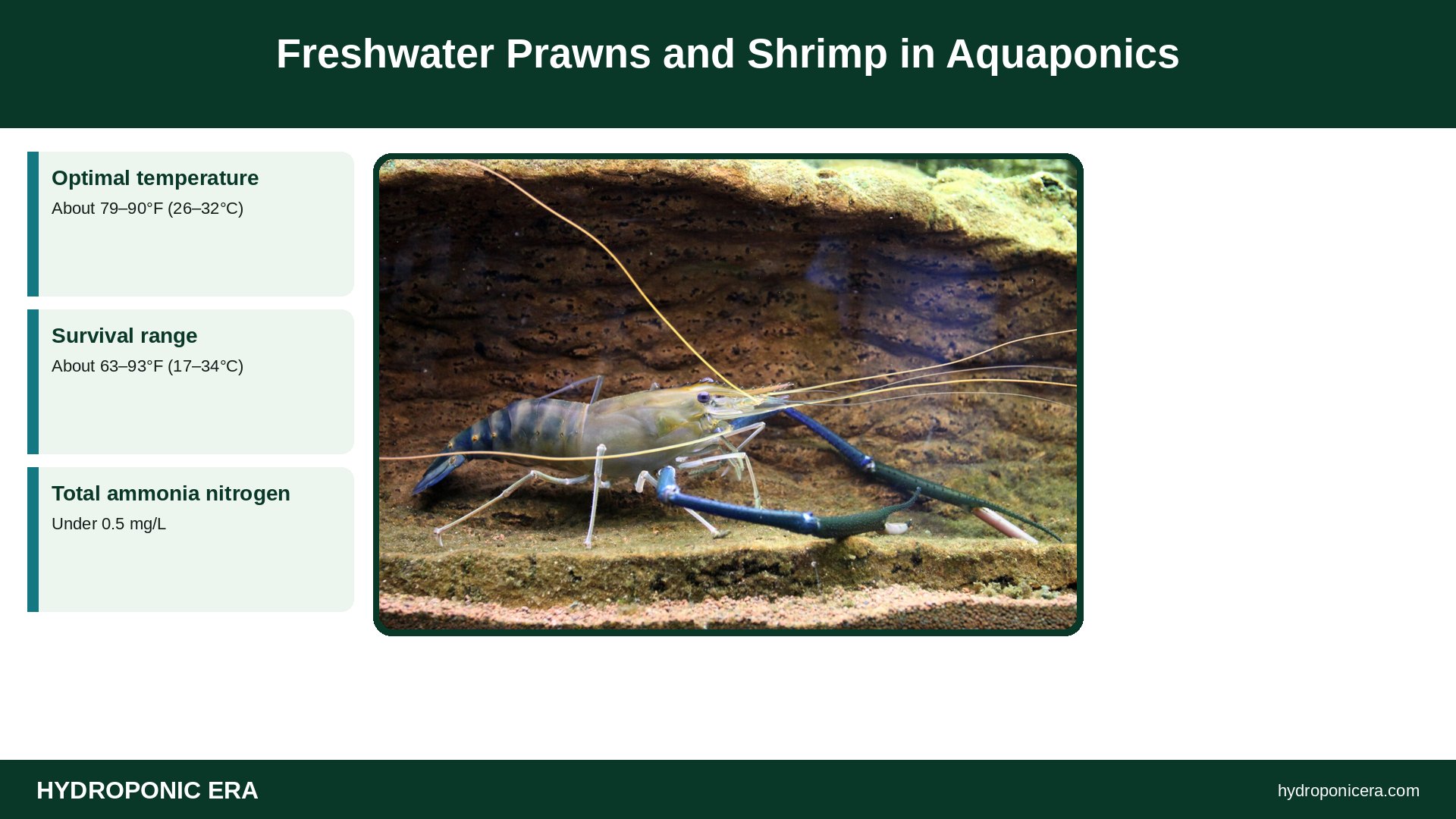
Shrimp aquaponics in a home freshwater system usually means the giant river prawn (Macrobrachium rosenbergii), a warm-water species often sold in the US as freshwater prawn or freshwater shrimp. FAO’s aquaponics manual lists an optimal range of about 79–90°F, a four-month growing cycle in ideal conditions, hard water, and good water quality. FAO also warns that prawns can’t be stocked densely enough to feed plants on their own and that they can eat plant roots. That’s why prawns work best as a clean-up crew in the fish tank alongside a mid-water fish such as tilapia, rather than as the only animal in the system.
Key takeaway: Add freshwater prawns as a bonus crop in the fish tank, not the main nutrient source. Give them warm, hard water and lots of floor space.
| Factor | Giant river prawn (FAO) |
|---|---|
| Optimal temperature | About 79–90°F (26–32°C) |
| Survival range | About 63–93°F (17–34°C) |
| Total ammonia nitrogen | Under 0.5 mg/L |
| Nitrite | Under 2 mg/L |
| Dissolved oxygen | Above 3 mg/L |
| Feed protein | About 35% |
| Growth example | About 30 g in 4–5 months |
| Where to keep them | Fish tank only (they can eat roots) |
Shrimp or Prawn? Clearing Up the Names
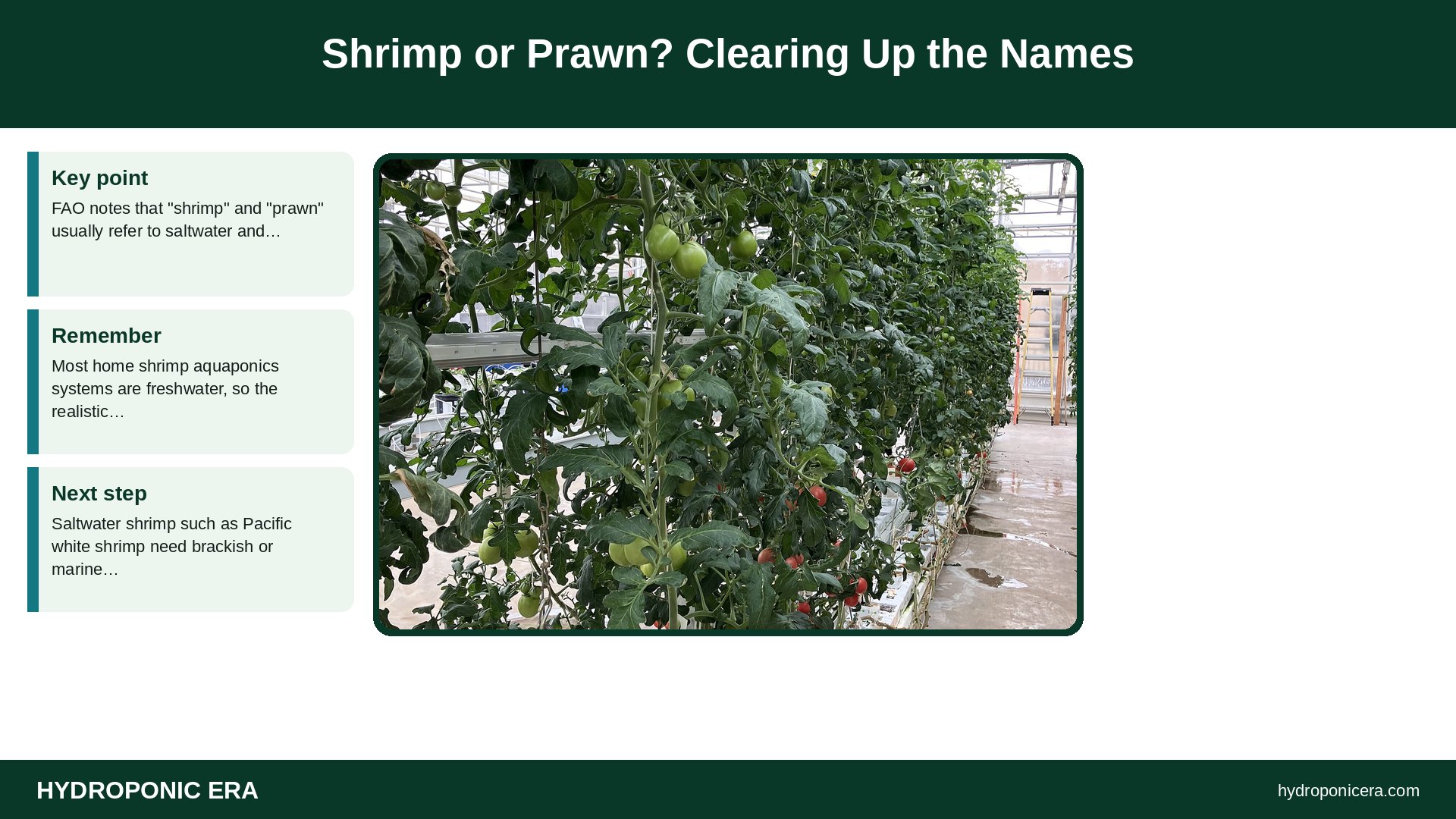
FAO notes that “shrimp” and “prawn” usually refer to saltwater and freshwater species, though the names are often mixed up, especially in cooking. Most home shrimp aquaponics systems are freshwater, so the realistic option is a freshwater prawn. Saltwater shrimp such as Pacific white shrimp need brackish or marine water, which most vegetable crops can’t handle. The freshwater prawn sold in the US for pond culture is Macrobrachium rosenbergii, which is the species FAO profiles.
What Prawns Do in Shrimp Aquaponics
According to FAO, prawns eat uneaten fish food, fish waste, and other organic material on the bottom. That helps clean the system and speeds up the breakdown of organic matter. But FAO is clear: prawns can’t be grown at high enough densities to produce enough waste for the plants. Successful shrimp aquaponics pairs prawns with a mid-water fish:
- Fish provide most of the nutrients for the plants.
- Prawns clean the tank bottom and give you a second harvest.
- Plants take up nutrients and keep water clean for both.
FAO notes polyculture with tilapia has been tested with varying success and that the number of prawns that can be stocked is low. See tilapia aquaponics.
Space: Prawns Are Territorial
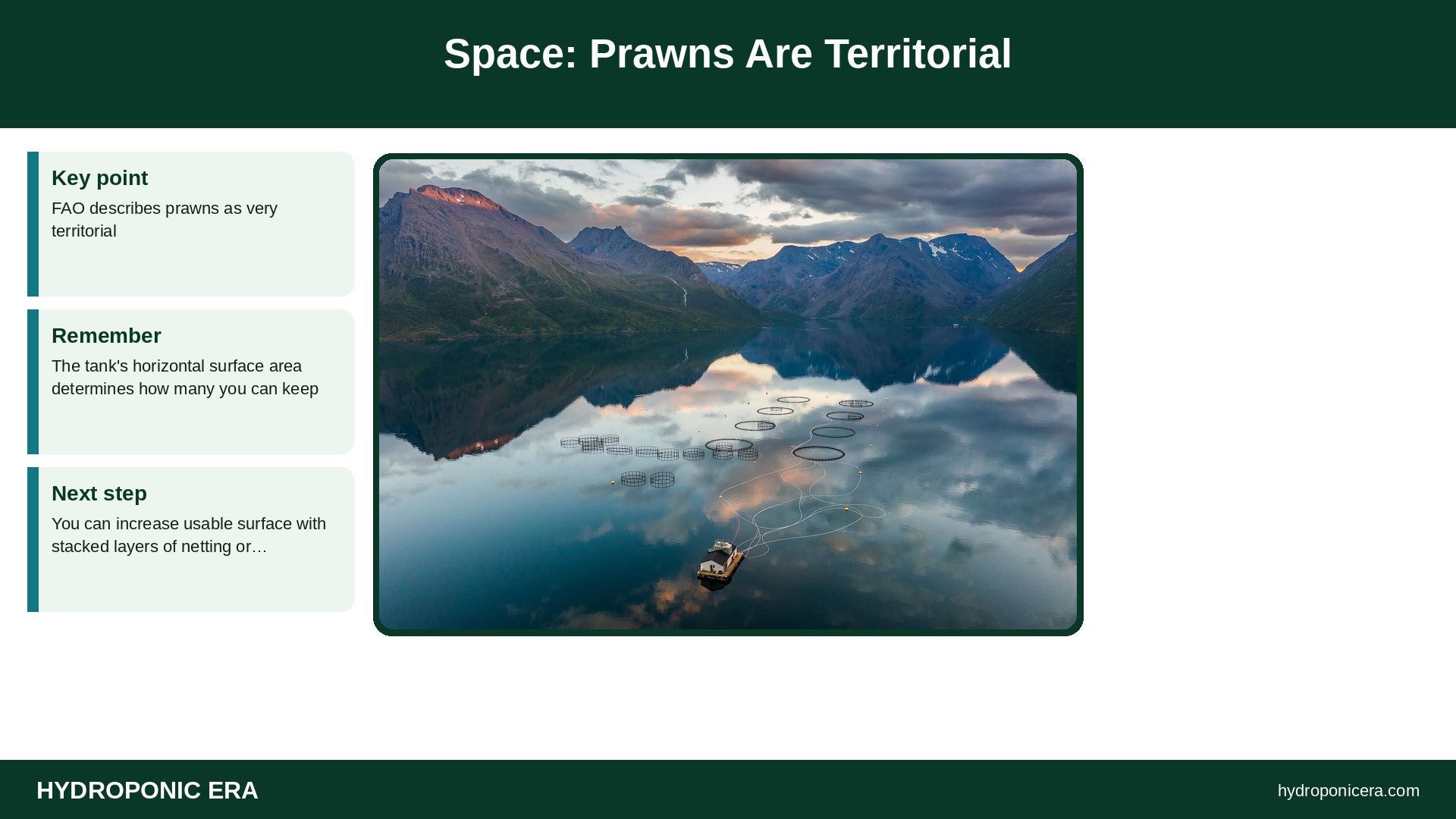
FAO describes prawns as very territorial. The tank’s horizontal surface area determines how many you can keep. You can increase usable surface with stacked layers of netting or mesh shelves. Hiding spots help molting prawns avoid attack, because a newly molted prawn is soft and vulnerable. A wide, shallow tank works better than a tall, narrow one.
Keep Prawns Out of the Grow Beds
FAO advises keeping prawns in the fish tank only because they can eat plant roots. Use screens on drains and plumbing so juveniles don’t travel into raft beds or media beds.
Shrimp Aquaponics Temperature and Hardness
Freshwater prawns are tropical, so shrimp aquaponics needs warmth. FAO lists the optimum at about 79–90°F, with a vital range of about 63–93°F; elsewhere the manual cites 75–88°F for most prawns. In most of the US, that means a heated indoor or greenhouse system, or an outdoor summer-only season. FAO also notes most prawns need hard water. Many aquaponics systems drift toward softer, lower-pH water as nitrification consumes carbonate hardness, so test hardness and buffer with calcium or potassium carbonate as needed. See heaters for tanks.
Water Quality: Stricter on Ammonia

FAO lists total ammonia nitrogen under 0.5 mg/L for prawns, half the general fish limit. In shrimp aquaponics, only add prawns after the system is fully cycled and ammonia and nitrite sit near zero. Prawns tolerate lower oxygen than trout, with FAO listing above 3 mg/L, but keep the whole system above 5 mg/L to protect fish and bacteria. See dissolved oxygen.
Buying and Breeding Prawns
FAO says prawn post-larvae should be purchased from a hatchery. The larval cycle is complex, with brackish water stages and special feed, so breeding is recommended only for experts. For shrimp aquaponics, order juveniles timed to arrive when your water is warm. Acclimate them slowly to your tank’s temperature and pH.
Feeding in Shrimp Aquaponics
Prawns scavenge leftover fish feed and waste, but in a lightly stocked tank they may also need a sinking pellet. FAO lists about 35% protein for prawn feed. Feed lightly and watch the bottom for leftovers; uneaten feed fouls water fast.
Shrimp Aquaponics Harvest
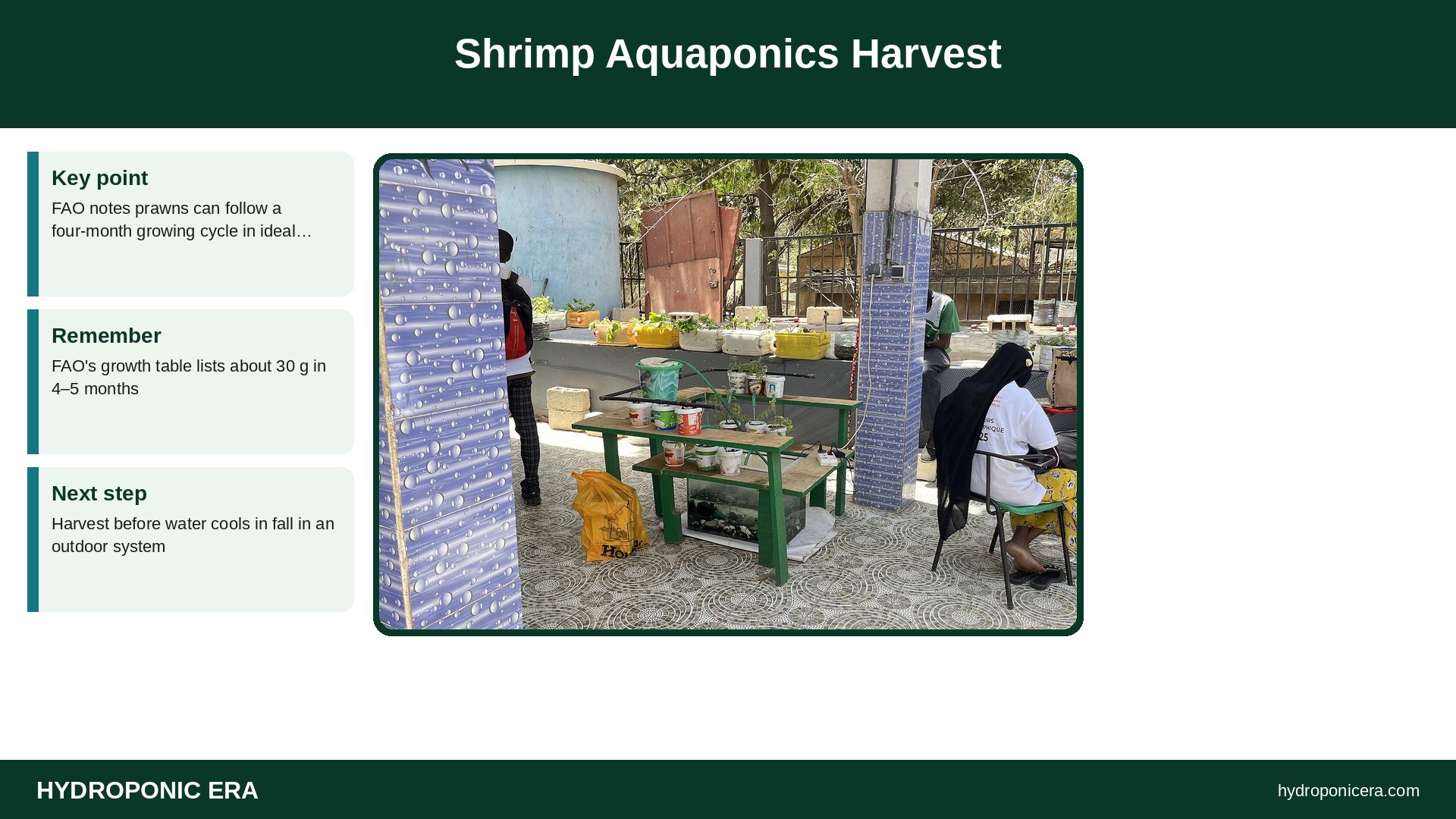
FAO notes prawns can follow a four-month growing cycle in ideal conditions, so in a warm system several crops a year are theoretically possible. FAO’s growth table lists about 30 g in 4–5 months. Harvest before water cools in fall in an outdoor system.
Legal Checks
Before starting shrimp aquaponics, note that many states regulate the possession, transport, and culture of non-native crustaceans. Some require aquaculture permits or limit certain species. Check with your state agriculture or fish and wildlife agency before buying prawns. See best fish for aquaponics.
Stocking Prawns With Fish: Practical Tips
- Add prawns last. Stock fish first and wait until ammonia and nitrite have been near zero for a few weeks.
- Start small with shrimp aquaponics. FAO notes only low numbers of prawns can be kept with fish, so begin with a modest group and watch survival.
- Add structure. Stacked mesh shelves, short pipe sections, and netting increase floor area and give molting prawns refuge.
- Avoid big predatory fish. Large fish may eat juvenile prawns.
- Match temperatures. Prawns and tilapia both like warm water; trout and perch systems are too cold.
Acclimating Prawn Juveniles
Juveniles are small and sensitive to sudden change. Following FAO’s general acclimation method, float the sealed bag for at least 15 minutes, then mix in tank water gradually over at least another 15 minutes. If pH differs by more than 0.5, take at least 24 hours. Release them near cover rather than into open water with hungry fish.
FAQs: Shrimp Aquaponics
Does shrimp aquaponics work at home?
Yes, freshwater prawns can work as a secondary crop with fish. Saltwater shrimp don’t suit most vegetable systems.
What temperature do freshwater prawns need?
About 79–90°F for best growth, per FAO.
Can prawns live in grow beds?
FAO advises keeping them in the fish tank because they can eat roots.
Can prawns be the only animal in a system?
Not usually; they can’t be stocked densely enough to feed plants.
Do prawns need hard water?
Yes, FAO notes most prawns need hard water.
Sources
- FAO — Small-scale aquaponic food production
- Photo credits (Wikimedia Commons, edited with titles): Macrobrachium rosenbergii by This illustration was made by Citron You must credit this : Citron / CC-BY-SA-3. (CC BY-SA 3.0); Solanum lycopersicum in aquaponics at the NC Greenhouse Nursery by Gogerr (CC BY-SA 4.0); Fish farming on Øksfjorden in Loppa, Troms og Finnmark, Norway, 2022 August by Ximonic (Simo Räsänen) (CC BY-SA 4.0); Recirculating Aquaculture System 1 by Narek75 (CC BY-SA 4.0); AQUAPONIE by Hopeballa (CC BY-SA 4.0)