
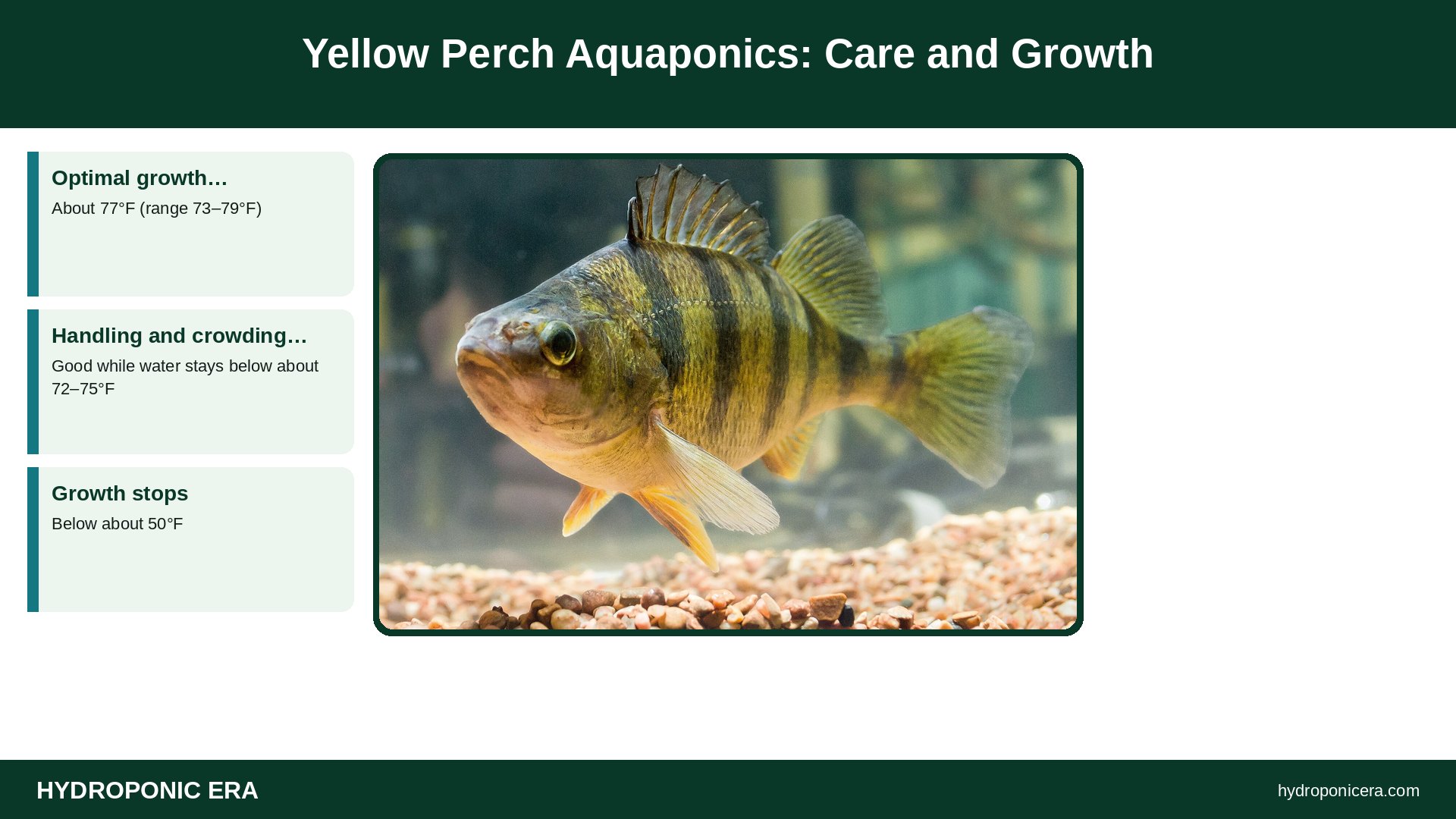
Yellow perch aquaponics is a strong choice for the northern US and Great Lakes region, where perch are native and in demand as a mild, flaky food fish. The Southern Regional Aquaculture Center (SRAC) says perch grow best around 73–79°F, tolerate crowding and handling as long as water stays below about 72–75°F, show little or no growth below 50°F, and become stressed and disease-prone above about 79°F. Perch need a protein-rich diet similar to trout feed and take roughly a year at good temperatures to reach market size of about a quarter to a third of a pound.
Key takeaway: Perch fit cool-to-moderate systems and northern growers. Buy feed-trained fingerlings and keep summer water below about 79°F.
| Factor | Yellow perch (SRAC 7204) |
|---|---|
| Optimal growth temperature | About 77°F (range 73–79°F) |
| Handling and crowding tolerance | Good while water stays below about 72–75°F |
| Growth stops | Below about 50°F |
| Stress and disease risk | Above about 79°F |
| Market size | 120–150 g (about 0.25–0.3 lb) in about 1 year at optimal temperatures |
| Diet protein | 34–44% |
| Daily feed for max growth | 2–3% of body weight |
| Feed conversion | 1.5–2 units feed per unit gain |
Why Choose Yellow Perch Aquaponics?
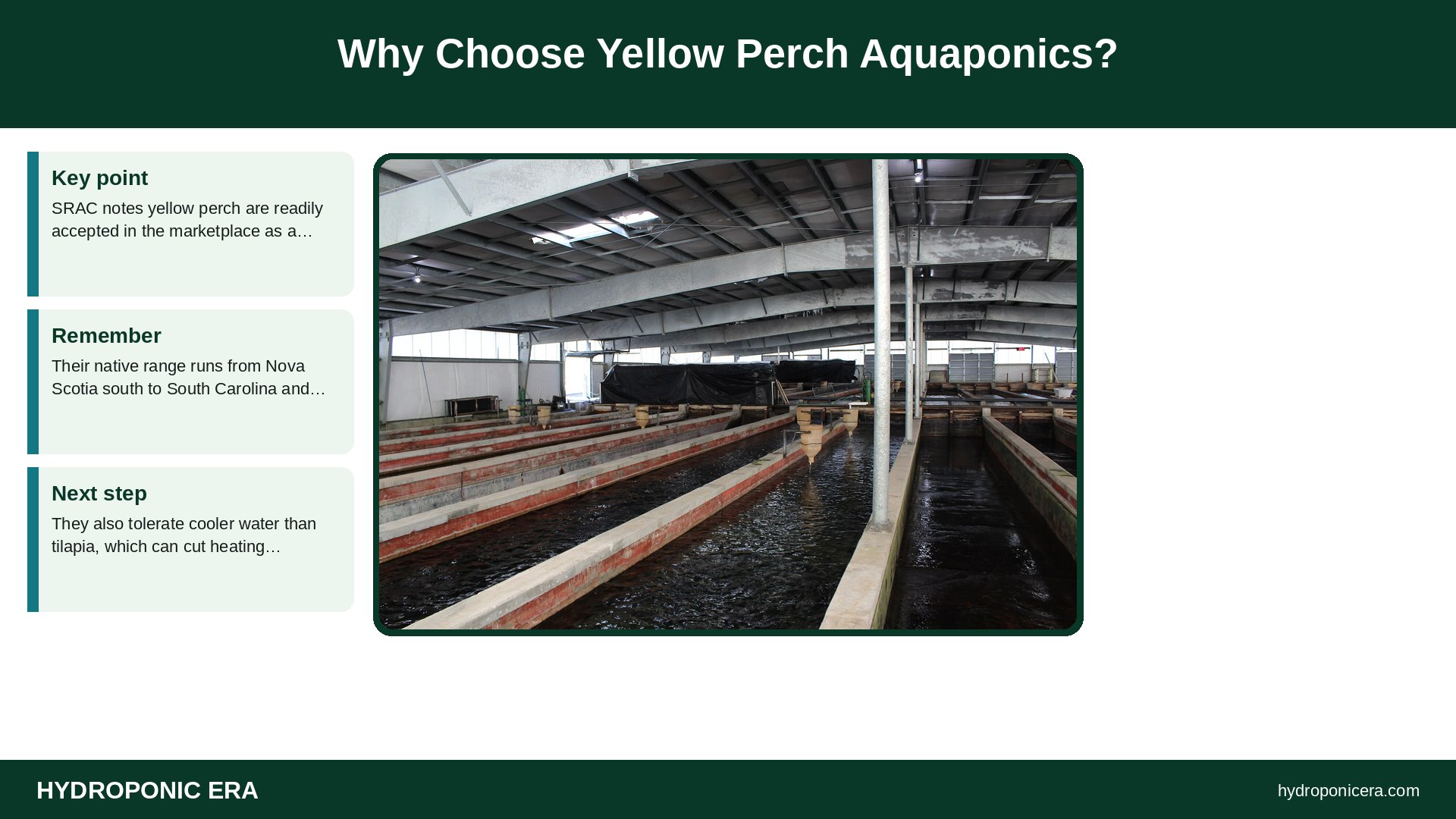
SRAC notes yellow perch are readily accepted in the marketplace as a firm, flaky fish with a mild flavor, with established demand around the Great Lakes. Their native range runs from Nova Scotia south to South Carolina and west to Kansas and Montana, so in many northern and eastern states they’re easier to keep legally than non-native species. They also tolerate cooler water than tilapia, which can cut heating costs.
Yellow Perch Aquaponics Temperature
SRAC’s figures give a clear temperature picture:
- Below 50°F: little or no growth.
- 59°F: growth of about 0.5% of body weight per day.
- 75°F: about 1.5% per day, assuming food isn’t limiting.
- Above 79°F: growth declines, perch don’t handle stress well, and disease risk climbs.
Perch also tolerate crowding and handling best below about 72–75°F. For yellow perch aquaponics, a basement or insulated garage system in the low-to-mid 70s °F is a sweet spot. In the South, summer heat is the challenge; plan shade, insulation, or a chiller. See water chillers.
Feed-Trained Fingerlings Matter
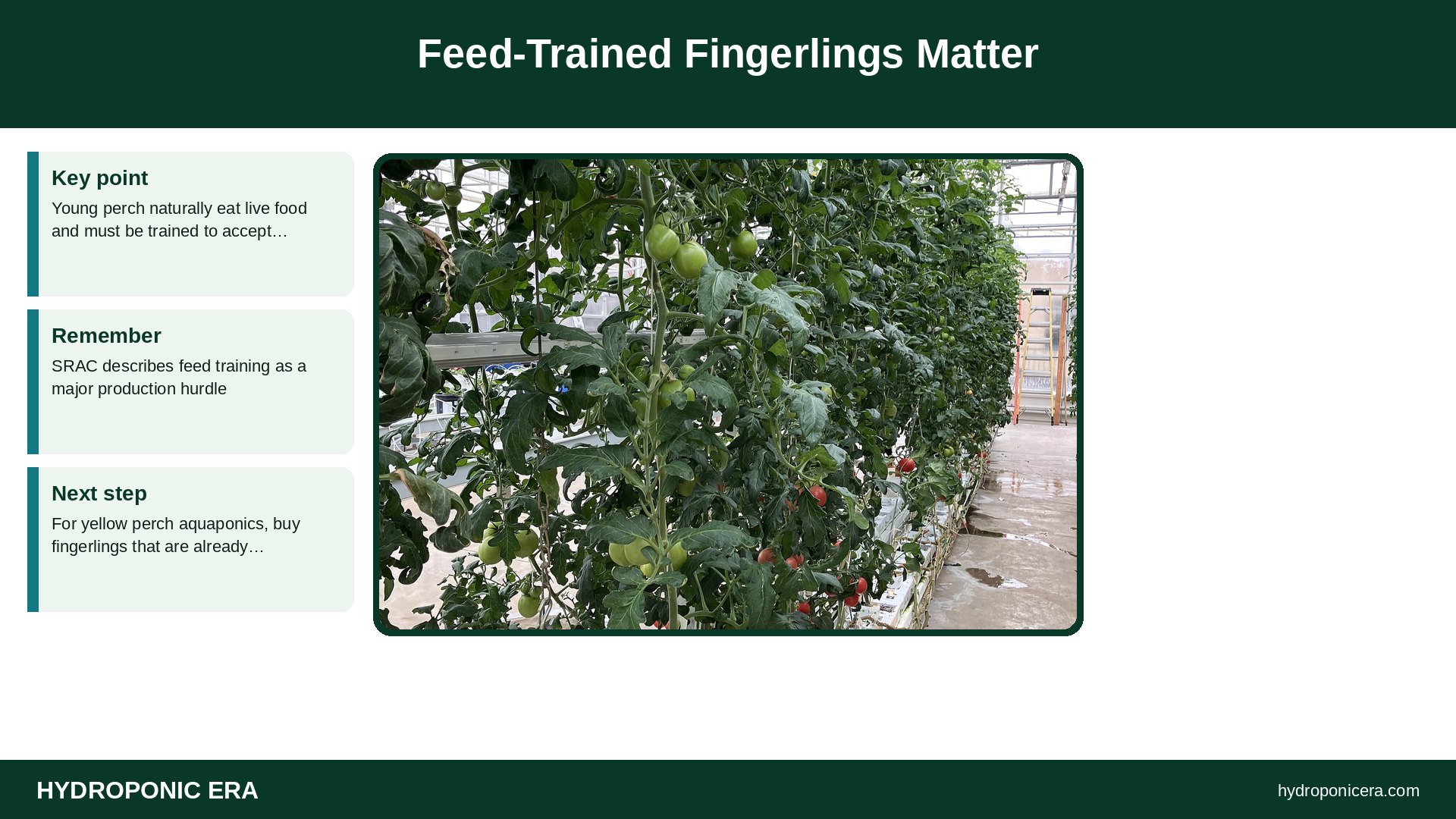
Young perch naturally eat live food and must be trained to accept pellets. SRAC describes feed training as a major production hurdle. For yellow perch aquaponics, buy fingerlings that are already feed-trained so they accept pellets right away. SRAC also notes year-round fingerling supply is a challenge, so order ahead, often in spring or summer.
Feeding Fish in Yellow Perch Aquaponics
SRAC says perch need 34–44% protein and up to 12% lipids, similar to rainbow trout diets, and that smaller trout diets can be used if a perch diet isn’t available. At optimal temperatures, perch eat 2–3% of body weight daily, with typical feed conversion of 1.5–2. They take floating feed, and demand feeders work in tank systems. A high-protein feed means plenty of nitrogen for plants. See fish farming basics.
Stocking Density
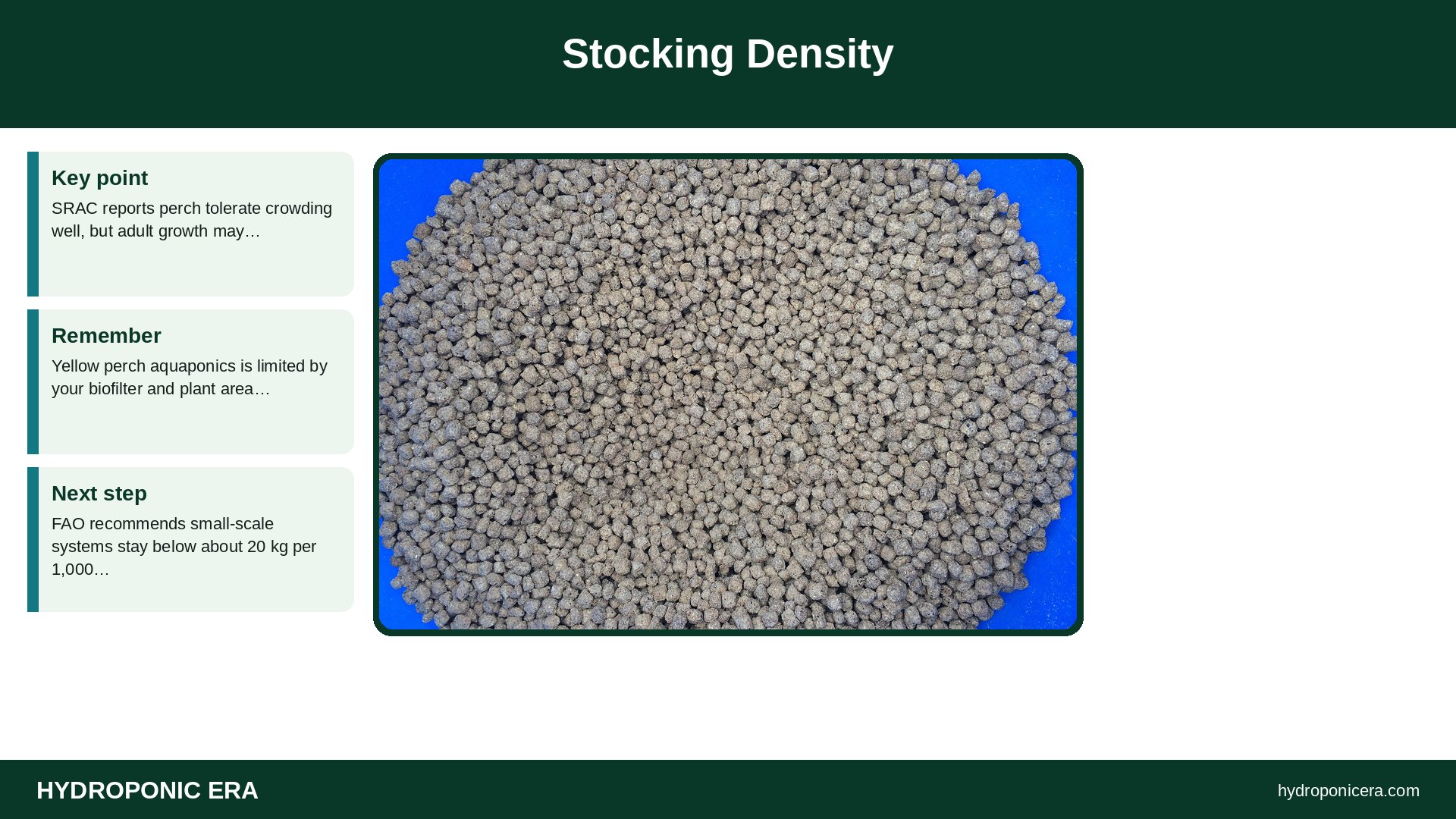
SRAC reports perch tolerate crowding well, but adult growth may decline at very high commercial densities, mostly due to water quality. Yellow perch aquaponics is limited by your biofilter and plant area rather than the fish. FAO recommends small-scale systems stay below about 20 kg per 1,000 liters (about 0.17 lb per gallon). Start below that, and grade fish by size because growth varies widely without grading, as SRAC notes. Females typically grow faster than males.
Yellow Perch Aquaponics Water Quality
Follow FAO’s general aquaponics targets: ammonia and nitrite near zero (below 1 mg/L), dissolved oxygen above 5 mg/L, and pH around 6–7. Cooler perch water holds more oxygen, but steady aeration is still important. SRAC lists bacterial diseases such as Flavobacterium among the problems seen in perch tank culture, which makes clean water and low stress important. See dissolved oxygen and pH meters.
Plants for Yellow Perch Aquaponics
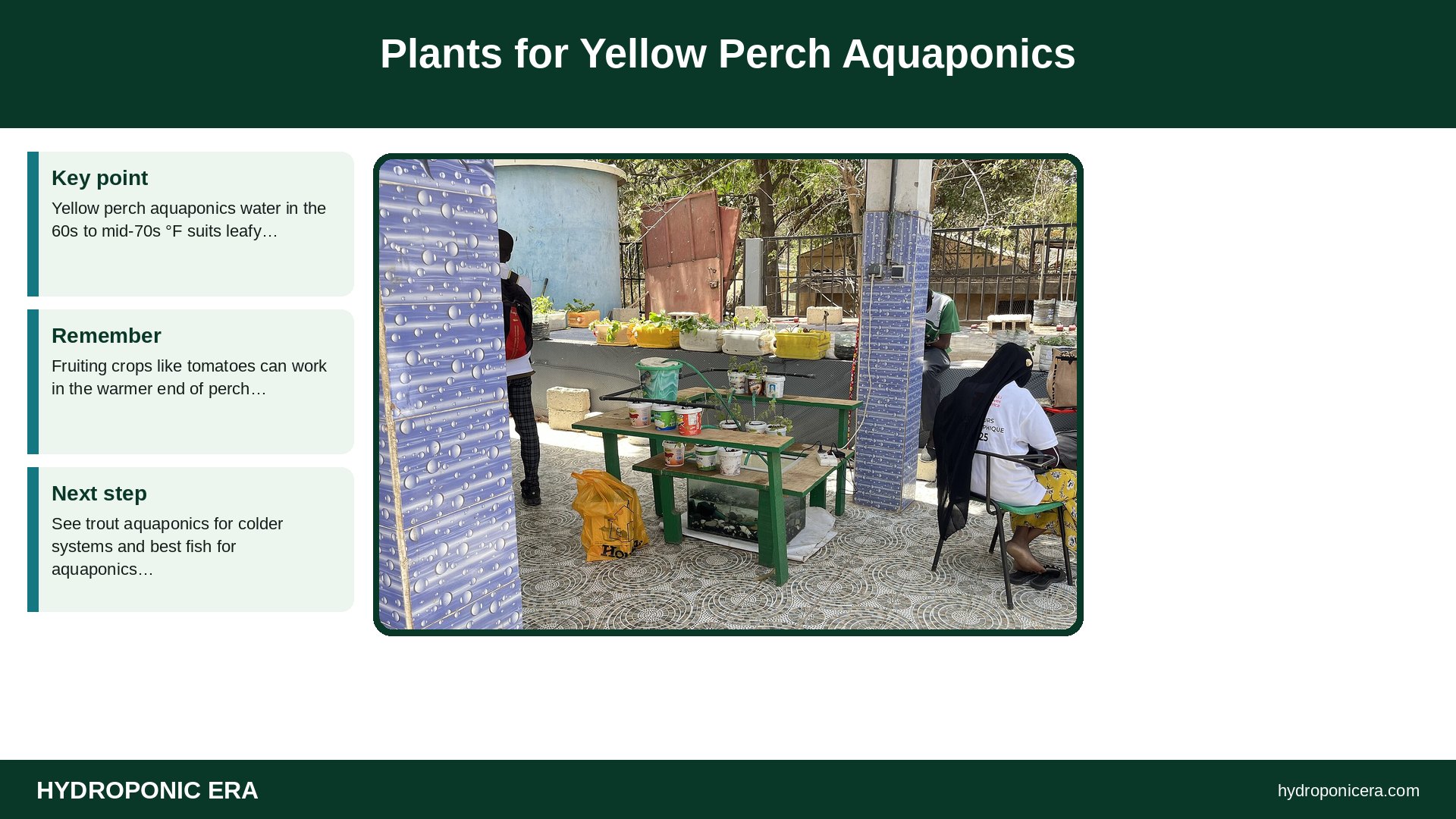
Yellow perch aquaponics water in the 60s to mid-70s °F suits leafy greens and herbs: lettuce, kale, chard, spinach, parsley, and basil. Fruiting crops like tomatoes can work in the warmer end of perch range, especially in a greenhouse with warm air. See trout aquaponics for colder systems and best fish for aquaponics to compare species.
Legal Checks
Although perch are native in many states, yellow perch aquaponics still needs a legal check: live fish rules vary. Some states require permits for aquaculture, buying from approved sources, transport, or sale. Check with your state fish and wildlife or agriculture department before stocking.
Acclimating Perch
SRAC notes yellow perch become stressed and disease-prone in warm water, so move them on a cool day and keep the bags out of the sun. FAO’s acclimation method works: float the sealed bag for at least 15 minutes, add small amounts of tank water for another 15 minutes or more, and if pH differs by more than 0.5, acclimate over at least 24 hours in an aerated tub. Handling is easiest below about 72–75°F, the range SRAC says perch tolerate crowding and handling best.
Lighting and Feeding Behavior
SRAC observes that in ponds, perch feed most vigorously early in the morning. In tanks, a demand feeder or several small daily feedings work well. FAO’s general advice is to keep fish tanks shaded but not completely dark, because fish panic when a dark tank is suddenly uncovered. Indirect light also limits algae.
Grading for Even Growth
SRAC reports perch growth varies widely if fish aren’t graded, and that females usually grow faster than males. In yellow perch aquaponics, sort fish by size every couple of months. Larger fish can go to harvest, while smaller fish get a chance at feed. Higher growth may be possible with all-female stocks, according to SRAC, if you can source them.
Purging Before Harvest
FAO recommends purging fish for 3–5 days in clean, aerated water without feed before eating them, to reduce muddy off-flavors caused by compounds from algae and some bacteria. Use the purge water to top up your system afterward.
FAQs: Yellow Perch Aquaponics
Is yellow perch aquaponics good for northern states?
Yes, especially in northern states with cooler water. They need feed-trained fingerlings and protein-rich feed.
What temperature do perch need?
SRAC lists about 73–79°F for best growth, with little growth below 50°F.
How fast do perch grow?
About a year to reach 0.25–0.3 pound at optimal temperatures.
What feed do perch eat?
A 34–44% protein diet; small trout pellets can work.
Do perch handle crowding?
Yes, while water stays below about 72–75°F.
Sources
- Southern Regional Aquaculture Center — Species Profile: Yellow Perch (SRAC 7204)
- FAO — Small-scale aquaponic food production
- Photo credits (Wikimedia Commons, edited with titles): D3149-1. yellow perch (Perca flavescens) by Robert Colletta (Public domain); Raceways at Ennis National Fish Hatchery (51267218370) by USFWS Mountain Prairie (Public domain); Solanum lycopersicum in aquaponics at the NC Greenhouse Nursery by Gogerr (CC BY-SA 4.0); Fish Feed Pellets by Narek75 (CC BY-SA 4.0); AQUAPONIE by Hopeballa (CC BY-SA 4.0)